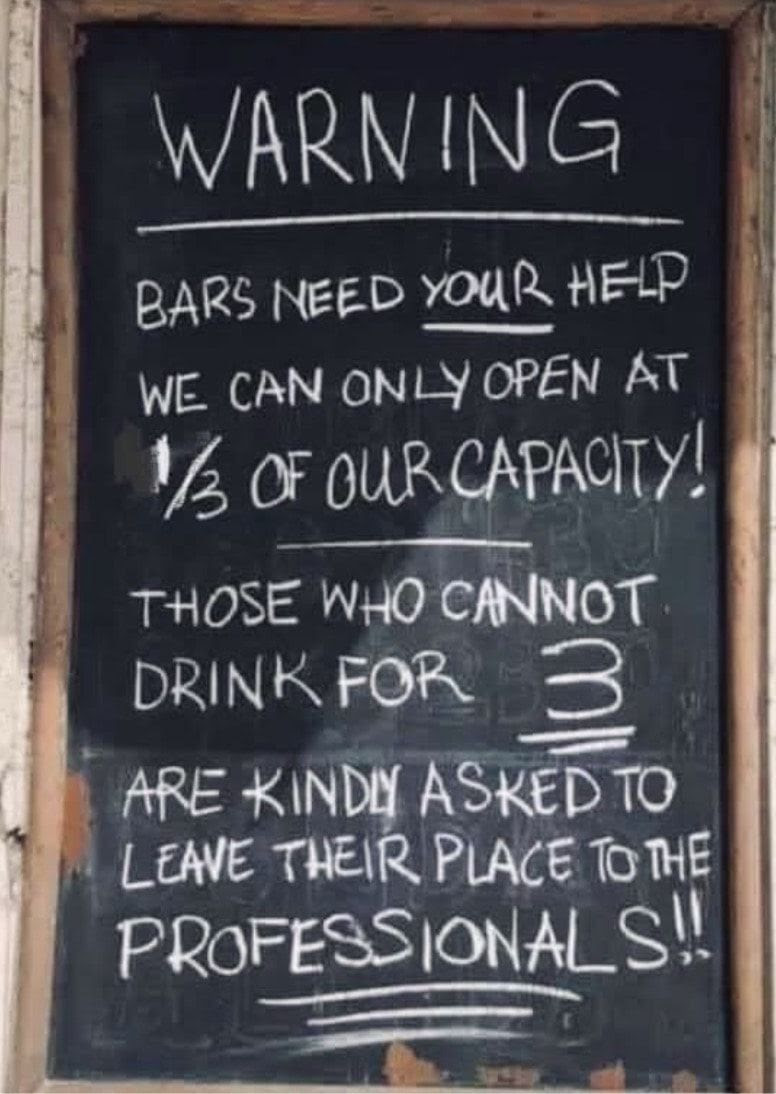
NOTE: Edge and Odds is renovating. Sorry for the inconveniences. Hopefully, it should not be too long.
Massive U.S. Protests Raise Fears of New Virus Outbreaks
Chinese Covid-19 Vaccine Expected to Begin Mass Output This Year
A front-running Covid-19 vaccine candidate being developed in China is expected to be available as soon as the end of this year, according to a report published in the official Wechat account of the State-owned Assets Supervision and Administration Commission.
The vaccine, jointly developed by the Beijing Institute of Biological Products and China National Biotec Group Co., has completed phase II testing and may be ready for the market at the end of this year or early next year, said the report.
The production line for the vaccine will be fully disinfected and closed in preparation for output to start Saturday, and will have a full manufacturing capacity of 100 million-120 million vaccines each year. (…)
In total, five vaccines developed by Chinese companies are being tested on humans, the most in any country. Beijing has mobilized its health authorities, drug regulators and research institutes to work around the clock with local companies to come up with the world’s first successful one for Covid-19.
President Xi Jinping has promised to share any successful vaccine globally, but Chinese companies still face challenges. Phase III testing needs to be done in a place where the coronavirus is still spreading rapidly, and China’s cases have dwindled to a handful each day. Also, an effective vaccine needs massive production capabilities in order to meet global distribution demands. (…) (Bloomberg)
‘Superforecasters’ Say a Covid-19 Vaccine Is Still a Ways Off
People who get paid to make forecasts say there’s only a 9% chance that there will be a widely available vaccine for Covid-19 before next April.
That’s according to Good Judgment Inc., a company that maintains a global network of forecasters to make predictions for clients based on publicly available evidence. (…)
Good Judgment asked its network, “When will enough doses of FDA-approved Covid-19 vaccine(s) to inoculate 25 million people be distributed in the United States?†As of May 25, the forecasters put a 9% probability on that happening by March 31, 2021; a 34% probability on its happening by Sept. 30, 2021; a 63% probability on its happening by March 31, 2022; and a 37% probability on its happening sometime after that, if ever. (…)
Other forecasts, as of May 25: There is a 51% probability that the Food and Drug Administration will approve a drug or biological product for the treatment of Covid-19 before July 1, 2021. And there is a 99% probability that the U.S. gross domestic product will be smaller in the second quarter of 2021 than it was in the second quarter of 2019.
PANDENOMICS
Consumers Spent a Lot Less, Saved More During April Lockdowns U.S. consumer spending, the U.S. economy’s main engine, fell by a record 13.6% in April during coronavirus lockdowns, but there are signs suggesting damage from the crisis is starting to ease.
Personal income, which includes wages, interest and dividends, increased 10.5% in April, the Commerce Department reported Friday. The jump reflected a sharp rise in government payments through federal rescue programs, primarily one-time household stimulus payments of $1,200. Unemployment insurance payments also rose sharply in April, helping make up for some of the 8% decline in wages and salaries tied to job losses. (…)
In April, consumers pulled back on services, cutting spending on restaurants and hotels by half compared with April 2019. Health-care expenditures fell nearly 40% from a year ago. Spending on autos shrank more than 30% from April 2019, while furniture and appliance outlays fell by one-fifth. Americans shelled out half as much on clothes and shoes as they did in April 2019. (…)
Consumers spent almost half of their federal stimulus checks in the two weeks after receiving them before reverting to prior spending habits, according to a study by the Chicago Federal Reserve.
Expanded unemployment benefits, including $600 a week tacked on to the regular weekly benefit amount, will provide a temporary, but longer-lasting, impact than the stimulus payments. (…)
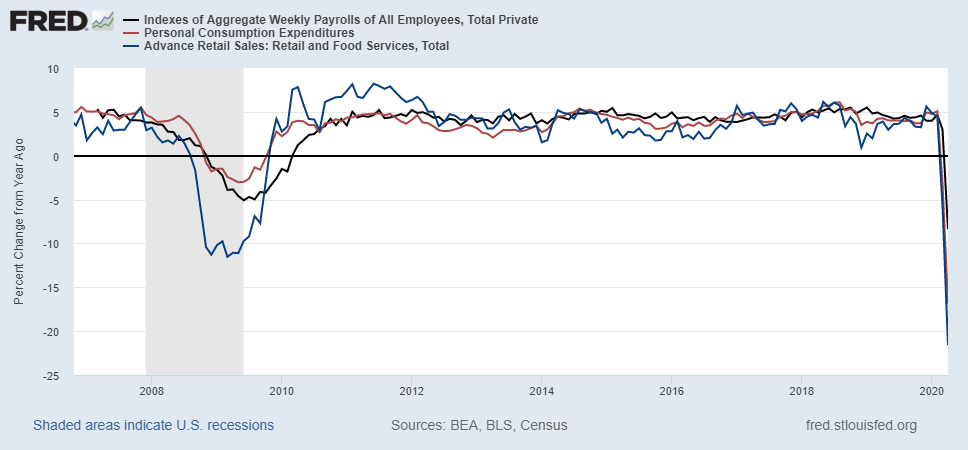
We should not give much attention to data before we get May-June stats but this chart illustrates the devastation in labor income and spending in April, relative to Q4’08. Government payments and various deferments are helping bridge the gaps but they will eventually stop.
The inflation data is more meaningful: core PCE declined 0.4% after -0.05% in March to bring the YoY change to +1.0%, almost already at the July 2009 low of +0.9%.
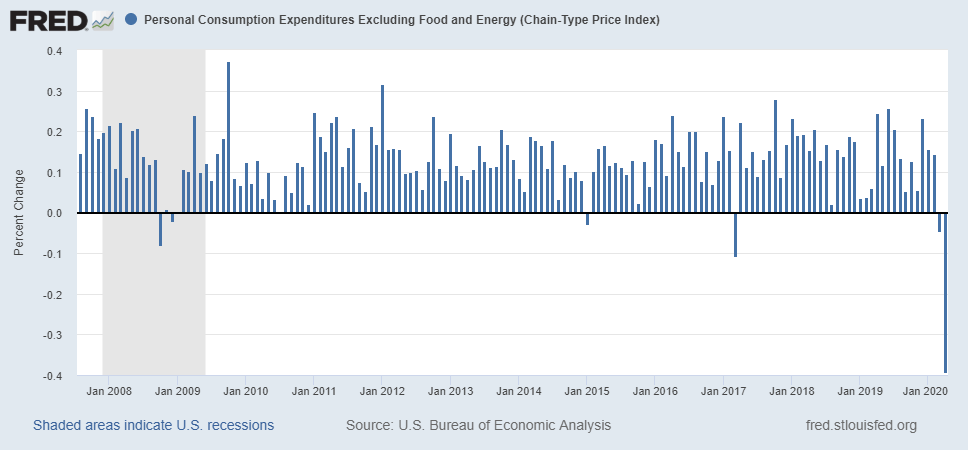
Here’s the relationship with core CPI which also dropped 0.4% in April after -0.1% in March.

GREEN SHOOTING
The green shoot season starts in the middle of a recession when everybody watches for the first green shoots to call for spring. This season is likely to be particular: the shoots will be coming from very deep and could well decide to retreat back down seeing how this virus behaves. Beware: many indicators will look like green shoots with great sequential growth rates. Stemming from so deep, they may prove to be only leaves, no flowers.
The New York Fed has designed a Weekly Economic Index to help us all green shooters.
The Weekly Economic Index (WEI) provides a signal of the state of the U.S. economy based on data available at a daily or weekly frequency. It represents the common component of ten different daily and weekly series covering consumer behavior, the labor market, and production. It is updated Tuesday and Thursday at 11:30 a.m., using data available up to 9:00 a.m.

MANUFACTURING PMIs
USA: Ongoing COVID-19 impact drags output down further in May
May data signalled a slightly softer, but nonetheless severe, contraction in U.S. manufacturing output. The decrease in output was largely driven by a further weakening of client demand and lower new order inflows from both domestic and foreign customers amid the coronavirus disease 2019 (COVID-19) outbreak. A marked decline in total sales and negative sentiment towards the outlook for output over the coming year drove employment down, as firms reduced workforce numbers substantially.
At the same time, lower input buying and weaker overall demand conditions put pressure on suppliers to lower their prices. Consequently, input costs fell again, in turn helping manufacturers to cut their output charges at a record pace as firms sought to remain competitive.
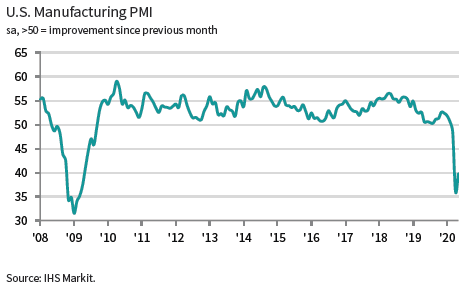
The seasonally adjusted IHS Markit final U.S. Manufacturing Purchasing Managers’ Indexâ„¢ (PMIâ„¢) posted 39.8 in May, up from 36.1 at the start of the second quarter. Although slightly higher than April’s recent low, the latest figure signalled the second-steepest deterioration in manufacturing operating conditions since April 2009. (…) With the exception of April’s recent nadir, the rate of contraction was the fastest since February 2009.
Concurrently, new business fell for the third month running. The cancellation and postponement of orders weighed on inflows of new work, according to panel members, with some firms also highlighting a negative impact on client renewals. New export orders also fell at a marked pace in May, as ongoing global lockdowns reduced customer purchasing activity. The rate of decline in foreign sales was the second-fastest on record.
Lower new order volumes led to a further fall in the level of backlogs of work in May amid signs of excess capacity. Despite efforts to adapt using reduced working hours and furloughing staff, firms cut their workforce numbers at the second-quickest rate in over 11 years. Fears of a slow recovery, which will stymie demand, led to further pessimism among goods producers. Output expectations were negative for only the second month since the series began in July 2012, though was not as downbeat as that seen in April. (…)
Eurozone manufacturing sector continues to contract sharply
There was a noticeable easing in the recent downturn in the euro area manufacturing sector during May, as evidenced by a six-point rise in the IHS Markit Eurozone Manufacturing PMI® to a two-month high.
However, at 39.4, compared to April’s survey record low of 33.4, the index still indicated a considerable rate of contraction in operating conditions. Despite being generally looser across the region compared to April, government restrictions designed to limit the spread of the global coronavirus disease (COVID-19) continued to severely hamper the sector. (…)
After April’s extreme and survey-record contractions, both production and new orders placed with euro area manufacturers fell at noticeably slower rates in May. However, the net reductions remained severe, in line with ongoing restrictions in place on economic activity. Export* sales suffered a similar fate, with the latest data showing the second-sharpest fall in 23 years of data collection.
Faced with ongoing contractions in orders and output, manufacturers continued to cut back on their purchasing in May. Latest data showed another considerable reduction in purchasing activity, although this did little to alleviate supply-side challenges. May’s survey indicated that average lead times continued to deteriorate. In line with other data, the lengthening of lead times was not as severe as April but nonetheless remained considerable.
Manufacturers also continued to sharply reduce their staffing levels in May, extending the current period of contraction to 13 successive months. Led by France, Spain and Germany, all nations recorded severe reductions in employment. (…)
On the price front, deflationary pressures continued to build. Latest data showed that input costs fell for a twelfth successive month, and to the greatest degree since March 2016. Falling prices for oil-related items were widely reported.
With the demand environment remaining challenging, and competitive pressures mounting, firms chose to cut their output charges for an eleventh successive month during the latest survey period. The rate of discounting was unchanged on April’s ten-and-a-half year record.
Finally, confidence about the year ahead improved to a three-month high in May but remained inside negative territory as worries about the longer-term impacts on economic activity of the COVID-19 pandemic weighed on sentiment.

China: Manufacturing output rises solidly as COVID-19 restrictions ease
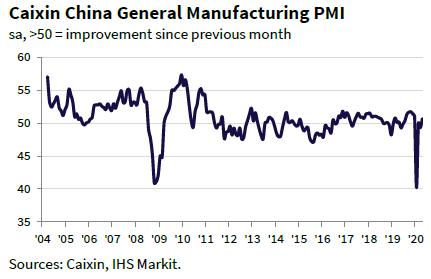
The headline seasonally adjusted Purchasing Managers’ Index™ (PMI™) rose from 49.4 in April to 50.7 in May. The above 50.0 reading signalled a renewed improvement in overall operating conditions midway through the second quarter, albeit one that was only marginal.
May data signalled a further increase in output following February’s record decline, with firms widely mentioning the resumption of works due to an easing of COVID-19 related measures. The rate of expansion was the quickest since January 2011 and solid.
Demand conditions remained subdued, however, with total new work declining again in May. Data indicated that the fall was largely driven by weaker external demand, as many nations faced strict measures to stop the spread of the pandemic including company closures, leading new export orders to contract at a historically sharp rate.
New export orders were 35.3 but contracted at a slightly slower pace than indicated by the 33.5 reading in April. Imports, some of which are parts to serve export orders, also followed the same pattern as new export orders, at 45.3 in May, slowing less than implied by April’s 43.9.
The increase in production since February came at the expense of firms tapping into backlogs of previously placed orders, many of which had been placed before the COVID-19 restrictions were imposed. Indeed, the rise in backlogs had slowed since February’s high, with May showing the first decline in the amount of unfinished work for over four years.
The resumption of production led to a renewed increase in buying activity, but the rate of expansion was only marginal. Manufacturers meanwhile took a relatively cautious approach to inventories in May, with both stocks of purchases and finished items falling since the previous month. (…)
Manufacturers signalled a third successive monthly fall in average input costs. Panel members often mentioned that subdued market demand had led suppliers to cut prices for raw materials. At the same time, factory gate prices were little-changed from the previous month following a three-month period of discounting.
Business confidence picked up in May, with firms generally optimistic that output will rise over the next year. Positive forecasts were often linked to hopes of a global economic rebound once the pandemic situation improves.

Japan: Manufacturing downturn gathers pace in May
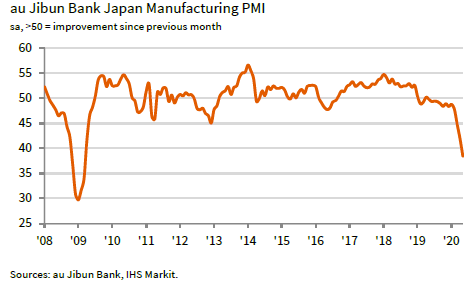
The headline au Jibun Bank Japan Manufacturing Purchasing
Managers’ Index™ (PMI)® recorded below the neutral 50.0 mark yet again in May, falling for a fourth successive month to signal a sharper rate of deterioration in the health of the sector than in April. At 38.4, the headline figure slumped from 41.9 in the previous month to its lowest since March 2009.
May survey data revealed a severe and accelerated drop in manufacturing production which was the strongest since March 2009. Approximately 55% of companies recorded lower output volumes when compared to April, which anecdotal evidence suggests was due to production suspensions and sinking demand conditions. Some firms managed to remain operational, but at a capacity that was significantly below potential.
New orders placed with Japanese goods producers fell at the fastest rate since February 2009, with the respective index now down by 22 points since the start of the year. The rapid deterioration in demand during May was overwhelmingly linked to the COVID-19 pandemic, which had drastically reduced clients’ requirements and led some to cancel orders.
Demand from international markets also slumped at a substantial pace during May. Around 46% of panel members registered a decline in exports when compared to April, while only 7% reported an increase. (…)
Elsewhere, latest survey data showed a third successive monthly decline in operating costs. Panellists attributed this to lower prices for certain raw materials, particularly oil. Consequently, firms reduced their output charges.
Looking ahead, firms remained pessimistic towards the outlook for output. Many firms attributed their negativity to fears of a protracted global economic downturn.
Canada GDP Fell at Near Record 8.2% Canadian economic output plunged by a near record 8.2% annualized rate in the first quarter, as household spending collapsed on coronavirus-induced shutdowns. Exports also fell markedly.
-
Canada’s Banks Take Earnings Hit from Loss Provisions For now, bank executives say they can handle the weakness they see in their lending books
(…) Canada’s five largest banks boosted loss provisions by a combined C$10.43 billion, more than four times the amount they put away a year ago.
Bank executives said during conference calls that they expected the provisions to decline for the rest of the year after the second quarter’s big jump.
RBC’s chief risk officer, Graeme Hepworth, said the provisioning “has reached the high-water mark,†but cautioned that the amounts his bank sets aside in the coming quarters will depend on how the pandemic evolves and the economy recovers.
The remark was echoed by TD’s chief risk officer Ajai Bambawale, though he warned the bank’s portfolio of impaired loans—where payments have fallen behind by more than six months—could increase as the economy struggles. (…)
Canadian households are among the most indebted among developed economies, leaving them vulnerable to any prolonged economic slowdown. (…)
Canadian homeowners are being allowed by their lenders to defer mortgage payments for up to six months, allowing some breathing room. And, even if homeowners do default, RBC loans are protected by the 42% equity held on average by Canadian home borrowers, a cushion that’s “quite healthy,†said Mr. Bolger.
But the credit loss provisions are so high even a small movement of the loans to impaired status could represent historic levels for Canadian banks who largely avoided the last financial crisis.
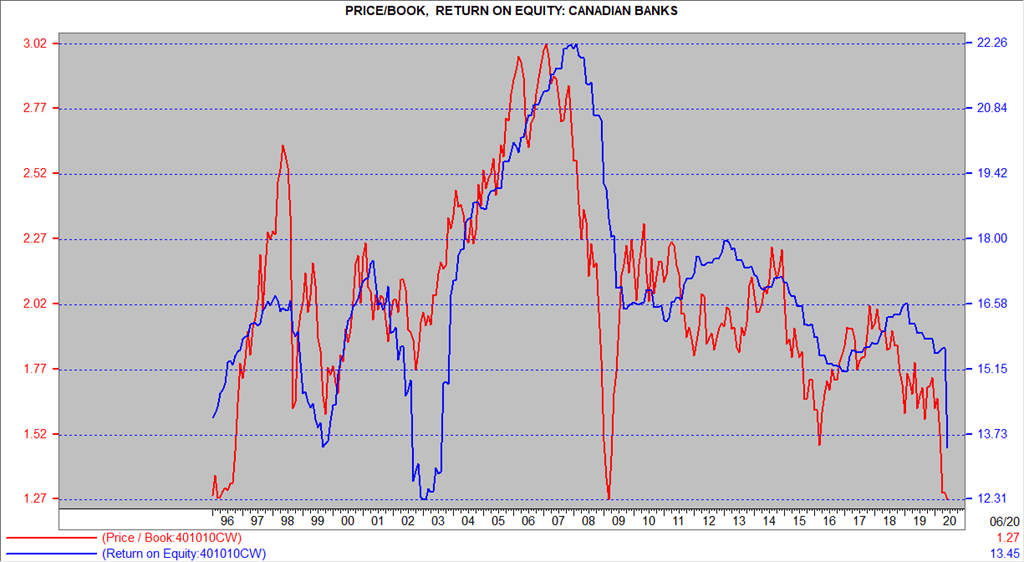
Normally, we should be buying the solid, well managed Canadian banks here. The group is selling at 1.27x book value after their Q2 April quarter, a level it has not broken in 25 years:
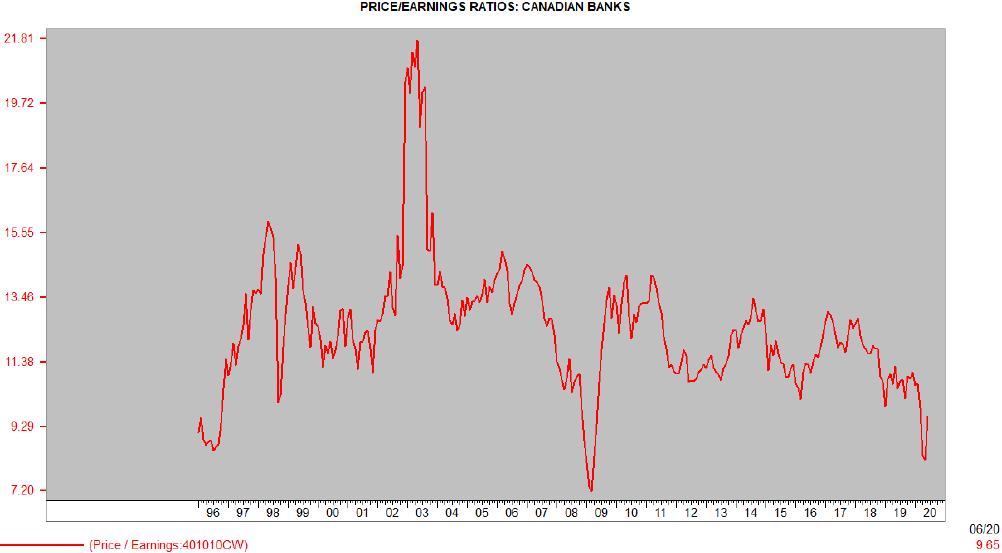
Canadian bank stocks yield 5.4% at their current “sacrosanct†dividend rates, lower than the 7.0% touched in early 2009 but, hey, interest rates are much lower too. Banks are selling at 9.6x trailing EPS. They rarely get cheaper:
Alas, there is no free lunch. The heavily levered Canadian economy is on critical life support by the federal government and the BoC. More significantly, Canadian households sport a debt-to-income ratio of 176% and their debt servicing ratio is 15%, where it was in 2007. For perspective, American households’ debt-to-income ratio peaked at 139% in 2007 and their debt servicing ratio is currently at 9.7%, down from 13.2% in Q4’07.
Evan Siddall, chief executive of Canada Mortgage and Housing Corp., added the insurer now forecasts the average house price will fall 9% to 18% in the coming year, and won’t fully rebound until 2022. “The resulting combination of higher mortgage debt, declining house prices and increased unemployment is cause for concern for Canada’s longer-term financial stability,†Mr. Siddall said, in testimony before a parliamentary committee on Tuesday.[May 19]
The math with levered assets can be brutal as any stock speculator knows. At the current leverage ratios, a 10% drop in housing prices will shave NAVs by 25%. As this shock reverberates throughout the economy, banks’ credit losses would mushroom well beyond acceptable for OSFI, the Canadian bank regulator. Pressures for banks to cut their dividends would no doubt rise. Low probability at this point but far from zero.
If you care more about the lesser quality U.S. money center banks, they are selling at exactly book value, still much higher than during and right after the GFC. They yield 4.3% (6.9% in Feb. 2009).

While Canadian banks are fairly homogeneous (by U.S. standards), the largest U.S. banks are far from equal. JPM sells at 1.3x BV (2009 low: 0.63) with a 6.7% trailing ROE. BAC: 0.9x BV (0.14) and 5.4% ROE. C: 0.6x BV (0.10) and 3.8% ROE.
U.S. regional banks are also selling at BV, only 10% above their GFC lows. They yield 4.1% (5.9% in Feb. 2009).

- It is far from business as usual in the market for new issues. Both Warner Music and ZoomInfo’s executive teams are in the middle of virtual roadshows. Instead of crisscrossing the country via airplane to meet with large fund managers and analysts in conference rooms, as is custom, they are sitting behind computer screens trying to convince investors to buy their stock over video.
Protectionism Spreads Globally With Coronavirus More governments move to defend hard-hit industries and limit China’s influence
Since the health and economic crises struck, free-market countries world-wide have pumped out trillions of dollars in subsidies and have enhanced their defenses against foreigners bargain-hunting prized companies in sectors including technology, mining and pharmaceuticals.
In a sign of how profoundly sentiments have shifted, the U.K.—long one of the world’s most open countries for outside investors—has joined the roster, thwarting a Chinese-owned company’s recent attempt to take control of a British tech firm. (…)
The U.S. in February expanded the powers of its Committee on Foreign Investment, allowing Cfius to block foreign purchases of minority stakes, not just takeovers, and widening its jurisdiction to cover more sectors, including real estate.
President Trump in April issued an executive order formalizing an advisory group of federal agencies known as Team Telecom to block unwanted foreign investments. Five days later, it recommended revoking state-owned China Telecom’s operating licenses in the U.S.
Other developed nations including Japan, Canada, Australia, Germany, France and Italy in recent months have also tightened foreign-investment regimes amid fears of hostile takeovers during the coronavirus slump. Governments have expanded the number of sectors under scrutiny and lowered foreign-investment thresholds that trigger reviews. (…)
In a notable move that could affect many more deals, the European Commission, the EU’s executive arm, is revising its own market-definition rules, which will allow it to block acquisitions by heavily subsidized foreign companies. Observers see China as the main target of the new rules. (…)
France in March blocked the sale of a steel plant to a Chinese investor, citing national security concerns. Paris also set up a €20 billion ($22 billion) fund to protect the 70 listed companies in which the French state holds stakes. (…)
Canyon Bridge at the time reassured the British government that it wasn’t controlled by the Chinese government. It promised not to transfer any technology to China.
But in April, several senior Imagination managers resigned after Canyon Bridge announced an emergency board meeting to discuss the appointment as directors of four representatives of China Reform Holdings, the state-owned investment fund that holds a 35% stake in Imagination. (…)
Some politicians noted that Canyon Bridge’s move came as the U.K. was being pummeled by the pandemic and the prime minister was hospitalized with Covid-19. (…)
Nine of the world’s 10 largest economies have introduced new measures restricting foreign investment since 2017, according to the U.N. Committee on Trade and Development. At least 20 deals valued at a total of more than $162 billion have been blocked or withdrawn on national security reasons in 2016-2019, according to Unctad. (…)
TECHNICALS WATCH
Lowry’s Research remains positive, advising to use any pullback as a buying
opportunity. “The breadth, depth and power of the
current market uptrend are significant. (…) the April-May trading
range has now resolved to the upside, preceded
by strong Demand and confirmed by broadening
participation and intensity.â€
The S&P 500 has retraced back to where it was in early March, before the big virus scare. It is now above its 200dma which is trying to turn upwards:

But the equal-weight index is not there yet. Actually, only 4 of the S&P 500 eleven sectors are above their 200dma (all rising) but these sectors now account for 63% of the index weight. Seventeen of the 25 largest weights in the S&P 500 are part of the 4 stalwart sectors and they collectively represent 29% of the index weight.

The NDX is actually almost back to its high:

Meanwhile, the Value Line index (nearly 1700 stocks) is still well short of its still falling 200dma:
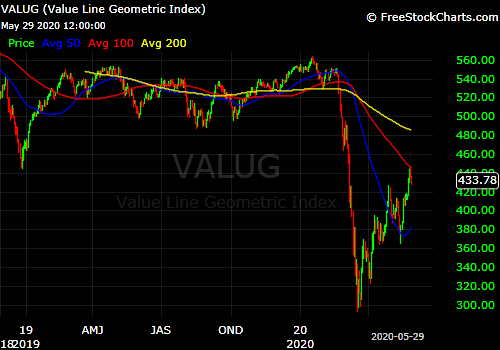
This is a very narrow bull.
PANDEMONIUM
China Halts Some U.S. Farm Imports, Threatening Trade Deal
Chinese government officials told major state-run agricultural companies to pause purchases of some American farm goods including soybeans as Beijing evaluates the ongoing escalation of tensions with the U.S. over Hong Kong, according to people familiar with the situation.
State-owned traders Cofco and Sinograin were ordered to suspend purchases, according to one of the people, who asked not to be identified discussing a private matter. Chinese buyers have also canceled an unspecified number of U.S. pork orders, one of the people said. Private companies haven’t been told to halt imports, according to one of the people. (…)
Beyond Hong Kong, an Emboldened Xi Jinping Pushes the Boundaries With the U.S. and its allies distracted by the pandemic, China’s leader has taken bold steps on issues where he’s often faced international pushback, including Taiwan, the South China Sea and a disputed border with India.
(…) At the opening of a yearly parliament meeting last week, China’s Premier Li Keqiang also flagged a more aggressive posture toward Taiwan, a self-ruled, democratic island that Beijing sees as its territory. In references to dealing with and assimilating the island in an annual policy speech, he dropped China’s usual calls for a “peaceful†approach—a departure from nearly 30 years of precedent. Other senior leaders also renewed warnings against efforts to seek Taiwan’s independence, saying that a forceful takeover remains an option even though they prefer a peaceful solution. (…)
A long-running border dispute between China and India flared again in the past few weeks after Chinese troops moved into a contested Himalayan area close to where India has been upgrading infrastructure, prompting fistfights between the two sides.
Tensions on the China-India border often flare this time of year, when warmer weather makes it more accessible. But observers say this is one of the bigger standoffs since the two sides fought a war in the area in 1962, and unusual in that China appears to be objecting to India’s road building in an area where Indian forces have long operated.
Beijing has further upset the status quo in the South China Sea in recent weeks. It created two new administrative districts in contested areas, named 80 geographical features there—the first such Chinese move since 1983—and sent ships into waters off Vietnam and Malaysia.
Chinese diplomats have meanwhile adopted more confrontational language toward the West, along with trumpeting China’s assistance to other countries and stepping up efforts to portray Mr. Xi as the new champion of globalization and multilateralism. (…)
Mr. Xi’s actions on Hong Kong in particular have helped to reinforce his self-styled image as an ardent nationalist and decisive leader. The party’s main newspaper embellished that image this week, taking the unusual step of hailing him on its front page as “commander-in-chief.†(…)
Some Chinese scholars are concerned that Beijing may be underestimating the antipathy towards China building among countries beyond the U.S.
“The international mood towards China has never been more unfriendly. It’s not just Americans, but Europeans and other peoples,†said Zhu Feng, an expert on China’s international relations at Nanjing University. If China pushes too hard to reap short-term diplomatic gains now, he said, it could be “disastrous.†(…)
Trump’s China Response Leaves Room to De-Escalate Tensions
While the U.S. president’s speech Friday was heated in rhetoric, it lacked specifics around measures that would directly impact Beijing. He announced the U.S. would begin the process of stripping some of Hong Kong’s privileged trade status without detailing how quickly any changes would take effect and how many exemptions would apply. (…)
“Our actions will be strong. Our actions will be meaningful,†Trump said in the White House Rose Garden. (…)
“This binds the president to nothing with regards to China,†Derek Scissors, a China analyst at the conservative American Enterprise Institute. “With regards to a Hong Kong policy, it is a non-event. Nothing happened.†(…)
Trump’s remarks omitted key details about what actions he’s taking, but his tone marked an escalation of hostile relations with China, said Jude Blanchette, China expert at the Center for Strategic and International Studies. “This further entrenches the view in Beijing that we haven’t found rock bottom yet in the relationship,†he said.
The president said Beijing “unlawfully claimed territory in the Pacific Ocean†and “broke its word with the world on ensuring the autonomy of Hong Kong.â€
“The Chinese government has continuously violated its promises to us,†Trump said. “These plain facts cannot be overlooked or swept aside. The world is now suffering as a result of the malfeasance of the Chinese government,†he added, referring to the pandemic. (…)
“This was an election speech,†Blanchette said. “This will be the tone and tempo until November.â€
-
U.S.-China Tension Only Set to Get Worse: ‘There Is No Off Ramp’ With Donald Trump and Xi Jinping both focused on ramping up domestic support in the wake of the pandemic, the bottom is rapidly falling out of U.S.-China relations. And few in either Washington or Beijing seem in the mood to stop it.
(…) “There is no off ramp for the moment for the U.S. and China, for the pretty obvious reason that neither is looking for one,†said Richard McGregor, a senior fellow at the Lowy Institute in Sydney and author of “The Party: The Secret World of China’s Communist Rulers.†“The U.S. feels it is playing catch up in muscling up to Beijing, a debate that will only be sharpened in a presidential election year. And China under Xi is programmed not to take a backward step.†(…)
Avenues for de-escalation are also increasingly sparse. With the exception of on-again, off-again trade discussions, there are no formal talks between Beijing on domains ranging from military-to-military relations to cybersecurity. Even beneath the surface, there are few signs of the kinds of backchannel contacts that have helped Beijing and Washington in the days going back to Henry Kissinger’s secret visit to Beijing in 1971. (…)
“This is a vicious cycle, pushing China-U.S. relations to the brink of losing control.â€
Bonnie Glaser, who directs the China Power Project at the Center for Strategic and International Studies in Washington and has advised the U.S. government, said that Beijing has “written off the U.S.†and “they’re not listening anymore.â€
“This is a worrisome time, especially as the U.S. goes into the presidential campaign in earnest over the next six months,†she said. “China’s just going to be a punching bag. So I think the relationship is going to deteriorate further and we’ve not yet seen the bottom.â€
(…) “The EU expresses its grave concern at the steps taken by China on May 28, which are not in conformity with its international commitments,†the bloc said in its statement published in Brussels. “This decision further calls into question China’s will to uphold its international commitments. We will raise the issue in our continuing dialog with China.†(…)
The EU is China’s No. 1 trade partner, while the Chinese market is the second biggest for exports from the bloc after the U.S.
-
China and the Rhineland Moment America and its allies must not simply accept Beijing’s aggression.
(…) In 1911 Germany sparked an international crisis when it sent a gunboat into the Moroccan port of Agadir and, as Winston Churchill wrote in his history of the First World War, “all the alarm bells throughout Europe began immediately to quiver.†In 1936 Germany provoked another crisis when it marched troops into the Rhineland, in flagrant breach of its treaty obligations. In 1946, the Soviet Union made it obvious it had no intention of honoring democratic principles in Central Europe, and Churchill was left to warn that “an iron curtain has descended across the Continent.â€
Analogies between these past episodes and China’s decision this week draft a new national security law on Hong Kong aren’t perfect. (…) But the analogies aren’t inapt, either. (…) The concept of “one country, two systems,†was supposed to last at least until 2047 under the terms of the 1984 Sino-British Joint Declaration. Now China’s rulers have been openly violating that treaty, much as Germany openly violated the treaties of Locarno and Versailles.
(…) the administration has undertaken a sober rethink of the U.S. strategic approach to China, the outlines of which are described in a new interagency document quietly released by the White House last week. (…) Beijing is described, accurately, as a habitual and aggressive violator of that order — a domestic tyrant, international bully and economic bandit that systematically robs companies of their intellectual property, countries of their sovereign authorities, and its own people of their natural rights. (…)
Beijing almost certainly chose this moment to strike because it calculated that a world straining under the weight of a pandemic and a depression lacked the will and attention to react.
(…) think of this as our Rhineland moment with China — and remember what happened the last time the free world looked aggression in the eye, and blinked.
-
UK widens visa rights offer to almost 3m Hong Kong residents Home Office clarifies pledge and sets government on collision course with China
(…) The move was made because “the new security law will undermine the existing legal commitments to protect the rights of Hong Kong peopleâ€, the Home Office said. It is symbolic of the UK prime minister Boris Johnson’s new willingness to adopt a tougher stance towards Beijing. (…) “If China imposes this law, we will explore options to allow British Nationals Overseas to apply for leave to stay in the UK, including a path to citizenship. (…)
Trump Says He Spoke to Modi About China Tensions. India Says No. Trump, who reiterated his offer to mediate between New Delhi and Beijing over the rising temperatures at their border, told a reporter in Washington on Thursday that he spoke to Modi. The Indian government says no such conversation took place.
The pandemic and the virus shouldn’t be political issues. But I think Niall [Ferguson]is right; politicians will use the situation if they think it will help score points. And since this election will likely be decided by a relatively small number of marginal votes in a handful of swing states, we will see a number of issues, including the virus, used as political fodder. It will not be one of America’s prouder moments.
So here we are, 5 months to the very tight U.S. elections, scheduled during an expected fall return of Covid-19 cases within the flu season, China challenging the world with Hong-Kong and, increasingly, Taiwan. The U.S. administration has yet to respond meaningfully to Xi’s bullying. Trump and Kudlow have both said they no longer care about the phase one deal with China, especially since China is unlikely to be able to abide by it given the pandemic.
And don’t forget North Korea where Kim is certainly dreaming of a way to take advantage of Trump’s vulnerability. If the President sees the need for a major how of force, who knows how China would react?
Trade-war collateral damage: destruction of $1.7 trillion in U.S. companies’ market value New York Fed report backs earlier evidence that American companies have continued to pick up the tab for Trump-initiated tariffs
A study by the Federal Reserve Bank of New York adds to previous findings that, despite pronouncements from the White House, Americans are paying — and paying stiffly — for the U.S.-China trade war.
The billions in tariffs hurled back and forth between Washington and Beijing have reduced the market value of U.S.-listed companies by $1.7 trillion during the course of the 2-year-old tax offensive. The conflict will continue to weaken the investment growth rate for these businesses up to two percentage points by year’s end, the study said.
The trade war is causing financial loss for several reasons, from the inefficient pricing that taxes can create, to supply disruptions, to companies’ pricey adaptations to the levies, among others. But this particular cause of losses is largely sentiment-based. (…)
The study model found that policy announcements lowered U.S. equity prices in a 3,000-company sample group by a total of six percentage points. Those outfits together command a $28 trillion market capitalization, so the six-percentage-point fall wiped away $1.7 trillion. (…)
“Reductions in share prices due to trade war announcements significantly lower firm-level investment rates four quarters later,†the report found. “Most of the 2019 effect is driven by the impact of tariffs on U.S. firms doing business with China, but the 2020 effects are driven more by the fact that tariff announcements drove down returns of firms regardless of their exposure to China.†(…)


 BAR NONE?