Stocks Slide as Virus Cases Accelerate Outside of Asia Global stocks fell as investors grappled with the potential economic fallout from mounting coronavirus infections in South Korea and other countries outside China.
- Total China cases at 77,150, up by 409; death toll 2,592
- Worldwide death toll 2,624; total cases 79,440
- Afghanistan, Bahrain, Kuwait confirm first cases; 12 dead in Iran
(…) In Italy (…) more than 50,000 people weren’t allowed to leave their towns under a quarantine in effect Sunday. The outbreak’s epicenter within the country is just miles from Milan, the engine of Italy’s economy, and led to trade shows, soccer matches and other public events being canceled. (…)
South Korea on Sunday raised its infectious-disease alert to red—the highest level—for the first time since the H1N1 swine flu outbreak in 2009. (…)
“This will also put the hosting of Tokyo Summer Olympic Games under scrutiny, as Japan now has the highest number of infections outside of China alongside an aging population.” (…)
-
Coronavirus Tests Europe’s Open Borders as Italy Death Toll Rises
-
With Migrant Workers in Limbo, Part of China’s Economy Is Stalled The Chinese economy’s quick return to normal will hinge largely on how migrant workers choose between two bad options: Stay in their hometowns without jobs, or return to cities where they face a 14-day coronavirus quarantine
-
Wuhan to quarantine all cured patients for 14 days after some test positive again Decision follows several instances in which recovered patients were found to be still carrying the virus and able to infect others
(…) Zhao Jianping, a doctor heading a team working in Hubei, said on Thursday that there had been cases in which patients tested positive after they had seemingly recovered. “This is dangerous,” Zhao was quoted as saying by Southern People Weekly magazine. “Where do you put those patients? You cannot send them home, because they might infect others, but you cannot put them in hospital because resources are stretched.” (…)
MORE CENTRAL BANK STIMULUS COMING
US Flash PMI signals first fall in business activity since 2013
Adjusted for seasonal factors, the Composite PMI Output Index (covering both manufacturing and services) slumped to 49.6 in February, down from 53.3 in the opening month of 2020.
Weakness was primarily seen in the service sector, where the first drop in activity for four years was reported, but manufacturing production also ground almost to a halt due to a near-stalling of orders.
New orders meanwhile fell for the first time in over a decade. The deterioration was in part linked to the coronavirus outbreak, manifesting itself in weakened demand across sectors such as travel and tourism, as well as via falling exports and supply chain disruptions. Exports of goods and services both fell at increased rates in February. However, companies also reported greater caution in respect to spending due to worries about a wider economic slowdown and uncertainty ahead of the presidential election later this year.
Compared with official data, statistical analysis indicates that the survey indices are consistent with GDP growth slowing from just above 2% in January to a crawl of just 0.6% in February. Manufacturing output is meanwhile indicated to be falling at a quarterly rate of 0.8% (roughly 3.2% annualised). Note that any IHS Markit PMI manufacturing output index below 53.7 is indicative of the official (Fed) measure of manufacturing production declining on a quarterly basis.
(…) the marked slump in the headline composite PMI in February is a warning that the coronavirus outbreak is having a material impact on the US economy, both through reduced service sector activity and via lost manufacturing exports and supply chain delays. As such, the PMI has moved further into territory that would be historically consistent with an easing bias at the FOMC. The big question for policymakers will be how long the PMI remains in such weak territory. (…)

Xi Pledges Easier Monetary Policy for Economy Pummeled by Virus
Fiscal policy will be more proactive, while construction projects will be accelerated, according to a statement issued after a Politburo meeting chaired by President Xi Jinping on Feb. 21.
The central bank will free up part of the reserves of some commercial lenders to unleash long-term funding to the economy, and consider adjusting the benchmark deposit rate at an appropriate time, Deputy Governor Liu Guoqiang said in a separate statement. (…)
Flash Australia PMI signals deeper downturn amid adverse weather, coronavirus
Eurozone:
Our colleagues in the European economic forecasting team expect eurozone GDP increase 0.9% this year, 1.0% in 2021, and 1.2% in 2022. On this basis, we assume no additional policy easing from the ECB in 2020, albeit with the current highly accommodative policy stance set to continue for a considerable period of time.
However, the next Governing Council meeting on 12th March is likely to see the ECB tweak its assessment of downside risks to the growth outlook to reflect the increased uncertainty stemming from the COVID-19 outbreak and restate, perhaps more forcibly, that it stands ready to adjust all of its policy instruments if necessary. The bottom line is that the ECB is going to want to have more time and information to gauge the significance of the COVID-19 outbreak and its consequences. It will therefore keep options open until it has a better grasp of the potential economic effects on the eurozone and their longevity. (…)
German manufacturing exports fell during February at a marked and accelerated rate, whilst there was clear evidence of supply-chain disruption stemming from the COVID-19 related shutdowns in China (average lead times for the delivery of inputs to manufacturers deteriorated for the first time in over a year during February).
Subsequently, the German nowcast for Q1 GDP has been revised a little lower to -0.17%, from a previous estimate of -0.14%. Whilst we believe that official GDP growth in the first quarter will surely benefit from compensating rebounds in both industrial production and retail sales, which were driven markedly lower in December due to calendar-related distortions, the latest nowcast and PMI figures reinforce our view that the underlying performance of the German economy remains weak. (Markit)
Home Sales Sluggish as Lack of Inventory Frustrates Buyers U.S. home sales sputtered in January, the latest sign that some of the lowest interest rates in half a century are failing to offset the high prices and limited inventory keeping many buyers on the sidelines.
Existing home sales fell 1.3% in January compared with December at a seasonally adjusted annual rate of 5.46 million, the National Association of Realtors said Friday.
That compared with economists’ expectations for a 2% decline last month.
Existing-home sales were up 9.6% in January from a year earlier. (…) NAR said the housing inventory level was the lowest for January since 1999. (…)
Limited housing stock has contributed to higher home prices, with the median sales price for an existing home in January up 6.8% from the prior year at $266,300.
Inventory has been tight at the cheaper end of the market. Homes priced from $100,000 to $250,000 experienced a 10.3% drop in inventory from a year earlier in January. Meanwhile, homes in the $250,000 to $500,000 range saw inventory fall 6%. (…)
 (Haver Analytics)
(…) the slowest pace we’ve seen in 18 months, as the seasonal winddown wears on through the winter.
Rents are likely to maintain an upward streak throughout 2020, as the number of renters continues to rise in the U.S. The demand for apartments is high, including among those renting by choice. 157% more Americans who earn over $150K per year began renting this past decade, showing a preference for a more flexible and comfort-driven lifestyle. (…)
Saudis Weigh Breaking Oil Alliance With Russia as Virus Crimps Demand Saudi Arabia is considering a break from its four-year oil production alliance with Russia, as China’s coronavirus outbreak contributes to a drop in global oil demand, according to people familiar with the matter.
The Saudi kingdom, Kuwait and the United Arab Emirates—which collectively represent over half of OPEC’s production capacity—are holding talks this week to discuss a possible joint output cut of as much as 300,000 barrels a day, said the people.
The coronavirus outbreak has created a rift in the partnership between Russia and the Saudi-led Organization of the Petroleum Exporting Countries. The two sides have collaborated since December 2016 in an effort to balance global oil supply amid a surge of crude from U.S. shale producers. If the Saudis, Kuwait and the U.A.E. break with the Russians, the split could further weaken OPEC’s ability to influence oil prices. (…)
At an emergency meeting earlier in February, Russia rejected a Saudi push to deepen the alliance’s existing oil production curbs by 600,000 barrels a day.
Russian officials still don’t see a need for reductions, the people familiar with the matter said. Russian delegates say business activity in China is recovering and the impact of the virus on oil demand is limited, the people said.
Saudi exports to China have remained stable since the crisis began, though sales from other OPEC members have shown weakness, according to commodities-data provider Kpler. (…)
The International Energy Agency warned Feb. 13 that demand for oil is likely to be 435,000 barrels a day less in the current quarter compared with a year ago. Vitol Group, the world’s largest independent oil trader, cut its forecast demand for the quarter to 98.3 million barrels a day, down 2.2 million barrels a day from its previous forecast for the period. Under either scenario, a quarterly decline would be the first since the height of the global financial crisis.
However, Moscow says weakened demand would be offset by reduced supply resulting from Libya’s oil shutdown and new sanctions targeting Venezuela’s crude sales, one person familiar with the matter said.
Libya’s oil output has fallen to 120,000 barrels a day from 1.2 million daily barrels since a renegade general shut pipelines and oil ports in January in a dispute with the central government.
The U.S. on Tuesday imposed sanctions on a subsidiary of Russian state-run company Rosneft Oil Co. that had become the main marketer of banned Venezuelan crude. The new restrictions could cut Venezuelan exports by 600,000 barrels a day, said energy consulting firm FGE, which sees the market tightening by June as a result of the Libyan and Venezuelan disruptions.
Trump Says Farmers Might Get More Aid President Trump said the U.S. would consider a third round of aid payments for American farmers who have borne the brunt of retaliation for U.S. tariffs for much of the past two years.
(…) If farmers “need additional aid until such time as the trade deals with China, Mexico, Canada and others fully kick in, that aid will be provided by the federal government,” the president said on Twitter on Friday. (…)
The U.S. authorized a $12 billion program in 2018 and a $16 billion program in 2019.
The president has described the programs as being funded with tariff revenue and said a third program would be similarly funded. (…) The previous farm-aid programs weren’t directly funded by tariffs, however, but through a Depression-era Department of Agriculture program that is currently authorized to spend up to $30 billion a year to aid farmers amid poor farm conditions. Using the USDA program requires no congressional vote.
But corn stocks are going in the opposite direction, ballooning to the highest in three decades. And the president’s hints for more farmer aid could make the disconnect between the two even more pronounced.
Soybean reserves will fall 25% in the coming season to the lowest since 2016-17, the U.S. Department of Agriculture forecast at its outlook forum in Arlington, Virginia. Higher exports, especially to top importer China, will add to increased domestic demand to eat up stocks.
Meanwhile, the government forecast corn inventories will jump about 29% to 2.637 billion bushels as farmers plant more. That would be the highest in 33 years.
Current prices and yield prospects have increased bets that farmers will sow the yellow grain over the oilseed. The USDA on Thursday said corn plantings would likely climb to the highest in four years. While soybean acres should also rise, they are projected to stay below pre-trade war levels. (…)
“The farmer will plant like crazy,” Joe Davis, a director at brokerage Futures International, said in a message. “Trump is almost wanting the farmer to be happy and plant.”
EARNINGS WATCH
 We need to be careful with recent backward looking data as COVID-19 has the capability to completely change the picture.
From Refinitiv/IBES:
Through Feb. 21, 437 companies in the S&P 500 Index have reported earnings for Q4 2019. Of these companies, 70.5% reported earnings above analyst expectations and 19.9% reported earnings below analyst expectations. In a typical quarter (since 1994), 65% of companies beat estimates and 20% miss estimates. Over the past four quarters, 74% of companies beat the estimates and 19% missed estimates.
In aggregate, companies are reporting earnings that are 5.0% above estimates, which compares to a long-term (since 1994) average surprise factor of 3.3% and the average surprise factor over the prior four quarters of 4.9%.
Of these companies, 64.7% reported revenue above analyst expectations and 35.3% reported revenue below analyst expectations. In a typical quarter (since 2002), 60% of companies beat estimates and 40% miss estimates. Over the past four quarters, 58% of companies beat the estimates and 42% missed estimates.
In aggregate, companies are reporting revenue that are 1.0% above estimates, which compares to a long-term (since 2002) average surprise factor of 1.5% and the average surprise factor over the prior four quarters of 1.0%.
The estimated earnings growth rate for the S&P 500 for 19Q4 is 3.2%. If the energy sector is excluded, the growth rate improves to 6.1%. The estimated revenue growth rate for the S&P 500 for 19Q4 is 5.1%. If the energy sector is excluded, the growth rate improves to 6.3%.
The estimated earnings growth rate for the S&P 500 for 20Q1 is 3.2%. If the energy sector is excluded, the growth rate declines to 3.0%.
Analysts continue to ratchet down their Q1’20 and 2020 numbers,and at an accelerating rate:


Overall, pre announcements look ok BUT, in just the last week, 8 of the 10 new pre-announcements were negative:
Q4 2019 U.S. RETAIL SCORECARD
Fifty seven percent of companies in the Refinitiv Retail/Restaurant Index have reported Q4 2019 EPS. Of the 119 companies in the index that have reported earnings to date, 71% have reported earnings above analyst expectations, 6% reported earnings in line with expectations and 23% reported earnings below expectations. The Q4 2019 blended earnings growth estimate is 8.0%.
The Q4 2019 blended revenue growth estimate is 4.6%. Fifty eight percent have reported revenue above analyst expectations and 42% reported revenue below expectations.
A Look at Leverage, Market Cycles, and Current Valuations


TECHNICALS WATCH
- 13/34–Week EMA Trend Chart (CMG Wealth):

- NDR Crowd Sentiment Poll (Ned Davis Research via CMG Wealth)

-
CAUTION
It has been a while since Lowry’s Research flagged caution. After Friday’s close, Lowry’s explained that while Adv-Dec lines still show broad participation in the market rally, the quality of the rally, “the strength or ‘intensity’ of the Demand supporting rising prices” is “providing a reason for caution about the market’s short-term outlook.” Specifically, nearly half of stocks are trading below their 10-day moving averages and 53% are below their 30-dmas.
“While a lack of intensity is not necessarily fatal to a market advance, this lack can leave a rally especially vulnerable to a rise in selling”, happening today. However, Lowry’s says that down volume on recent declines has been relatively light, concluding that “any near-term pullback would serve only as an interruption in an ongoing bull market still headed for new highs in the months ahead.”
My own caution here is to be aware that medium and long-terms are made up of a sequence of short-terms. Given the potential damage of COVID-19, I would be prudent buying the dips until they get into more reasonable valuation ranges.
At today’s preopening of 3265 (charted below), the Rule of 20 P/E is 22.1 (recent peak 22.87). Fair Value at current trailing earnings ($164.60) and inflation (2.27%) is 2918 (R20 P/E = 20.0), 10.6% lower.
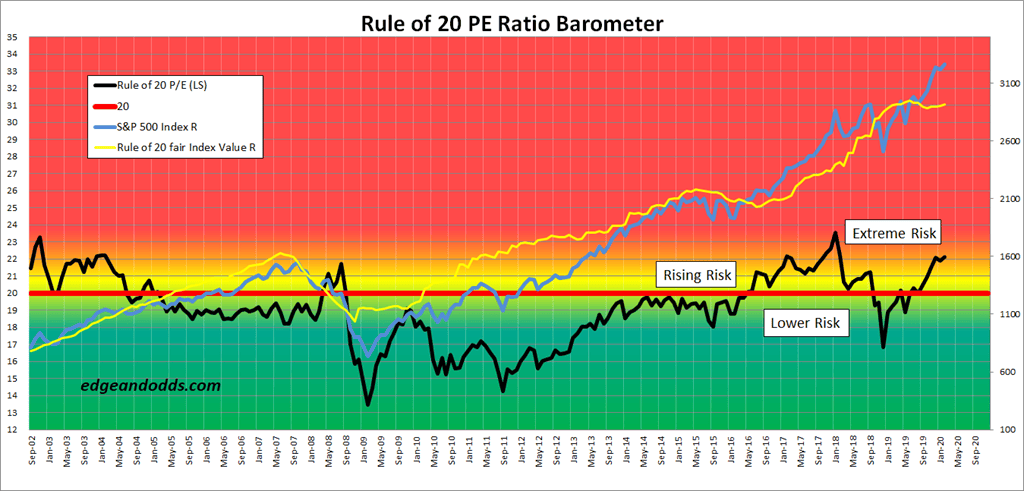
The December 2018 low was reached at a R20 P/E of 16.85 (2400) and the May 2019 low at 18.88 (2735). Technically, the 50-dma is at 3268, the 100-dma at 3155 (R20 = 21.4) and the 200-dma at 3038 R20= 20.7).


 in the opening month of 2020. Although only fractional, the decrease in business activity brought to an end a near-four year sequence of expansion following a contraction in service sector output and a slower rise in manufacturing production amid supplier delays following the outbreak of coronavirus.


