The enemy of knowledge is not ignorance, it’s the illusion of knowledge (Stephen Hawking)

It ain’t what you don’t know that gets you into trouble. It’s what you know for sure that just ain’t so (Mark Twain)

Invest with smart knowledge and objective odds

THE DAILY EDGE: 21 NOVEMBER 2018: Safe Haven?

U.S. Housing Starts Increased in October Underlying figures, however, signal weakness in the construction pipeline

Housing starts climbed 1.5% in October from the prior month to a seasonally adjusted annual rate of 1.228 million, the Commerce Department said Tuesday. The growth was due to a rebound in construction of buildings with two or more units. Starts fell in October for single-family construction.

Residential building permits, which can signal how much construction is planned, dropped 0.6% from September to an annual pace of 1.263 million last month. Permits were down for single-family homes as well as buildings with multiple units. (…)

 large image large image

Global growth heading towards fragile soft landing: OECD

Trade tensions and higher interest rates are slowing the global economy, though for now there are no signs of a sharp downturn, the OECD said on Wednesday, lowering its outlook for next year.

The Organisation for Economic Cooperation and Development forecast that global growth would slow from 3.7 percent this year to 3.5 percent in 2019 and 2020. It had previously projected 3.7 percent for 2019.

The global growth slowdown would be worst in non-OECD countries, with many emerging-market economies likely to see capital outflows as the U.S. Federal Reserve gradually raised interest rates. The OECD cut its outlook for countries at risk such as Brazil, Russia, Turkey and South Africa. (…)

“We’re returning to the long-term trend. We’re not expecting a hard landing, however, there’s a lot of risks. A soft landing is always difficult,” OECD chief economist Laurence Boone told Reuters in an interview.

“This time it is more challenging than usual because of the trade tensions and because of capital flows from emerging markets to countries normalising monetary policy,” she added.

A full-blown trade war and the resulting economic uncertainty could knock as much as 0.8 percent off global gross domestic product by 2021, the OECD calculated. (…)

Trimming its outlook for China, the OECD forecast the country’s growth would slow from 6.6 percent to a 30-year low of 6.0 percent in 2020 as authorities tried to engineer a soft landing in the face of higher U.S. tariffs.

The outlook for the euro area was also slightly darker than in September, with growth seen slipping from nearly 2.0 percent this year to 1.6 percent in 2020 despite loose monetary policy over the period. (…)

EARNINGS WATCH

We now have 478 companies in, a beat rate of 78% and a surprise factor of 6.5%. Q3 earnings are seen up 28.2% (24.9% ex-Energy). Revenues are up 8.5% (7.4% ex-E). Trailing EPS are $157.74 or about $160.25 pro forma the tax reform for a full 12 months. Full year 2018 EPS are expected to reach $162.79.

image

(…) “If you’re heavily engaged in digital sales, you’re experiencing margin pressure,” said Ken Perkins, president of consultancy Retail Metrics. (…)

Sales are pretty good and most retailers very optimistic for the coming holiday season. But investors are getting spooked by seemingly high inventories (Target’s rose from $10.5B to $12.3B), gross margins are down and operating costs skyrocket (e.g. freight, wages).

There is little doubt that sales will be strong amid good employment growth, rising wages, softer inflation and declining gas prices.

XLY is down 14% from its Oct. 1 peak. Its 200dma is still rising, but very slightly Fingers crossed.

xly

Analysts are forecasting a sharp slowdown in earnings in Q4 and Q1’19 as sales are seen rising only 4.3% and 5.0% respectively from the 8.0% range during the first 9 months of 2018. This is material for upside surprise in the current environment.

image

image

Forward estimates assume a complete loss of the tax reform boost:

image

Keep in mind that this is a large and eclectic sector mixing Homebuilding with Retail, Autos, Restaurants…

SENTIMENT WATCH

DoubleLine Capital’s top dog Jeffrey Gundlach told Reuters that the selloff will continue and we aren’t yet seeing “anything resembling a panic low.” Now is the time for “capital preservation,” said Gundlach, adding that investors should steer clear of investment-grade bonds for one.

Some credited Gundlach’s comments with triggering a near 650-point drop at one point for the Dow on Tuesday.

There’s an echo of Gundlach’s advice in our first call of the day from Morgan Stanley’s chief investment officer Mike Wilson who told CNBC Tuesday that it is too soon to buy into this latest dip.

“It all stems back to liquidity and the Fed and the tightening of financial conditions—that is our thesis all year—it’s been this rolling bear market and we finally got to the big tech stocks. I actually think we’re about 90% of the way done with the valuation damage that is going to happen,” added Wilson.

The selloff is coming now because some investors are realizing that companies will be delivering some bad earnings news next year, Wilson said. He also wants to see some more dovish Fed comments.

Wilson is a cool cucumber, though saying the asset correction is a “normal course of business that is very natural at the end of a bull market that needs to consolidate.” He’s got his eye on cyclicals such as utilities, health care, energy and banks, because they’ve already discounted a lot of bad news. “They’ll be the first to recover,” he says.

Last word goes to our counter call of the day, from UBS’s chief investment office, which sent a note to clients late Tuesday. “We view the selloff as overdone and a bull market correction, with valuations that have become more compelling,” said UBS, adding that risk-reward for owning equities is “asymmetric to the upside over the next six months.”

But they also hold so-called countercyclical positions, such as an overweight in 10-year U.S. Treasurys to manage market volatility as investors wait around for “more clarity on trade, the Fed and growth.”

(…) Dalio is back, as he says we’ve “squeezed a lot out of U.S. markets,” and investors should get more comfortable expecting less from that cash cow.

“I think we’re in an environment where we’re going to have low returns going forward for a very, very long time,” Dalio told Bloomberg in an interview. And in a refrain we’ve heard elsewhere, he says stocks were juiced by a period of lower interest rates and liquidity injections, which has “largely run its course.”

“I think the world by and large is leveraged long,” he said, explaining that low interest rates have fueled buybacks and M&A, boosting stock prices, which also got a lift from the effect of White House tax breaks. “We’ve pushed assets up to levels where it is difficult to see where you can squeeze that.” (…)

TECHNICALS WATCH

For what it’s worth, I notice that none of the 19 world index that I track have made new lows recently. That includes small, mid and large caps.

SAFE HAVEN?

Robert K., long time reader and supporter of Edge and Odds, asked for my thoughts on this T. Rowe Price article IS U.S. TREASURIES’ STATUS AS A FLIGHT-TO-QUALITY ASSET UNDER THREAT?

U.S. Treasuries have traditionally been the ultimate “flight to quality” asset, regarded by governments, institutions, and individual investors as a haven during periods of volatility and uncertainty. This may be changing, though. Shifting supply/demand dynamics, a breakdown in traditional correlation patterns, and even concerns over the U.S. government’s creditworthiness have raised doubts over whether Treasuries will continue to function as the defensive portfolio anchor of choice.

Semantics are key here:

  • U.S. government’s securities will remain “safe havens” almost whatever happens. But that is as far as return OF capital is concerned given the credit and printing capability of the U.S. government.
  • As to the “flight to quality” aspect, though unlikely, a rating downgrade is not impossible and that would impact valuation and return ON capital until maturity but not the return OF capital at maturity.
  • Also impacting return ON capital until maturity would be rising long term interest rates which the article is mainly concerned with. Obviously, the supply/demand equation looks unfavorable at this time but who really knows what interest rates will be  2-5 years hence? I sure don’t.
  • But I know where rates are vs the last 60 years:

image

  • And I know where real rates are vs the last 60 years:

image

  • I can then assess what the odds of higher real rates are in light of these also known factors, very heavy in the supply/demand equation:
    • The U.S. government borrowings will total $1.3T this year, more than during the last 2 years combined and likely another $2.0-2.5T during 2019-20.
    • The Fed is now on the sell side.
    • Russia sold out of its Treasuries and China is unlikely to help going forward.

image

There is more to the supply side as high yield debt refinancing will move along its hockey stick curve in 2019 as Artemis Capital Management points out:

image

Starting in 2019-2021 a dustbowl of debt re-financings will hit markets when they are most vulnerable to a liquidity drought. Annual combined U.S. government and corporate debt supply is expected to exceed $2 trillion each year between 2019 and 2022 (Deutsche Bank). Leveraged corporations will need to roll $1.2 trillion of high yield debt starting in 2019 and peaking in 2023 (Bank of America). For the first time in modern history the U.S. government will require a massive supply of debt to finance fiscal deficits during a period of tighter monetary policy. The irony is we are simultaneously pursuing trade wars with the main foreign buyers of that debt (China and Japan).

As if all that is not enough, demographics will become a major factor driving outflows from financial markets for first time in modern U.S. history further exacerbating the liquidity drought. The Baby Boom generation that formed after World War II (Mid-1940s to 1962) drove massive in-flows into financial markets when they started working and saving in the 1980s. Following 30 years of financialization all that Baby Boomer money will now start flowing out of markets to support their golden years.

As Boomers age, they will draw down on their retirement assets and spend less, and this includes redemptions of about $17 trillion in 401(k) and IRA accounts. The U.S. tax code requires 401(k) account holders to begin selling assets at 70 ½ years old, and the first wave of Baby Boomers began these forced redemptions starting last year. In 1980 there were 19 U.S. adults age 65 and older for every 100 citizens. By, 2017 the number of older adults increased to 25 for every 100, and this number is expected to climb to 35 for every 100 by 2030, and 42 by 2040.

Deteriorating demographics is a global phenomenon and by 2030 Canada will have 40 retirees for every 100 people, Germany 44, Japan 58, and China 22. Social Security is now reaching into the trust fund for the first time since 1982. Demographics in the developed world will have a major negative impact on capital market flows right as passive investing, which relies entirely on flow, becomes dominant.

All in all, it seems to me that the odds are stacked in favor of higher real rates. Watch inflation now.

Share Buybacks, the Latest Tool to Calm Markets, Surge in China Chinese companies have bought back record amounts of stock this year, helping offset souring market sentiment caused by trade tensions and economic weakness.

Some 913 companies listed in Shanghai and Shenzhen have repurchased a total 35.5 billion yuan ($5.1 billion) of shares this year, Wind data shows. That’s nearly four times the sums spent in all of last year, by roughly half as many companies.

To be sure, the absolute haul remains tiny for two markets worth a total $6.4 trillion—or compared with the $645.8 billion that companies listed in the U.S. S&P 500 spent in the 12 months to June. (…)

Until October, buybacks were only allowed for limited purposes such as employee stock incentives. But a legal change, at the urging of the securities regulator, means they can now be used for much broader reasons, such as to “defend corporate value” and or “protect shareholders’ interests.”

Ninja (…) many companies buying back stock are either short of cash or are suffering from margin calls on pledged shares, said Ms. Hu.

Jacky Zhang, a Shanghai-based analyst at BOC International, said: “In other markets, companies buy back their stocks in a bull market. Here, we do it so as to heed the regulator’s call to rescue the market.”

Ninja China’s Warning to Market Economists: You Must Toe the Party’s Line It said those who predict the economy’s direction for a living should take state interests into account.

THE DAILY EDGE: 20 NOVEMBER 2018: Testing, Testing…

Trump Threatens High-Tech Export Curbs in Latest Swipe at China

The Trump administration is considering tighter curbs on technology exports, a step that Deutsche Bank AG says would have a “profound and long lasting adverse impact” on relations between the U.S. and China.

A request for public comment, published Monday on the U.S. government’s Federal Register, asks if a list of new technologies that have national security applications — from artificial intelligence to microprocessors and robotics — should be subject to more stringent export-control rules. That would affect U.S. manufacturers as well as purchasers in China. (…)

Under the proposed curbs, Apple Inc., Alphabet Inc.’s Google, IBM, Amazon.com Inc. and similar companies could see limits placed on the way they export the technology behind voice-activated smartphones, self-driving cars and fast supercomputers to China, the Washington Post reported. (…)

The proposal also raises the prospect of retaliation from China, where the anti-monopoly regulator is already investigating Samsung Electronics Co., SK Hynix Inc. and Micron Technology Inc. (…)

From the WaPo article:

(…) “If you think about the range of products this potentially implicates, that’s massive. This is either the opening of a big negotiation with the industry and the public, or a bit of a cry for help in scoping these regulations,” said David Edelman, the director of the Project on Technology, the Economy, & National Security at the Massachusetts Institute of Technology. (…)

The Commerce Department explicitly said it hopes to protect national security without “hampering the ability of the U.S. commercial sector to keep pace with international advances.” The rules come at the request of Congress, which authorized them as part of a recently passed defense bill. On Thursday, the agency said it is “committed to laying the proper foundation to ensure that those technologies critical to national security remain protected to ensure the safety of our country.” (…)

Many executives at big tech companies have bristled at White House-backed tariffs on China, fearing that Beijing’s retaliation could result in higher costs for them — or higher prices on components for their products. Others simply don’t want to anger Beijing, which controls one of the world’s largest markets for tech devices. (…)

“We view this as a really important process that our industry is taking very seriously and plan to engage in, because the outcomes are of great consequence for us,” said Christian Troncoso, a policy director at BSA | The Software Alliance, a Washington-based trade group for companies including Apple, Microsoft, IBM and Oracle.

Pretty serious stuff with loads of known and unknown unknowns.

NDX

xlk

xlc

image
U.S. Home-Builder Sentiment Fell in November NAHB index drops eight points, underscoring builders’ rising concerns over climbing interest rates and home prices

Eight points! Traffic also declined by 8 points, that’s 15%!

large image

John Burns, CEO of John Burns Real Estate Consulting, says that his own survey suggests that the Home Builders Index should be closer to 50 than its current 60 and that home sales will collapse in the next 6 months.

Big hurdles for builders is that house prices have risen much faster than wages and rent while mortgage rates have increased nearly 50% from 3.4% in 2016 to almost 5.0%.

  • How vulnerable is the housing market?

(…) Those trends look eerily similar to those observed back in 2006, or just before the U.S. housing market collapsed. So, should investors be concerned about the U.S. housing outlook? To be sure, a house price correction can never be ruled out, especially if, as we expect, economic growth and employment creation pace down next year. But in our view, a housing crash à la 2007-2011 is unlikely anytime soon. Our optimism rests on the quality of mortgage originations in recent years. Latest data from the New York Fed puts the mortgage delinquency rate in the third quarter at just 1%, the lowest since 2006Q2. The difference between now and 12 years ago, however, is the share of sub-prime in mortgage origination. As today’s Hot Charts show, just 3% or so of recent mortgage originations has been sub-prime, compared to 13% back in 2006. Mortgage lenders have seemingly learnt from past mistakes by not only tightening lending standards but also disproportionately increasing the qualifying threshold for lowest rated borrowers. (NBF)

image

A case where the solution is part of the problem (my yellow highlight).

SENTIMENT WATCH
Goldman Says It’s Time for Equity Investors to Boost Their Cash It may be wise to dial back on risk in equities, the bank said.

“Mixed-asset investors should maintain equity exposure but lift cash allocations,” Goldman strategists led by David Kostin wrote in a Nov. 19 report. “Cash will represent a competitive asset class to stocks for the first time in many years.” (…)

As for stocks, investors should tilt their portfolios toward defensive sectors including utilities, the Goldman strategists wrote. They forecast the S&P 500 will generate “a modest single-digit absolute return” next year as the “robust” profit and economic growth seen in 2018 slows. (…)

  • The base case, with 50 percent probability, sees the S&P 500 Index closing this year at 2,850, up from Monday’s close of 2,690.73. It then rises 5 percent to 3,000 in 2019.
  • The downside case, with 30 percent odds: the risk of a 2020 recession starts weighing heavily on investors, with the S&P 500 ending 2019 at 2,500.
  • The upside case, at 20 percent probability: economic growth stays strong for a longer period of time, and the benchmark index closes at 3,400 next year.

Let’s see. Trailing EPS are now $157.74 or about $160.25 pro forma the tax reform for the full 12 months. At today’s opening of 2600, the Rule of 20 P/E is 18.3, where it troughed in January 2016, a testing level for investor sentiment with an actual P/E of 16.2. Back in early 2016, trailing EPS were still declining from their mid-2015 high and inflation was rising, unlike now.

image

Goldman’s “base case” for a 2850 close this year would bring the Rule of 20 back to 20.0 assuming no change in inflation. It “upside case” of 3400 next year would require a Rule of 20 P/E of 21.9 given current forward EPS of $172. Always gutsy to expect equities to trade at overvalued levels…As to GS’ “downside case”, assuming a recession, all bets are off but a 2500 close in a recessionary 2019 seems pretty optimistic to me.

Interestingly, Merrill’s recent manager survey reveals a similar negativism for world profit growth as in 2011, 2012 and 2016.

  • SMALL CAPS EARNINGS REVISIONS

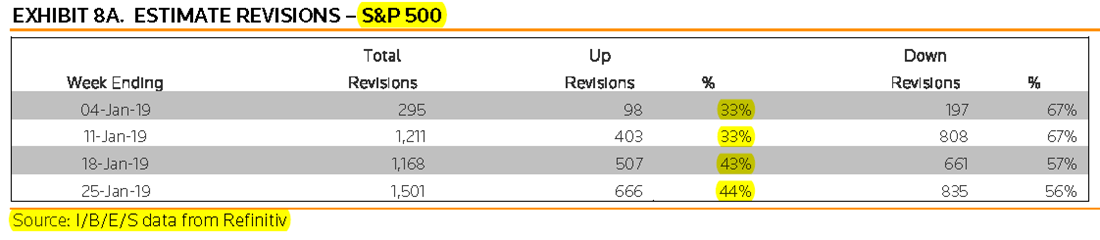
Just received Refinitiv’s latest numbers and up revisions went back below 50% for small caps (ALL minus 500): 47% last week from 55.8% in the previous two weeks.

imageimage

If GE Debt Gets Junked, Markets Have Reason to Shudder Holders of GE bonds are preparing for one of the world’s biggest borrowers to be downgraded to junk. To get a sense of what that might do to the markets, take a look back to the turmoil caused by the 2005 downgrades of General Motors and Ford—but worry that this time it might be worse.

(…) GE’s financial troubles are self-inflicted, not a sign of broader problems in the economy. Yet, it is the world’s sixth-most indebted nonfinancial company, behind Volkswagen ,Toyota, AT&T , SoftBank, Ford and Daimler. And it has more traded debt outstanding than any of them, totaling $122 billion, according to Refinitiv. It is big enough to shake the entire market. (…)

But the credit-rating firms say that if GE’s restructuring goes as planned, there’s no need for further downgrades. If GE can get its finances under control, the panic will abate all by itself. (…)

Hopefully GE will end up merely as a case study in financial mismanagement, rather than the trigger for messy markets. I’d expect only a short period of turmoil, rather than serious trouble, if GE is downgraded—but I do fear that the overall debt load will hurt a lot in the next economic downturn.

James Mackintosh misses a few points discussed yesterday (There Will Be Blood!)

(…) “At the end of the process GE will look like a shell of what it used to be, but it will survive,” said Mr Culp’s confidant. “As long as there is a debt pile that risks bring the company down, GE will keep on selling.” (…)

image