The enemy of knowledge is not ignorance, it’s the illusion of knowledge (Stephen Hawking)

It ain’t what you don’t know that gets you into trouble. It’s what you know for sure that just ain’t so (Mark Twain)

Invest with smart knowledge and objective odds

THE DAILY EDGE: 18 OCTOBER 2018

U.S. Housing Starts Decline

Total housing starts fell 5.3% during September to 1.201 million units (AR) from 1.268 million in August, revised from 1.282 million.

Last month’s shortfall reflected a 13.7% drop in the South to 567,000 units from 657,000, as Hurricane Florence made landfall. Nevertheless, starts remained 4.4% higher than twelve months earlier. In the Midwest, housing starts also were weak and posted a 14.0% decline to 160,000 units (-14.0% y/y) from 186,000. In the Northeast, housing starts improved 29.0% (18.8% y/y) to 120,000 units, the highest level in six months. Housing starts in the West increased 6.6% (7.9% y/y) to 354,000, also the highest level in six months.

Starts of single-family homes eased 0.9% (+4.8% y/y) last month to 871,000 units following a 2.1% rise to 879,000. Starts of multi-family units declined 15.2% (+0.9% y/y) to 330,000 and reversed most of their rise during August.

Building permits slipped 0.6% (-1.0% y/y) to 1.241 million, the lowest level since May 2017, from 1.249 million, revised from 1.229 million. Single-family permits increased 2.9% (2.4% y/y) to 851,000. Permits to build multi-family homes declined 7.6% (-7.8% y/y) to 390,000, the lowest level since March 2016.

 large image large image

large image
Fed Minutes Point to Continued, Gradual Interest-Rate Increases

(…) “A few participants expected that policy would need to become modestly restrictive for a time,” the Fed said in minutes of the Sept. 25-26 meeting released Wednesday. “A couple of participants indicated that they would not favor adopting a restrictive policy stance in the absence of clear signs of an overheating economy and rising inflation.” (…)

The most recent projections revealed most officials believed interest rates over the long-run should settle around 2.75% or 3% to balance supply and demand. The minutes showed “a number” of officials believed they would need to raise rates above that level “to reduce the risk of a sustained overshooting” of the inflation target or “significant financial imbalances.” (…)

(…) The U.S. is lucky that a cautious, thoughtful and intelligent man named Jerome Powell is running the Fed—not the mercurial Donald Trump. Mr. Powell is not doctrinaire, and he is not stubborn. So if the Fed makes a mistake—which is always possible—it should be a small one that can be rectified quickly. It won’t do anything wild or crazy.

Trump Seeks 5% Budget Cuts From Cabinet Agencies

President Trump on Wednesday asked his cabinet members to find ways to cut their department budgets by 5% next year, targeting government spending after an official tally showed Republicans’ tax cuts drove the federal budget deficit to its widest level in six years. (…)

The Peterson Foundation, a nonprofit group that advocates for reducing budget deficits, estimated that cutting discretionary spending by 5% in fiscal 2020 would yield savings of about $67 billion. The savings would be about half of that if military spending is excluded from the calculation. In comparison, payments on the national debt are projected to total about $479 billion in 2020, the group said. (…)

“There’s been a bipartisan reluctance to tackle entitlement changes because of the popularity of those programs,” Mr. McConnell told Bloomberg News. “Hopefully at some point here we’ll get serious about this. We haven’t been yet.” (…)

During last year’s tax debate, Democrats warned that Republicans would use the deficits created by the tax cut to press for cuts in safety-net programs. Many have spent the past two days saying “I told you so” and folding that into their midterm campaigns. (…)

Top Republican Mitch McConnell warns Trump’s trade war hurting U.S. economy Senate GOP Leader voiced his concerns about the effects of rising trade tensions, particularly with China

(…) “The tariffs are beginning to have some impact in a negative way, so I hope that we make some progress quickly on some of these other fronts, in particular with China,” Mr. McConnell told the round table discussion with Reuters journalists, although he said of the overall U.S. economy: “I think it’s red hot.” (…)

U.S. Assails China on Currency, but Doesn’t Add Manipulator Designation But Treasury Secretary Mnuchin says China’s practices are a source of ‘particular concern’
China Stock Market Rocked by Forced Sellers; Yuan Hits Fresh Low
Ross Says Progress of Trade Talks With EU Is Unsatisfactory

(…) He said the U.S. stressed “the need for speed and for getting to near-term deliverables.”

Mr. Ross’s remarks came just hours after Ms. Malmstrom blamed Washington for not engaging with the EU to establish the framework of a trade pact.

The fighting words by Mr. Ross and Ms. Malmstrom highlight the difficulty of clinching any U.S.-EU trade deal less than three months after Mr. Trump and European Commission President Jean-Claude Juncker agreed to slash tariffs and regulatory barriers to trade. They also raise the risk of U.S. tariffs on European car exporters, which the White House pledged to withhold as long as negotiations continue. (…)

“We are ready to start the scoping exercise on a limited agreement focused on industrial goods,” Ms. Malmstrom said Wednesday. “The U.S. has not shown any big interest in this. The ball is in their court.”

Mr. Ross hit back within hours that Ms. Malmstrom’s allegation was “simply inaccurate.”

On Wednesday, Washington’s ambassador to the EU, Gordon Sondland, reiterated the U.S. view that any final trade deal would have to include agriculture. That is a problem for Brussels, and EU officials said the White House agreement specifically left out agriculture to avoid prolonged, contentious negotiations. (…)

EARNINGS WATCH

We got 51 reports in, 84% above expectations with a +4.0% beat rate. Blended Q3 estimates now +21.9% (+19.0% ex-Energy). Q4 estimates unchanged at +19.9% (17.2% ex-E).

The Earnings Elephant in the Room The strengthening dollar weighs on U.S. multinationals’ earnings

The U.S. dollar rose 5% in the third quarter from a year ago against a basket of currencies weighted by trade volume, according to Federal Reserve data. That is the strongest reading since the first quarter of 2016 as higher U.S. interest rates have attracted foreign capital.

This presents a challenge for companies that report earnings in dollars but have significant overseas businesses. Shares of health-care giant Abbott Laboratories sold off after earnings Wednesday despite reporting impressive operating results. Abbott, which books two-thirds of its sales in international markets, said unfavorable exchange rates shaved 2.7% off of reported sales in the third quarter. That drag could exceed 3% in the fourth quarter, the company said. (…)

On Tuesday, Johnson & Johnson said international sales in the third quarter grew by 3.5% from a year ago but expanded 7.5% excluding foreign exchange. (…)

Makers of Dove Soap, Nescafe Are Raising Prices Again Two of the world’s largest consumer goods companies, Unilever and Nestlé, reported stronger sales as a wave of inflation in many markets emboldened them to raise prices

(…) “The combination of underlying commodity increases but also the stronger U.S. dollar is really putting a lot of inflation into our market,” said Unilever Chief Financial Officer Graeme Pitkethly. “I see pricing being a key feature of the entire sector through the balance of the year and in 2019.”

Unilever said commodity costs and hence price growth was particularly strong in emerging markets while both companies said prices rose in the U.S. However, in Western Europe both cut prices. (…)

In developed markets, Unilever said underlying third-quarter sales climbed by 1.3%, driven mostly by volume gains. Emerging market sales jumped 5.6% as Unilever was able to raise prices by 2.1%. The results exclude pricing in Argentina, which is going through a period of hyperinflation. The company raised prices there by 34% in the third quarter while volumes dropped 10%. (…)

“We got to get the price moving but keep volume first,” he said. “The true test of the strength of a brand is the ability to price and give a degree of inflation protection.” (…)

Nestlé said higher pricing in the third quarter reflected inflation in commodity and freight costs in North America.

In plain English, this is companies struggling to protect margins against cost-push inflation.

SENTIMENT WATCH
‘Bonds are the bubble, not stocks,’ says billionaire investor Cooperman

(…) he also argued that stocks are “fundamentally cheap” following a U.S.-led global equity rout last week. (…)

While market bears argued that the rise in yields and stock-market reaction belied investor fears that a growth slowdown is around the corner, Cooperman, the founder of Omega Advisors, argued that the economy, “if anything, is too strong” and that the conditions “that normally lead to a big decline just aren’t present.” (…)

Howard Marks, the ultimate bargain hunter Renowned investor on appetite for risk and failing to learn lessons from the crash

In an FT interview, Marks says risk appetite is close to the level seen just before the 2008-09 financial crisis that felled US investment bank Lehman Brothers. He says credit markets are at 7-8 on a 1 to 10 risk aversion scale with 10 being extreme risk tolerance.

2007 was totally risk-averse, totally unconscious of risk. It’s not that bad today. The building block of the crash last time was subprime [mortgages]. There is no parallel in terms of magnitude that’s comparable today. People have been very diligent in trying to identify the risks. (…)

THE DAILY EDGE: 17 OCTOBER 2018: Curb Your Enthusiasm

NOTE TO EMAIL SUBSCRIBERS: That feature has not been working in recent days due to a problem at the host which has now been resolved. You might have missed these posts:

U.S. JOLTS: Job Openings Rate Hits Another Record

The Bureau of Labor Statistics reported that the total job openings rate rose to a record 4.6% in August; July was revised higher to 4.5%. The job openings rate is the job openings level as a percent of total employment plus the job openings level. The hiring rate increased to 3.9%, matching the eleven-year high reached in May. Meanwhile, the quits rate, a measure of confidence in job prospects, was unchanged at a 17-year high of 2.4%. The private-sector job openings rate remained at July’s record 4.8% (though July’s data was revised higher). (…)

The level of job openings increased 0.8% month-to-month (18.1% year-on-year) to 7.136 million in August following an upwardly revised 3.7% July gain. Private-sector openings jumped 17.0% y/y with the factory sector revving 17.3% y/y and construction 38.6% y/y. Openings in professional & business services advanced 27.0% y/y; leisure & hospitality gained 17.4% y/y; trade, transportation & utilities increased 15.5% y/y; and education & health services were up 6.7% y/y. Government sector job openings gained 29.4% y/y.

The private-sector hiring rate in August rose to 4.3% matching May’s eleven-year high. (…) Total hiring rose 1.2% (5.0% y/y) in August to 5.784 million. Hiring in the private sector increased 5.2% y/y with trade, transportation & utilities jumping 17.2% and leisure & hospitality gaining 5.9% y/y. Professional & business employment increased 1.8% y/y and educational & health services were up 1.3% y/y. Factory sector hiring slowed to 2.2% y/y and construction sector fell 10.3% y/y. (…)

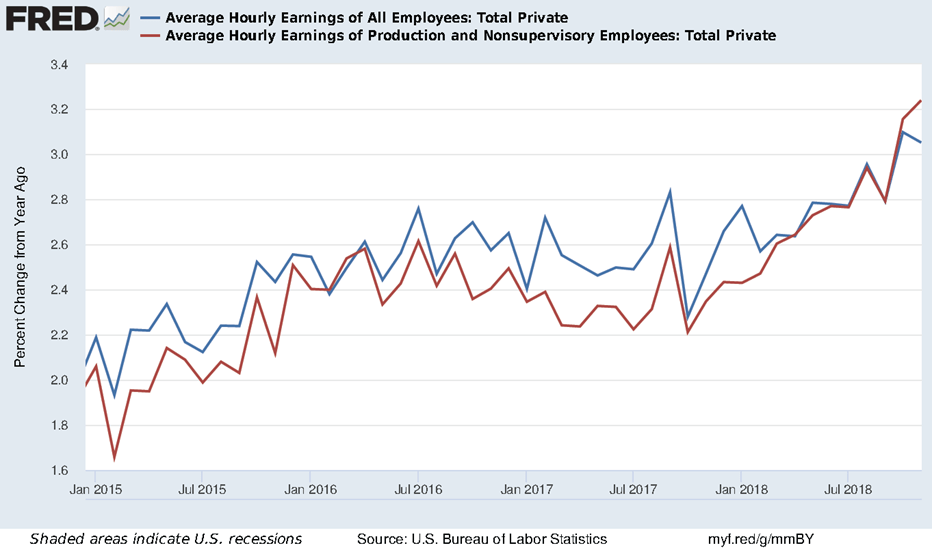
What eventually must happen when the blue line gets above all other lines?

image

(…) The higher payroll spending helped drive overall operating costs up 21.2% even as overall revenue rose 20%. (…) fleets have added more than 33,000 jobs in the past 12 months, according to the Bureau of Labor Statistics, and overall payrolls in the sector rose to their highest level in more than a decade in September. (…)

Like other carriers, the company is passing those pay increases along to customers in the form of higher freight rates.

Ms. Simpson said at this point in the year shipping customers appear to be more concerned about service than cost (…)

The Lowell, Ark., company’s salaries, wages and employee benefits costs grew by more than $87 million from the third quarter a year ago, and were up 6.5% from the second quarter. That helped pull down operating earnings growth to 6% year over year, to $174.7 million.

Overall, J.B. Hunt reported net earnings of $131.1 million in the third quarter, or $1.19 a share, up 31% compared with the same three-month period in 2017.

So, JBHT’s Q3 labor costs are up at a 28.7% annualized rate (although that will not repeat quarterly, god forbids). PPI-Truck Transportation is up 6.6% YoY in September and has increased at a 7.5% annualized rate in the past 6 months.

Big Jump in Americans Saying Renting Is Cheaper Than Owning Freddie Mac data shows 78% of people now say that renting is more affordable than owning

(…) That is up 11 percentage points from only six months ago.

The survey also indicates that demand for for-sale housing could remain soft in the coming months. Some 58% of renters now say they don’t currently have plans to buy a home—up from 54% in February, according to Freddie. (…)

Two-thirds of renters say they have had difficulty affording their rent at some point in the past two years, according to the Freddie survey. Nearly nine in 10 renters in what Freddie deems “essential” fields like health care and education say they have had significant struggles to pay rent during the past two years.

Mr. Brickman cautioned that if more people decide to continue renting that could eventually reverse the current dynamic and make rents once again begin to rise quickly. (…)

The above coupled with the first item could well explain the below:

image

Employment growth in Education and Health Services has slowed from +3.0% in 2015 to +1.9%. Wage growth in these trades is 2.0%, while inflation is 2.3%. Gas prices are up 9.1% YoY, fuel oil 23.4% (!) and shelter 3.3%. The savings grace for many is that grocery inflation is only 0.4%.

image
U.S. Manufacturing Capacity Increases for 16th Month in a Row Factory output also rose in September, helping drive overall industrial production up 0.3% for month

(…) Manufacturing capacity began recovering from a steep decline in 2011, faded in 2014 and resumed a modest march higher in mid-2015. In September it was up 1.4% from a year earlier. The report suggests investment in U.S. manufacturing has been increasing at a steady pace over the past three years. In June it passed its 2008 peak. (…)

U.S. IP is up 5.1% YoY and 4.0% annualized in Q3 with the energy sector contributing big time. Capacity may be up a little but still low capacity utilization rates prevent a sharp increase. Manufacturing production remains 2.4% below its December 2007 peak. (Table and chart from Haver Analytics)

image

PMI data largely skewed to the downside for “vulnerable” emerging markets

A combination of US economic strength, rising US interest rates and various risks in certain emerging markets has resulted in the underperformance of EM FX markets during 2018 so far. While Turkey and Argentina are two stand-out examples of such currency stress, there has been a contagion effect which has resonated through the developing world.

Broadly speaking, EM manufacturing sector growth has deteriorated markedly since a five-year peak seen at the end of 2017. September PMI data signalled a pace of expansion that was only marginal and the slowest in just over two years. Charting the EM Manufacturing PMI against currency changes suggests that the PMI has moved in line with markets.

(…) inflationary pressures are likely to build in all cases as the combined effect of rising commodity prices (which are generally priced in US dollars) and weak domestic currencies increases the cost of imported goods and materials. (…)

Despite weaker currencies and improved international competitiveness, PMI data have signalled a distinct drop in exports across all ‘fragile five’ economies except India, in line with the wider trend of deteriorating export performance seen across all EMs. All else being equal, a combination of currency depreciation and declining exports will contribute to a further worsening of current account deficits, potentially leaving these countries more susceptible to further capital flight. (…)

China’s Stock Rout Puts $613 Billion of Share Pledges at Risk

Loans extended to company founders and other major investors who pledged their shareholdings as collateral emerged as a popular financing channel in recent years. But given the losses in equities — Shenzhen’s stock benchmark is down 33 percent in 2018 — there’s a growing risk that brokerages will be forced to sell the shares, accelerating the downturn.

At least 36 companies have seen pledged shares liquidated by brokerages since the start of June, more than triple the 10 in the first five months of the year, according to company filings. At least two firms announced after Monday’s close that their shares were at risk of forced selling, including Jilin Zixin Pharmaceutical Industrial Co., which plunged by the 10 percent daily limit the following day. (…)

China Exporters Feel the Trade-War Strain: Canton Fair Notebook

The fair claims to be the world’s largest trade forum, bringing together more than 25,000 exhibitors and 200,000 buyers, mostly foreign. Here are some of the most interesting entries in our notebook so far:

  • China Is Starting to Lose Out to Vietnam, Turkey

(…) China’s becoming expensive and some of Empire Crystal’s suppliers have already set up factories in Vietnam, Vana said.

The company’s also starting to source some glass, ceramic and wooden products from Turkey, he says. The production cost is about the same but transportation costs are lower and there are no customs duties, he said. 

Eastern European nations including Ukraine and Romania now have lower costs than China, says Vana. The company’s also checking out producers in Bangladesh, he says.

Empire Crystal’s not directly impacted by the U.S.-China trade war but Vana says it’s possible European companies like his may benefit if as a result China moves to boost trade with Europe via measures including lower customs duties.

(…) In the meantime, they’re starting to switch away from U.S. inputs — they’re buying more control systems from Canada and using Chinese-sourced acrylic

  • Prices Going Up If Americans Still Want to Buy

(…) Reida is receiving interesting offers for help. A trading company in Mongolia reached out, suggesting it could aid them in circumventing tariffs by importing the company’s goods and re-exporting them to the U.S. market, according to Zeng. A similar overture came from Mexico, she says. (…)

  • Protectionism, Volatile Yuan Worry Aluminum Exporter

(…) A weaker yuan makes JMA’s products cheaper for foreign buyers, but the company prefers a stable exchange rate, Wong says. A lot of its foreign sales are in emerging markets like Latin America, and weaker currencies there have made it harder for would-be buyers to purchase their aluminum, which is priced in dollars.

  • Trade War Means Better Sales…For Now

Ningbo Staxx Material Handling Equipment Co., a manufacturer of pallet jacks, is experiencing a short-term boom as its customers try to get ahead of U.S. tariffs, says Jeremy Chow, a sales manager at the company. It’s a good illustration of the front-loading of orders that analysts said explained the surprise acceleration in export growth in China’s September trade data.

  • Will Trump’s Tariffs Make Next Christmas Pricier?

Jiang, who is handling North American sales for the company’s booth at the Canton Fair, said the industry is already struggling amid rising labor costs, which in recent years have spurred a relocation of production to southeast Asian countries where it’s less expensive, like Vietnam.

But companies are having trouble building out capacity quickly enough to meet demand, and margins, at just 5 percent to 10 percent, are already too thin for producers to make concessions on price, Jiang says. The bottom line: if tariffs end up covering their products, U.S. consumers will just have to pay more. (…)

Nyah-Nyah GE beats Siemens to Iraq power-generation contract Trump administration pressured Baghdad to reject German rival’s bid for $15bn deal

The FT says that Siemens was told two weeks ago to give up because the US government was putting intense pressure (“The US government is holding a gun to our head”) on Irak to favor GE.

Iraq needs support from the Trump administration over the country’s gas imports from Iran. About 35-40% of Iraq’s electricity is generated by plants burning Iranian gas and Irak is worried that when reinstated US sanctions on Iran take effect on November 5, the U.S. would penalize Irak.

Here’s the big rub as the FT puts it: “If GE does beat Siemens to win a large contract to sell power plants to Iraq that will burn gas from Iran, it could cause a political furore in Germany. Richard Grenell, the US ambassador, has been forthright in warning German companies to cease doing business with Iran “immediately” in the wake of the Trump administration exiting the international deal over the country’s nuclear programme.”

Trump is not about to say “Ich bin ein Berliner”.

World stocks extend rise after blockbuster U.S. earnings

Forecast-beating U.S. company earnings improved the mood on world equity markets on Wednesday, as Asian and European shares put aside concerns on global growth and trade and took their cue from Wall Street’s best one-day rise in eight months.

EARNINGS WATCH

Forty-one companies in and the beat rate is a record 88% with a strong beat rate of 4.0%. Still a lot left but the season is shaping up like a repeat of Q2. The blended estimate for Q3 has increased a little to 21.8% (18.0% ex-Energy). Monitoring how analysts react to conference calls, Q4 estimates are holding (+19.9%) and so are Q1 and Q2 of 2019 estimates.

At today’s pre-opening of 2800, the Rule of 20 P/E using full year 2018 estimates is exactly 20.0.

The market has thus held, so far, on the Rule of 20 “Fair Value” (now 2878) and on its 200-day moving average (2763).

But there has been some technical damage that merits attention:

The S&P 500 Index has recovered its 200dma…

spy

…but not the equal weight index which is also showing a flattening 200dma.

rsp

The mid-cap index remains below its 200dma and the latter is now pointing down…The small cap index also could not reach back on its 200dma but the latter remains upward sloping.

mdy

Tech stocks were strong yesterday and the NDX roared back above its 200dma…

NDX

…but its equal weight measure failed the same reclaim and displays a wavering 200dma:

NDXE

Large caps are resilient amid strong earnings and ok valuations as inflation seems to have paused a little. But technical cracks keep coming. It started with small caps a few weeks ago when earnings revisions turned negative. Last week, revisions on S&P 500 companies were weaker. Q3 releases are accelerating this week and next and guidance on conference calls will be important to monitor through analyst revisions.

Punch In case you missed the point from J.B. Hunt’s results above: its Q3 EPS are up 31% but its operating income is up only 6%. This in a booming industry with strong pricing power. Revenues were up 20% but operating income could only rise 6%! Any slowdown will hurt big time. The squeeze is on but hides under lower taxes. We know that won’t last…

Meanwhile, many key indices are showing weakening 200dmas.

Let’s not forget that this is not a happy, serene and smooth world. Same for the U.S. President who has smartly found a handy scapegoat should he need one (he will eventually):

Trump describes Fed as his “biggest threat”

Hmmm…really? Let’s see: