-
Flattening Yield Curve Raises Warning Flag
-
Don’t Fear the Yield Curve—Just Yet
-
Flattening Yield Curve Isn’t Just the Fed’s Problem
It’s now all about the yield curve. Inverting or not? Bad or not? Every economist, strategist or commentator has a theory.
As always, I prefer to look at the facts.
A look at this 40-year chart quickly dispels the myth. Yield curve inversions always precede recessions but do not necessarily lead to recessions, unless you are willing to wait 2-3 years.

Inversions occur because short term rates rise faster than long-term rates. The Fed’s arm looms very large on short-term rates while market forces, essentially dictated by inflation and inflation expectations, generally set the course for long-term rates (not quite so simple since 2009).
In effect, recessions are “engineered” by the central banks’ desire to slow economic and inflation growth rates. There have been 13 Fed tightening since the 1950s and 10 eventually ended in recessions and 3 in soft landings. It is thus a fairly riskless call to say that we are presently on a path to a recession. The big unknown is when. And do not count on the “engineers” to help on timing, they themselves have no clue as David Rosenberg demonstrates.

Judging from the past 10 recessions, the first rate hike preceded a recession by an average of 28 months with a range of 11 to 55 months (!) and a median of 22-25 months. It has been 28 months since the first Fed rate hike in December 2015 (red arrows in chart below). Unless this cycle beats yet another record, the latest the recession will start is August 2020.
Some could argue that the second hike in December 2016 was actually the real first hike. We would thus be only 16 months into the hiking cycle.
Being more concerned with equity markets than economic recessions, I once posted on EQUITIES AFTER FIRST RATE HIKES: THE CHARTS SINCE 1954. You can see all the evidence in the article but here’s the conclusion:
To be brief, in layman’s terms, in reality, there seems to be no consistent nor typical pattern after the first rate hikes.
However, digging a little more into the history book, I found that in 6 of the 8 years when the S&P 500 rose during the initial rate hike, inflation was actually diminishing or stable (2004). This did not verify in 1987, although the market eventually avenged itself and in 1999 when internet speculation blinded everybody.
Maybe we got ourselves a bit of a rule here: rate hike cycles are not damaging to equities in as much as inflation is not rising at the time. Since profits are generally still rising when the Fed takes its foot off the pedal, stable or declining inflation rates help sustain P/E ratios as demonstrated by the Rule of 20.
So, SHOULD INVESTORS FEAR A FED TIGHTENING? The short answer is yes. The longer answer is watch inflation.
Core inflation was 2.1% in December 2015 and 2.2% one year later. It dropped to 1.7% in mid-2017 and is now 2.1%. So far, this rate hike cycle has not met rising inflation but price pressures are seen rising in many corners.
The yield curve has actually been declining since 2014 as long-term rates dropped from 3.0% to 1.4% in July 2016 while short-term rates were slowly creeping up.

The real flattening move began in September 2017 when short rates journeyed decidedly upward without similar conviction from the long end. In fact, ten-year Treasury yields remain below their early 2014 level while the 2Y yields jumped six-fold from 0.4% to 2.4%.
In a December 22, 2016 post (RISING LONG-TERM RATES: THE SCARY FACTS!), I showed that rising long-term rates have almost always been damaging to equity returns:
In the 12 periods of rapidly rising long-term rates between 1965 and 1996 (I grouped a few short periods on the chart), not one was accompanied with any meaningful gains in equities while most saw equities perform a really deep dive (average –14.5%).
(…) Since 1996, there were some instances when rising rates coincided with higher equity prices, like in 1998-2000, maybe 2005-06, and 2010. The first two instances saw equity valuations truly explode as investors bought into “great stories”, only to totally deflate when the dreams turned into terrible nightmares.
The problem this time is really not whether the yield curve inverts or not, rather that the general level of interest rates is rising rapidly amid a highly indebted world.
THIS TIME IS DIFFERENT
It really is.
- The Fed has begun its Quantitative Tightening in a race against the economic cycle, aiming to refill its empty toolbox in order to be prepared to fight the next recession.
- It has thus clearly set the path for the Fed funds rate: two or three more hikes in 2018 to reach its estimated “neutral policy rate” of 2.875%, and three more in 2019 to get some wiggle room in case it needs to reboot the economy.
- Where things are very different is that the Fed is also degreasing its balance sheet, gradually and systematically shedding long-term securities into the market, thereby putting upward pressures on long-term rates. This could well prevent the “dreaded inversion” but it could lift the whole interest rate spectrum.
This “engineered” general increase in U.S. interest rates is happening when the federal government is also putting increasing pressures on the bond market with its explosive deficits and financing needs over the next several years, even though its debt ratios are already in danger zones.
More recently, inflation has picked up, also putting pressure on interest rates. And now oil prices are pushing upwards, and maybe wages as well.
Given all the above, bond investors might well be inclined to demand more than the current puny 0.7% real return on their 10-year commitments.
Meanwhile, in the real world, corporate CEOs, CFOs and treasurers have to incorporate the well telegraphed higher interest rates in their 2018-2019 budgets. Corporate America is more indebted than ever. Total nonfinancial corporate indebtedness is almost $9 trillions, up 33% from its 2008 peak and 80% above its 2000 level.

Thanks to the Fed’s transparent communications, corporations can confidently calculate that, even without any new borrowing, their short-term interest expense, up 60% in 2017, will increase 30% in both 2018 and 2019 simply through rising discount rates. On an after-tax basis, considering the new lower tax rate, the scheduled rise in short-term rates will cost 35% more in 2018 and 2019.
These calculations take no account of the rising spread between LIBOR and the Fed Funds rate. Whatever the reasons, the spread has recently reached 0.7% from 0.24% in mid-2016. Since most corporate short-term interest rates are linked to LIBOR, if the current spread remains through 2019, interest costs will be 20% higher than calculated above.
Ten-year Treasury yields averaged 1.8% in 2016 and 2.3% in 2017. They are presently 30% higher at almost 3.0%. For the above mentioned reasons, a good case can be made for even higher long-term rates in the next 2 years (see below for caveat). If inflation is 2.0% and real rates are 1.5% (still below their 2.4% 50-year average), refinancing long-term debt in 2018-19 could lift long-term interest rates 50-70% above their 2017 level, assuming constant corporate spreads, a rather optimistic assumption given the current low spreads amid Fed tightening.
In all, budgeting this year and next, corporate officers are facing a scheduled explosion in their financing costs. Compared with 2017, the cost of floating rate debt will more than double in the next 2 years while that of new fixed rate debt will rise some 70% (or more) on an after-tax basis.
According to the Federal Reserve Board, U.S. nonfinancial corporations incurred $490B in interest payments in 2016. Given the rise in interest rates during 2017 and assuming that 20% of long-term debt matures each year, we can infer that interest payments rose to about $530B in 2017 and could reach $580B in 2018 and $625B in 2019. While rough but conservative estimates, these numbers provide an idea of the hit corporate borrowers will take this year and next: somewhere around $100B (nearly 20% vs 2017) more cash outlays over 2 years.
Corporate cashflow was some $2T or 22.5% of total debt in 2017 per Ed Yardeni’s calculations. If interest expense rise $100B pretax by the end of 2019, after tax cashflow will decline by about $80B or 4% assuming no spread widening nor rating downgrades. Since corporate revenues will also be negatively impacted, we can safely assume that the scheduled rise in interest rates will hurt after tax cashflow by 6-8% during the next 2 years, about equivalent to the average effect of the tax reform on corporate USA.
The bulk of the hit will be felt during the second half on 2018 and in 2019.
Importantly, keep in mind that all calculations above are economy-wide and aggregate the full spectrum of companies, from cash rich to debt heavy. Obviously, the latter group will get hit much harder than the 6-8% average. Consider
- Even median investment grade borrowers are levered like never before, in the ninth year of the cycle.

- Nearly 50% of investment grade borrowers are rated BBB, up from 42% in 2014 and 32% in 2009. (David Rosenberg notes that the volume of BBB-rated bonds globally has soared to nearly $3 trillion or triple what it was in 2008). Any cashflow shortfall will hurt and any refinancing will be challenging, and costly, especially after another eventual (likely) downgrade.
- The number of zombie companies (not earning their interest expense) is already beyond the previous peaks reached after a recession. Recession or not, this number will swell well past 220 companies in coming years.
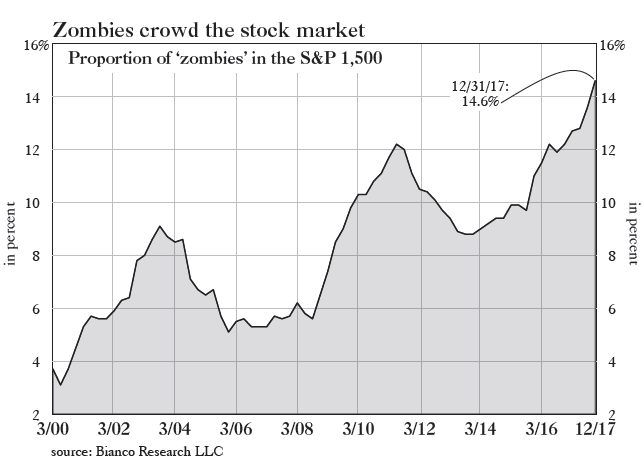
- Many of these zombies are of the small cap breed. While corporate America has enjoyed record margins throughout the cycle, smaller companies have experienced a rather large drop in profit margins since 2013. The recent tax reform is providing some relief, but for how long?

- Actually, David Hay, CIO at Evergreen/Gavekal says that 20% of the Russell 2000 companies can’t cover interest with EBIT. That’s 400 companies. And yet, according to David, the Russell 2000 index is trading at 26x forward earnings, excluding the 1/3 or so that lose money.
- This is a scary alligator chart from David’s latest webinar:

Maybe we should also get short the U.S.consumer. Small cap Alli’s lower jaw above will sink by $5B for every 100 bps increase in interest rates. Assume that the average Russell 2000 company incurred a 4% average interest rate in 2017, a doubling in that number would eat $20B off the $150B in ebitda, a 13% drop.
Now that also assumes that revenues don’t get hurt. But since Consumer Alli below also gets bitten by the rate hikes, each 100 bps effective rise eats almost $150B, or 1% off its disposable income, lifting the lower jaw below by 1 percentage point and requiring a commensurate redistribution of expenditures. If higher oil prices also get in the beat, consumers will need to seriously retrench on discretionary spending during the next several years.

Adding to executives’ nightmares, any American company using imported steel or aluminum (there are many, many, employing an estimated 6M workers) is now facing 10-25% cost increases and high anxiety on their competitiveness. Any company trading in goods subject to potential tariffs is anxiously awaiting a resolution of the USA-China face-off, several months away given the lengthy process.
Tax reform was an important but one-shot event. Rising financing costs, refinancing challenges and real and potential trade issues will be grinding through 2019 which already compels corporate executives to review their priorities for the next several years. This will more than likely result in renewed efforts to cut costs but, imperatively, in a sharp focus on conserving cash and reducing debt. The economic momentum will likely suffer as a result but also dividends and stock buybacks.
This could explain
- Small corporations’ sudden and sharp swing in capex intentions (The Daily Shot):

- The surprising sharp drop in expectations without weakening current conditions in the April NY Fed survey:

- The sharp drop in expected new orders in the April Philly Fed survey:

- The sharp drop in the ZEW survey of expectations in countries hit by the steel tariffs:

Faced with such financial certainties and business uncertainties, several corporate officers could very well call a freeze on spending and borrowing on very short order. If they don’t do it voluntarily, the bond vigilantes will intervene and force their hand.
The whole point here is that there is a severe increase in interest rates virtually scheduled through 2019 which will hit throughout a highly indebted economy. The harsh reality is that each of these hikes immediately takes real cash out of the system and reduces revenues and profits. If companies are not yet planning for these certain events, the shock will be even bigger.
There are no buffers in this economy. The Fed desperately needs to reload, the consumer has no savings and corporations are loaded with debt.
THE BOND CAVEAT
Bond bulls have become a pretty rare breed, especially after the “big breakout”:

Van Hoisington and Lacy Hunt at Hoisington Investment Management have such a track record that we must pay heed to their view. This is their conclusion as of April 13:
(…) Important to the long-term investor is the pernicious impact of exploding debt levels. This condition will slow economic growth, and the resulting poor economic conditions will lead to lower inflation and thereby lower long-term interest rates. This suggests that high quality yields may be difficult to obtain within the next decade. In the shorter run, in accordance with Friedman’s established theory, the current monetary deceleration, or restrictive monetary policy, will bring about lower long-term interest rates.
So, what if long-term rates don’t go much higher, or even decline? It will necessarily mean that the economy is getting slower, vindicating Hoisington’s argument that excessive debt levels lead to slower economic growth.
What would the Fed do? So far, the evidence from the FOMC communications points to a strong desire to “normalize” as quickly as possible. Absent a recession, therefore, QT will continue. Tightening in a slowing economy!
Investors are thus trapped in this environment of high indebtedness, rising interest rates, threatening inflation and a boxed Fed. There seems little hope for a gracious and harmless exit.
Investing is dealing with uncertainty. When certain important things become certain, it is wise to take advantage of this rare advantage. We must ascertain that our investment portfolio is built with these certainties well accounted for.
What we know, at this time, known knowns and known unknowns:
- the world is highly indebted;
- the U.S. government is highly indebted;
- corporate America is highly indebted;
- more companies are more indebted than in previous cycles;
- more small companies are highly indebted;
- more small companies have poorly rated debt;
- more small companies are already not covering interest expense;
- a very large percentage of loans are covenant-lite;
- U.S. short-term interest rates are set to rise through 2019;
- U.S. long-term rates are up 30% from their 2017 level and could rise further;
- tax reform has raised the after cost of financing by 22%, much more for highly indebted companies;
- the U.S government will need to borrow heavily over the next 10 years, starting right now;
- heavy corporate refinancing will also pressure rates in the next several years.
Therefore, we should expect difficulties for companies with high debt, high floating rate debt, and large maturities in 2018 and 2019. God forbids that rising rates also hurt the economy…
On the more macro picture, Lacy Hunt warns of the virtuous circle:
Regardless of whether there was an associated recession, the last ten cycles of tightening all triggered financial crises. In conjunction with the non-monetary determinants of economic activity (referred to as initial conditions), monetary restraint served to expose over-leveraged parties and, in turn, financial crises ensued.
Only unknown: not if, when?
Peruse your portfolio. Quality and safety deserve a premium.


