China: Operating conditions improve for first time in four months
China’s manufacturing sector finished the opening quarter of 2019 on a positive note, with operating conditions improving for the first time since last November. Firms signalled slightly quicker rises in output and overall new work, while employment increased for the first time in over five years. Firmer demand conditions led to a softer fall in purchasing activity, while inventories of inputs rose slightly for the first time since last November. Average input costs rose slightly, though companies generally passed this on to clients in the form of higher selling prices. Sentiment regarding the 12-month business outlook improved to a ten-month high, amid hopes of further improvements in market conditions.
The headline seasonally adjusted Purchasing Managers’ Index™ (PMI™) posted 50.8 in March, up from 49.9 in February, to signal the first improvement in the health of China’s manufacturing sector for four months. Although consistent with only a marginal pace of improvement, the index reading was the highest seen since July 2018.
Manufacturing production in China rose for the second month in a row in March. Though modest, the rate of increase was the quickest seen since last August. The upturn was supported by a stronger, albeit still relatively muted, rise in total new work. Furthermore, new export orders rose slightly after a fall in February. The subindex for new orders climbed to its highest level in four months, and the gauge for new export orders returned to expansionary territory, showing that both domestic and external demand rebounded moderately.
Staffing levels at goods producers increased during March, to mark the first expansion since October 2013. Some firms mentioned hiring additional workers to support greater production and new business developments. Staff hiring also coincided with sustained signs of stretched capacity at manufacturers, as outstanding workloads continued to rise at a moderate pace.
Although purchasing activity continued to decline at the end of the first quarter, the rate of reduction was only slight. Inventories of finished goods also fell at a softer pace in March, contracting only marginally. Stocks of purchases meanwhile expanded slightly for the first time in four months.
Average lead times for inputs continued to lengthen during March, but the degree at which vendor performance deteriorated was marginal overall.
After declining in the prior three months, average input prices increased at the end of the first quarter. That said, the rate of inflation was only slight. Companies generally passed on higher input costs to clients by raising their selling prices modestly in March. Some firms also noted that firmer customer demand had enabled them to hike their charges
Optimism towards the year-ahead outlook for production improved to a ten-month high in March, with a number of firms linking positive forecasts to expectations of further improvements to overall market conditions. Nonetheless, confidence remained below the long-run series trend.
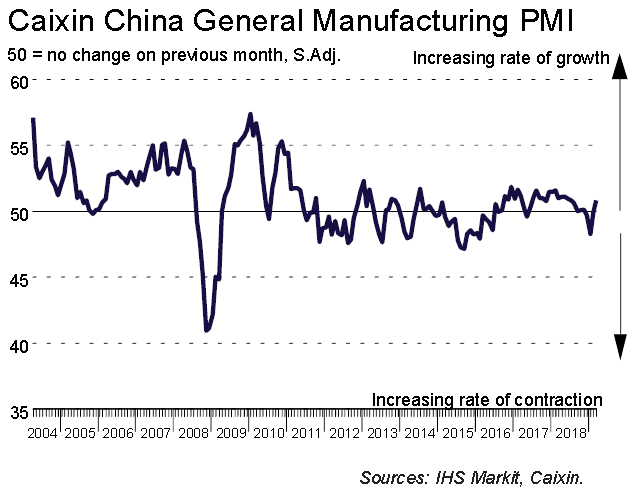
China Manufacturing Gauge Rebounds An official gauge of activity in China’s crucial manufacturing sector rose to a six-month high in March, suggesting that Beijing’s support policies are gaining traction.
Factories showed a pickup in activity almost across the board, from new orders to production, according to the official purchasing managers index released Sunday. The index rose to a six-month high of 50.5 in March from 49.2 in February, well above the forecasts of many economists. (…)
“It’s beyond seasonal,†said Shuang Ding, an economist at Standard Chartered . “Such strong readings reflect both seasonal effects and support measures.†(…)
The purchasing managers index is based on replies to monthly questionnaires sent to purchasing executives at 3,000 companies in 31 manufacturing sectors.
In the March index, a subindex for production rose to 52.7—well above the 50 mark that separates expansion from contraction—and up from 49.5 in February. The new orders subindex climbed to 51.6 from 50.6. A new exports subindex, an indicator of external demand for Chinese goods, rose to 47.1 from 45.2, although still showing contraction.
A separate official purchasing managers index for nonmanufacturing businesses edged up to 54.8 in March from 54.3 in February, as construction activities accelerated. (…)
Japan: Output falls at fastest rate in nearly three years in March
(…) New orders from domestic and international clients had reportedly both fallen further. Panellists linked weaker foreign sales to Chinese and Taiwanese clients. Overall exports fell moderately during March. In response, production volumes were cut across the Japanese manufacturing sector for the third straight month. Furthermore, although only moderate, the reduction was the sharpest since May 2016. (…)

Eurozone: Greatest contraction of manufacturing sector for nearly six years in March
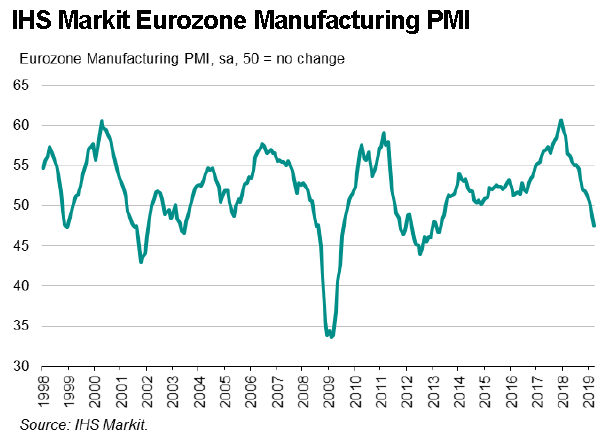
Manufacturing operating conditions in the eurozone deteriorated in March to the greatest degree for nearly six years, according to the latest PMI® data from IHS Markit. After accounting for seasonal factors, the IHS Markit Eurozone Manufacturing PMI posted a level of 47.5, down from 49.3 in February and its lowest level since April 2013. March marked a second successive month that the PMI has posted below the 50.0 no-change mark. (…)
The overall downturn was led by Germany, where operating conditions deteriorated to the greatest degree in over six-and-a-half years. Italy fared little better, with its PMI at a near six-year low. France returned to contraction, having recorded modest growth in the preceding survey period.
(…) orders books contracted to the greatest degree since the end of 2012. Export orders* were down at the sharpest rate since August 2012.
(…) production was increasingly used to serve existing orders, as evidenced by the greatest deterioration in work outstanding recorded by the survey since November 2012. Firms were also able to add to their warehouse inventories, which rose marginally in March for a sixth successive month.
The deteriorating picture for production and new orders showed signs of spilling over into the labour market during March. Although staffing levels rose compared to February, the increase was marginal and the weakest since November 2014. Net job losses were seen in both Germany and Italy. (…)
On the price front, input cost pressures continued to soften as indicated by the weakest rise in input prices for just over two-and-a-half years. A similar trend was seen for output charges, with inflation easing to the slowest since November 2016. (…)
The survey is indicative of output falling at a quarterly rate of approximately 1% in March, suggesting that the January rebound from one-off factors late last year seen in the latest official data is likely to prove short lived.
Looking at the forward-looking indicators, downside risks have intensified, and the trend could clearly deteriorate further in the second quarter. New orders are falling at a rate not seen since 2012, and disappointing sales mean warehouses are filling with unsold stock. The orders-to-inventory ratio – a key indicator of the future production trend – is at its lowest for almost seven years. Expectations of output for the coming year are also the gloomiest since 2012. (…)
Cost cutting has become more evident as firms grow more risk averse, notably with respect to hiring. (…)

Consumers’ Cautious Start to 2019 Trims Expectations for Growth American consumers barely increased their spending in January after a sharp pullback in December, adding to recent evidence the economy may have slowed after strong growth in 2018.
(…) Personal-consumption expenditures, a measure of household spending on everything from Netflix subscriptions to big-screen TVs, increased a seasonally adjusted 0.1% in January from the prior month, the Commerce Department said Friday. That was less than the 0.3% rise economists had projected, and it did little to recover lost ground after a 0.6% slump in December. (…)
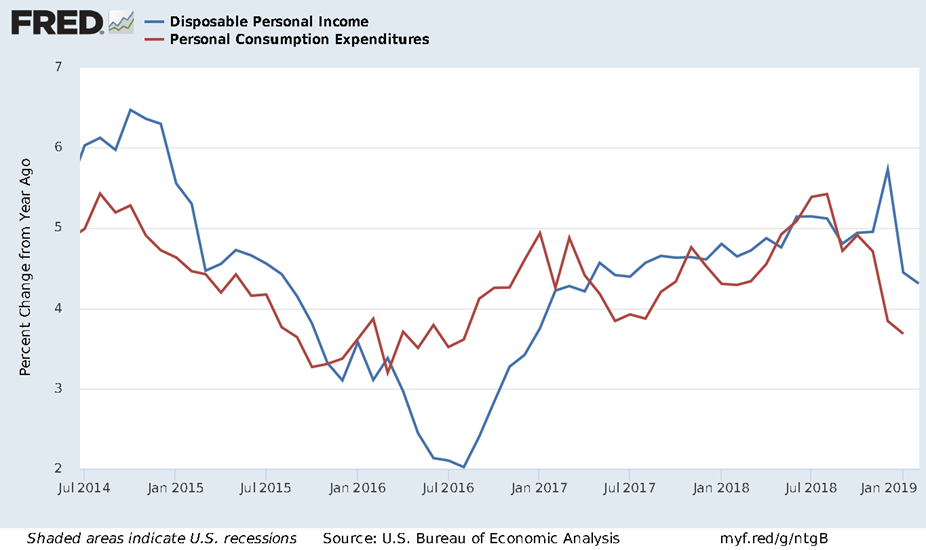
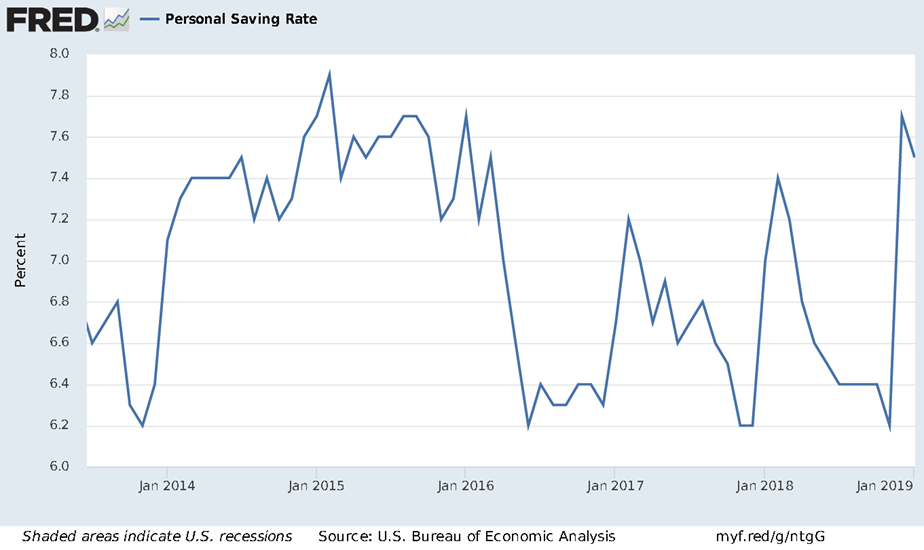
The shutdown has delayed expenditures data for February while also likely impacting actual spending from shutdown impacted Americans. The good news is that the Wages and Salaries component was up 0.3% in each of January and February after +0.5% in December. Last 3 months: +4.5% annualized when inflation is in the 1.8% range. The consumer has good purchasing power with rising labor income and good savings while inflation and interest rates are quiet.
U.S. Inflation Gauge Slid in January A key measure of U.S. inflation fell in January to its slowest pace since 2016, underscoring concerns about softening price pressures that have confounded policy makers at the Federal Reserve.
The Fed’s preferred inflation gauge, the price index for personal-consumption expenditures, fell 0.06% in January from December and was up just 1.37% from a year earlier, the smallest gain since September 2016, the Commerce Department said Friday.
Stripping out volatile food and energy components, the so-called core PCE price index rose 0.06% from December and 1.79% from January 2018, an 11-month low. (…)
Prices for services, which are less influenced by factors such as currency strength, commodity markets and trade than goods and have risen briskly in recent years, dropped 0.07% in January from December.
Canada’s economy posts strongest gain in 14 months, topping expectations
Statistics Canada reported Friday that real gross domestic product rose 0.3 per cent month over month, its biggest gain since November, 2017, and well above economists’ consensus estimate of 0.1 per cent. The gain represents a sharp rebound from the downturn that marked the end of 2018, in which GDP fell 0.1 per cent in each of November and December – prompting speculation in some quarters that Canada was sliding toward a recession.
The strong report prompted economists to upgrade their growth expectations for the first quarter and reduced the likelihood that the Bank of Canada will consider a rate cut in the near term. The Canadian dollar rose almost half a cent against its U.S. counterpart in reaction to the news, trading at 74.94 U.S. cents within a half-hour of the Statscan report. (…)
The upturn came despite a 4-per-cent slump in output from Alberta’s oil sands, after the province imposed production cuts effective Jan. 1 to address a serious glut. That was more than offset by widespread gains across the rest of the economy, as 18 of 20 sectors posted increases, led by strong rebounds in construction and manufacturing. (…)
Statscan said goods-producing sectors surged 0.6 per cent in the month, despite the downturn in oil output as well as mining production. Construction jumped 1.9 per cent, its first increase in eight months and its biggest one-month gain in more than five years. Manufacturing rose 1.5 per cent, reversing two months of declines.
Meanwhile, services-producing sectors rose 0.2 per cent, led by solid gains in wholesale trade, real estate and the financial sector. (…)
EARNINGS WATCH
With 498 companies in, Q4’18 earnings are up 16.9% on a +3.4% surprise factor. Revenues are up 5.1% (+0.5% surprise).
Trailing EPS are now $162.90, almost $1.00 above than analysts estimates of $161.93.
Corporate guidance worsened last week with 5 new negative pre-announcements and no new positives.

Earnings revisions also turned for the worse:
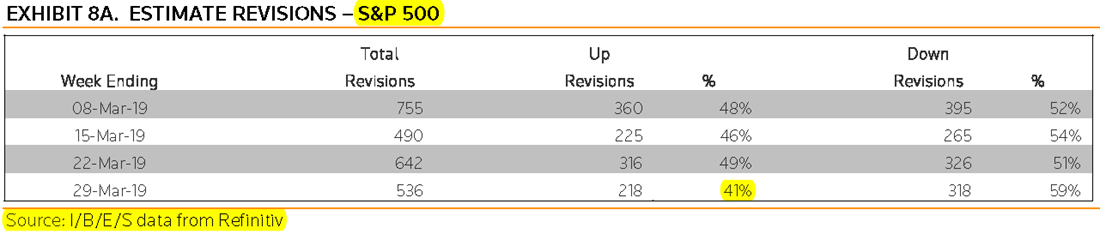
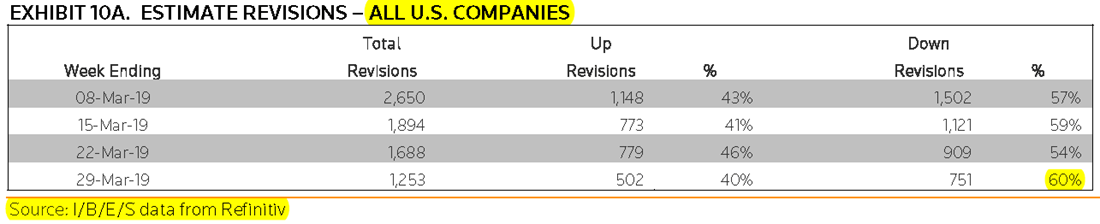
Factset illustrates the poor revisions in Q1:
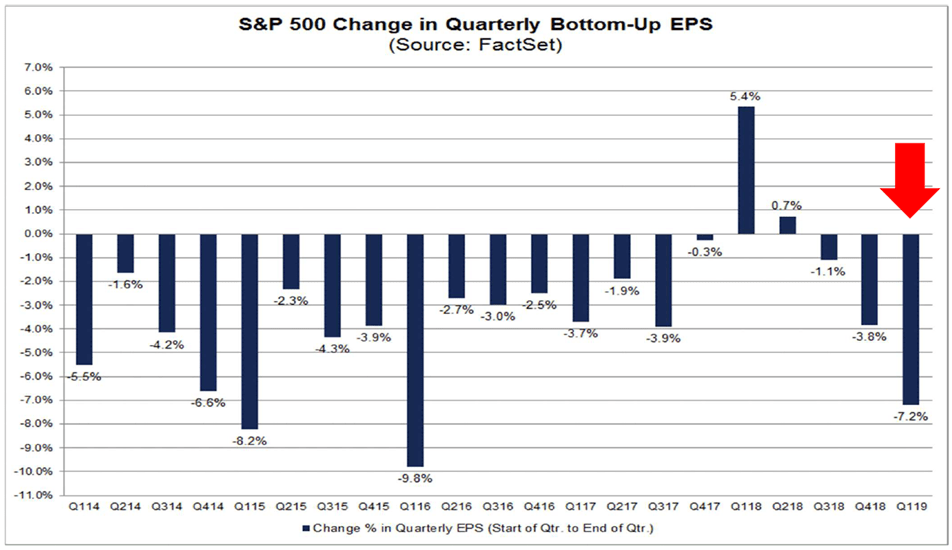
As Ed Yardeni shows, all sectors are negative in Q1 with Energy, Materials and IT getting hit the most:

The Rule of 20 P/E is 19.5, only 2.9% below its Fair Value of 2916.
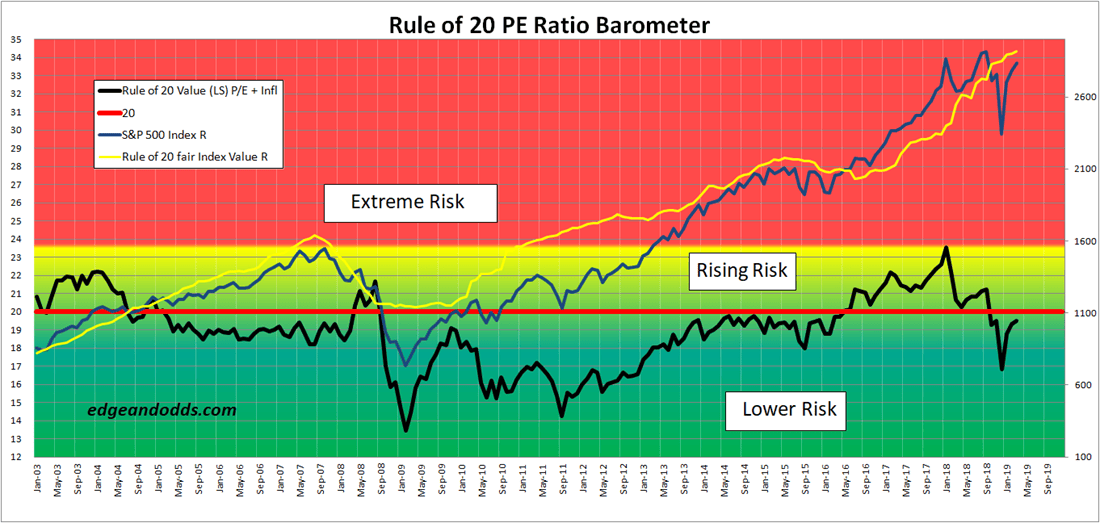
Analysts expect Q1’19 EPS to decline 1.9% YoY before resume growth in Q2. If so, and assuming unchanged inflation (2.1%), the Rule of 20 Fair Value will not provide much impetus until Q4’19 when earnings are expected to rise 8.9%.
Investors Push Into Stocks on the ‘Fear of Missing Out’ As the rally in stocks continues, powering major indexes toward last year’s records, investors say they are increasingly wary of missing out on further gains.
(…) After another weekly advance, the S&P 500 is up 13% for the year and sits just 3.3% below last September’s all-time high. Some analysts have been caught off guard by the durability of the early-year rally because S&P 500 companies are expected to report a nearly 4% drop in first-quarter earnings from a year earlier, according to FactSet. (…)
Despite downbeat earnings projections for the January-March quarter, some investors have already grown increasingly optimistic following the Fed’s cautious shift. After investors pulled money from U.S. stock mutual and exchange-traded funds at the start of the year, more than $25 billion flowed in during the week ended March 13, the largest weekly inflow in a year, according to EPFR Global.
Investors withdrew money from such funds again during the weeks ended March 20 and 27, but they still increased their allocation to both stock funds and stocks in February, according to an American Association of Individual Investors survey. More than 80% of active traders say it is a good time to invest in U.S. stocks, a Charles Schwab survey found. (…)