Small Business Job Growth Continues to Accelerate in August
We will get the BLS employment report Friday. Here’s IHS Markit’s Small Business Employment report:
National job growth continued to rise significantly in August, according to aggregated payroll data of approximately 350,000 clients provided by Paychex. The data released in the latest report of the Paychex | IHS Markit Small Business Employment Watch shows the Small Business Jobs Index gained 0.45 percent in August. At 99.80, the national index has increased 5.74 percent during the past 12 months, representing a record-high year-over-year growth rate. Hourly earnings growth increased to 3.42 percent in August, its third consecutive gain.
“The Small Business Jobs Index reached its highest level since January 2018,” said James Diffley, chief regional economist at IHS Markit. “The national index climbed 1.56 percent in the quarter to 99.80.” (…)
In further detail, the August report showed:
- Leisure and hospitality continued its recovery in August with its employment index surging to 101.90, up 14.61 percent since August 2020.
- Hourly earnings growth is up 8.36 percent since last year in leisure and hospitality.
- All regions of the U.S. had sizable employment gains in August. The South remains the leader in small business job growth.
Paychex business solutions reach 1 in 12 American private-sector employees, making the Small Business Jobs Index report an industry benchmark. The national jobs index uses a 12-month same-store methodology to gauge small business employment trends on a national, regional, state, metro, and industry basis.
National Wage Report
- Hourly earnings growth increased to 3.42 percent in August, its third consecutive increase. One-month annualized growth surpassed four percent for the fourth straight month, indicating stronger growth in recent months.
- Weekly earnings growth also improved in August, though only slightly (2.48 percent) with weekly hours worked continuing to slow.
- Weekly hours worked growth (-0.75 percent) has posted negative year-over-year growth since May.


 The most interesting part of the report is in the hourly wage data. The 12-m growth rate of 3.4% in August is up only slightly from +3.0% in January 2020, before the pandemic. But it reached +4.7% annualized in the last 3 months. All major industries are in sharp acceleration
12-Month Growth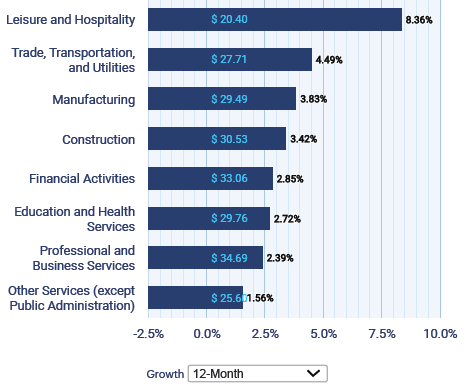
3-Month Annualized Growth
Jay Powell last Friday (my emphasis):
(…) if wage increases were to move materially and persistently above the levels of productivity gains and inflation, businesses would likely pass those increases on to customers, a process that could become the sort of “wage–price spiral” seen at times in the past. Today we see little evidence of wage increases that might threaten excessive inflation. Broad-based measures of wages that adjust for compositional changes in the labor force, such as the employment cost index and the Atlanta Wage Growth Tracker, show wages moving up at a pace that appears consistent with our longer-term inflation objective. We will continue to monitor this carefully.

Today:
- Walmart to hire 20,000 supply chain workers ahead of holiday season The average wage for supply chain workers would be $20.37 per hour, the statement added, which compares with the company’s announcement of $15.25 an hour average wage pay in February. (Reuters)
- Morgan Stanley boosted salaries for the second time in a month. Junior bankers will get $110,000, a mark that will now also cover first-year staff in the trading division, according to a person familiar. Meantime, Fidelity plans to hire 9,000 new workers across the U.S. by year-end. (Bloomberg)
- Wilcox, the owner of the childcare centers in New Orleans, increased hourly wages for all of her staff this spring, going from a range of $10 to $13 per hour to a range of $12 to $16. But she still hasn’t been able to fill all of her openings. (Reuters)
Europe’s Latest Inflation Surprise Maybe it’s time for a global response to a global problem.
By the WSJ Editorial Board
(…) As in the U.S. and United Kingdom, the usual suspects are emerging to argue eurozone inflation will be transitory. For Europe, these allegedly temporary factors are a shortage of agricultural labor, surging demand for services such as tourism, a temporary German consumption-tax cut last year setting a deceptive baseline, and so on.
A political problem for ECB President Christine Lagarde is that inflation isn’t evenly distributed across the eurozone. Prices rose 4.7% in Belgium, 3.4% in inflation-hawk Germany, and 2.7% in the Netherlands—but a below-target 1.3% in Portugal and 1.2% in Greece. Inflation is supposed to help southern European economies devalue their way to prosperity on the sly, yet the economies that have inflation are those where it’s most politically toxic. (…)
If inflation turns out to be persistent, Ms. Lagarde will need to abandon the ECB’s exceptionally loose policies. That includes the quantitative easing program of bond purchases that has become the ECB’s main tool for suppressing government borrowing costs. The ECB absorbed all of Italy’s net bond issuance in 2020, the Institute of International Finance estimates. Only this program—which may be inflationary—can shield Italy from the interest-rate ravages of more inflation.
Tuesday’s news underscores that the current burst of inflation is global. Monetary authorities increasingly seem to treat this as an excuse to keep current policies—“But Mom, everyone else is doing it!”—rather than a warning. No one wants to discuss whether central bankers should start coordinating an exit from their Covid crisis policies.
Instead they delay for fear of being the first mover, or they pretend they’re starting to tighten when they’re not. Expect Ms. Lagarde to take her turn at passing the hot potato of global monetary leadership. We had hoped this go-it-alone impulse would turn out to be transitory, but so far it is proving to be all too well-anchored.
(If you missed the EU inflation data yesterday, THE DAILY EDGE: 31 AUGUST 2021)

MANUFACTURING PMIs
Eurozone manufacturing growth slows to six-month low in August
The euro area manufacturing sector registered another marked expansion during August, latest PMI® data showed, although momentum waned once again as the headline index fell to a six-month low. The final reading of the IHS Markit Eurozone Manufacturing PMI for August of 61.4 was fractionally lower than the earlier ‘flash’ print of 61.5, and down from 62.8 in July. This marked a second successive month in which growth has slowed in the sector since June’s survey-record expansion.
All three sub-sectors registered sharp, albeit weaker, improvements in operating conditions over the month. Growth at investment goods makers continued to lead over consumer goods and intermediate goods producers, as has been the case in each of the past 12 months.
Of the monitored euro area constituents, the Netherlands once again saw the strongest improvement in manufacturing business conditions, despite growth here slowing to a five-month low. Softer expansions were also recorded in Germany, Ireland, Austria and France.
August survey data were particularly notable in Greece, which registered the highest reading in its Manufacturing PMI since April 2000. Meanwhile, Italy and Spain also observed accelerated expansions.
Goods production across the eurozone continued to expand in August, as has been the case in each month since July 2020. Although the pace of growth was the weakest in six months, it was still sharp overall and well above the historical average.
Supporting robust production schedules were continued improvements in demand for euro area goods. Total new orders increased for a fourteenth straight month in August, while new export business also grew at a marked rate. The Netherlands, Germany and Italy performed particularly well on the export front. However, the overall rate of growth in export demand across the eurozone lost momentum in August.
There were clear signs of strong capacity constraints at eurozone manufacturers as work-in-hand increased at a rate that was historically unmatched when compared to anything seen prior to March of this year. This came despite firms once again depleting inventories of finished goods from warehouses to fulfil orders.
To boost output capabilities, manufacturers added to their workforce numbers in August, continuing the employment growth trend which started in February and with the rate of job creation down only modestly from July’s all-time high.
Elsewhere, supplier delivery times lengthened to a considerable extent once again in August amid strong demand for production materials and inputs, though the rate of lengthening eased slightly further from May’s record. Latest data showed firms increasing their buying activity sharply during August. For the first time since January 2019, inventories of purchased items increased, albeit only mildly.
Meanwhile, price pressures remained stubbornly elevated midway through the third quarter. Input costs increased substantially once again amid ongoing supply chain issues and strong input demand. However, latest data showed the first slowdown in cost inflation since input prices started rising again in August 2020.
A similar trend was observed in output charges, where the rate of inflation remained historically steep after July’s survey high, but eased for the first time since January.
Lastly, euro area manufacturers recorded an optimistic outlook towards the next 12 months during August. The level of positive sentiment was strong, but eased for the second consecutive month to reach its lowest since November 2020.


China: Business conditions deteriorate slightly in August
Chinese manufacturers signalled a slight deterioration in business conditions in August, driven by a renewed drop in output and a further fall in new work. Panellists often stated that the resurgence of the COVID-19 virus at home and abroad had weighed on the sector’s performance. Restrictions to contain the virus also impacted supplier performance, which deteriorated solidly, while shortages led to steeper rises in cost burdens and prices charged. At the same time, subdued market demand led firms to trim their purchasing activity and payroll numbers slightly.
The headline seasonally adjusted Purchasing Managers’ Index™ (PMI™) posted below the neutral 50.0 level at 49.2 in August, down from 50.3 in July, to signal a deterioration in the health of the sector. Though only marginal, it was the first time that business conditions had worsened since April 2020, with the index dipping to its lowest level for a year-and-a-half.
Chinese goods producers recorded the first fall in output since February 2020 in August. Survey respondents frequently mentioned that the recent uptick in COVID-19 cases and subsequent restrictions had impacted production, dampened demand and led to greater difficulties sourcing inputs.
Total new work fell for the second month in a row and, though only mild, the reduction was the fastest seen since April 2020. Panellists commented on relatively muted demand both at home and overseas amid a resurgence of the COVID-19 pandemic. New export orders declined for the first time since February, albeit modestly.
Companies registered a fractional fall in employment during August, after payrolls were broadly unchanged in July. Some firms mentioned reducing their staff numbers due to reduced output requirements. Consequently, backlogs of work increased again, and at the fastest rate since May.
Lower production requirements led to a renewed fall in purchasing activity in August. That said, the rate of decline was only marginal. At the same time, stocks of purchased items fell for the second month in a row. Inventories of finished goods meanwhile rose for the first time in six months, albeit only slightly, as some firms cited difficulties in shipping goods to clients and muted sales.
Supplier performance deteriorated again in August. Lead times increased to the greatest extent since February and solidly overall, as firms reported logistical delays due to the pandemic and relatively low stock levels at vendors.
Higher raw material prices and greater transportation costs drove a further marked rise in overall input prices. The rate of cost inflation picked up for the first time in three months and was sharp overall. At the same time, factory gate prices rose only modestly, despite the rate of increase picking up since July. Some surveyed manufacturers said demand was sluggish due to the pandemic and their ability to pass rising costs onto clients was limited.
Business confidence remained strong overall, albeit with the overall degree of optimism unchanged from July’s 15-month low. Concerns over how long the pandemic will take to be brought under control globally weighed on overall sentiment.


ASEAN: Manufacturing downturn continues into August
The ASEAN manufacturing sector remained in a downturn during August, according to the latest IHS Markit Purchasing Managers’ Index (PMI™) data, as rising COVID-19 cases and lockdown measures continued to impact the sector. Operating conditions declined sharply again amid further rapid falls in factory production and new orders, while sentiment among goods producers towards output over the year ahead slipped to a 13-month low.
The headline PMI posted 44.5 in August, down slightly from July’s reading of 44.6, to signal a third straight monthly deterioration in the health of the ASEAN manufacturing sector and one that was sharp overall.
For the first time since May 2020, each of the seven constituent nations recorded deteriorations in conditions during August. The steepest pace of contraction was seen in Myanmar, where the PMI (36.5) remained among the lowest on record. This was followed by Vietnam, where the headline index (40.2) fell to the lowest since April 2020 amid the ongoing COVID-19 outbreak.
Elsewhere, sustained deteriorations were recorded in Malaysia and Indonesia, although both saw the rates of decline ease from July. Nonetheless, the latest PMI readings of 43.4 and 43.7, were indicative of sharp deteriorations in the health of the respective manufacturing sectors.
Renewed contractions were meanwhile registered in Singapore and the Philippines. In the former, the headline index (44.3) moderated noticeably from July’s more than eight year high, and sunk to the lowest since last September. In the Philippines, the latest reading (46.4) signalled the first deterioration in conditions since May and one that was the sharpest for 15 months.
Finally, Thailand’s PMI dipped further below the 50.0 mark in August. At 48.3, the latest reading signalled the quickest rate of decline for three months, but one that was only marginal.
Overall, the ASEAN manufacturing sector remained firmly in contraction territory in August. Output and new orders fell for the third straight month, with the rates of decline little-changed since July and among the strongest on record, reflecting ongoing challenges posed by the reintroduction of stricter containment measures. Foreign demand also weakened during August, as new export orders decreased for the third month in a row and markedly, although the rate of reduction did ease since July.
As a result, ASEAN goods producers pared back on their purchasing again in August, extending the current sequence of declining buying activity which began in June. The rate of reduction was marked, despite slowing on the month. Subsequently, inventories declined further. Nonetheless, supply chain disruption remained substantial. Although delays were slightly less severe than in July, lead times for inputs lengthened to one of the greatest degrees on record.
Meanwhile, goods producers continued to trim their workforces in August, extending the current sequence of falling employment which began in June 2019. The rate of job shedding eased on the month, but was still strong overall. August data also highlighted sustained capacity pressures, as backlogs of work rose at a series record pace.
Inflationary pressures also remained elevated. Input costs increased markedly again, with firms raising their average charges at an accelerated pace as a result.
The continued downturn also weighed on business confidence during August. Although still optimistic overall, the level of positive sentiment towards output over the next year dipped to the weakest since June 2020 and was historically muted.

Japan: Softer expansion in manufacturing output inAugust
The Japanese manufacturing sector registered a slightly softer improvement in operating conditions in August, according to the latest PMI® data. Firms reported slower expansions in both production and incoming business, with the latter increasing at the softest pace since January. Manufacturers often noted that rising COVID-19 cases both domestically and in South East Asia had dampened output and demand. As such, new export orders saw a renewed decline, the first since the start of the year. At the same time, supply chain disruption continued to hamper manufacturing activity across Japan, as firms noted the strongest deterioration in average lead times since the 2011 earthquake and tsunami.
At 52.7 in August, the headline au Jibun Bank Japan Manufacturing Purchasing Managers’ Index™ (PMI) dipped from 53.0 in July. This indicated a softer improvement in the health of the sector, reflecting the continued impact of the COVID-19 pandemic on the Japanese manufacturing sector.
The lower reading in the headline index was partly the result of a softer rise in output levels. Production increased for the seventh successive month, though growth eased to a marginal pace overall. Firms linked ongoing growth to a sustained rise in new orders, though noted that a surge in COVID-19 cases and lack of raw materials and hindered production.
New orders also rose in the latest survey period, though the pace of expansion was the weakest recorded since January. According to anecdotal evidence, client confidence was dampened by the extension of virus restrictions in domestic and international markets. Moreover, new export sales fell into contraction territory for the first time since the start of the year as COVID-19 cases rose across the Asia-Pacific region.
More positively, employment rose for the fifth month running in August. The rate of job creation quickened from July and was the fastest recorded since January 2020. Firms noted that headcounts were increased in preparation for higher production requirements.
Reflecting increased new orders, outstanding business rose for the sixth successive month. Manufacturers commented that a lack of raw materials had disrupted the ability to complete existing orders.
In line with slowing growth of output and new orders, buying activity rose at the softest pace in the current six-month sequence of growth. Japanese manufacturers noted ongoing difficulties in sourcing and receiving inputs due to material shortages and global COVID-19 restrictions, as evidenced by supplier delivery times lengthening to the greatest extent since April 2011. As a result, businesses reported that orders were fulfilled using existing stocks of finished goods.
There were continued reports that rising raw material prices placed further pressure on average cost burdens at Japanese goods producers during August. Input prices have now risen in each of the last 15 months and, while the rate of inflation softened from July, it remained rapid overall. Output prices meanwhile increased for the ninth consecutive month, and at the quickest pace since October 2018 as firms sought to partially pass on higher costs to clients.
Finally, business confidence regarding activity over the coming 12 months eased in August. Sentiment was positive overall, but at its lowest level for seven months as firms cited uncertainty regarding the duration of the pandemic. Nonetheless, manufacturers were confident that a broad-based recovery would occur once the pandemic subsided.

U.S. Home-Price Growth Rose to Record in June The Case-Shiller index rose 18.6% in the year that ended in June, as robust demand continued to outpace the number of homes on the market.
(…) Active listings in the four weeks ended Aug. 22 were up 16% from their recent low in the four weeks ended in March but still down 23% from a year earlier, according to real-estate brokerage Redfin Corp. (…)
Pending home sales fell 1.8% during July (-8.5% y/y) following a 2.0% June decline, revised from -1.9%. The Realtors Association reports that purchases continue to be restrained by a limited supply of homes for sale.
The July sales decline was largest in the Northeast where sales fell 6.6% (-16.9% y/y) after improving 0.5% in June. Sales in the Midwest weakened 3.3% (-8.5% y/y) after a 0.5% June increase. In the South, sales eased 0.9% last month (-6.7% y/y) following a 3.2% drop in June. To the upside, sales in the West improved 1.9% (-5.7% y/y) after falling 4.0% in June.

Redfin’s Key housing market takeaways for 400+ U.S. metro areas
Through August 22:
- Pending home sales were up 10% year over year. Pending sales were down 6% from their 2021 peak during the four-week period ending May 30.
- New listings of homes for sale were nearly flat (+1%) from a year earlier. The number of homes being listed is in a typical seasonal decline, down 9% from the 2021 peak during the four-week period ending June 27.
- Active listings (the number of homes listed for sale at any point during the period) fell 23% from 2020—the smallest decline since the four-week period ending September 20, 2020. Active listings are up 16% since their 2021 low during the four-week period ending March 7, but have declined 1% from their 2021 peak during the four-week period ending August 8.
- 49% of homes that went under contract had an accepted offer within the first two weeks on the market, above the 44% rate during the same period a year ago, but down 8 percentage points from the 2021 peak, set during the four-week period ending March 28.
- 35% of homes that went under contract had an accepted offer within one week of hitting the market, up from 32% during the same period a year earlier, but down 8 percentage points from the 2021 peak during the four-week period ending March 28.
- Homes that sold were on the market for a median of 18 days, up from the all-time low of 15 days seen in late June and July, and down from 34 days a year earlier.
- 52% of homes sold above list price, up from 32% a year earlier. This measure has been falling since the four-week period ending July 11 when it peaked at 55%.
- On average 5.1% of homes for sale each week had a price drop, up 1.5 percentage points from the same time in 2020, and the highest level since the four-week period ending October 13, 2019.
- The average sale-to-list price ratio, which measures how close homes are selling to their asking prices, decreased to 101.6%. In other words, the average home sold for 1.6% above its asking price. This measure is down 0.6 percentage points from its peak during the four-week period ending July 11 and up 2.5 percentage points from a year earlier.
- From January 1 to August 22, home tours went up 11%, compared to a 30% increase over the same period last year according to home tour technology company ShowingTime.
- During the week ending August 22, the seasonally adjusted Redfin Homebuyer Demand Index—a measure of requests for home tours and other services from Redfin agents—edged up slightly from the previous week to its highest point since the week ending April 11, and was up 20% from a year earlier.
Lots of charts here.
China Evergrande Warns of Possible Default Cash-strapped real-estate developer posts 29% drop in profit for first half of this year
Cash-strapped China Evergrande Group said work has been suspended on some of its real-estate projects after it delayed payments to its suppliers and contractors, showing how the developer’s financial troubles have spilled over into its business operations.
The highly indebted company on Tuesday also warned for the first time that it may default on its borrowings if it can’t resolve its liquidity problems. (…)
The company’s core property business lost $634 million during the period after it sold many apartments at heavily discounted prices. Evergrande said the average delivered price of its apartments fell 11.2% from a year ago, and revenue from property development declined nearly 19%. (…)
The Shenzhen-based group said it had the equivalent of about $88 billion in borrowings at the end of June, 42% of which come due in less than a year. It disposed of $2.2 billion worth of assets in the first half. (…)
The EV business, China Evergrande New Energy Vehicle Group Ltd., a day earlier warned that its plans to start mass producing cars might be delayed if it can’t raise additional capital in the short term. Its shares have plummeted nearly 80% in the year-to-date, giving the company a market capitalization of about $7.4 billion.
The company, which once had ambitions of rivaling Tesla Inc., said its loss for the six months to June more than doubled from a year ago, and it reported just $5.7 million in revenue from its new energy vehicle division. Like its parent, the business has also delayed payments to some suppliers and contractors, and is at risk of defaulting on its loans, it said.
Did you know that?
China’s home ownership rate was 90% in 2020, far higher than the global average of 69%, which makes it difficult for cities to contain price increases and speculation in the market, according to Li. In Germany, the rate was only 43%, while 57% of households lived in rented houses, he said. China needs to create an effective rental market, he added. (Bloomberg)
Desperately searching equity weakness
There is an emerging divergence between the broad market and the popular averages. The chart shows the Value Line Arithmetic Composite Index, which consists of about 1700 equally weighted stocks, has flattened out for months, while the popular averages have continued to surge, led by a few large-cap growth names. Similarly, the Russell 2000 Index has also stalled this year, with the index having gone literally sideways. It is not immediately clear whether the Russell 2000 has any predictive power for SPX, but what is clear is that the divergence between the two indices for nearly nine months is rare. The last time such a sustained divergence occurred was in the second half of the 1990s when the technology mania was running amok.

Google, Apple Hit by Law Ending Dominance Over App Payments The companies will have to open their app stores to alternative payment systems in South Korea under newly passed legislation there, threatening their lucrative commissions on digital sales.
Didi and JD.com workers get unions in watershed moment for China’s tech sector
Chinese ride-hailing giant Didi Global Inc (DIDI.N) has set up a union for its staff while e-commerce powerhouse JD.com (9618.HK) has also established one – landmark moves in the country’s tech sector where organised labour is extremely rare.
Regulators in China have come down hard on its biggest technology firms this year, criticising them for policies that exploit workers and infringe on consumer rights in addition to unleashing a slew of anti-trust probes and fines.
The government is also encouraging companies to implement initiatives to share wealth as part of a recent “common prosperity” drive laid out by President Xi Jinping to ease inequality in the world’s second-largest economy.
Didi’s union, announced on an internal forum last month, will be initially managed by employees at its Beijing headquarters and will be guided by the government-backed All China Federation of Trade Unions (ACTFU), said two people familiar with matter. (…)
Didi and JD.com are believed to be the biggest tech firms to date to have established company-wide unions, though authorities in the county of Shishou in China’s Hubei province said in June that local subsidiaries of Meituan (3690.HK) and Alibaba’s (9988.HK) Ele.me had established unions. (…)
COVID-19
- Two-Thirds in U.S. Now Say COVID-19 Situation Worsening The percentage of Americans who say the coronavirus situation in the U.S. is getting worse has surged to 68% from 45% in July and 3% in June.
- A third dose of Pfizer/BioNTech’s COVID-19 vaccine provides a 70+% reduction in the risk of infection, according to study of Israeli data. The study, which has not yet been peer-reviewed, did not look at the issue of severe disease. More time is needed for that, the researchers said. Fortune

Data: Google Trends. Chart: Jared Whalen/Axios