CPI for all items rises 1.0% in May; shelter, gasoline, food indexes rise In May, the Consumer Price Index for All Urban Consumers rose 1.0 percent, seasonally adjusted, and rose 8.6 percent over the last 12 months, not seasonally adjusted. The index for all items less food and energy increased 0.6 percent in May (SA); up 6.0 percent over the year (NSA).
FIVE BUCKS!
The spike gas prices in March-July 2008 totally broke the consumer for over one year.
![image_thumb[6]](https://i0.wp.com/www.edgeandodds.com/wp-content/uploads/2022/06/image_thumb6.png?ssl=1 "image_thumb[6]")
That would be really untimely:
![image_thumb[8]](https://i0.wp.com/www.edgeandodds.com/wp-content/uploads/2022/06/image_thumb8.png?ssl=1 "image_thumb[8]")
FYI, retail inventories were up 5.0% in mid-2000 and +2.5% YoY in March 2008. They are now up 17.2%. Imagine a consumer strike during an inventory liquidation period by over-staffed merchants!
U.S. Jobless Claims Rise Above Prepandemic Average Workers filed 229,000 jobless claims last week, the largest total since January, adding to signs the labor market could be cooling a bit.
Initial jobless claims, a proxy for layoffs, increased by 27,000 to 229,000 last week from the previous week’s revised level of 202,000, the Labor Department said Thursday. Claims had been at or below the 2019 average of 218,000 since late January.
The four-week average of new claims, which smooths volatility in the weekly figures, also rose slightly to 215,000 last week. That figure hasn’t decreased since early April.
Continuing claims, a proxy for the total number of people receiving payments from state unemployment programs, remained at 1.3 million in the week ended May 28—the lowest point since December 1969. Continuing claims are reported with a one-week lag.
Recent claims increases can be attributed to seasonal factors being thrown off balance because of the Covid-19 pandemic, Ian Shepherdson, chief economist at Pantheon Macroeconomics, wrote in a note. Memorial Day also fell on Monday last week, shortening the number of workdays. Claims figures can be more volatile around holidays. (…)
 (Bespoke)
- The Great Resignation has seen workers of all stripes leave their jobs. But millennials are proving particularly flighty. About two-thirds of bosses say that generation has the highest turnover in their companies, according to a survey of 72 execs whose firms employ about 400,000 staff by WorkJam. By comparison, just 4% said Gen X, who’re in their 40s and 50s, are the biggest quitters.

China’s Inflationary Pressures Stay Muted Inflation remained benign in China as Covid-19 lockdowns hammered domestic demand, leading economists to forecast that policy makers may ramp up stimulus to boost economic growth and employment.
Consumer inflation continued low in May, the National Bureau of Statistics reported Friday, with prices up 2.1% from a year earlier, matching April’s rate. (…)
The producer-price index, which gauges factory-gate prices, was up 6.4%, easing from April’s 8%, as commodity rallies tamed. (…)
While the war in Ukraine has pushed global grain and energy prices higher, weak consumer spending on travel and entertainment helped keep China’s consumer inflation steady, an official with the NBS said. A cooling rally in commodities such as coal and nonferrous metals helped pull back factory-gate inflation, which last October was running at the fastest pace in 26 years. (…)
The WSJ did not bother to tell us the key core figure but Bloomberg has it:
Core inflation, which removes the more volatile food and energy prices, rose 0.9%, unchanged from April.

ECB Plans July Rate Increase as Inflation Problem Deepens The European Central Bank laid out plans to increase rates for the first time in more than a decade, joining many of its peers in raising borrowing costs to tackle persistent inflation that is spreading far beyond the U.S.
The ECB’s policy shift, about a year after eurozone inflation rose above its 2% target, would help to narrow the gap with the Federal Reserve, which has increased interest rates twice since March to a range between 0.75% and 1%. (…)
But unlike the Fed, the ECB needs to worry as it raises rates about how higher borrowing costs will pressure fragile and highly indebted southern European economies like Italy and Spain, whose sovereign debt sold off after the ECB’s rates decision.
The ECB said in a statement that it intends to raise its key rate by a quarter percentage point at its next policy meeting in July to minus 0.25%, and increase it again in September, possibly by a larger amount. The bank will also end its large-scale bond-buying program on July 1. After September, the ECB said it expects a series of further gradual rate increases. (…)
“It’s not just a step, it’s a journey,” [Lagarde] added. (…)
Under the ECB’s plans, the bank’s key rate would rise to zero or higher after its Sept. 8 policy meeting, exiting negative territory for the first time in eight years.
As part of its balancing act aimed at partly shielding fragile economies from rising borrowing costs, the ECB is expected to hold on to all of its mammoth portfolio of sovereign debt, unlike the Fed. The ECB’s balance sheet has almost doubled to about €8.8 trillion, equivalent to $9.39 trillion, since the start of the pandemic, swollen by large-scale bond purchases and cheap loans to households and companies.
Ms. Lagarde said the ECB would act to avoid “fragmentation” of its monetary policy—a code word that indicates the bank is ready to buy the debt of fragile eurozone governments like Italy’s, if needed, to avoid what it considers an undue increase in market rates.
Investors were unimpressed by the lack of details about a possible new bond-buying tool, dumping southern European debt. The yield on the benchmark 10-year Italian bond rose to 3.628%, the highest level since 2018, and the equivalent German bund yield rose to the highest level since 2014 at 1.461%, before both eased down moderately.
(…) Ms. Lagarde warned that inflation had spread to three-quarters of the items that the ECB tracks, and would remain elevated for some time. (…)
Ms. Lagarde pointed to a pickup in eurozone wages and a rapid recovery in sectors such as hospitality and tourism, which is fueling price increases. While Europe’s inflation problem “is largely, and certainly much more so than in the U.S., for instance…imported inflation” rather than a sign of overheating demand, inflation is also spreading more broadly, she said. (…)
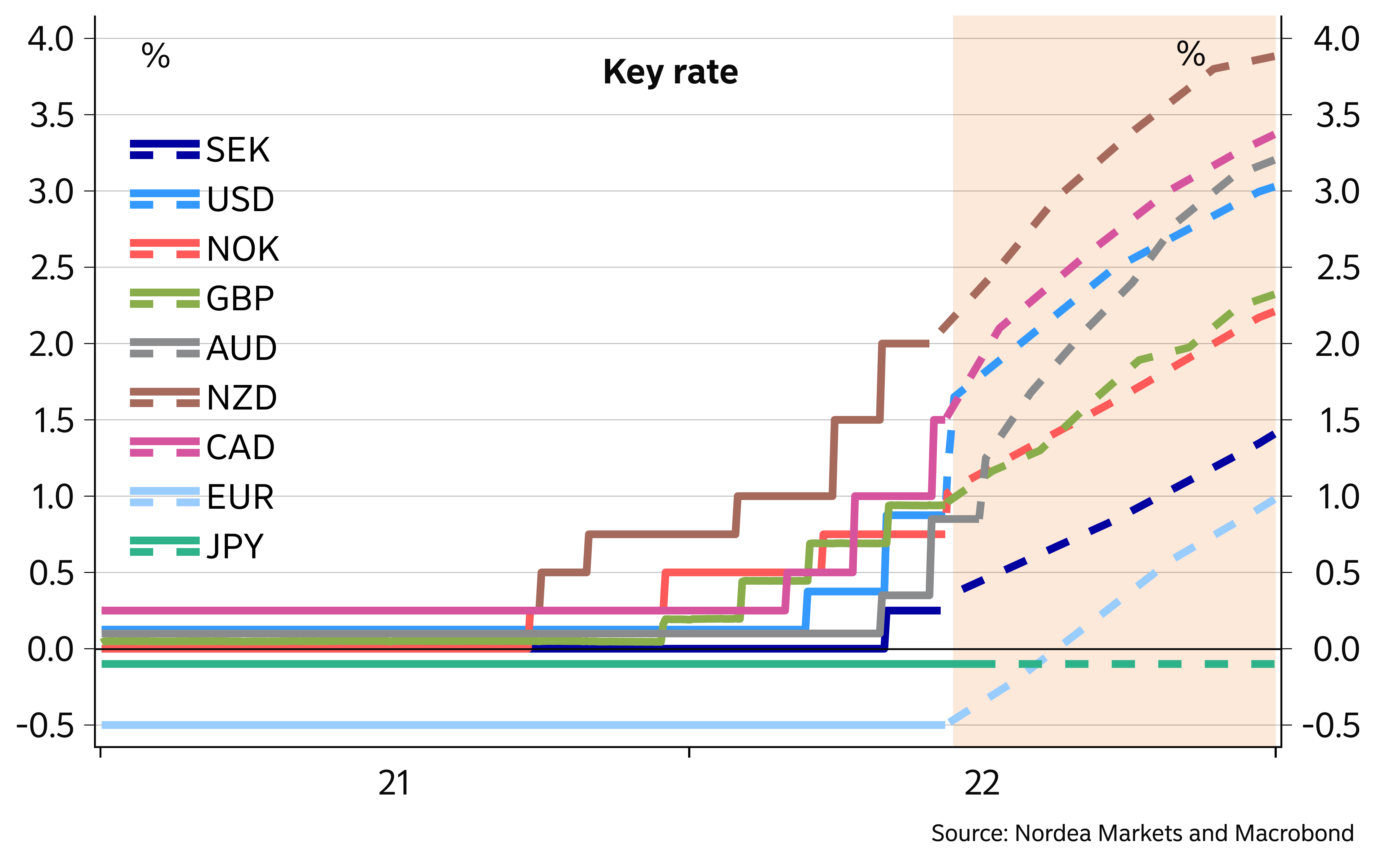
(…) It’s not only the Fed and the ECB that see 50bp as the new normal for now among G10 central banks. The Reserve Bank of Australia hiked its key rate this week by 50bp to 0.85% – and markets see a similar move at its next meeting in July. The Bank of Canada has hiked twice by 50bp and is expected to hold the same course until year-end. New Zealand has also already hiked twice by 50bp and is expected to hold that course until year-end at which point the key rate should rise to around 4% and be the highest among G10 currencies – see chart 1. The one major central bank that won’t hike rates in the foreseeable future is the Bank of Japan. (…)
Most G10 central banks are in a rush to hike rates – OIS pricing ahead
Looking until year-end, we see a lower EUR/USD since we expect the Fed to out-hawk the ECB. Moreover, the economic risks are highly tilted downwards in the energy importing Euro area, which could cast doubts on the ECB’s ability to hike interest rates as much as markets expect now. Meanwhile, the outlook for the energy-exporting US economy remains solid.
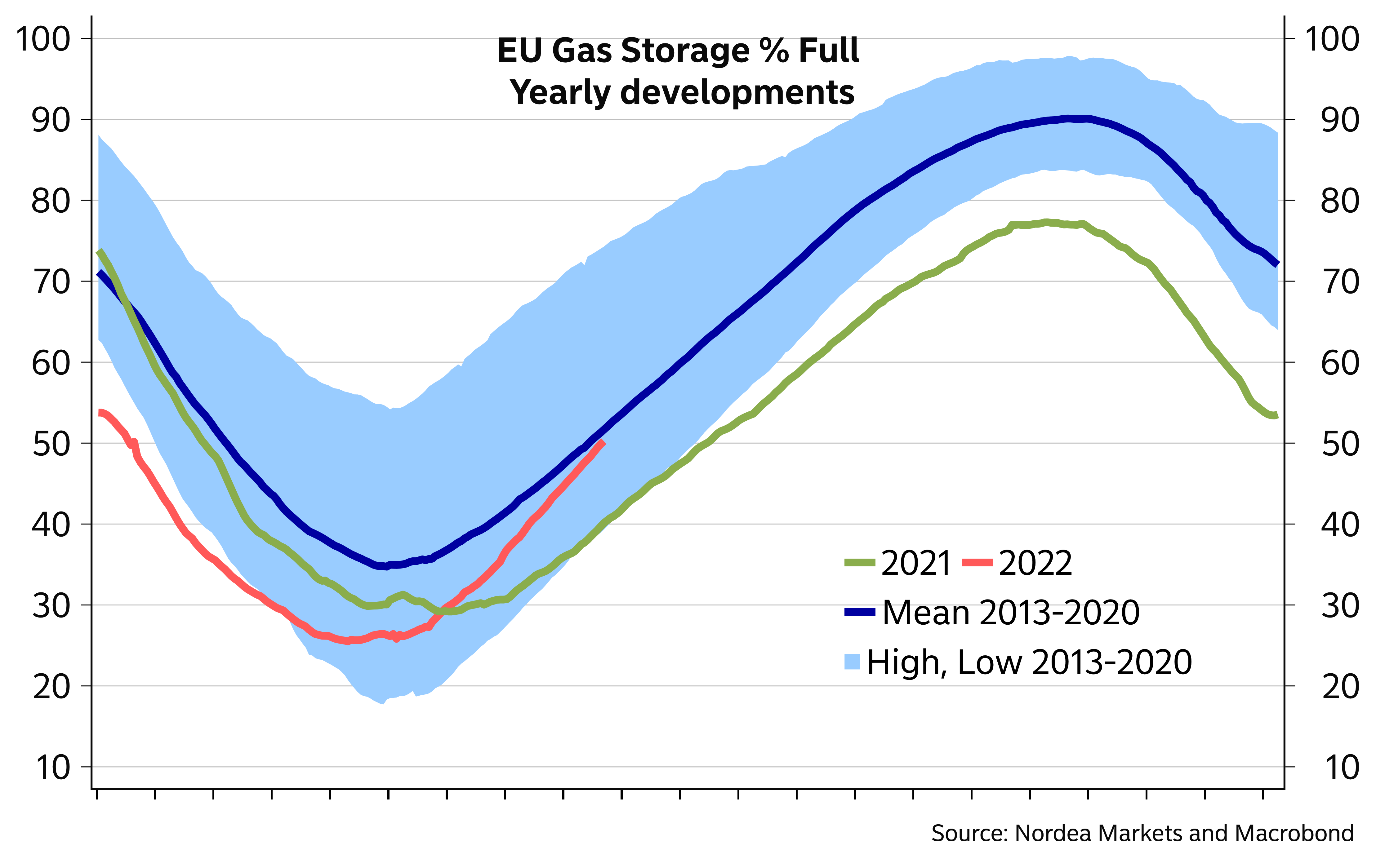
The energy-rationing theme in Europe is barely starting to get traction among rates and FX markets. Markets are still not pricing in this risk, likely because of better gas inventories in Europe compared to last year. Yet, there is little that could help Europe if Russia decides to materially cut the gas over the upcoming winter. Except perhaps a really mild winter, which would reduce the need for heating, but the latest meteorological models suggest that we won’t be that lucky with La Niña predicted to continue this winter.
We see this and continued volatility in financial markets materialising in a stronger USD ahead. That said, the primary risk to our view is that risk sentiment improves and/or if the energy crisis view does not materialize in Europe. (…)
CIBC Ramps Up Canada Banks’ Hunt for Staff With Wage Pledge
The lender’s minimum wage will rise to C$20 per hour in Canada and $20 in the US in July, and the bank is committing to raise those figures to C$25 and $25 by the end of 2025, according to a statement from Chief Executive Officer Victor Dodig on Thursday. The bank is also providing a 3% raise for workers in the six lowest levels of its pay scale next month. (…)
The bank’s minimum entry wage for merit-based pay team members is currently C$17. (…)
Royal Bank of Canada said last month that it would spend more than C$200 million on pay increases, benefits and other incentives to retain workers. The bank is raising base salaries by 3% in the four lowest levels of its pay scale, accounting for almost half of its workforce.
Bank of Nova Scotia is raising pay for workers in assistant manager roles and below, representing half of its Canadian employees, by 3% as of June 20. The increase, announced to employees last month, is in addition to regular year-end salary adjustments.
Bank of Montreal in October said it was raising its minimum wage for US branch and contact-center employees to $18 an hour, a 20% bump. (…)
Bank of Canada Sees Housing-Market Slowdown as ‘Healthy’
Macklem, speaking Thursday after the release of the central bank’s annual report on financial stability, argued home-price gains during the pandemic were unsustainable and produced vulnerabilities among new buyers who were forced to take on extremely high levels of debt.
“The economy can handle — indeed needs — higher interest rates,” Macklem said in an opening statement to reporters. “Moderation in housing would be healthy.” (…)
Canadians who purchased homes recently would be “more exposed” in the event of a correction, according to the 57-page report. Many households stretched themselves financially to get into the housing market, which saw price gains of nearly 50% since the beginning of the pandemic.
“If the economy slowed sharply and unemployment rose considerably, the combination of more highly indebted Canadians and high house prices could amplify the downturn,” Macklem told reporters, adding it could have “broad” implications for the economy and financial system. (…)
The central bank estimated the share of new mortgages this year going to highly indebted households — those carrying loan to income ratios above 450% — has surpassed pre-pandemic levels to hit new records.
Druckenmiller Warns ‘Bear Market Has a Ways to Run’ as Fed Hikes Rates
“My best guess is that we’re six months into a bear market,” Druckenmiller, who runs Duquesne Family Office, said Thursday at the 2022 Sohn Investment Conference. “For those tactically trading, it’s possible the first leg of that has ended. But I think it’s highly, highly probable that the bear market has a ways to run.” (…)
The catalyst for additional losses is that the Federal Reserve has turned aggressive about tackling the highest inflation in decades. That will likely lead to a recession at some point in 2023, Druckenmiller said.
About a year ago, he said the central bank’s policy was totally inappropriate and that “we are in a raging mania in all markets.” (…)
Because US Treasury yields are so much lower than inflation, he said he’s not confident bonds will hold up in a downturn as they have in the past. So he’s largely taking a break from trading for now. (…)
He also said he’s looking to bet against the dollar sometime in the next six months.
“If you’re predicting a soft landing, it’s going against decades of history,” he said.
Greenlight Capital’s David Einhorn, appearing at the same conference, said inflation is the big problem and that it’s likely to persist, in part because of under-investment in things such as cement, housing, mining oil and paper.
 Retail loves splits Retail participation in AMZN shares jumped post stock split

JPM via The Market Ear
Business Losses From Russia Top $59 Billion Nearly 1,000 Western companies plan to leave the country or cut back operations, with more write-downs expected as sanctions hit.