Trump to Propose Steps to Ease Economic Fallout From Coronavirus President Trump said the administration would discuss with Congress several measures to ease the economic pain inflicted by the coronavirus, including a possible payroll-tax cut and help for hourly wage earners.
Virus Update
Cases surpass 113,000 worldwide; deaths exceed 3,900
South Korea’s health ministry confirmed 131 more coronavirus cases in the nation, raising the total to 7,513, according to a statement. The number continues a declining trend since March 6. Total deaths in the country rose to 54 from 51 previously.
Italy became the first country to attempt a nationwide lockdown as cases topped 9,000 overnight.
Iran, the epicenter of the outbreak in the Middle East, on Monday reported 595 infections and 43 deaths. Overall, 7,161 cases have been reported so far in the country and 237 people have died.
Only 4,384 people in the U.S. have been tested for the new coronavirus, nearly two weeks after the disease was found to be spreading across America, according to the Atlantic. “The lack of testing means that it is almost impossible to know how many Americans are infected with the coronavirus and suffering from Covid-19, the disease it causes,” the Atlantic wrote.
Vietnam confirms 33rd coronavirus patient, a 58-year-old British man who was on board Vietnam Airlines Flight 0054 that landed March 2 in Hanoi from London, Ministry of Health says on its website.
The Philippines, with a population of more than 100 million, had only 2,000 coronavirus test kits available earlier this week as the number of infections jumped. Its government once had 4,500 kits in stock, but the number dwindled to 2,000 by Monday as the number of people who wanted to be diagnosed surged. Confirmed cases in the Southeast Asian nation had increased to 33 on Tuesday.
China reported 19 additional coronavirus cases as of March 9, according to a statement from the National Health Commission, bringing the total number of infections to 80,754. The new cases are the lowest since Jan. 18.
The head of DHL owner Deutsche Post AG played down the impact of the coronavirus, saying he’s optimistic about the outlook and that China appears to be staging a recovery from the outbreak. “When I talk to our colleagues in China they say it is getting better every day,” Chief Executive Officer Frank Appel told Bloomberg TV in an interview on Tuesday. “There are encouraging signs, even if it’s not over.”

Source: Oxford Economics (via The Daily Shot)


The Virus is a Time Machine
This next chart suggests that the initial phases of the coronavirus outbreaks appear to be relatively similar in China, Italy, South Korea and Iran. By Day 40 in China, the worst of the outbreak is behind them. If so, we are looking at end of March-early April for the U.S..

-
Seattle’s Patient Zero Spread Coronavirus Despite Ebola-Style Lockdown First known U.S. case offers lessons in how and how not to fight the outbreak.
The man who would become Patient Zero for the new coronavirus outbreak in the U.S. appeared to do everything right. He arrived Jan. 19 at an urgent-care clinic in a suburb north of Seattle with a slightly elevated temperature and a cough he’d developed soon after returning four days earlier from a visit with family in Wuhan, China.
The 35-year-old had seen a U.S. Centers for Disease Control and Prevention alert about the virus and decided to get checked. He put on a mask in the waiting room. After learning about his travel, the clinic drew blood and called state and county health officials, who hustled the sample onto an overnight flight to the CDC lab in Atlanta. The patient was told to stay in isolation at home, and health officials checked on him the next morning.
The test came back positive that afternoon, Jan. 20, the first confirmed case in the U.S. By 11 p.m., the patient was in a plastic-enclosed isolation gurney on his way to a biocontainment ward at Providence Regional Medical Center in Everett, Washington, a two-bed unit developed for the Ebola virus. As his condition worsened, then improved over the next several days, staff wore protective garb that included helmets and face masks. Few even entered the room; a robot equipped with a stethoscope took vitals and had a video screen for doctors to talk to him from afar.
County health officials located more than 60 people who’d come in contact with him, and none developed the virus in the following weeks. By Feb. 21, he was deemed fully recovered. Somehow, someone was missed. (…)
On Jan. 15, when the traveler to Wuhan who became the first known U.S. case returned to Seattle-Tacoma International Airport, he took group transportation from the airport with other passengers, county officials have said. (…)
Some researchers who’ve traced the viral genomes of patients around the world now believe someone else in the area picked it up between Jan. 15 and Jan. 19, before the traveler went to the hospital. He might have sneezed in the airport shuttle or on some surface—all but impossible for health workers to trace.
“This virus is more contagious than the flu, so any sort of exposures before he got to the hospital would be certainly of high concern,” said George Diaz, who leads the infectious disease department at Providence, where the patient was treated. (…)
So far, Bedford [a genome expert] has reported, sequencing still suggests the transmission is related to the original patient—and the number of active infections could reach 1,100 by March 10 and 2,000 by March 15.
What’s more, the state’s early cases may have seeded infections now exploding on the cruise ship Grand Princess off California’s coast, he tweeted this week. Researchers from the University of California at San Francisco have said the viral strain from a patient infected on the ship is similar to the cluster circulating in Washington state.
The incoming White House chief of staff, Rep. Mark Meadows of North Carolina, was among three Republican congressmen who said Monday that they were quarantining themselves because of suspected contact with a confirmed carrier of the novel coronavirus.
A spokesman, Ben Williamson, said Meadows learned this weekend he “may have come in contact” with the individual who attended the annual Conservative Political Action Conference in suburban Washington late last month. Meadows tested negative for the virus and is not displaying symptoms but is remaining home in self-quarantine until Wednesday, Williamson said in a statement.
Williamson’s statement did not address whether Meadows physically interacted with Trump since the conference last month.
Two other lawmakers also said Monday they had contact with the same individual at CPAC — both of whom later interacted with the president.
Rep. Matt Gaetz (R-Fla.) rode with Trump on Air Force One as he flew from Florida to Washington on Monday. He said he had no symptoms but was awaiting the results of tests.
In an interview, Gaetz said he was put into a “closed-up room” on Air Force One after he found out about his exposure to the virus. After the plane landed, Trump “coaxed” him up front before leaving the aircraft. “He was not hyper-cautious about being in the same space that I was in,” Gaetz said. “I refused to go into his office; I stood outside the door. I told him he could talk from that distance.”
Rep. Douglas A. Collins (R-Ga.), who came in contact with the same carrier of the virus at CPAC, joined Trump during a visit Friday to the Georgia-based Centers for Disease Control and Prevention. Photos from that day show Collins shaking the president’s hand on the tarmac in Georgia. (…)
A seventh lawmaker, Rep. Louie Gohmert (R-Tex.), said he possibly had been exposed to the carrier at CPAC, but after discussing his situation with a CDC physician, he decided to return to work. (…)
 Coronavirus can travel twice as far as official ‘safe distance’ and stay in air for 30 minutes, Chinese study finds
Note: The study at the centre of this article on the transmission of the coronavirus was retracted on Tuesday by the journal Practical Preventive Medicine without giving a reason. The South China Morning Post has reached out to the paper’s authors and will update the article.
The coronavirus that causes Covid-19 can linger in the air for at least 30 minutes and travel up to 4.5 metres – further than the “safe distance” advised by health authorities around the world, according to a study by a team of Chinese government epidemiologists.
The researchers also found that it can last for days on a surface where respiratory droplets land, raising the risk of transmission if unsuspecting people touch it and then rub their face.
The length of time it lasts on the surface depends on factors such as temperature and the type of surface, for example at around 37C (98F), it can survive for two to three days on glass, fabric, metal, plastic or paper. (…)
Coronavirus Hurts Broadway Box Office More than 15 productions posted lower grosses for the week that ended this past Sunday, compared with the previous week, according to the Broadway.
Global Fear of Flying Spawns Crisis for Airlines
Bookings around the world are falling sharply. U.S. carriers are following Asian and European airlines in cutting flights, grounding planes and enacting draconian cost reductions, such as hiring freezes and unpaid leave. Foreign airlines are looking for help from governments, banks and investors. Major airlines are trying to reassure passengers with promises of scrubbed cabins, filtered air and free-flowing hand sanitizer. (…)
The International Air Transport Association, a trade body, estimates the virus could reduce passenger revenue world-wide this year by between $63 billion and $113 billion, or as much as 20%. (…) The coronavirus has grounded 2,000 aircraft around the world, analysts at Jefferies estimate.
By comparison, the Sept. 11, 2001, terrorist attacks cut airline revenues by 7%, or $23 billion, according to IATA. (…) Bookings for April travel made over the past week are estimated by analysts to have fallen 25% from last year’s levels. (…)
“Numerous insolvencies are expected to occur in our industry,” Deutsche Lufthansa AG ’s Chief Executive Carsten Spohr told employees in a video message on Friday.
The German flag carrier arranged new bank financing in recent days to help weather the next few months, he said, and was asking for further industrywide support from the German government and the European Union. Lufthansa said cancellations on Thursday of last week reached the same level as new bookings, forcing it to consider capacity reductions of as much as 50%. It is considering indefinitely grounding its entire fleet of Airbus SE A380 super jumbo jets.
Airlines are accustomed to adjusting capacity to reflect demand, and the big slide in fuel prices has lowered the break-even level for each flight. Nevertheless, a dearth of passengers has forced carriers to consider grounding more jets, starting with larger planes that are tougher to fill, and focusing on aircraft that are already paid for or not being used as collateral for loans and bond issues. (…)
More than two dozen carriers went out of business last year. The bankruptcies freed up more than 400 planes, according to IBA Group Ltd., a consulting firm. They were snapped up by other carriers, just as travel growth started to stall.
Global traffic growth peaked at 8% in 2018 and slowed to 3.4% last year, according to IATA. It is now forecast by analysts to fall by 5% or more in 2020. (…)
Average fares per mile flown were down 15% for the cheapest tickets last week, compared with the prior week, and down 11% from a year earlier across 278 domestic routes, said consultant Harrell Associates LLC. (…)

SAUDI’S IRRESPONSIBLE WAR
Saudi Arabia escalates oil price war with extra supplies State oil producer plans to ramp up production to 12.3m barrels of crude a day in April
Now Comes the Oil Shock Putin shows again he’s not Trump’s friend. What about MBS?
(…) The immediate cause for this chaos is a game of chicken between Riyadh and Moscow. The Saudis were keen to orchestrate production cuts among fellow OPEC members and other major producers to sustain prices as oil demand falls due to Covid-19. Vladimir Putin refused, and in retaliation the Saudis slashed prices on Sunday and promised more production to steal market share from Russia. (…)
The market worry is that the oil-price plunge will hurt the U.S. economy—the main support for global growth these days—by damaging U.S. shale oil production. (…) Analysts peg energy companies’ bond issuance at anywhere between 10% and 16% of the U.S. high-yield debt market. Widespread defaults on that debt could have systemic financial consequences for banks and other lenders. (…)
Mr. Putin is willing to endure lower prices because he wants to break the U.S. shale industry. U.S. exports to Europe threaten Russia’s energy hold on Western Europe. He’s also sore at U.S. opposition to his Nord Stream 2 gas pipeline linking Siberia to Germany. This oil action is another example, among dozens already, that Mr. Putin isn’t Mr. Trump’s friend. (…)
The Saudis last tried a stunt like this in 2014-15. Their target then was U.S. shale and they nearly tipped America into a recession as lower global prices pushed numerous U.S. oil-and-gas companies into bankruptcy. (…)
Even the resilient U.S. economy, which had been gaining steam as trade tensions eased, may be hard-pressed to power through the dual shocks of a pandemic and suddenly collapsing oil prices.
Crown Prince bin Salman, widely known as MBS, is famous for actions that seem rash and ill-considered. In this case he’s hurting Saudi interests by hurting his main geopolitical benefactor, the United States. President Trump may need to use the phone to remind the crown prince which country has stuck by him during his war with Yemen, his standoff with Qatar, and missile attacks from Iran.
MBS may think he’s blessed with the lowest lifting costs, he misses the point not considering his country’s huge budget deficit. Like a manufacturer making widgets at very low direct costs but in an extravagantly large and lavish plant. If you don’t consider the cost of servicing the plant when pricing your widget, you may end up needing to sell a lot more widgets than the world needs or wants.

-
Energy Industry Faces Reckoning After Oil Prices Crash Withdrawal of capital threatens a sector that has been a pillar of the debt markets
(…) Stocks in the S&P 500 energy sector fell 20% Monday in their worst day on record in data going back to 1994. Bonds traded as if the companies that issued the debt were already out of money. (…)
The main U.S. oil price, West Texas Intermediate, fell 25% to $31.13 a barrel Monday. Brent crude, the international benchmark, lost 24% to close at $34.36. It was oil’s biggest decline since the Persian Gulf War in 1991. (…)
North American oil-and-gas companies have more than $200 billion of debt maturing over the next four years, according to Moody’s Investors Service. Some companies were able to push out due dates earlier this year by refinancing debt. But the ability of others to follow suit looks doubtful now that oil prices have dropped to their lowest level since shortly after OPEC initiated the price war with shale producers in late 2014.
Though oil producers are generally better prepared than they were then for crude prices in the $30s, the latest decline will “stress-test the creditworthiness of companies,” said Jefferies analyst Sean Darby. “The impact on companies is less about earnings and more about solvency.” (…)
Low oil prices pose risk to banks, which have more than $100 billion on loan to energy producers through lines of credit that are based on the value of companies’ oil and gas reserves. Those credit lines are typically recalibrated twice a year to reflect market prices for the still-in-the-ground fossil fuels that serve as collateral.
These loans were last evaluated in autumn, when crude prices were north of $50 a barrel. If prices remain in the $30s, a lot of oil won’t be economical to extract, meaning companies can no longer borrow against it and must promptly repay banks. (…)
U.S. crude-oil production hit a fresh record of 13.1 million barrels a day during the week ended Feb. 28, according to the U.S. Energy Information Administration.
MBS may also be missing the point that when an oil producer goes bankrupt, the debt disappears but the oil remains and eventually gets pumped out. American producers have demonstrated their ability at cutting costs when needed. The technology also never disappears.
Finally, going to war with Russia, three times S.A’s population and 2.5x its GDP, does not strike me as a great idea. Even more so if, at the same time, you antagonize the U.S., now a net oil exporter, and President Trump who is so focused on the trade deficit.
Let’s rewind back to 2014, when OPEC initially declared war on U.S. shale oil producers. Oil prices had begun to weaken as shale oil production continued to expand, so OPEC decided it needed to act to protect market share. A price war ensued that dropped oil prices all the way into the $20s. At that time I noted that the decision would probably cost OPEC a trillion dollars or more (and it likely did).
While some shale producers were forced into bankruptcy, most were far more resilient than OPEC had imagined. Thus, two years later OPEC waved the white flag and returned to the strategy of making production cuts in order to support prices. (Forbes)
Many experts have been predicting an imminent peak for U.S. shale oil that has yet to materialize.
The US saw record-breaking growth in liquids production in 2018 at c.2.2 mn b/d. This level of growth surpassed our expectations, with almost all of the beat driven by shale where production growth (which was higher than anticipated) was geographically broad-based with all the major shale basins contributing. This was driven by a vast shale resource base, a well-equipped US services sector, a fragmented network of operators, and relatively low base decline rates. (Goldman Sachs)
Maybe it will happen. GS says that “US shale oil could decline almost 3 mn blsd within a year, if all investment stopped”. Maybe MBS will prove successful, bankrupting a large swat of the oil industry and killing investments. But his timing could prove atrocious if he drives the world in a recession and hurts oil demand in the process.
Lower Oil Prices: A Net Negative
for the US Economy Today
From Morgan Stanley:
The decline in oil prices may add as much as $125bn in extra
disposable income to consumer wallets. Discretionary consumer
spending is typically the key beneficiary when retail gas prices
decline, so a more cautious consumer in the current environment is
likely to pare down the upside effect from lower oil prices in the
near-term.With consumers more cautious, the downside from lower energy
investment may dominate in the near-term, leading to a net negative
effect on overall GDP growth. Putting it all together, we believe the
cumulative decline in oil prices since the beginning of the year, if
sustained, is enough to reduce real GDP growth by about 15 to 35bp.While the near-term impact may be net negative, it is important to
note that the consumer savings from lower oil prices does not just
evaporate. If consumers hold on to all of their savings from lower oil
prices, we estimate the consumer savings rate would rise to about
8.25%, all else equal. That’s a meaningful medium-term cushion for
the consumer and would act to strengthen the rebound on the other
side of the slowdown.
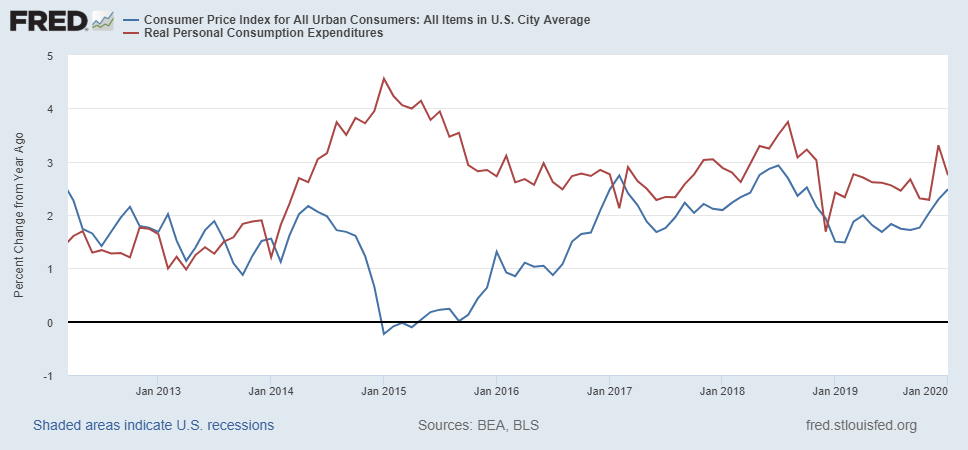
In 2015-16, the sharp drop in U.S. industrial production had but a tiny effect on GDP growth, unlike in previous episodes.

Lower oil prices quickly fed through the CPI, boosting real expenditures:
Cumberland Advisors calculates that
every penny per gallon that the gas price declines will be equivalent to a $1.4 billion consumption tax cut for the American economy. Estimates of the likely gasoline price change now range from a 30–40 cents per gallon cut to a 70–80 cents per gallon cut.
EARNINGS WATCH
Q1’20 earnings are now seen up 1.7% but this will come down further in coming weeks. So will Q2, now +4.8% when the oil price collapse will impact energy profits. Keep in mind, however, that Energy is only 3% of the S&P 500 Index and 4% of earnings. A large part of the other 96% will benefit from lower oil prices.
In the 2015-16 episode, S&P 500 trailing earnings peaked in November 2015 and declined 4.5% until July 2016, this while core inflation was also edging higher which explains the decline in the Rule of 20 Fair Value (yellow line below). Energy earnings collapsed 133% into negative numbers in 2015 and 2016 when energy stocks accounted for 7.5% of the Index.

New York Fed Repo Totals $112.93 Billion All repos outstanding rise to $202.9 billion; Fed increases amount of very short-term loans it has been offering to money markets
(…) Earlier Monday, the New York Fed said that it was increasing the maximum size of its temporary market interventions. With the top size of the overnights rising to $150 billion, longer term repos increased from a $20 billion cap to $45 billion.
The New York Fed’s operation Monday came amid heavy market pressures, as stocks sold off, Treasury yields dove through historic lows and oil prices plunged. The New York Fed said in a statement that its bigger repos “should help support smooth functioning of funding markets as market participants implement business resiliency plans in response to the coronavirus.” (…)
Fed repo operations take in U.S. Treasury, agency and mortgage bonds from primary dealers in a de facto short-term loan of central-bank cash, collateralized by those securities. Primary dealers have individual limits in the amount of liquidity they can take in exchange for their securities, and they pay interest to the central bank to get the funds. (…)
Stock-Buyback Plans Shrink The new coronavirus may threaten companies’ buyback plans—though a down market could also create a buying opportunity
Companies authorized around $122 billion in future buybacks through February, according to data compiled by equity research firm Birinyi Associates, marking a nearly 50% drop from the same period a year ago and representing the slowest pace in three years. Meanwhile, S&P Dow Jones Indices projects that the total amount of buybacks in the final three months of 2019 was down 18% compared with a year earlier, totaling around $183 billion.
Companies repurchased around $730 billion of their own stock during 2019—one of the biggest sources of money flowing into the stock market. Analysts are still projecting around $800 billion in buybacks this year, according to S&P Dow Jones Indices, but that figure may be threatened by the uncertainty surrounding the new coronavirus’s effect on the global economy. (…)
So far this year, the biggest buyers of their own stocks are underperforming. The Invesco BuyBack Achievers ETF is down 16%, compared with an 8% drop in the S&P 500 during that same period. The SPDR S&P 500 Buyback ETF is down 15%. (…)
SENTIMENT WATCH

Source: CNN Business (via The Daily Shot)
- Another contrarian indicator is the NAAIM exposure index (investment managers’ allocation to stocks), which declined by the highest amount since 2008. It looks like capitulation. (The Daily Shot)

- 78% of S&P 500 stocks now have a dividend yield that is above the 10yr Treasury.

Source: @StrategasRP (via The Daily Shot)