Unemployment Claims Held Steady Last Week Unemployment claims held steady at 884,000 last week, a sign the labor-market recovery is losing steam six months after the pandemic struck the U.S.
Unemployment claims were unchanged at 884,000 last week, the Labor Department said Thursday. Claims fell steadily for weeks after hitting a peak of about 7 million in March, but the pace of descent has slowed and claims remain above the prepandemic record of 695,000.
The number of workers collecting state unemployment benefits also has dropped from highs reached earlier in the pandemic, but is still elevated. So-called continuing claims increased to about 13.4 million at the end of August. (…)
The total number of workers receiving assistance from state and federal programs also remained high in late August, as more workers turned to pandemic-related programs for assistance. The total of about 29.6 million people, which isn’t seasonally adjusted and lags two weeks behind new state claims figures, includes temporary pandemic programs for self-employed and gig workers in addition to those receiving regular state benefits. (…)
More individuals have run through their regular state benefits and are now relying on an extra 13 weeks in benefits provided in a federal stimulus bill passed in March. About 1.42 million people were collecting benefits through this program in the week ended Aug. 22, compared with 1.39 million a week earlier. (…)
CPI for all items rises 0.4% in August on broad set of increases
The Consumer Price Index for All Urban Consumers (CPI-U) increased 0.4 percent in August on a seasonally adjusted basis after rising 0.6 percent in July, the U.S. Bureau of Labor Statistics reported today. Over the last 12 months, the all items index increased 1.3 percent before seasonal adjustment.
The monthly increase in the seasonally adjusted all items index was broad-based; a sharp rise in the used cars and trucks index was the largest factor, but the indexes for gasoline, shelter, recreation, and household furnishings and operations also contributed. The energy index rose 0.9 percent in August as the gasoline index rose 2.0 percent. The food index rose 0.1 percent in August after falling in July; an increase in the food away from home index more than offset a slight decline in the food at home index.
The index for all items less food and energy rose 0.4 percent in August after increasing 0.6 percent in July. The sharp rise in the index for used cars and trucks accounted for over 40 percent of the increase; the indexes for shelter, recreation, household furnishings and operations, apparel, motor vehicle insurance, and airline fares also rose. The indexes for education and personal care were among the few to decline.
The index for all items less food and energy increased 1.7 percent over the last 12 months. The food index increased 4.1 percent over the last 12 months, with the index for food at home rising 4.6 percent. Despite recent monthly increases, the energy index fell 9.0 percent over the last 12 months.

- March to May: core CPI -0.6% sequentially.
- June to August: core CPI: +1.24% sequentially.
- March to August: core CPI: 0.64% sequentially = +1.3% annualized.

So, while core CPI rose 0.6% between February and August, aggregate weekly payrolls (labor income) dropped 4.6%.

PANDEMIC NEWS
From Goldman Sachs:
- The rate of daily confirmed new cases has fallen further to 110 per million population.
- States representing 95% of the population have daily new cases under 200 per million, but in states representing over half the country daily new cases are still over 100 per million, a level that may be too high for officials to push forward with robust reopening policy.
- Daily new cases and the positive test rate remain very high in the Dakotas and Midwest, for example, while conditions generally continue to improve across the Sunbelt and remain fairly stable in the Northeast.
Israel will enter a second coronavirus lockdown, becoming the only developed country to shut down again nationwide after a botched reopening of the economy sent infections soaring. An inner cabinet of ministers late Thursday approved a two-week, full-fledged lockdown, to be followed by two more weeks of strict restrictions on movement and economic activity. After that, if the situation improves, limitations will be applied only to communities with large outbreaks. (Bloomberg)

- Since returning for the fall at the start of this month, 32 of France’s 60,000 schools have shut because of the virus, and 525 classes are in quarantine.
- Only a handful of German schools closed down completely at the end of last school year and have closed so far this fall.
- In Spain, where the start of school this week has coincided with the country’s highest coronavirus cases since spring, only 53 out of 29,000 schools have had confirmed or suspected cases. In most instances, specific groups were isolated and sent back home. At least one school closed after a few days when five staff tested positive for the virus. (WSJ)
China Starts Testing Covid-19 Nasal Spray Vaccine
China on Wednesday approved phase I human testing for the nasal spray vaccine, which is co-developed by researchers at Xiamen University and Hong Kong University, as well as by vaccine maker Beijing Wantai Biological Pharmacy Enterprise Co. (…)
The intranasal vaccine is the 10th candidate from China to proceed to the crucial stage of human testing. (…)
The nasal spray joins about 35 other candidates currently in human testing, as the global race to be first with an effective vaccine against the deadly pathogen intensifies. (…)
How COVID-19 Is Changing the Holiday Shopping Season Morning Consult’s Managing Director of Brand Intelligence Victoria Sakal looked at how consumers plan to celebrate, travel, spend and shop this year, and what they’re expecting from brands.
- While a slim majority (53 percent) said their family’s usual holiday get-togethers will go on as planned this year, 47 percent already report that they will be canceled altogether. Democrats are most likely to entirely cancel their usual holiday get-togethers this year: 59 percent expect this to happen compared to 47 percent of all adults and just 35 percent of Republicans.
- Seventy-five percent of Americans don’t plan to travel for or around the Thanksgiving holiday and 72 percent don’t plan to travel at all for or around any of the winter holidays.
- Just 8 percent plan to purchase more gifts for their family or friends, while a whopping 66 percent plan to save any money not spent on travel.
- Only 20 percent are explicitly worried about their finances this holiday season, with women notably more concerned than men. That being said, as of early August, 67 percent planned to cut back spending in order to reserve funds for holiday shopping.
- The vast majority will be spending less on holiday celebrations this year: 71 percent will be spending less than usual on celebrations with friends, and 67 percent will be spending less than usual on celebrations with family. A similarly substantial share of shoppers (62 percent or higher) plans to spend less on key categories this holiday season as well, from alcohol and other beverages to holiday snacks and other food. This trend is similar across generations and other demographics.
- Shoppers are most likely to spend the same amount on gifts this year, but nearly 4 in 10 (39 percent) do plan to cut back

- Nearly half (47 percent) of Americans plan to do most of their holiday shopping online, with 48 percent of those that do citing safety concerns as the primary reason why; convenience is the main reason for nearly a third (29 percent) and a preference for online shopping driven by increased usage in recent months is top for just over a fifth (21 percent). Thirty-one percent plan to roughly split their holiday shopping between online and in store while 27 percent plan to do most holiday shopping in stores.
- Thirty-five percent of consumers said they will be shopping less at malls this year, unsurprising considering 59 percent of Americans indicate they’re uncomfortable going to a shopping mall this holiday season. While nearly two-thirds (64 percent) said they’re likely to shop in-store this year, that category experienced the second second-largest drop in interest year-on-year with 33 percent of Americans anticipating shopping in-store less.
- Department stores may face a tough season as well, though perhaps less devastating than some pundits have suggested. Thirty-five percent plan to shop at department stores this year, and 30 percent said they will shop at these less than last year. But Americans are largely split as to whether they’re comfortable or uncomfortable going to department stores (48 percent vs. 52 percent, respectively) and 63 percent said they’ll shop at these about as much as they did in 2019.
Tesla plans to export China-made Model 3s to Asia and Europe, say sources
Nothing from the USA?
EQUITIES
Volatility Teaches New Investors That Stocks Go Down, Too Technology shares plunged over three days by their widest margin in nearly six months, erasing thousands of dollars from portfolios with shares of companies including Tesla.
Technology stocks plunged over a three-day trading span that ended Tuesday by their widest margin in nearly six months, erasing thousands of dollars from some individual investors’ portfolios. (…)
“The market has been an emotional roller coaster,” said Temitayo Ola, who is 31 years old and lives in Los Angeles. Mr. Ola got deep into trading stocks back in March. “As someone new to the stock market, I didn’t realize it could hit periods where you have a pullback like this,” he said. (…)
Some investors said they weren’t fazed by the pullback and saw it as an opportunity to buy stocks they missed out on earlier in the year. Tyler Snyder, a 21-year-old HVAC service technician in Kitchener, Ontario, took some of his losses in stride and bought shares of International Business Machines Corp. IBM -1.39% last Friday after the company’s stock slid nearly 5% over two trading days.
“I feel like a kid in a candy store,” Mr. Snyder said. “The market is what you make of it. A lot of scared money is being shaken out right now.” (…)
As well as investing in Tesla, Mr. Moaddel bought shares in a few other tech companies at about the same time. Those shares have also fallen—and the timing is far from ideal for the couple.
“We were planning to get married, and we could do with every pound,” he said.
“V” is also for volatility
According to Lowry’s Research, yesterday’s 1.8% decline was “intense” even though IT “bore the brunt of the selling”. Down volume was 80% of total Up/Dn. Selling Pressure is crawling up while Buying Power keeps falling at a good rate. This volatility puts to question the relentless Big Mo as a reason to buy stocks absent appealing valuations. But weak holders are still negating major reasons to sell, hoping the 50dma will hold.

One problem is that the equal weighted SPY seems tired…
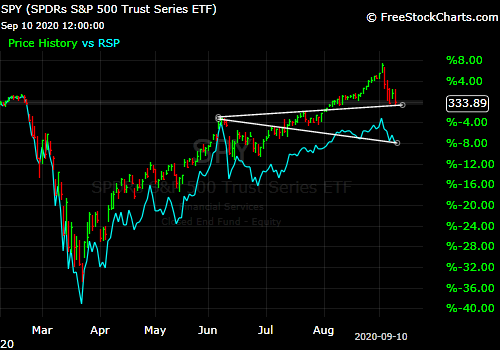
…with its 200dma still declining:

The NDX is also resting on its 50dma but its equal weight clone closed through its own 50dma yesterday.

Axios’ Felix Salmon on NFLX:
(…) In just five years — from 2015 to 2019 — Netflix had more than $10 billion of negative free cash flow. That’s just the cash going out the door; it doesn’t include many billions more in promised future payments. Cash flow improved this year, just because production halted on so many productions after the pandemic hit. But expect it to go sharply negative again as soon as filming restarts in earnest. (…)

Goldman Sachs raises global equities to ‘overweight’ Goldman Sachs said it had upped global equity allocations to “overweight” for the next three months after a recent market pullback, citing an inflection in earnings growth and catch-up moves by cyclical stocks, which had lagged the summer rally.
“A strong recovery in earnings growth (global earnings sentiment is now positive) coupled with a lower cost of equity should drive high single digit returns for global equities over a 12-month horizon,” Golman Sachs analysts wrote in a note issued late on Thursday.
Reuters was rather brief. Here’s what GS wrote yesterday (my emphasis):
Looking ahead, although we think correction risk remains elevated, we remain constructive in our asset allocation with a modestly pro-risk tilt on a 12-month basis. In particular, we think the current bull market in equities has more room to run driven by an improved economic outlook coupled with supportive monetary policy, which should maintain a search for yield among investors. And, despite the recent volatility, we think the coronavirus pandemic has accelerated the shift toward the digital economy, and we expect the tech sector to remain dominant for some time.
 9/11 & COVID-19
Cumberland Advisors’ David Kotok links 9/11 to Covid-19:
Here’s a YouTube of a mother and daughter being removed from a commercial flight because of their refusal to wear masks. It takes less than a minute to view it: https://www.youtube.com/watch?v=eWPK29BY1a4. Note these facts, please. No masks. Forcible eviction from the plane. The plane’s passengers are applauding her eviction, not her no-mask stance. (Listen closely to words of the passengers, including one calling her a “dumbass.”) Note the guards, all of whom are Caucasian. The unmasked woman yells “Racism at its best!” There is no evidence of racism, but she screams it anyway.
That scream has critically important implications if she is asymptomatic but carrying COVID-19. Her infectious droplets have a potential range of up to 20 feet. Here is a link to an important research paper that describes how aerosolization of SARS-CoV-2 works and how the six-foot distance standard that originated decades ago is now very much antiquated with COVID-19: “Two metres or one: what is the evidence for physical distancing in covid-19?,” British Medical Journal, https://www.bmj.com/content/370/bmj.m3223. And here’s why masking protects folks like those on this airplane: “Promoting mask-wearing during the COVID-19 pandemic: A policymaker’s guide,” Resolve to Save Lives, https://preventepidemics.org/wp-content/uploads/2020/08/Promoting-Mask-Wearing-During-COVID-19.pdf.
After 9/11, our country mobilized under responsible leadership, and our leaders set examples by their behavior. This time around, with COVID-19, federal and state leadership has been haphazard, chaotic and often deplorably inadequate (Florida is a sad example of repeated failure). We have had repeated warnings of the pandemic threat (just as we were warned of an imminent terrorist attack in the runup to 9/11). The pandemic warnings came in the form of SARS, MERS, Ebola, bird flu, H1N1, Zika, etc. We stepped up preparations for a while, but then stopped. Then we cut funding for research. ( https://www.washingtonpost.com/news/to-your-health/wp/2018/02/01/cdc-to-cut-by-80-percent-efforts-to-prevent-global-disease-outbreak/)
Two months ago, as the global pandemic raged, our federal government even withdrew from the World Health Organization (WHO) (“Trump Said He Would Terminate the U.S. Relationship With the W.H.O. Here’s What That Means,” https://time.com/5847505/trump-withdrawl-who/). Put your politics aside if you can, and think about what people would do if the US withdrew from the IATA and stopped supporting worldwide aviation safety. Would you still fly and feel that everything was back to business as usual? And now the US is the only major country not participating in the worldwide COVAX vaccine initiative (“U.S. says it won’t join WHO-linked effort to develop, distribute coronavirus vaccine,” Washington Post, https://www.washingtonpost.com/world/coronavirus-vaccine-trump/2020/09/01/b44b42be-e965-11ea-bf44-0d31c85838a5_story.html).
Think about what Americans would do if we made TSA screening optional. Try out this script: You can fly with or without screening. If you want to be screened, we will screen you, but we will allow unscreened people to fly with you. Would you take that flight? Is this scenario business as usual? Why is a COVID-19 death any different than a terrorist bomb death? Isn’t an unmasked, infected person carrying a tiny terrorist bent on infecting others? Statistically, many people’s chances of surviving a coronavirus infection are good, yet those tiny viral hijackers have killed more than 60 times the number of Americans who died on 9/11.
The world has changed in the wake of COVID-19, just as it changed after 9/11. Then, the US led the world’s response. Now, the US has an awful record. We will see the next chapter as we watch school openings around our nation. And then we may or may not see it in the election outcome. In a political race that appears to us to be too close to call, the “coronavoters” may be the wild card; they originate from diverse subsets of the electorate. A coronavoter may be a Democrat, Republican, independent or a previously disinterested voter return for this election.