Small Business Optimism Returning to Normal Levels as Owners Express Uncertainty about the Future
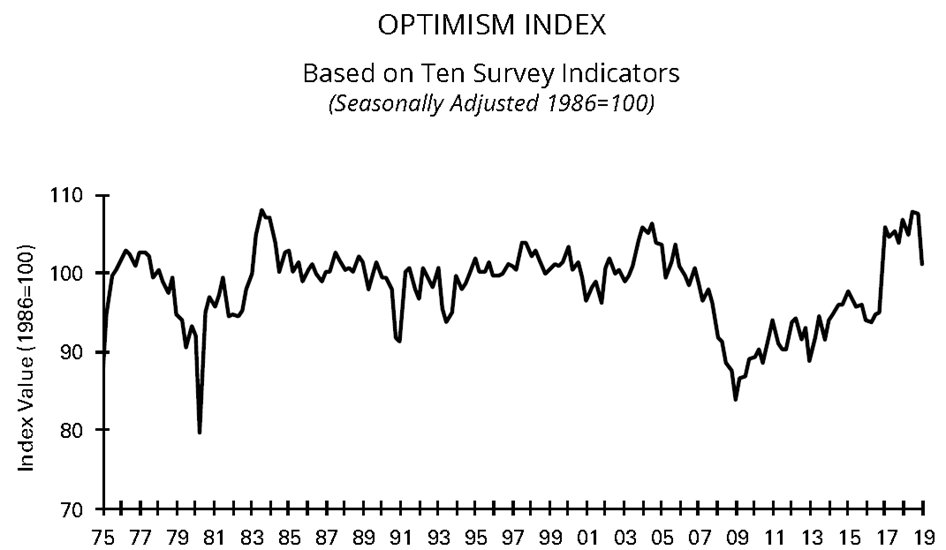


Healthy sales are very important given this below chart:
So far, so good but…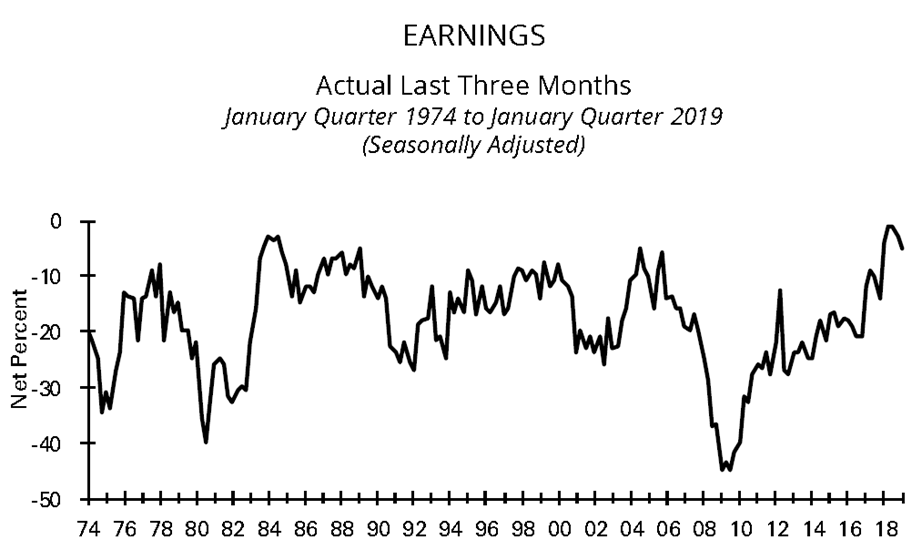
N.Y. Fed Consumer Survey Finds More Negativity in January Outlook
In its January Survey of Consumer Expectations, the bank found that respondents now expect rising unemployment down the road. For the fourth straight month, the survey reported expectations of higher joblessness a year from now rose, with 40.6% of respondents holding that view, from the prior month’s 38.8%. (…)
The New York Fed said that was the highest reading since March 2014, and that the increase was found broadly across age, education and income levels.
The report also found respondents saying the odds of losing a job have risen, as have the probabilities of voluntarily leaving a job and being able to find a new one.
The report also said that expectations of higher income declined slightly to 2.8% of respondents, while expectations of spending growth “decreased notably,” from 3.5% of respondents, from 3% in December. The survey also said expectations of rising credit availability ebbed in January to its lowest level since October 2016. (…)
Dutch banker calls on ECB to pause plan to ditch stimulus Klaas Knot’s shift in position underlines steep deterioration in eurozone sentiment
OPEC Production Falls Significantly on Saudi Output Cuts OPEC significantly reduced its crude-oil production in January, making good on its latest deal to curb output and rebalance an oversupplied market, the oil cartel said.
In its closely watched monthly oil market report, the Organization of the Petroleum Exporting Countries said its crude output had fallen by 797,000 barrels a day in January, month-on month, to average 30.81 million barrels a day, citing secondary sources. The bulk of the cuts were shouldered by Saudi Arabia—the de facto head of OPEC—as well as the United Arab Emirates and Kuwait, according to the report. (…)
Saudi crude output came down by 350,000 barrels a day last month, according to secondary sources, Tuesday’s report showed.
However, preliminary figures for January showed that Russian oil supply came down by just 90,000 barrels a day month-on-month, to stand at 11.56 million barrels a day last month, according to the OPEC report.
As part of the December OPEC-led deal, Russia had agreed to cut 230,000 barrels a day during the first half of this year. (…)
OPEC said Tuesday that total global oil supply had decreased by 1.09 million barrels a day in January, to average 99.32 million barrels a day.
The cartel slightly lowered its oil demand growth forecast for 2019, by 50,000 barrels a day, for a growth rate of 1.24 million barrels a day. The revised projection was mainly the “result of downward revisions to the economic outlook for major economies,” OPEC said.
The cartel also said that commercial oil stocks in the Organization for Economic Cooperation and Development—a group of industrialized, oil-consuming nations that includes the U.S.—fell by 10.8 million barrels in December, to stand at 2.851 billion barrels. That is 28 million barrels above OPEC’s target of the latest five-year average, but 2.5 million barrels lower than the same time a year ago.
Amazon Slashed Prices at Whole Foods; Now They’re Shooting Back Up Whole Foods is raising prices again. Amazon cut prices after acquiring the natural grocer in 2017, but pressure from consumer-product makers has led Whole Foods to raise prices on hundreds of products.
(…) Whole Foods said in the December email that suppliers were charging more for those products due to inflation. The separate price increases this month followed the expiration of annual contracts to sell about 700 goods at low prices, Whole Foods said. Those contracts won’t be renewed, the chain said, and the increases add up to hundreds of thousands of dollars a week in additional revenue. (…)
The average hike was 66 cents, according to the list. (…) At Whole Foods, a basket of 40 select items purchased from their stores cost $191 last month, according to the Telsey Advisory Group, up more than 3% from what the same basket of goods cost last fall. (…)
How Bad Is the China Slowdown? U.S. Companies Offer Answers Fourth-quarter results from U.S. companies indicate that slowing growth in China is modest, but broad
(…) Fourth-quarter results from U.S. companies highlight the many and varied ways that China’s cooling economy affects American business, and, in turn, offer a glimpse of what’s happening inside China. The indications are that slowing growth there is broad, if still modest. (…)
About a third of companies in the S&P 500 generate no direct revenue from China, according to estimates by FactSet, based in part on company disclosures. Another third generate at least 3% of sales in China. About 60 of the biggest U.S. companies generate 10% or more of sales there. (…)
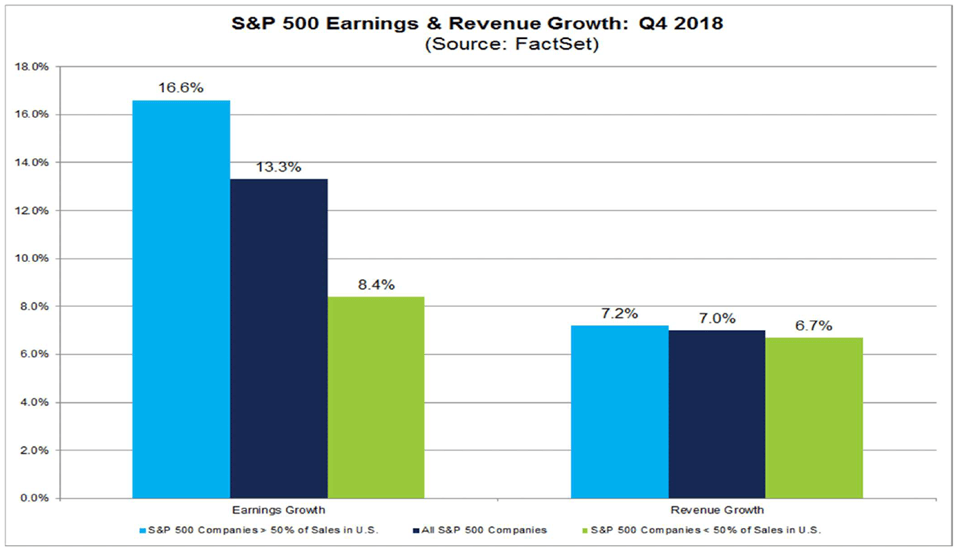
(…) The blended (combines actual results for companies that have reported and estimated results for companies yet to report) earnings growth rate for the S&P 500 for Q4 2018 is 13.3%. For companies that generate more than 50% of sales inside the U.S., the blended earnings growth rate is 16.6%. For companies that generate less than 50% of sales inside the U.S., the blended earnings growth rate is 8.4%.
The blended revenue growth rate for the S&P 500 for Q4 2018 is 7.0%. For companies that generate more than 50% of sales inside the U.S., the blended revenue growth rate is 7.2%. For companies that generate less than 50% of sales inside the U.S., the blended revenue growth rate is 6.7%. (…)
The estimated earnings growth rate for the S&P 500 for CY 2019 is 5.0%. For companies that generate more than 50% of sales inside the U.S., the estimated earnings growth rate is 6.7%. For companies that generate less than 50% of sales inside the U.S., the estimated earnings growth rate is 1.9%.
The estimated revenue growth rate for the S&P 500 for CY 2019 is 5.1%. For companies that generate more than 50% of sales inside the U.S., the estimated revenue growth rate is 5.9%. For companies that generate less than 50% of sales inside the U.S., the estimated revenue growth rate is 3.1%.

SENTIMENT WATCH
Market Indicators Turn Bullish After Flashing Red Investors look to technical signals as they try to reconcile a dizzying December swoon with a dramatic January recovery
And these investor worries:
-
Trump Wants to Meet With Xi ‘Very Soon’ Over Trade War, Adviser Says The U.S. president has said no deal will be final until he meets with his Chinese counterpart.
(…) “He wants to meet with President Xi very soon,” White House adviser Kellyanne Conway said Monday on Fox News. “This president wants a deal. He wants it to be fair to Americans and American workers and American interests.”
(…) some aides privately acknowledge the most likely scenario is for the March 1 deadline to be extended and for tariffs on some $200 billion in Chinese imports not to be raised to 25 percent as Trump as threatened. (…)
It’s still possible the leaders may get together in March at Trump’s Mar-a-Lago resort in Florida, Conway said Monday, when asked about a report from news agency Axios to that effect. The U.S. president has said no deal will be final until he meets with his Chinese counterpart. (…)
-
Lawmakers Agree in Principle to Fund Border Security Senior lawmakers said they had reached an agreement in principle to fund border security and avoid a partial government shutdown this weekend.
(…) Major U.S. indexes have crossed or are nearing their 200-day moving averages and the number of stocks setting 52-week highs is on the rise, among other indicators favored by portfolio managers and investment gurus trying to divine the market’s next move. (…)
1 thought on “THE DAILY EDGE: 12 FEBRUARY 2019”
Following a crisis-induced plunge of 10.4% in the volume of global trade in 2009 – a modern-day record – recovery has been muted. After a brief two-year rebound in 2010-2011, world trade growth averaged just 3.6% from 2012 to 2018 – about half the 7.1% average annual pace in the 20 years before the crisis.
All in all, the global trade cycle is facing major stress in 2019, and markdowns have only just begun. This underscores the risks of a major shortfall in world GDP growth. In a still tightly connected world, no major economy will be an oasis. That includes the US, whose 45th president continues to insist that it’s easy to win a trade war.
https://think.ing.com/opinions/stephen-roach-warnings-from-the-global-trade-cycle/
P.S. I hope my posts are not bothersome, just trying to add extra stuff that I run into.
Comments are closed.