More Workers Are Quitting as Job Openings Rise
The number of available jobs in the U.S. exceeded the number of job seekers by more than 650,000 in July—a gap that has been growing—in a sign of an increasingly tight labor market that is altering how employers find workers.
The number of available jobs in the U.S. rose by about 117,000 to a seasonally adjusted 6.94 million in July, the Labor Department said Tuesday. That is the highest level on records back to 2000, exceeding the prior peak set in April. It also exceeds the 6.28 million Americans who were unemployed during the month, meaning they were without work but actively seeking a job. (…)
In July, 3.58 million workers voluntarily left their jobs, the highest level on record, the Labor Department said. (…)


Here’s a catalyst for switching jobs as Facset reports:

(…) U.S. auto companies are feeling significant pressure on their receivables as a result of the delinquent debt. General Motors (GM), which recorded 76% of its sales in the U.S. in the 2017 fiscal year, saw a 31% increase in bad debt expense from a year earlier. At the same time, Ford Motor Company, which generates 60% of its sales in the U.S., saw its bad debt expense increase 15% year-over-year. For GM, the inability to collect on outstanding debt has created a liquid asset issue, characterized by a negative free cash flow margin. A shortage of cash could in turn lead to diminishing productive capacity down the road. (…)

This must be related one way or the other:
Steel Workers Demand Higher Pay as Tariffs Lift Profits Workers at two top U.S. steelmakers are demanding higher compensation as tariffs on foreign metal push prices and profits to their highest point in years.
(…) The United Steelworkers union is in a contract standoff with both companies. Workers have authorized union leaders to call a strike against U.S. Steel, and say they could do the same at ArcelorMittal if an agreement isn’t reached soon. Contracts for both companies expired Sept. 1.
U.S. Steel said it doesn’t anticipate a strike. “Talks are ongoing, and we continue to work diligently to reach a mutually agreeable conclusion,” the company said. ArcelorMittal declined to comment on the strike threat.
U.S. Steel and ArcelorMittal account for 40% of the U.S. production capacity for flat-rolled steel used throughout manufacturing for products ranging from tin cans to car doors. The price of steel has risen by more than 30% this year, as the Trump administration’s tariffs on foreign steel have taken effect.
U.S. Steel has forecast a more-than-60% increase in adjusted pretax income this year, compared with 2017. (…)
This year U.S. Steel has proposed a six-year contract with a raise of 4% in the first year and 3% in each of the next two. Annual raises would drop to 1% in the last three years, with the addition of new bonuses pegged to pretax profit. (…)
Union negotiators want U.S. Steel to provide bigger pay increases or drop a demand that workers pay part of their health-insurance premiums and higher copayments. (…)
The union said ArcelorMittal’s wage offer is also too low. The Luxembourg-based company offered a three-year contract with pay increases of 2% and 1.5% in the final two years. The union, which represents 15,000 ArcelorMittal employees, said the company also is seeking concessions on health insurance and other benefits that would cost workers more than their pay raises would provide. (…)
Simmering Alcoa Labor Dispute Morphs Into ‘Clash of the Titans’
(…) For Pittsburgh-based Alcoa, the dispute has resulted in a production decline at the plant, adding to pressures resulting from U.S. aluminum tariffs that have hit its three smelters in Canada. The company is now seeking deeper changes — including reduced payrolls — to make the plant more competitive. For their part, workers say they’ve already made concessions and are fighting to retain seniority rights. (…)
Alcoa currently faces another labor conflict at its alumina operations in Western Australia, where workers are striking over a new labor deal they say doesn’t contain any job security provisions. (…)
Federal borrowing soars despite strong economy According to the Congressional Budget Office, the U.S. government spent $895 billion more than it brought in during the past 11 months, a 33 percent increase from one year before. And lawmakers from both parties are proposing ideas that would make the deficit swell even further.
Businesses Ramp Up Lobbying Against Trump’s Tariffs From California apple growers to Maine lobstermen, businesses are joining forces to try to persuade President Trump that tariffs are hurting U.S. industries.
(…) When the Office of the U.S. Trade Representative took testimony on proposed tariffs in August, a majority of the industry representatives who participated said tariffs would hurt their businesses.
In a letter they plan to send to Congress on Wednesday, business groups will announce their latest effort to make the case against tariffs. The group’s multimillion-dollar Tariffs Hurt the Heartland campaign aims to tell the stories of farmers and business owners dinged by import duties.
“Every sector of the U.S. economy stands to lose in a trade war,” said Matthew Shay, president of the National Retail Federation. The goal of the campaign is to “ensure Washington understands the real-world consequences of a trade war.” (…)
There’s Never Been a President This Unpopular With an Economy This Good That’s a big problem for Republicans as they try to maintain control of Congress.
The president’s party almost always suffers a net loss of U.S. House seats in midterm elections. However, losses tend to be much steeper when the president is unpopular. In Gallup’s polling history, presidents with job approval ratings below 50% have seen their party lose 37 House seats, on average, in midterm elections. That compares with an average loss of 14 seats when presidents had approval ratings above 50%.
History, then, is not on the Republicans’ side this fall, as President Donald Trump has a 40% job approval rating two months before the 2018 midterm elections. With Republicans holding the White House and the majority of both houses of Congress, the lines of accountability are clear for voters who are unhappy with the state of the nation. Democrats need a net gain of 23 seats to take majority control of the House of Representatives. (…)
-
GOP worries about Senate as candidates struggle and Trump’s support tumbles “I hope when the smoke clears, we’ll still have a majority,” said Senate Majority Leader Mitch McConnell (R-Ky.) as the Republican Party finds itself fretting over races in Texas, Indiana and West Virginia
China Woos U.S. Companies Again, Curbs Trade Threats Change reflects Beijing’s fears that trade battle could batter economy and curb critical investment, officials say
(…) At a meeting last month, Liu He, President Xi Jinping’s economic-policy chief, told visiting American business executives that U.S. companies’ China operations won’t be targeted in Beijing’s trade counterattacks.
“We won’t allow retribution against foreign companies,” Mr. Liu said, said people briefed on the event. (…)
Beijing is looking to U.S. companies to help it lobby the Trump administration for a negotiated settlement. (…)

SENTIMENT WATCH
Ray Dalio’s Seven Bubble Indicators Are ‘Flickering But Not Flashing’ The founder of hedge fund giant Bridgewater Associates says his study of history prepared him for the 2008 crisis.
(…) and his depression gauge, which sent out an alarm before the 2007-09 financial crisis, isn’t glowing red. (…)
“I’m significantly concerned for the next economic downturn for two reasons,” he said. “The first is that we have right now a higher level of populism and a worse wealth gap, so that when we have a downturn, the rich and the poor, the left and the right, will be more at each other’s throats.” Second, he said, monetary policy will be less effective because there’s not much room to cut interest rates, and because quantitative easing—the Federal Reserve’s purchase of long-term bonds to lower interest rates—“has much less marginal effectiveness.”
When a financial crisis does hit, as it inevitably will, regulators may not be well-equipped to fight it, Dalio said. “There’s a cycle here. What they did was to write regulations that reduced the chance of a financial crisis but significantly limited the flexibility in dealing with it. History has shown that all financial crises don’t work out exactly as they are anticipated.” (…)
LIQUIDITY (USD) SQUEEZE
From Gavekal’s Louis-Vincent Gave via John Mauldin:
If it walks like a duck and quacks like a duck, then it probably is a duck. By the same token, if central bank reserves are shrinking, the US dollar is rising, and emerging market currencies are cratering, we probably face a liquidity squeeze (see Towards A Global Liquidity Crisis?). None of this should be surprising given that the Federal Reserve is tightening policy, the US budget deficit is growing, the oil price is rising and US corporates are repatriating dollars held abroad and embarking on huge share buybacks. In short, the drains on US dollar liquidity have come from all directions this year.
Assuming that current market behavior—with all major asset classes outside of US equities underperforming cash since late January—is a symptom of an unfolding liquidity squeeze, the next question is: what stops the rot? I can see several exits although (spoiler alert) none yet seem to be coming into view. (…)

Asian Stocks Are Caught in the Longest Sell-off in 16 Years

Vanishing Jobs Growth Spells Trouble for Korea The nation’s unemployment rate jumped to 4.2 percent in August
Crypto’s 80% Plunge Is Now Worse Than the Dot-Com Crash Investors who bet big on a seemingly revolutionary technology are suffering a painful reality check.
UNHEDGED
The AUM of many high-profile hedge funds has been shrinking.

Source: Bloomberg, @sobata416; Read full article (via The Daily Shot)
AMERICA CURSED
John Mauldin’s latest Thoughts From the Front Line adds interesting facts to my recent piece:
(…) China needs to develop its own technology, and doing so requires research, and research requires capital. So, through a combination of government edicts and profit-seeking, it is right now in a major effort to build its own innovation economy. (…) As of 2016—before the numbers Peter lists there—China VC investment had roughly caught up to US level. Now it is probably ahead. (…)
As a graphic indication, here’s the countries with the most STEM graduates:
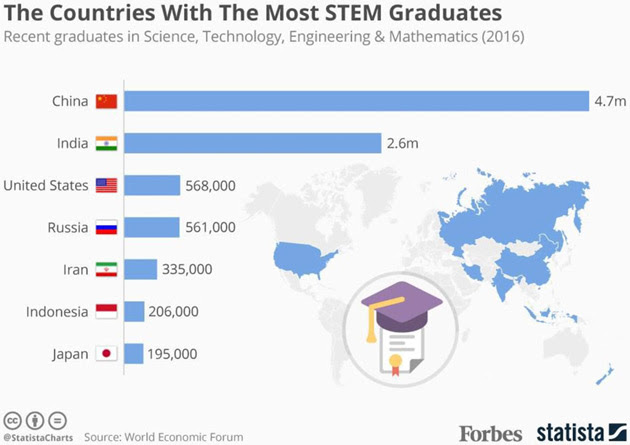
(…) China has 15% of global GDP but produces more than a third of the scientific papers. It seems those university degrees are beginning to pay off in actual research. (…)