U.S. Producer Prices Unexpectedly Surge in July
The Producer Price Index for Final Demand strengthened 1.0% (7.8% y/y) in July for a second straight month. The year-to-year increase is the largest in the series history, dating back to 2009. A 0.6% rise for last month had been expected by the Action Economics Forecast Survey. The PPI excluding food and energy prices also rose 1.0% (6.2% y/y) in July for the second straight month. A 0.5% increase had been expected. The PPI less prices of food, energy and trade services rose 0.9% (6.1% y/y) following a 0.5% gain.
Strength in final demand services prices led the gain in the PPI last month with a record 1.1% increase (5.8% y/y) after rising 0.8% in June. Trade services prices surged 1.7% (6.7% y/y) after a 2.1% strengthening. Prices for final demand transportation and warehousing services rose 2.7% (11.8% y/y) after gaining 0.9% in June. Prices for services less trade, transportation, and warehousing rose 0.6% in July (4.9% y/y) after a 0.3% rise.
Prices for final demand goods increased 0.6% (11.9% y/y) in July after rising 1.2% in June. Final demand goods less foods and energy rose 1.0% (7.5% y/y) in July, about the same as during the prior three months. Core finished consumer goods prices rose 0.9% (4.3% y/y), the strongest increase since October 2008. Durable consumer goods prices improved 0.7% (5.6% y/y) following a 1.1% increase. The cost of core nondurable goods rose 0.9% (3.5% y/y) following three consecutive 0.3% gains. Capital equipment prices gained 0.8% (4.2% y/y) for the third consecutive month.
Energy prices for final demand surged 2.6% in July (35.4% y/y) following a 2.1% June rise. Gasoline prices surged 6.2% (78.0% y/y) after gaining 2.8% and 2.2% in the prior two months. The cost of home heating oil strengthened 7.2% (62.5% y/y), about the same as in the prior two months. Finished food prices declined 2.1% last month (+9.5% y/y) after a 0.8% increase. The cost of beef & veal fell 11.6% (+40.3% y/y) following a 5.6% gain. Fresh fruit & melon prices were off 4.4% (-5.1% y/y) and vegetables prices declined 2.7% (-17.3% y/y). Dairy products costs eased 0.5% (-1.6% y/y).
Construction costs increased 1.5% (4.5% y/y) in July after rising 0.7% and 0.6% in the prior two months.
Intermediate goods prices jumped 1.7% (22.9% y/y) in July after a 1.9% June surge.
The pipeline is bursting with broadly exploding prices. If you believe, like some pundits claim, that there is little correlation between PPI and CPI, Ed Yardeni has a chart for you:

And if the same pundits argue the base effect, this chart plots core PPI inflation rates on a MoM basis to eliminate any base effect. This is transitory…

The above charts are for final demand, at the pipeline exit. Within the pipeline, things are not slowing down: PPI Intermediate Demand for Processed Goods is up 22.9% YoY in July. On a MoM basis: +2.8% in May, +1.9% in June and +1.7% in July. I will let you calculate the annualized rates.
A Covid outbreak that has partially shut one of the world’s busiest container ports is heightening concerns that the rapid spread of the delta variant will lead to a repeat of last year’s shipping nightmares.
The Port of Los Angeles, which saw its volumes dip because of a June Covid outbreak at the Yantian port in China, is bracing for another potential decline because of the latest shutdown at the Ningbo-Zhoushan port in China, a spokesman said. Anton Posner, chief executive officer of supply-chain management company Mercury Resources, said that many companies chartering ships are already adding Covid contract clauses as insurance so they won’t have to pay for stranded ships. (…)
The partial closure of Ningbo “is likely to be another blow to supply chain disruptions,” said Jeffrey Halley, Asia-Pacific senior market analyst at foreign-exchange firm Oanda Asia Pacific Pte. wrote in a note. “The rest of the day in Asia is likely to be dominated by the small but quite widely spread virus outbreaks in Mainland China and the partial port closures and their implications for global trade. None of that is likely to be positive for regional stocks, currencies, or energy prices.”
Ningbo-Zhoushan Port said in a statement late Thursday that all other terminals aside from Meishan have been operating normally. The port is actively negotiating with shipping companies, directing them to other terminals, and releasing information on a real-time data platform, it said.
To minimize the impact, it’s also adjusting the operating time of other terminals to make sure clients can clear their shipments.
Some ships that docked at the Meishan terminal before the closure are suspending cargo operations until the terminal re-opens, according to a notice sent by shipping line CMA CGM SA to shippers. (…)
U.S. Initial Unemployment Claims Decline
Initial claims for unemployment insurance were 375,000 in the week ended August 7, down from 387,000 in the prior week (revised up 2,000). The four-week moving average rose to 396,250 from 394,500 in the previous week. Claims have been in a relatively tight range over the past ten weeks and have averaged 392,000. The Action Economics Forecast Survey consensus for the latest week was 380,000.
Initial claims for the federal Pandemic Unemployment Assistance (PUA) program rose to 104,572 in the week ended August 7 from 94,427 in the previous week (revised down slightly from 94,476). The PUA program provides benefits to individuals who are not eligible for regular state unemployment insurance benefits, such as the self-employed. Given the brief history of this program, these and other COVID-related series are not seasonally adjusted.
Continuing claims for regular state unemployment insurance in the week ended July 31 fell 114,000 to 2.866 million from an upwardly revised 2.980 million (originally 2.930 million) in the prior week. In the July 31 week, the associated rate of insured unemployment decreased to a pandemic low of 2.1% from 2.2% in the previous week (revised up from 2.1%).
Continued claims for PUA declined 336,195 in the week ended July 24 to 4.821 million, the lowest level since April 2020. Continued PEUC claims fell 393,638 to 3.853 million, the lowest level since the week ended January 16, 2021. The Pandemic Emergency Unemployment Compensation (PEUC) program covers people who have exhausted their state unemployment insurance benefits.
In the week ended July 24, the total number of all state, federal, PUA and PEUC continued claims was 12.055 million, down 919,593 from the week before. This is the lowest level since March 2020 and down sharply from the pandemic peak of 33.228 million reached in the week ended June 20, 2020. These figures are not seasonally adjusted.
 (Bespoke)
Home Prices Jumped Across the U.S. Prices surged in almost every corner of the U.S. in the second quarter as robust demand continued to overwhelm the supply of homes for sale.
(…) The median sales price for single-family existing homes was higher in the second quarter compared with a year ago for 182 of the 183 metro areas tracked by the National Association of Realtors, the association said Thursday. In 94% of those metro areas, median prices rose by more than 10% from a year earlier.
Nationwide, the median single-family existing-home sales price rose 22.9% in the second quarter to $357,900 from a year ago, a record in data going back to 1968, NAR said. (…)
But in the past few months, high prices have attracted more sellers to the market and pushed some buyers to the sidelines. Active listings in the four weeks ended Aug. 1 were up 13% from their recent low in the four weeks ended in March, according to real-estate brokerage Redfin Corp.
“The housing market looks to move from ‘superhot’ to ‘warm,’ with markedly slower price gains,” said Lawrence Yun, NAR’s chief economist. “Housing affordability for first-time buyers is weakening.” (…)
About 28% of consumers surveyed by Fannie Mae in July said it was a good time to buy a home, a record low in data going back to mid-2010.
Prices are rising so rapidly they are outweighing the benefit of low borrowing rates. In the second quarter, the typical monthly mortgage payment for a single-family home rose to $1,215, from $1,019 a year earlier, NAR said, even as mortgage rates declined. (…)
“Much of the rise in sales we’re seeing this year are at the higher price levels, and they’re also not using a mortgage,” Mr. Pruner said. “Mostly where we’re seeing the big jump up is the cash buyers.” (…)
Self-defeating, again? What if mortgage rates turn back up?


BTW:
(Fortune)
Bank of Mexico Raises Interest Rates Again in Split Decision The Bank of Mexico raised interest rates for a second consecutive meeting Thursday, citing persistent price pressures and supply shocks that it expects will keep inflation above its 3% target into early 2023.
New data on coronavirus vaccine effectiveness may be “a wakeup call”
A new preprint study that raises concerns about the mRNA vaccines’ effectiveness against Delta — particularly Pfizer’s — has already grabbed the attention of top Biden administration officials.
The study found the Pfizer vaccine was only 42% effective against infection in July, when the Delta variant was dominant. “If that’s not a wakeup call, I don’t know what is,” a senior Biden official told Axios.
The study, conducted by nference and the Mayo Clinic, compared the effectiveness of the Pfizer and Moderna vaccines in the Mayo Clinic Health System over time from January to July.
- Overall, it found that the Moderna vaccine was 86% effective against infection over the study period, and Pfizer’s was 76%. Moderna’s vaccine was 92% effective against hospitalization and Pfizer’s was 85%.
- But the vaccines’ effectiveness against infection dropped sharply in July, when the Delta variant’s prevalence in Minnesota had risen to over 70%.
- Moderna was 76% effective against infection, and Pfizer was only 42% effective.
- The study found similar results in other states. For example, in Florida, the risk of infection in July for people fully vaccinated with Moderna was about 60% lower than for people fully vaccinated with Pfizer.
Although it has yet to be peer-reviewed, the study raises serious questions about both vaccines’ long-term effectiveness, particularly Pfizer’s.
- It’s unclear whether the results signify a reduction in effectiveness over time, a reduced effectiveness against Delta, or a combination of both.
- “Based on the data that we have so far, it is a combination of both factors,” said Venky Soundararajan, a lead author of the study. “The Moderna vaccine is likely — very likely — more effective than the Pfizer vaccine in areas where Delta is the dominant strain, and the Pfizer vaccine appears to have a lower durability of effectiveness.”
- He added that his team is working on a follow-up study that will try to differentiate between the durability of the two vaccines and their effectiveness against Delta.
There has been no data so far that has found either vaccine’s protection against severe disease and death is significantly less against Delta, and the study notes that there doesn’t appear to be much of a difference in complications stemming from breakthrough infections based on which vaccine someone got.
- And experts cautioned against rushing to conclusions.
- “This is the kind of surprising finding that needs confirmation before we should accept its validity,” said Cornell virologist John Moore.
The two shots both use mRNA, but there are significant differences between them.
- For example, Moderna is given in a stronger dose than Pfizer, and there is a slightly different time interval between shots.
- “There are a few differences between what are known to be similar vaccines …. None of these variables is an obvious smoking gun, although the dosing amount seems the most likely to be a factor,” Moore said.
In a statement, Pfizer said it and BioNTech “expect to be able to develop and produce a tailor-made vaccine against that variant in approximately 100 days after a decision to do so, subject to regulatory approval.”

Delta cases increasing, but fatalities not following as before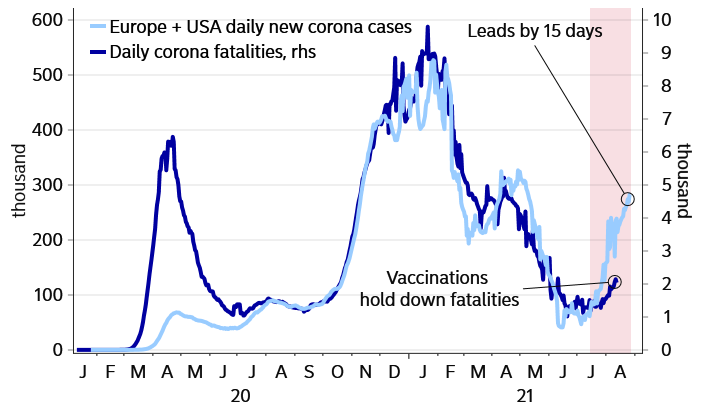

FYI: Between 2010 and 2020, More than half of all U.S. counties showed declines:
Trudeau Expected to Call Election Sunday, Seeking a Third Term

(NBF)