‘Make or Break’ Call on Inflation Is Stumping Global Investors
(…) “Inflation and rates, especially as a bond investor right now, is the call that you have to make,” said Elaine Stokes, fixed income portfolio manager at Loomis Sayles. “It’s the make-or-break call of your year.” (…)

- John Authers: The Reflation Trade Is Losing Some Air. About Time It had come too far, too fast so it’s no surprise that the market took a step back after the consumer price data.
(…) the latest auction of long-dated Treasury bonds had been a success, revealing robust demand even with yields still very low. By the end of the New York day, the 10-year yield was threatening to drop through 1.6%, barely 12 hours after it had touched 1.7%. (…)
- The UIG “full data set” measure for March is currently estimated at 2.2%, a 0.5 percentage point increase from the previous month.
- The “prices-only” measure for March is currently estimated at 2.6%, a 0.3 percentage point increase from the previous month.
- The twelve-month change in the March CPI was +2.6%, a 0.9 percentage point increase from the previous month.
- For March 2021, trend CPI inflation is estimated to be in the 2.2% to 2.6% range. The width of the range is smaller than in February, with both bounds higher than they were in February.
Atlanta Fed’s Sticky-Price CPI Rose in March
The Atlanta Fed’s sticky-price consumer price index (CPI)—a weighted basket of items that change price relatively slowly—increased 3.5 percent (on an annualized basis) in March, following a 2.3 percent increase in February. On a year-over-year basis, the series is up 1.8 percent.

 But the sticky core and core-core are not scary at this point:

U.S. Rents Rose for the First Time in 8 Months in March The median rent across 50 metros increased 1.1% year over year to $1,463 per month
Oil Demand Is Recovering Despite Vaccination Hiccups, IEA Says A year after the pandemic and a price war sparked one of the weakest months in history for oil prices, the global energy market is well on its way to recovery, the International Energy Agency said.
In its monthly report, the IEA raised its annual forecast for global oil demand in 2021 by 230,000 barrels a day to an increase of 5.7 million barrels a day. Earlier in the week, the Organization of the Petroleum Exporting Countries increased its 2021 demand forecast by 100,000 barrels a day.
While the Paris-based organization’s forecast recovery will still leave demand 3% short of 2019 levels, investors will likely take the agency’s increased demand forecast for the final quarter of 2021 as a sign that consumption is on its way to recovering. (…)
With OPEC and its allies set to increase their collective output by more than 2 million barrels a day over the coming months, “prices could yet come under renewed pressure in the coming months with world oil supply set to ramp up and shift the market from deficit towards balance,” the IEA said.
The agency was less worried about rising output from non-cartel countries, though, trimming its non-OPEC supply-growth forecast by 90,000 barrels a day to 610,000 barrels a day this year. U.S. supply is set to decline by 100,000 barrels a day this year after falling by 600,000 barrels a day in 2020.
With the oil market set for a brighter second half of 2021, OPEC’s 6 million barrels a day of spare capacity—a figure that excludes 1.5 million barrels a day of Iranian capacity as Tehran negotiates reviving the 2015 nuclear deal with the U.S.—means producers within the cartel will have the flexibility to meet changes in demand, the IEA said.
Even so, the wealthy countries of the Organization for Economic Cooperation and Development had around 3 billion barrels in their crude inventories in February and “the market does not face an impending supply crunch,” the report added.
ANOTHER RECORD
When I get old ( ), I will boast to my grandkids about all the records broken during my investing life since 1972. Here’s the latest from SentimenTrader:
The largest ETF in the world, SPY, has now closed above its open price for 12 straight days, and it’s enjoyed a higher intraday low for 11 days. That combined streak of 23 days is a new record, surpassing the prior records from January 2013 and October 2017.
“Look Ma, No Hands!”
Last week, the Equity Hedging Index (EHI) dropped below 10 for one of the few times since we began calculating this nearly 20 years ago.
There are many ways in which an investor can hedge against a stock market decline, such as:
- Raise cash
- Buy put options
- Buy an inverse exchange-traded fund
- Buy an inverse mutual fund
- Sell short a futures contract
- Buy credit default swaps
The Equity Hedging Index looks at each of the factors above and compares the current level to its historical average. The more each indicator shows hedging activity, the higher the Equity Hedging Index will be.
This is a contrary indicator, meaning that the higher the Equity Hedging Index is, the more likely stocks will rally going forward; the lower the Equity Hedging Index, the less likely stocks will rally, which we can see from the annualized returns in the chart below.
In that entire history, there have been only 9 other weeks with an EHI as low as this according to the Backtest Engine. All of them preceded weak medium- to long-term returns. (…) The 20-week average of the EHI has dropped below 20 for only the 3rd time ever.


Here’s another (more modern!) way to hedge:

AAARK!
There is not a more emotional ETf out there and it reversed lower just when yields decided moving sharply higher earlier this year. (The Market Ear)

Looks like the retail mob is quieter (E.G. AARK stocks, small caps)…while the “smart crowd” is focused on the more mundane tech stocks:

Survey says:
The retreat from tech shares earlier in the year is reversing course, as investors continue to buy on the dip. That phenomenon shows up in the latest BofA survey as well, with fund managers crowding back into tech so far this month.

Equities have split since Feb. 12: overall volume down, selling volume up. SPY +5.2%, NDX +1.3%, Russell 2000 -2.7%, NYFANG -2.4%, ARKK -18.5%.
BofA also asked investors where they stood on Bitcoin: is it a bubble, or not?

COVID-19
A New Virus Variant Is Rampaging Through Latin America
Latin America reported more Covid-19 cases and deaths than at any time since the pandemic started in the seven days through Sunday, as new variants rip through the region. Most of those cases and deaths are in Brazil, which has the region’s biggest population but also its deadliest outbreak on a per capita basis. The P.1 variant, first spotted in the Amazon city of Manaus in December, has pushed the health system to breaking point and is spreading beyond Brazil’s borders. Uruguay, which came through the first wave of the virus relatively unscathed, reported more than 1,000 cases per million inhabitants in the past week. That’s the most in the world.
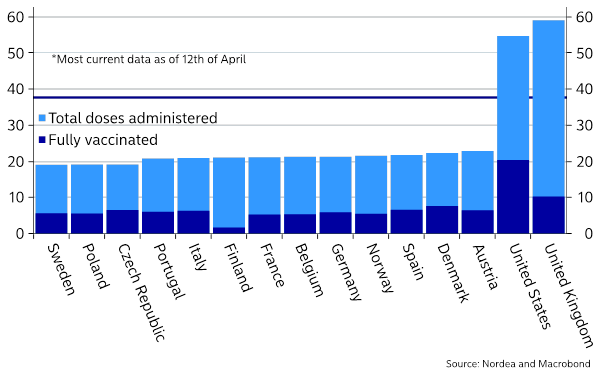
Doses administered and fully vaccinated people as percent of population
Bloomberg:
- The J&J freeze risks fueling vaccine hesitancy. “This is going to scare a lot of people, and rightfully so,” said UNC professor Noel Brewer. Still, “the actual risk is vanishingly small.” At least there’s this: The delay is expected to last just days, and Pfizer and Moderna supplies will be able to satisfy U.S. demand, a person familiar said.
- Pfizer has ramped up production and “can deliver 10% more doses to the U.S. by the end of May than previously agreed,” its CEO tweeted. Meanwhile, Moderna’s shots remained more than 90% effective after six months, according to a new analysis of the company’s final-stage trial. Plus, mouse studies showed that several strain-specific vaccines and boosters the company is testing produced higher levels of antibodies against variants.

Data: CDC and Simon Willison. Chart: Danielle Alberti/Axios
US pushes Japan to back Taiwan at Biden-Suga summit Washington seeks joint statement of support as it courts allies to counter China
The Unlikelihood of War With China and Russia (by George Friedman)
(…) An invasion of Taiwan would obviously be an amphibious operation. One of the principles of war is the value of surprise. Surprise is particularly important in an amphibious assault. (…)
There’s also the issue of distance. Some 100 miles (160 kilometers) of water lay between China and Taiwan. Assuming a direct line of attack, the attack force will be at sea for about five hours. (…)If Chinese troops successfully land, and if Taiwanese troops are forced to cede ground, supply and reinforcement will pose an enormous problem for the Chinese. At this point, the landing point would be known, and the routes needed to resupply Chinese infantry mapped. Resupply and reinforcement by aircraft would not be enough. So even if the initial landing took the beach, the resupply problem would cripple Chinese operations. (…)
China must win fast if it is to use the attack as a lever to intimidate the region.
This is the ultimate problem for China. In any war you can lose. A victory would turn China into a genuine, not notional, superpower. A defeat would shatter that dream. In addition, the U.S. might choose to counter an invasion with simultaneous actions in chokeholds critical to China, such as the Strait of Malacca, or at Chinese ports. The Chinese could not control the U.S. response, which might include (or theoretically substitute for a Taiwan strategy) seeking to paralyze China’s maritime trade. This coupled with hostile economic actions by Europe would make anything but a stunningly rapid victory, potentially crippling.
(…) China is aware of this, which is why they forfeited surprise. They do not intend to invade Taiwan. Alternative islands are somewhat (only somewhat) less risky. (…)
Russia is in the process of trying to recreate the strategic depth that it had for centuries and lost when the Soviet Union collapsed. So far, it has reached a dominant position in Belarus and managed to emerge from the war in Nagorno-Karabakh with a sound political position as well as peacekeepers deployed. This means, respectively, that it has strengthened its position on the western path over the North European Plain, and that the entry point in the Caucasus has been shored up with soft, political moves.
There is a third line of attack into Russia, via the Carpathians or, more precisely, Ukraine. Of all the buffers Russia lost in 1990-91, none is more critical to Russia than Ukraine. The Russians have attempted soft maneuvers designed to change or shift the alignment of the Ukrainian government, but they have consistently failed, both for passing reasons and because Ukraine has a memory of Soviet brutality. Moreover, Kyiv has been bolstered by Western support. This support is cautious in the extreme so as not to provoke Russian fears of an attack, but it is there as a potential reality.
The massing of Russian troops along the border of Ukraine has to be read in this sense. Are the Russians preparing a military operation to retake Ukraine? The problem with such an operation is the vast size of Ukraine. Assuming no resistance at all, which is not likely, it would take weeks for Russia to fully occupy Ukraine, and during those weeks it would have to assume that Western weapons and supplies, and perhaps troops, would pour in.
An extended campaign by Russia would do more than prove costly; it would leave other Russian interests short of defenders. The status of Belarus might be challenged, as well as the Russian position in the Caucasus. The emergence of Russia against the borders of a range of NATO members, from the Baltics to Slovakia, Hungary, Romania and Bulgaria, would likely revitalize NATO, driving much of Europe from its strategic complacency and toward panic.
There is no question that Ukraine is critical for Russia, and a revitalized NATO might be a small price to pay for it, but Russia faces the same problem as China: It could lose. Russia has a vast army, but as with the Soviets, only parts of it are effective. And as with the Soviets, Russia’s ability to support a massive armored force logistically is unknown. (…) should the U.S. and NATO rapidly arm Ukrainian forces with anti-tank and anti-air weapons, and support them logistically, a quick win could become a long battle. This would particularly prove true if U.S. aircraft, optimized for anti-armor warfare, were thrown into the battle. Turkey, seeing an opening, might test Russian forces in the Caucasus, and Poland could move in on Belarus.
None of this is certain, but Russian planners must be taking these possibilities seriously. Optimists rarely win wars, and Russia has learned not to be optimistic. It could find itself bogged down in Ukraine, hammered with advanced weapons and facing attacks on its flanks. In other words, it could lose. What’s more, starting a war in Ukraine would mean sacrificing economic possibilities in Europe.
Now, a war is possible. Russia has used military exercises as cover for war before, namely, with Georgia. But Georgia is small and Russia didn’t take all of it. Ukraine is startlingly big, and I suspect its forces will have training on U.S. weapons that have not been distributed out of concern for Russian fears – but they could be rapidly distributed in the event of war.
There is, then, the possibility of coordination between Russia and China. On the surface this is reasonable. In practice it would have little effect. A war with China would be a naval war. A war with Russia would be a ground war. There would be no contest for troops between regions, only for supplies, and only if both wars were extensive, which is doubtful. The two at war with the U.S. at the center would not achieve a dilution of forces, nor could Russia or China support the other. Russia cannot supply meaningful naval support, and China cannot sustain meaningful ground forces at that distance. An alliance to launch a war together would of course panic the U.S., but the U.S. has been good at using panic to mobilize the public.
So in my view the likelihood of war, let alone a coordinated war, is low. Neither China nor Russia is so desperate as to risk defeat or a long, bleeding war. And each is acting as if it is not serious about war; instead, they are advertising the threat. Of course, all things are possible, but this seems farfetched.
How People Get Rich Now (Paul Graham) Of the 73 new fortunes in 2020, 56 derive from founders’ or early employees’ equity and 17 from managing investment funds.