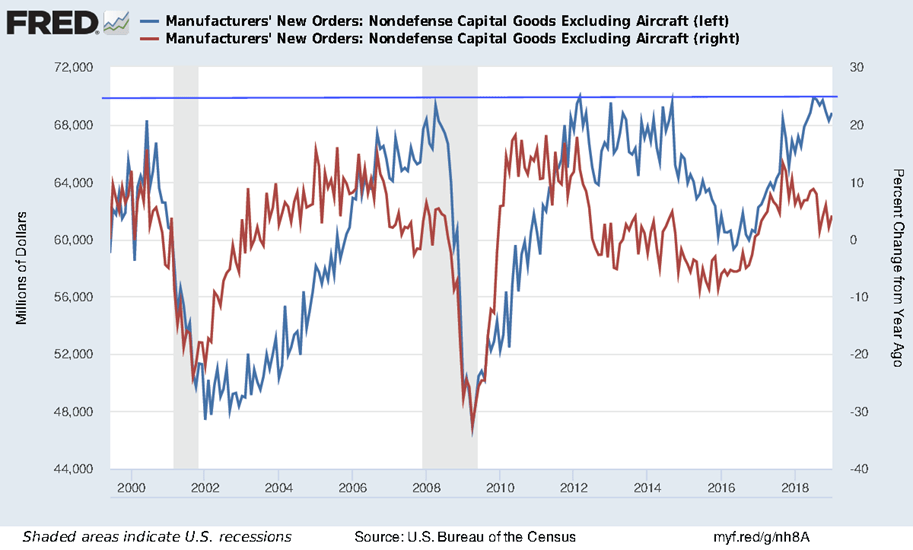
U.S. Durable Goods Orders Rose in January Gain driven by a sharp rise in orders for civilian airplanes
Overall orders for durable goods, manufactured products intended to last at least three years, increased a seasonally adjusted 0.4% in January from the prior month, the Commerce Department said Wednesday. The gain, marking the third consecutive increase, was driven by a sharp rise in orders for civilian airplanes.
When removing transportation, orders declined at a 0.1% pace. (…) An underlying measure of business investment, new orders for nondefense capital goods excluding aircraft, climbed 0.8% from December, the strongest pace since last summer. (…)
It may be the strongest MoM pace since last summer but it comes after 2 very negative monthly drops totalling –2.0%. Previous cyclical peaks still seem solid, Still up 4.1% YoY but down 1.5% from July 2018.
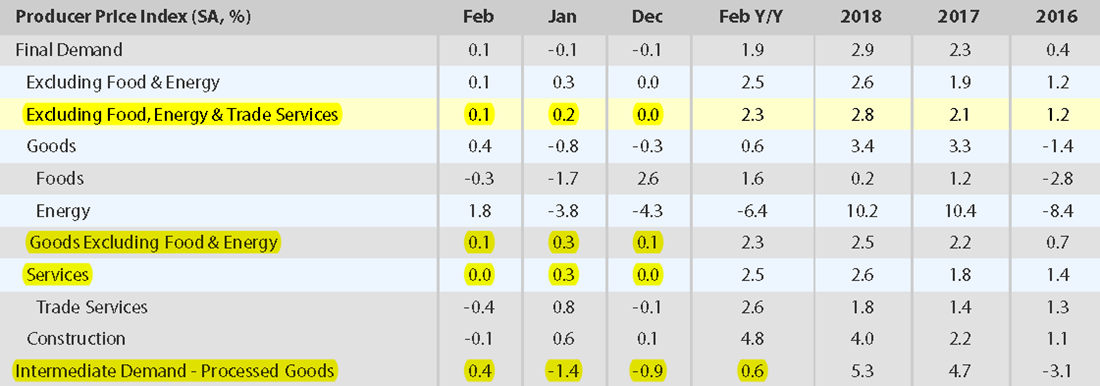
U.S. Producer Prices Remained Tame in February Producer-price index rises 0.1%, driven mostly by higher energy prices
When excluding the often-volatile food and energy categories, prices were up 0.1% in February from the prior month. Prices excluding food, energy and a volatile gauge of margins called trade services also rose 0.1% last month.
From a year earlier, overall prices were up 1.9% in February, while prices excluding food and energy rose 2.5% and prices excluding food, energy and trade services climbed 2.3%. (…)
As Haver Analytics’ table reveals. PPI inflation is pretty tame and the pipeline suggests more of the same for a while. Core goods inflation is holding steady around 2.0% however.
China’s Economic Slowdown Broadens, Despite Government Support Industrial activity and home sales cooled in the first two months of the year, despite a rebound in investment driven by Beijing to shore up growth.
(…) Value-added industrial output, which measures the economy’s manufacturing, mining, utilities and other output, rose 5.3% in the January-to-February period from a year earlier, slowing from a 5.7% year-over-year increase in December. Home sales by value climbed 4.5% in the two months from a year earlier, sharply down from last year’s 14.7% gain. (…)
Getting an accurate read on the state of the Chinese economy is trickier at the start of the year because the timing of the long Lunar New Year holiday shifts, so economists often combine the January and February data for a clearer picture.
Smoothing out those distortions, the National Bureau of Statistics said that industrial output increased 6.1% in January and February, from a year earlier. (…)
A national urban survey unemployment rate inched up to 5.3% in February from December’s 4.9%; January’s figure wasn’t released. Beijing aims to keep the unemployment rate at about 5.5% this year. (…)
Overall fixed-asset investment outside Chinese rural households rose 6.1% over the two-month period from a year ago. Infrastructure investment rose 4.3% in the first two months, accelerating from a 3.8% growth last year.
(…) Property investment, including in commercial and residential real estate, rose 11.6% in the first two months of the year from a year earlier, compared with 9.5% for all of 2018. (…)
Mr. Mao, the bureau spokesman, said developers rushed to purchase land and accelerated construction, leading to the boost in property investment.
Retail sales climbed 8.2% in the first two months from a year earlier, holding steady from December’s on-year growth, as economists had expected. (…)
-
China: Data shows fiscal stimulus is working (ING)
Fixed asset investment increased by 6.1% year-on-year, year-to-date in February, faster than the 5.9% rate in December.
Infrastructure investment grew 4.3%YoY YTD in February, 0.5 percentage points higher than the average rate in 2018. Road and transport investment, which is the main category of investment funded by local government special bonds, rose 13%YoY YTD, an increase of 4.8 percentage points from the average 2018 rate.
Faster growth in these areas helped to mitigate slower growth in the manufacturing sector.
The impact of fiscal stimulus on infrastructure investment is likely to become even more obvious as the year goes on, and will be the main driver of economic growth in 2019. This will be particularly true if there is no imminent agreement on a trade deal.
Real estate development rose by 11.6%YoY YTD in February from 9.5% in December. Within that, residential property development grew 18.0%YoY YTD, making up 72.1% of total real estate development. This is due to the fact that some local governments have started to relax home buying measures, with lower mortgage rates, taxes and down payments as well as fewer purchasing restrictions.
We are likely to see more local governments relax home buying policies to support growth.
Retail sales growth was flat at 8.2%, with consumers more cautious about buying expensive items; jewellery grew just 4.4%YoY YTD and auto sales essentially shrank by 2.8%YoY YTD. (…)
Taking into account the Chinese New Year, industrial production grew 6.1%YoY YTD. If you exclude this factor, however, the growth rate went down to 5.3%YoY, while the previous data was 5.7%YoY.
Our preferred gauge, the production of industrial robots fell 11.0%YoY YTD, and production of automobiles continued to shrink, by 5.3%YoY YTD, while new energy vehicle production rose 53.3%YoY YTD.
We are cautious about this data because factories close for three weeks or more during the Chinese New Year, and the holiday fell into different calendar months for 2018 and 2019, so the base effect is an issue when calculating year-on-year numbers. We can draw better conclusions about the manufacturing sector’s growth rate when we have the March data.
Overall, the activity data shows us that the economy has started to rely on fiscal stimulus, especially for infrastructure investment. This will continue for the rest of 2019, and will be particularly important if a trade deal comes later than expected.
The data was somewhat weak but that could be a result of the Chinese New Year’s base effect. We suggest waiting for March to confirm this weakness.
Looking at the data as a whole, our GDP growth forecasts at 6.3% for 2019 and 6.2% for 1Q19 remain intact.
(…) Most important, official data showed vacant, unsold residential floor space rising for the first time in two years—a sign the fall in inventories that has served as a key support for new construction since 2016 is probably at an end. The gap between investment growth and sales growth—11.6% and negative 3.2%, respectively—was wider than in all but one month since early 2015. The combination of strong investment and weak sales suggests restocking, and is unlikely to be sustainable.
Inventories remain low compared with the enormous glut of 2014, which presaged the next year’s housing slump. That suggests the looming downturn will be shallower too, as long as policy makers don’t try to delay the pain by opening the stimulus floodgates for another building spree. (…)
China and U.S. to Push Back Trump-Xi Meeting to at Least April Despite claims of progress in talks by both sides, a hoped-for summit at Trump’s Mar-a-Lago resort will now take place at the end of April if it happens at all.
China Calls for U.S. and European Companies to Join Belt and Road
China pledged greater cooperation with American and European companies on Belt and Road ventures, in its latest bid to counter criticism that President Xi Jinping’s initiative is focused on projecting Beijing’s influence at the expense of host countries.
China wants to combine its manufacturing and construction know-how with the advanced technology of Western firms on the global trade-and-infrastructure program, said Zhou Xiaofei, deputy secretary general of the National Development and Reform Commission. Projects could also benefit from partnerships with U.S. and European enterprises on professional services, management and financing, Zhou said Thursday. (…)
China customs lifts suspension on Tesla Model 3 imports
Why the Worst May Already Be Over for the Global Economy
(…) “Put the Federal Reserve pause, trade truce, and China stimulus together and we’re looking for a trough in the first quarter and very moderate pick up ahead,” said Tom Orlik, chief economist at Bloomberg Economics. (…)
After touching a 2 1/2-year low in December, the Bloomberg U.S. Financial Conditions Index — which measures the overall level of financial stress in money, bond and equity markets — has since rebounded. (…)
An easing in U.S. dollar strength versus 2018 has also given relief to emerging markets, taking some pressure off policy makers to guard against capital flight. Credit numbers for China and Japan in February were up strongly from a year ago. (…)
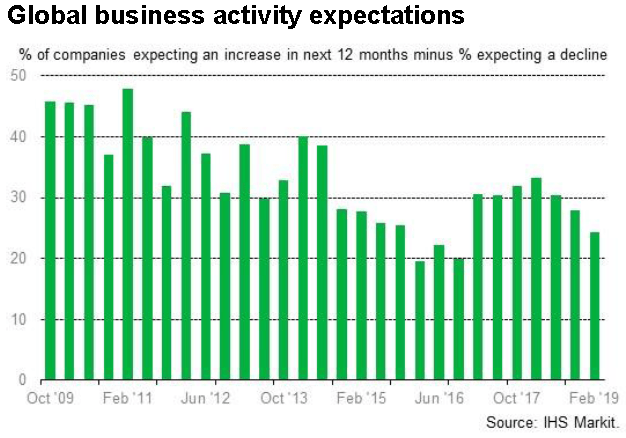
 IHS Markit Global Business Outlook Global optimism at near two-and-a-half-year low
Worldwide confidence surrounding the outlook for business activity in the year ahead has waned further in 2019. February data indicate that worsening sentiment in developed markets underpins the gloomiest global picture for almost two-and-a-half years, while developing markets’ optimism has improved to a one year high.
At +24% in February, the net balance of global firms predicting output growth in the coming 12-month period is the lowest seen since October 2016. The IHS Markit Global Business Outlook Survey – based on responses from a panel of 12,000 companies – show a considerable loss of optimism in developed markets (net balance down from +31% in October to +25%), while confidence in developing nations has strengthened since late last year. (…)
Only firms in Spain and China are more upbeat compared to the prior survey (conducted last October), although sentiment among the latter is still the second lowest globally. Confidence levels are unchanged in France, Russia and India. Prospects are the brightest in Brazil and the darkest in Japan. (…)
Aggregate profits look set to expand in the coming 12 months, but sentiment has sunk to a near two-and-a-half-year low. Global service providers are more positive regarding future earnings than manufacturers, although optimism has weakened in the former and strengthened in the latter.
Inflationary pressures are expected to subside. At +19% in February, the gauge for non-staff costs is the lowest since October 2017. Downward revisions are evident in both the manufacturing and service sectors. By comparison, the net balance of global firms predicting higher staff costs is at +25%. Selling price intentions have been revised lower or left unchanged in all 12 monitored countries.(…)
Despite waning to a two-year low in February, sentiment in the US is among the highest across developed economies, lower only than that recorded in Ireland. A similar picture is noted for profit forecasts, which are the lowest since February 2017 but still the highest seen across all developed economies. In both cases, levels of confidence at service providers and goods producers are similarly upbeat.
Hiring intentions have hit the lowest since mid-2017, though remain in line with the long-run average. At the same time capex plans have been revised lower, as have plans around R&D spending. Trends for price expectations are similar to late last year, with anticipated growth of non-staff costs and selling prices the lowest since October 2017. (…)
Eurozone optimism has sunk to the lowest in almost six years during February. In the manufacturing sector, output expectations have dipped to the lowest since October 2012, while sentiment in the service economy is the weakest since October 2014. At the composite level, all indicators have fallen, signalling waning confidence for profits, hiring and capex, as well as downward revisions to inflation expectations.
Predictions of sharp cost rises have dragged profit projections to the lowest in nearly eight years. Output expectations in Germany and Italy are down to the lowest since October 2012, while sentiment in France is unchanged from the two-year low noted in the prior survey period.
Political instability, US-imposed tariffs, trade tensions, automotive sector weakness, unfavourable tax policies, aggressive competition, cost inflation, interest rates, civil protests, subdued client confidence, shortages of skilled labour and fears of a global growth slowdown have all weighed on sentiment. (…)
Chris Williamson, Chief Business Economist at IHS Markit:
(…) whereas increased gloom late last year was fuelled principally by rising concerns in the manufacturing sector regarding trade protectionism, the recent worsening reflects weakening confidence creeping into the service sector.
This broadening out of the deterioration in sentiment suggests the global economy is facing increased headwinds and supports the expectation that global economic growth will weaken in 2019. (…)
The biggest drop in confidence compared to late last year was seen in the US, though marked declines were also recorded in Germany and Italy as well as the UK. The changes leave US optimism at its lowest for two years, while sentiment in the euro area has slumped to its lowest since 2013. Brexit anxiety has meanwhile contributed to UK business confidence running the lowest since data were first collected in 2009.
A slight uptick in business prospects in China and largely unchanged sentiment in India, Brazil and Russia meanwhile helped pull emerging market optimism marginally higher, contrasting with the darker picture seen across the developed world.
 DoubleLine’s Jeffrey Gundlach says we’re on a “highway to hell” and a bear market:
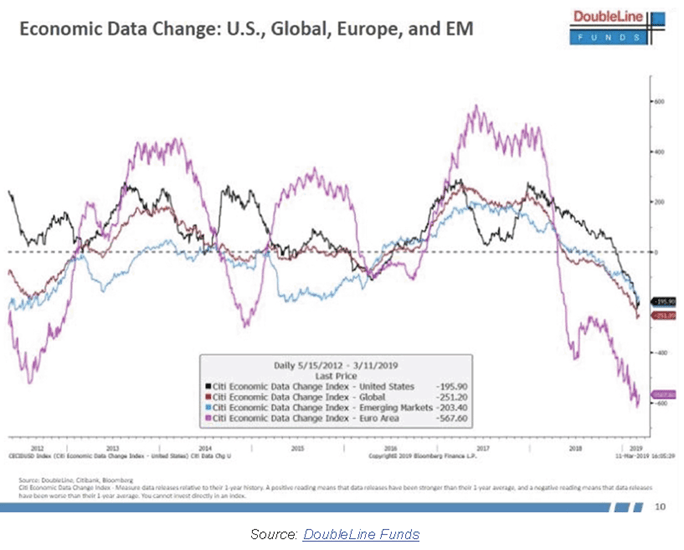
TECHNICALS WATCH
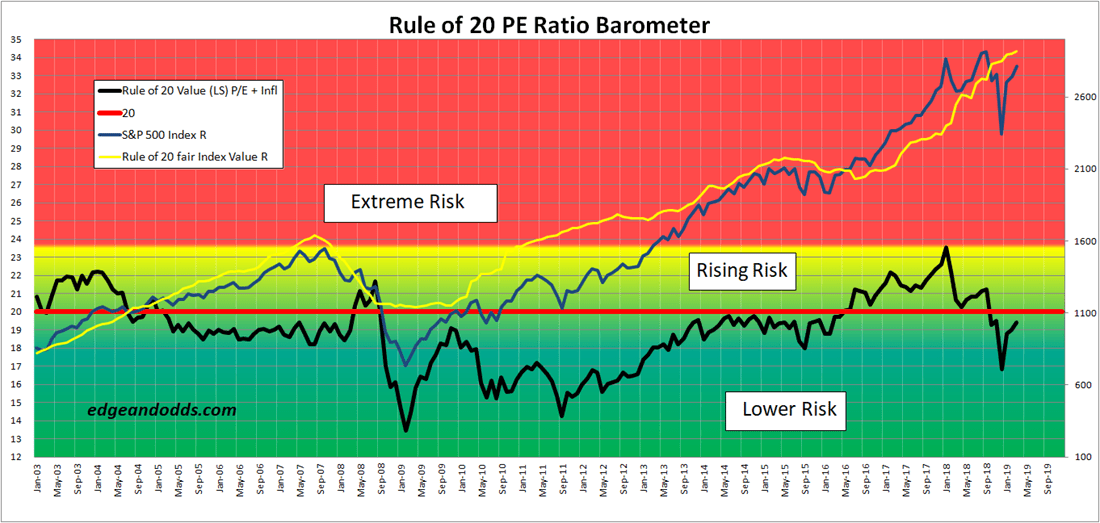
Mr. Market seems to pay little heed to Gundlach’s views, at least looking at the S&P 500 Index. U.S. Small cap indices, as well as most world markets, look more “hellish”.

The Rule of 20 P/E is at 19.4. “Fair Value” is 2915. Four weeks away from the start of the next earnings season which looks to be on the weak side of things, valuations look set for marking time like in 2014-2016 until a catalyst triggers another direction, up or down. Sitting on a fence never feels comfy, does it?