Fauci tells Americans to ‘hunker down’ this fall and winter, and neighborhoods that were redlined are more vulnerable to COVID-19, research suggests
(…) “We’ve been through this before,” he said. “Don’t ever, ever underestimate the potential of the pandemic. And don’t try and look at the rosy side of things.”
And he disagreed during an MSNBC interview on Friday with President Donald Trump’s insistence that the country has rounded the final turn in the pandemic. “I’m sorry, but I have to disagree with that,” he said, pointing to the “disturbing” statistics showing the country plateauing at about 40,000 new COVID-19 cases a day. He also expressed concerned about a possible surge in cases following the Labor Day weekend.
Fauci joined other health experts in expressing concern about the “unacceptably high” number of COVID-19 cases in the U.S. as the country heads into the flu season. Fauci wants to see this baseline down at 10,000 or less before influenza begins picking up in October. (…) “I keep looking at that curve, and I get more depressed and more depressed about the fact that we never really get down to the baseline that I’d like,” he said. (…)
And a New York Times review of 203 counties in the country where students make up at least 10% of the population found that new COVID-19 cases per capita are twice as high in college towns as the rest of the country. It should be noted, however, that it’s not clear how many cases are definitely tied to campus outbreaks, or whether extra testing in college communities could be driving the higher case counts. (…)

Canada Reports Zero Covid Deaths for First Time in Six Months
Population: USA: 328M, Canada: 38M. USA/Cda: 8.6x.


Israel to Shut Down Again as Second Wave Hits
Defying Nevada regulations, President Trump yesterday hosted his first indoor rally since June, telling a packed, nearly mask-less crowd in a warehouse in Henderson that the nation is “making the last turn” in defeating the virus. — AP (via Axios)

Photo: Jonathan Ernst/Reuters
As U.S. Gets Closer to COVID-19 Vaccine, Fewer People Say They’d Get One
In early April, 72 percent of U.S. adults said they would get vaccinated if a COVID-19 vaccine became available, a quick climb from 64 percent in a Feb. 28-March 1 poll, when Morning Consult began its weekly tracking of the vaccination question. Now, only 51 percent of U.S. adults say that they would get a COVID-19 vaccination, representing a decline of 21 percentage points over the past five months. This includes double-digit decreases among men, women, Democrats, Republicans, independents, residents of urban, suburban and rural environments and respondents of all levels of education.
When will a COVID-19 vaccine become widely available?
According to the Good Judgment group, “the pause in the AstraZeneca (aka “Oxford”) trial has had minimal impact on the Superforecasters’ expectations. As one Superforecaster® put it: Positive news of Sinovac and Pfizer more important than the Oxford glitch. October, no, but many are hopeful for next year.” The Superforecasters put a 65% probability (69% on Saturday) of a vaccine capable of inoculating 25 million Americans before March 31, 2021.
There are 7 vaccines currently in phase 3 trials and “according to this study, 73% of phase 3 trials of infectious disease vaccines were successful between 2006 and 2015. There haven’t been any successful SARS or MERS vaccines, but there also haven’t been any phase 3 vaccine trials for SARS or MERS vaccines, so it’s hard to know how to interpret that.”
BTW, the same Good Judgment group currently sees
- a 73% probability that Biden will be elected and 66% odds that Democrats will control the House and the Senate.
- a 48% probability that U.S. holiday season retail sales will be down 4-8% YoY (June-July retail sales were up 1.5% YoY).
- 5% odds of the U.S. unemployment rate falling below 6% by June 2021 (August: 8.4%).
- a 53% probability that the S&P 500 will close between 3110 and 3675 on June 30, 2021.
AstraZeneca Covid-19 Vaccine Trials Resume in U.K. The company has ended a pause in clinical trials for its experimental coronavirus vaccine in the U.K. after regulators concluded it was safe to do so. The trials were halted globally after a person who received the vaccine had an unexplained illness.
Pfizer Inc. Chief Executive Officer Albert Bourla said it’s “likely” the U.S. will deploy a Covid-19 vaccine to the public before year-end, adding that he is “quite comfortable” that the vaccine his company is developing with BioNTech SE is safe. (Bloomberg)
Not enough Covid vaccine for all until 2024, says biggest producer Serum Institute warns that companies are not increasing production capacity quickly enough
Global Economic Recovery Shows Signs of Slowing The global economy is bouncing back strongly from the dramatic collapse it suffered in the spring, but fresh data suggest the early gains from the lifting of coronavirus lockdowns are already exhausted.
(…) Business surveys indicate that the global recovery continued for a fifth straight month in August. A key measure of business activity in 45 countries, compiled by data firm IHS Markit on behalf of J.P. Morgan and based on responses from purchasing managers, hit a seven-month high.
But there were signs of fragility as fresh outbreaks of the virus prompted new restrictions and additional caution among consumers, with declines in activity recorded in Japan, India, Australia, Kazakhstan, Spain and Italy. Between them, those countries account for 15% of world output.
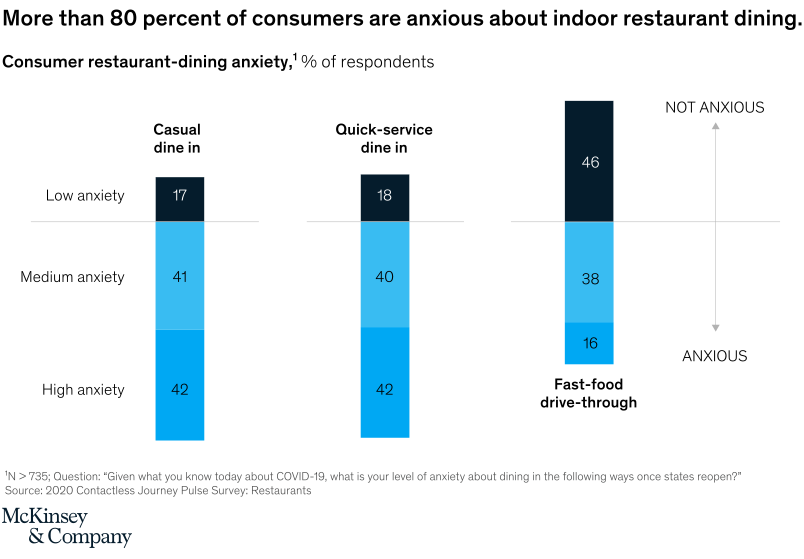
Most Americans aren’t comfortable eating inside a restaurant yet
Amazon to Hire 100,000 in U.S. and Canada Amazon is continuing its hiring spree due to the jump in online shopping with new full- and part-time positions that will pay at least $15 an hour and include benefits and signing bonuses of up to $1,000 in some cities.
(…) The company added 175,000 warehouse workers in March and April, 125,000 of whom Amazon said in May it would keep permanently. Last week, the company announced 33,000 vacancies for corporate and technology positions. (…)
Although not net job gains for the economy since AMZN sales gains are not net sales gains for the economy.
The $600 per week boom (and bust) – how the unemployment stimulus affected consumer spend
Consumers who received the $600 weekly unemployment benefit between mid-April to the end of July, increased their spend significantly more than those who did not receive this benefit. Now that these benefits have expired, those who received the benefit are reducing their expenditures once again.

Congress does not seem to be aware of the above…The above chart from Cardify is somewhat dated. Thankfully, Goldman Sachs has the means to keep us up-to-date (straight lines are mine).

The May-to August splurge in spending by UI-Beneficiaries is truly remarkable, reaching levels 20% above pre-pandemic levels. At the peak in May, more than 32 million Americans received governmental aid. The $1200 stimulus checks sent to other people making less than $75k boosted the blue line. “We’ll se what happens now.”
SENTIMENT, TECHNICALS AND EARNINGS WATCH
This BB piece pretty much exudes the positive sentiment out there:
Stock Sound and Fury So Far Failing to Signify This Rally’s Doom
(…) A closer look at market trends — particularly its ability to hold above levels that denote upward momentum — suggest what has happened can be categorized as a correction to prevailing froth rather than a full-blown reordering of sentiment.
To wit: even with a decline of almost 7% over five sessions through Thursday, the S&P 500 managed to hold firm above its 50-day moving average, a feat not seen since 1934. Similarly, for the first time since the dot-com era, the Nasdaq 100 suffered a 10% correction within a week without breaching its 100-day average. (…)
While things could of course get worse, for now, a consensus holds that with earnings sentiment improving and the Federal Reserve expected to stick to its dovish stance, this rout remains more of a hiccup than a life-threatening event. (…)
To put it mildly, retail investors aren’t convinced the rally is over. Evidence of this view includes flows to various exchange-traded funds, including not just deposits but seven straight days of deposits in a security whose return profile is that it pays three times the Nasdaq 100. (…)
Whatever technical forces behind the selloff, bulls were quick to point out that the fundamental story is intact. Earlier this week, Goldman Sachs Group Inc.’s strategists including Christian Mueller-Glissmann and Alessio Rizzi. raised their short-term view on stocks, urging investors to increase holdings partly because the economic outlook will be better than what’s priced in the markets.
Two months into this quarter, analysts have been busy ratcheting up their earnings estimates. S&P 500 profits for the June-September period are expected to reach $32.65 a share, data compiled by Bloomberg Intelligence show. While that’d be a 23% decline from a year ago, the forecast is up 3.4% from the start of the quarter, marking the first time since early 2018 that earnings sentiment improved at this time of a reporting cycle. (…)
Amid the turmoil, there were few signs of capitulation. Retail investors, whose hand-over-fist buying this summer supported one of the fastest rallies ever, continued to build up positions via options and stocks, separate data from JPMorgan Chase & Co. and TD Ameritrade Holding Corp. showed. Hedge-fund managers bought the dip in tech stocks Friday and Tuesday at the fastest pace in five months, according to data compiled by Goldman’s prime-brokerage unit. (…)
Maybe you missed the subtlety but the author above omitted to mention that the Nasdaq 100 closed below its 50dma on Friday.
Lowry’s Research keeps its constructive “intermediate” stance, pointing out that the decline so fare has been rather narrow (“the biggest winners have become the primary losers” and “small caps have outperformed”). However, Lowry’s also sees “little tangible evidence of an end to the consolidative period”, highlighting the need for renewed Demand. Its Buying Power Index declined 12 points last week after losing 17 points in the 2 weeks previous. Meanwhile, Selling Pressure keeps crawling up and is only 14 points away from a dominating position.
SentimenTrader looks at Nasdaq Up Volume Ratio which has just slid below 50%, “ending the Nasdaq’s 3rd-longest streak in 35 years with 10-day Up Volume above 50%.”

As I wrote before, a Demand renewal will not come from valuations, even less so on the Nasdaq high flyers. The S&P 500 Index is selling at 23.0 times trailing and forward earnings (they are the same) and 20 times 2021 estimates ($166). Let’s be really forward looking and use Goldman Sachs” $188 estimate for 2022: we are paying 17.8x thirty-month forward estimates, where the red line stands below.

The Rule of 20 P/E is now 24.7 using trailing EPS of $145.35 and inflation of 1.73%. (See FEARFUL FEARLESSNESS). Anyway you try to shape it, this is an expensive equity market. If I plug $166 as trailing EPS, the R20 P/E is 21.9, 10% overvalued on earnings 18 months away.

It has been a while since I wrote about earnings. We now have 499 Q2 reports in, a 83% beat rate and a +22.9% surprise factor with only 2 sectors, R.E. and Energy, surprising negatively.
In total, Q2 earnings are down 30.2% vs -43.0% expected on July 1. Revenues dropped 8.7% (-11.8% expected). Ex-Energy, earnings are down 23.5% and revenues were down 4.0%.
Analysts keep revising upwards, pretty much across the board:


And while much fewer companies offer guidance, 54% of those that have were positive, up from 40% at the same time during Q2’20.

Given the above, it is surprising that Q3 estimates have not improved more than going from -25.0% on July 1 to -22.3%. Actually, Q4 estimates are now -13.7% vs -13.2%. So analysts are revising up but pretty shyly.
In total for all of 2020, earnings are now seen falling 19.9% to $130.05, only slightly better than the -23.5% expected on July 1.
The Popular Trades Behind the Market’s Swoon and Surge Investors are trading stock options and chasing fast-rising shares at record rates, activity that’s expected to jolt markets through the coming election.
A surge in options trading targeted at giant tech stocks by both small and large investors is magnifying the market’s ups and downs. Investors are also simply buying shares that are going up, a strategy that can create its own wild swings in the market. (…)
The new money can make options and momentum strategies self-fulfilling, drawing in additional money hoping to cash in on the gains.
The volume of trading in single stock options recently topped the volume of regular shares for the first time, according to a Goldman Sachs analysis of notional shares and options traded. As of the end of August, single stock options volume made up more than 120% of the volume of shares, up from around 40% three years ago. (…)
Investors turned so bullish on stocks like Tesla and Apple that it cost more to bet on gains in the stock than hedge against declines, a rare occurrence.
Asian investors have emerged as new buyers of Tesla and tech stocks, says David Bailin, global head of investments for Citigroup’s private bank, which caters to wealthy clients. Those clients increased their net exposure to technology companies by 12% over the past year, Mr. Bailin says. Asian investors also are becoming more optimistic about Tesla because of its new Chinese factory and a rising interest in electric cars, Mr. Bailin says. (…)
Exchange-traded funds trading based on momentum have seen their assets under management jump to about $18 billion this year, a 16% increase from last year and the highest level of the past decade, according to FactSet data as of Aug. 31. (…)
Just over a week ago, though, as tech and other expensive shares began showing signs of weakness, momentum traders went from buyers to sellers, says Nikolaos Panigirtzoglou, a global market strategist for JPMorgan Chase.
But individuals trading options seemed undeterred by the selloff. “Small option traders saw last week’s correction as an opportunity to add to their call option buying, especially on individual equities,” Mr. Panigirtzoglou wrote in a note to clients.
Almost Daily Grant adds:
Retail investors have taken control of South Korea’s stock market, accounting for 87.5% of trading volumes in the first eight days of September according to exchange data. In March, retail participation stood at 51.4%.
The hobby has been lucrative, as the benchmark Kospi Index is up a cool 65% from its March nadir. “Retail investors appear to be seeking short-term profits after hearing their next-door neighbors earned lots of money from stocks after the March selloff,” Yoo Seung-Min, chief strategist at Samsung Securities Co., tells Bloomberg.
Retail has a bit less stock market muscle stateside, accounting for roughly 20% of trading volume over the first six months of the year. That is however a notable jump from the steady 15% retail share over the last five years.
Some look to get that Main Street participation level a bit higher. Twitter user @HotlantaCapital posted a photo of the following deal this morning:

Goldman, Deutsche Say U.S. Stock Selloff May Be Close to an End
(…) Its magnitude has matched a “typical” selloff in the S&P 500 since the financial crisis, albeit at a faster pace, wrote a team led by Goldman’s David Kostin in a note Friday. And options positioning — at the core of the weakness — has normalized, noted their counterparts at Deutsche including Srineel Jalagani the same day. (…)
“Since the financial crisis, the typical S&P 500 pullback of 5% or more has lasted for 20 trading days and extended by 7% from peak to trough, matching the magnitude of the most recent pullback if not the speed.” (…)
Meanwhile, the Deutsche team focused on the impact of the options market, using a metric that looks at the number of bearish contracts relative to bullish ones. It had fallen to the bottom of its 10-year range — indicating an extreme level of positive sentiment — but after the correction has already recovered to “about average” levels, the team said.
“Historically, corrections in the put-call ratio have tended to have sharp but short-lived market impacts,” the strategists wrote.
Still, both teams pointed to the U.S. elections as the key source of uncertainty for markets ahead.
“Investors still have to contend with the upcoming macro event of the U.S. presidential elections,” the Deutsche strategists warned. “With a likely unprecedented volume of mail-in ballots, prospects for volatility enduring post-election day are high.”
John Authers is not so sure about the calm in options (FT):
(…) It is just possible that a lot of speculation, largely placed by making bullish bets on individual stocks in the options market, has now unwound. However, it would be unwise to bet on it. As this chart from Deltec Bank & Trust Ltd. shows, trading in options has in the last two months outstripped trading in underlying cash equities for the first time on record. There aren’t too many good precedents for this, then. It would probably be wise to assume that there are more shoes to drop before calm is restored: (…)

Newton’s Law of Stock Momentum As Sir Isaac learned, market pile-ons follow the same pattern. Investor, beware.
Andy Kessler in today’s WSJ:
Does this sound familiar: Smart guy owns a stock in March at $200, sells it in June at around $600, but then buys it back in July and August for between $900 and $1,000. By September it’s back at $200. Ouch. Tesla this year? Yahoo in 2000? Nope. That was Sir Isaac Newton getting pulled into the great momentum trade of the South Sea Co., which cratered 300 years ago this month. He lost the equivalent of more than $3 million today. Newton, whose second law of motion is about the momentum of a body equaling the force acting on it, didn’t know that works for stocks too. (…)
Then there’s this year’s mania, when Tesla’s value hit almost $500 billion a few weeks ago despite no operating profit. Well, it’s certainly the waning days of a long technology bull run that started in 2009 (and lots of short covering along the way). But then add how Covid kept people home and focused on technology, plus no sports to bet on, which left day trading as the only game in town, cheered on by the founder of the Barstool Sports blog. The 13 million newbie investors on the Robinhood app have access to fractional shares and zero-commission trades, all through a gamelike interface that includes a big green “Trade” button. Feeding the speculation are trading ideas on r/wallstreetbets, a Reddit channel with 1.5 million members.
This mass of buyers brought Hertz back from the dead (at least temporarily) and chased after SPACs, or special purpose acquisition companies, which are modern-day blind pools that often don’t end well. Today’s momos also chase stock splits, which mean nothing for a company’s actual value. Same for new listing in indexes like the S&P 500. Isaac Newton could explain the math.
But is that enough to drive stocks to the moon? Maybe, but earlier this month the culprit was revealed, a monstrous hot air blowing bellows. SoftBank, which famously lost billions investing in WeWork, bought $4 billion in options to buy technology stocks, representing some $50 billion in underlying shares. Firms that sold SoftBank the options had to hedge themselves by actually buying shares as they went up. Did you catch that circular reasoning? Like all bubbles, it ends when the money runs out.
Last week the stock market was a roller coaster that many will keep riding. But when you see a source of hot air, the bellows, it’s best to let the last ones in become the last one’s out. I like another old Wall Street adage: Your hand should be trembling when you place a stock order at the ticket window. Same if you click “Trade.” Don’t be a momo.
- “The Tech Bubble Could Get Even Bigger,” Barron’s deputy editor Ben Levisohn reports (subscription): [T]he forces that drove stocks such as Apple and Amazon.com to astonishing heights remain firmly in place. They include the companies’ continued growth, the Federal Reserve’s determination to do whatever it takes to keep the economy afloat, retail investors’ newfound interest in trading, and maybe even a bit of fiscal largess. Stocks will remain volatile, but the tech bubble will continue to inflate.

Blank-Check IPOs in Europe Show Signs of Life The London Stock Exchange seeks to ignite initial public offerings of so-called blank-check companies, which are surging in the U.S.
Gilead Reaches Deal to Buy Immunomedics for $21 Billion The biotech drugmaker has a market value of roughly $10 billion, meaning that Gilead would be paying up for the company and its prized breast-cancer drug
Gilead agreed to pay $88/sh in cash for IMMU, whose shares closed at $42.25 Friday and $22 at the end of 2019.
(…) Immunomedics’s breast cancer drug Trodelvy reached the market in April and generated $20 million in its first two months. That is a promising start, but the hefty deal price cranks up expectations significantly. It is clear why Gilead is willing to take a chance. Its share price is down by 40% over the past five years despite relentless share buybacks. Its hepatitis C franchise, once the envy of the industry, is in decline, and its portfolio of HIV drugs is only growing modestly. Total revenue fell about 10% in the second quarter from a year ago. (…)
The therapy could ring up $3 billion to $5 billion a year in annual sales if it proves to work safely against other cancers, Jefferies & Co. analyst Michael Yee said in a note to investors. (…)
-
Trump Executive Order Takes New Aim at Drug Prices President Trump signed an executive order on Sunday to reduce the cost of prescription drugs for U.S. seniors by more closely aligning prices with what pharmaceutical companies charge in other countries.
Locked-in election
The undecided voter is an endangered species: The presidential election features a shrunken pool of undecided voters after four years of a polarizing, ubiquitous presidency, Axios’ Neal Rothschild writes.
- “Not sure” was just 4 points in the most recent NBC/Wall Street Journal poll, and is in the low single digits in most Trump v. Biden head-to-heads.
Why it matters: Entrenched views mean there’s less reason for campaigns to try to change voters’ minds. Instead, the money goes to trying to convince those already with them to vote.
- It makes for a loud, angry, backward-looking campaign.
A wealth of evidence suggests more Americans have made up their minds by this point compared with years past:
- The conventions had practically no impact on the shape of the race: Biden’s national polling lead (+7.5 in FiveThirtyEight’s average of polls) is just a half-point smaller than a month ago.
There’re still reasons the outcome is uncertain:
- While the polls tell a consistent story, we don’t know how accurate they are.
- Election systems have never dealt with anything close to the expected level of mail-in votes.