RECESSION WATCH
U.S. Initial Unemployment Insurance Claims Rise
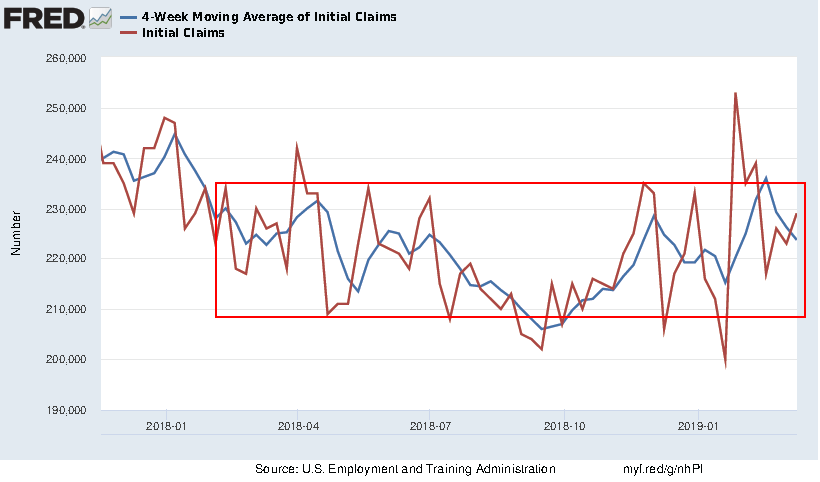
Initial claims for unemployment insurance rose 6,000 in the week ended March 9 to 229,000 from 223,000 the week before, which was unrevised. The Action Economics Forecast Survey projected 225,000 claims for this week. The four-week moving average of initial claims edged down to 223,750 from 226,250 the previous week. (…)
Keeping track of David Rosenberg’s concerns about “forward-looking initial claims”. Back into the 2018 channel after the shutdown:
U.S. New-Home Sales Fell in January Sales drop 6.9%, signaling a weak start to 2019 for housing industry
(…) The rate in December was revised up to 652,000 from an initial estimate of 621,000. (…) Sales of new homes were down 4.1% in January compared with a year earlier. (…)
- Recession indicators remain elevated but are still below the key thresholds. Here is a note from Oxford Economics. (The Daily Shot)

Source: Oxford Economics
Import Prices Strengthen With Higher Oil Costs; Export Prices Move Up As Well
The Labor Department reported that import prices rose 0.6% during February (-1.3 y/y) after improving 0.1% in January, revised from a 0.5% decline. (…) The rise in import prices last month was paced by a 4.7% increase (-7.9% y/y) in petroleum costs which followed a 7.1% gain. Nonpetroleum import costs edged 0.1% higher, but still were down an increased 0.5% y/y. (…)
Export prices also improved 0.6% (0.3% y/y) after three months of sharp decline. A 0.1% uptick had been expected. Agricultural commodities prices rose 0.3% last month (-0.2% y/y) after a 2.1% weakening. Nonagricultural export costs strengthened 0.7% (0.3% y/y) after three straight months of decline. (…)

China’s premier says ready to use more policy tools to help economy The Chinese government has additional monetary policy measures that it can take to support economic growth this year, and will even cut “its own flesh” to help finance large-scale tax cuts, Premier Li Keqiang said on Friday.
China Aims to Placate U.S. With Law Banning Theft of Trade Secrets China made last-minute changes to a foreign-investment law, trying to address U.S. complaints about forced technology transfer and bolster a compromise seen as crucial to striking a trade deal.
(…) The law, which was approved by the legislature Friday, adds language to bar officials from divulging corporate secrets and threatens criminal prosecution for doing so, according to a copy of the draft, dated March 12, which was reviewed by The Wall Street Journal.
The new language takes aim at the regulatory review panels, known as “conformity assessments,” that foreign companies must pass before manufacturing new cars and other products or setting up plants. (…)
By making those changes just before the proposed law was put to a vote, Beijing is hurriedly readying a concession aimed at a key U.S. complaint, according to people briefed on the discussions.
The added clauses, the people said, reflect the proposed text of a trade agreement being put together by both sides. Specifically, China agrees to “eliminate conflicts of interest” in such regulatory review processes, under the current version of the draft trade deal, one of the people said.
How such a pledge will be enforced, along with some other offers made by China, is unclear. U.S. businesses and officials say the review panels are often stacked with officials, experts and others who pass foreign companies’ proprietary information to Chinese competitors.
China skeptics in Washington say these transfers won’t stop unless Beijing changes the government-led industrial policies that drive companies to meet goals to upgrade and that offer subsidies and other incentives to do so. (…)
European Car Sales in February Offer Hope for a Turnaround
Passenger car registrations dropped 0.9 percent compared to the same month last year, the European Automobile Manufacturers Association said Friday. While German, French and U.K. sales rose for the first time since September, registrations fell a sharp 8.8 percent in Spain, which is preparing for a snap election in April, and 2.4 percent in Italy. (…)
Growing debt loads weighing on growth, opening up vulnerabilities, Bank of Canada deputy warns
(…) She said the combined global debt owed by governments, businesses and households now amounts to US$240 trillion, which is US$100 trillion higher than just before the financial crisis and more than three times the world’s gross domestic product.
Government debt, she added, has “skyrocketed” over the past 10 years, while corporate borrowing has “exploded” and now displays some risky qualities. (…)
Canada’s high household debt, which is now more than 178 per cent of disposable income, is the central bank’s top domestic financial vulnerability, she said. (…)
