US retail sales surge on stark weather contrast US retail sales jumped 3% month-on-month as warm weather encouraged people to go out and spend after harsh conditions depressed activity in December. Household incomes remain under pressure and with weather patterns normalising a correction is likely in February
This is the fourth biggest MoM rise in retail sales over the past 20 years. Importantly, the “control” group which excludes volatile categories and better correlates with broader consumer spending was also much stronger than anticipated, rising 1.7% MoM versus the 1% consensus.
We knew autos would be strong (+5.9% MoM) given unit volume figures jumped 18%, but there were huge gains elsewhere with clothing up 2.5% MoM, general merchandise up 3.2% (within which department stores saw a 17.5% MoM jump) and eating & drinking out, which surged 7.2%. The one real surprise was the flat gasoline station sales despite prices having risen by more than 4%. (…)
Remember that December experienced very cold temperatures with heavy snowfall disrupting travel in many parts of the nation. This also depressed spending with November and December both posting 1.1% MoM declines. Therefore we should expect a rebound in January anyway, but then very warm temperatures providing an additional stimulus that tempted more people to leave their homes and spend.
However, we have to be a little cautious that with weather patterns returning to more seasonal norms in February we could get a significant correction next month – especially with household finances remaining under pressure from high inflation and slowing wage growth. Consequently, today’s numbers back the case for a March and probably a May hike, but it shouldn’t push the case for Fed tightening beyond that.
The WSJ Justin Lahart details possible reasons for the strength:
There are several likely factors behind the strength in sales. The first is the job market: With the Labor Department reporting that the economy added a seasonally adjusted 517,000 jobs last month, and that the unemployment rate fell to its lowest level in more than 50 years, more people are drawing paychecks. Despite all of the recent layoff headlines, they aren’t worrying much about getting fired, either, with the Federal Reserve Bank of New York’s monthly survey of consumers still showing that people continue to put low probabilities on the possibility of losing their job.
Another factor: Social Security checks were 8.7% bigger last month, as last year’s jump in inflation led the Social Security Administration to put through its largest cost-of-living adjustment in four decades. That means that roughly 70 million people suddenly had more money coming in the door.
Then there is the pandemic. Unlike last year, the U.S. wasn’t beset by a big Covid-19 wave in January. To the contrary, there were fewer recorded cases last month than in December. As a result, people continued to re-engage in activities such as in-person shopping, heading into the office, and travel. Month-to-month retail-sales growth isn’t benchmarked to last year’s pandemic January, but the drop in cases and contrast in mood certainly could have had a psychological effect on spending. The category that saw the biggest gains in Wednesday’s report was food services and drinking places, where sales rose by 7.2% from December. That is notable because it is the only services category within the report, and Americans spend more on services than they do on goods. If restaurants were busier, maybe nail salons and hotels and dentists were, too.
But:
- Some economists believe the January jobs numbers are a statistical mirage that will dispel itself when February and March data are released.
- Bigger social security checks are merely adjusting for past inflation.
- Lahart omits the weather factor which was obvious in January:
- Department store sales jumped 17.5% in January after -6.5% in December. Last 3 months: -3.3% or -12.5% a.r. (+0.7% YoY).
- Restaurants and bars rose 7.2% MoM in January but that came after 0% in December and declining real sales in 6 of the past 8 months. Nonetheless, this particular revenge spending is impressive being up 17.1% YoY in the past 3 months while prices rose 8.3%. Real sales at grocery stores are down 4.2% in the last 3 months.

Nearly a third of the monthly increase in January retail sales came from restaurants and bars. Control sales, which feed into GDP, rose 2.8% MoM (+8.1% YoY) in January. Excluding restaurants and bars, control sales were up 1.7% (+4.4%).
Americans continue to slow their spending on goods. Labor income was up 8.5% YoY in January but total retail sales were up 6.4% and 4.4% excluding restaurants and bars.
Combining data from the latest retail sales and CPI reports, Goldman Sachs estimates that real core retail sales increased 1.2% MoM in January and only +0.4% on a 3-month annualized basis.
- Latest Atlanta Fed GDPNow Q1: 2.42% (was 2.16%)


- Capital One Financial yesterday said that net charge-offs in its credit card division jumped to 3.81% of loans in January from 2.03% in the prior year period, approaching the pre-pandemic baseline of 4.31% in January 2020.
- Discover Financial Services predicted that its net charge-offs will range from 3.5% to 3.9% across 2023 vs 1.82% and 1.84%, respectively, in 2022 and 2021.
China’s new home prices rise in Jan for first time in a year
New home prices in January were up 0.1% month-on-month, versus a 0.2% slide in December, according to Reuters calculations based on National Bureau of Statistics (NBS) data released on Thursday.
More major cities among the 70 surveyed by NBS reported increases in new home prices last month, with prices rising in 36 cities, up from 15 in December. (…)
Prices were down 1.5% year-on-year in January, with the rate of decline unchanged from December. (…)
TECHNICALS WATCH
From CMG Wealth:
 S&P 500 Large Cap Index – 13/34–Week EMA Trend

- S&P 500 Index Daily MACD Indicator: Sell Signal – Short-term Bearish for U.S. Large Cap Equities

YIELDS
 Data: FactSet; Chart: Axios Visuals
(…) Treasury bills are rarely cast as a route to riches, but right now their payouts are nearly as high as a similar marker in the equity space: profits generated by S&P 500 companies. While the comparison isn’t quite apples-to-apples, it’s a model sometimes employed to get a sense of relative value across asset classes.
Specifically, six-month Treasury bills currently yield a hair below 5%, the highest since 2007. Meanwhile, the S&P 500 earnings yield clocks in at about 5.08%. The gap between them is the slimmest advantage that stocks have held since 2001. (…)
Given what short-term debt is yielding right now, the risk-reward of owning them versus the earnings yield of stocks looks better than seen at any time since the great financial crisis, according to JPMorgan Chase & Co.’s Marko Kolanovic. In other words, the spread between the two-year and the equities earnings yield is at the narrowest since 2007. (…)

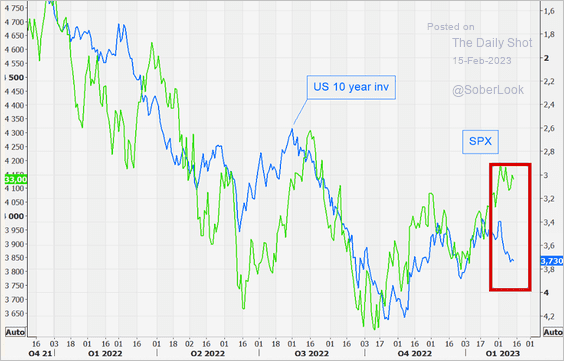
- Stocks have been remarkably resilient in the face of rising bond yields and higher Fed rate hike expectations.
 Source: @themarketear
- CBO Increases Deficit Forecast, Projects Debt Limit Deadline “Between July and September”
CBO is projecting much larger deficits. CBO is projecting a deficit of $1.41 trillion (5.4% of GDP) for FY23, and $1.58trn (5.8%) and $1.75trn (6.1%) for FY24 and FY25 (…), substantially larger than CBO’s prior projection from May 2022, which showed an average deficit of just under 4% of GDP for 2023-2025. (…)
Higher interest rates and lower asset prices (and lower capital gains taxes) were the main factors behind the upward revision to the current year deficit forecast, along with reduced near-term growth assumptions. (…)
CBO projects that the Treasury will exhaust its resources under the debt limit between July and September. (…)
China Hits Back at US with Sanctions on Lockheed, Raytheon
Lockheed Martin Corporation and a subsidiary of Raytheon Technologies Corp were added to a list of “unreliable entities” due to their participation in arms sales to Taiwan, China’s Ministry of Commerce said Thursday. The companies were fined twice the contract value of their arms sales to Taiwan since September 2020 when the list first came into effect and would be required to pay within 15 days, according to the statement.
China considers the democratically self-ruled Taiwan as part of its territory and has long complained about the US supplying weapons to the island. (…)
As with previous sanctions announced against the firms and other US defense companies, these measures are likely to be largely symbolic given both have little direct exposure to China. (…)
This action “shows that China’s retaliation remains very targeted and refrained, responding to US’ arms sales towards Taiwan, over which China has lodged its protest many times in the past,” said Feng Chucheng, a Beijing-based partner at independent consultancy Plenum. “China is not weaponizing its sanctions, which is consistent with China’s longstanding policies.” (…)