THE ART OF THE DEAL
This bad sitcom just keeps on surprising us!
U.S. Debates Lifting China Tariffs to Hasten Trade Deal U.S. officials are debating easing tariffs on Chinese imports as a way to calm markets and give Beijing an incentive to make deeper concessions on trade.
The idea of lifting some or all tariffs was proposed by Treasury Secretary Steven Mnuchin in a series of strategy meetings, according to people close to internal deliberations. They say the aim is to advance trade talks and win China’s support for longer-term reforms.
But Mr. Mnuchin faces resistance from U.S. Trade Representative Robert Lighthizer, who is concerned that any concession could be seen as a sign of weakness, these people said. (…)
In past China discussions, Mr. Trump has sided with Mr. Lighthizer on tariffs, rather than Mr. Mnuchin. But this time, the president has made clear he wants a deal—and is pressing Mr. Lighthizer to deliver one, according to people familiar with the discussions.
“I think we’re going to be able to do a deal with China,” he told reporters Monday.
The U.S. and China are seeking to resolve their dispute ahead of a March 1 deadline. At 12:01 a.m. the following day, tariffs on $200 billion of Chinese goods are scheduled to jump to 25% from the current 10%. The higher levies could batter U.S. importers and further harm an already weakening Chinese economy. (…)
But Mr. Lighthizer has shown some signs of easing his position, say people involved in the talks, including raising the possibility that some tariffs could be reduced if the U.S. strikes a favorable deal on March 1. (…)
Even high-level strategizing about eliminating tariffs represents a striking turnaround for an administration that hasn’t lifted steel and aluminum tariffs on its closest allies and is still threatening them with a 25% levy on car imports. (…)
Presidential adviser Jared Kushner has indicated some sympathy for lifting at least some tariffs, say those tracking the talks, but not on the scale of Mr. Mnuchin. (…)
The WaPo adds:
-
“He’s driving toward a deal,” said one business executive who asked not to be named, to avoid angering the administration. “He wants a deal and may be willing to settle for not very much to get it.”
-
In talks in Beijing this month, Chinese officials offered to increase annual purchases from the United States by about 30 percent, or roughly $40 billion, the business executive said. That figure is consistent with internal administration estimates of U.S. capacity to fill new Chinese orders, the executive said. (…) Chinese officials also expressed doubt that U.S. businesses could meet a sudden spike in orders, especially for liquefied natural gas and crude oil, according to two business executives familiar with the talks.
Sides Hatch Plan to Reopen Chicken Trade
U.S. and Chinese trade officials are in talks to reopen China’s market to U.S. chicken exports as they seek to forge a new trade deal, according to people familiar with the discussions. (…)
If the talks are successful, U.S. meat giants like Sanderson Farms Inc., Pilgrim’s Pride Corp.and Tyson Foods Inc. could begin clawing back some of the business in China, a key market that represented hundreds of millions of dollars in annual sales before a ban was implemented in 2015 in response to an outbreak of avian flu in the U.S.
China’s immense appetite for chicken feet, along with dark meat and other products less popular among Western consumers, has made the loss of that market particularly painful for chicken processors. (…)
-
US shutdown weighs on Trump’s standing with voters President’s approval rating slides as parties seek to avoid political fallout
Sitcom watchers in need to make decisions are confused, to say the least.
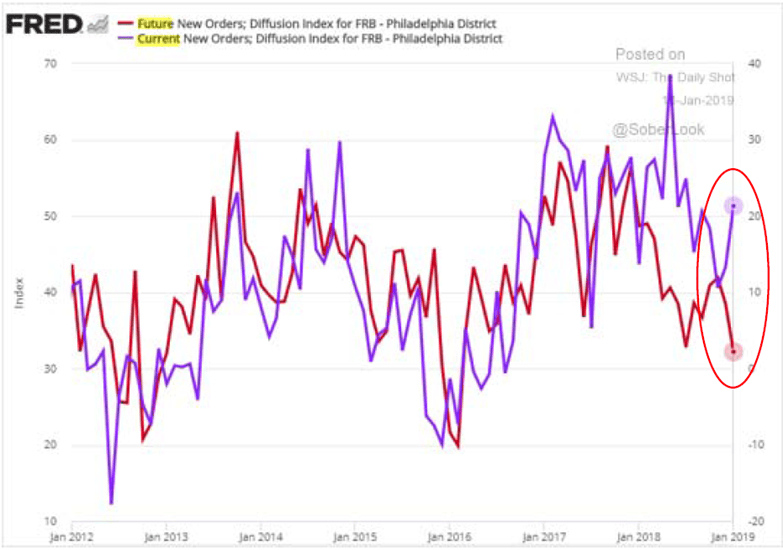
We should all be worried:

Source: Pantheon Macroeconomics (via The Daily Shot)
 Source: TS Lombard (via The Daily Shot)
Tax reform consequences?
Home Prices Are Dropping All Over New York City
In almost every Manhattan neighborhood, at least a fifth of the listings got a price cut in the last three months of 2018, data from StreetEasy show. The biggest share was in the East Village, where 33 percent of homes were offered for less.
Inventory is piling up across the city, and that’s good news for buyers in search of a bargain. For sellers with dreams of making a big profit, it’s time for a reality check.
“What we’re seeing right now is a lot of folks being forced to adjust their expectations,” said Grant Long, senior economist at StreetEasy. “We expect that prices are going to have to come down even more for it to make sense for a lot of buyers who are in the market.” (…)
EARNINGS WATCH
Amid the political chaos and confusion and the ensuing economic uncertainty, corporate America keeps delivering, but for how long?
As of Jan. 16, 77% of the 44 companies that have reported Q4 beat estimates. The earnings surprise factor is +1.6%. At the same time during the Q3’18 earnings season, the beat rate on 41 reporters (not necessarily the same) was 88% and the surprise factor +4.0%. On revenues, the beat rate is 59% so far in Q4 (+0.1%) compared with 71% (+0.5%) 3 months ago.
Earnings growth for the 44 companies having reported is 21.8% on revenue growth of 7.9% vs 28.7% on 7.5% for the 41 reporters in Q3.
The blended growth for Q4 is now 14.2%, down from 15.8% 2 weeks ago. It was 19.9% for Q3’18 last Oct. 16 but it ended up 28.4% for the full quarter.
Trailing EPS are now $162.00, up 32% YoY and 4.1% from their level 3 months ago. Trailing EPS are above the full year estimate of $161.45 (per Refinitiv), potentially leading to higher estimates for 2019.
Rising earnings and stable inflation are keeping the Rule of 20 Fair value positively sloped, just about the only fundamental factor still solid and supportive for the U.S. market.

TECHNICALS WATCH
From Steve Blumenthal’s Trade Signals:
- Last week, the Ned Davis Research (NDR) CMG Large Cap Momentum Index signaled a reduction in equity exposure to 40% from 80%. The balance of the equity market signals remain in sell signals.

- 13/34–Week EMA Trend Chart

The only bullish indicators from Steve’s list are sentiment indicators from Ned Davis Research:
- NDR Crowd Sentiment Poll: Extreme Pessimism (S/T Bullish for Equities). Current weekly sentiment reading is 55.5. It was 50.2 last week.

- NDR Daily Trading Sentiment Composite: Neutral Sentiment (S/T Neutral for Equities). Current daily sentiment reading is 42.22. It was 34.44 last week.


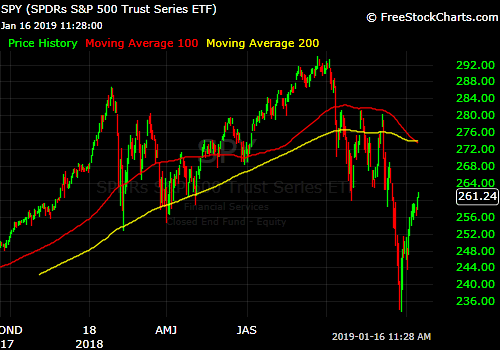
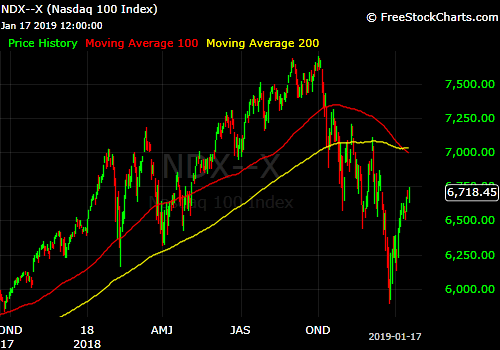
To ruminate this weekend: the SPY, W5000 and NDX all saw their 200-d m.a. tick up yesterday, but very, very slightly…

2 thoughts on “THE DAILY EDGE: 18 JANUARY 2019”
Meanwhile in on-going holiday warnings: “Tiffany’s holiday sales numbers came a day after the owner of Kay Jewelers and the Jared chains also reported a drop in sales. Parent company Signet Jewelers Ltd. said Thursday that fewer people came to its stores as competitors slashed prices in December.”
Re: “Chinese officials offered to increase annual purchases from the United States by about 30 percent, or roughly $40 billion”
==> I realize the market can get excited about any news and almost any fiction, to play off volatility, but the general theme seems to be that China is slowing down — on the cusp of a recession, or at least experiencing debt ratio problems and currency devaluation. Thus, how is the weaker economy in China going to increase greater demand for foreign imports? It is possible that China stockpiles commodities into larger and larger warehouses, but then that artificial supply and demand would be sort of like a tax that China would eventually engineer into a game, where they would punish someone with exports. The art of the deal, in this case is nothing other than buffoonery that will have no impact on anything but short-term market gyrations and overall chaos.
===> From 2015: “However, as domestic demand slowed down, the government was faced with an excess amount of unwanted stockpiles. It, therefore, ended its reserve-building policy in time for the 2014 crop and instead focused on subsidising local farmers. It also began unloading some of its stockpiles back onto the world market at reduced prices, which has since exerted substantial downward pressure on the prevailing world price. By November 2014, the global benchmark cotton futures price was below 60 cents per pound, the lowest since 2009, having lost more than a third of its value since May.”
Comments are closed.