U.S. Job Openings Ticked Up to 7.58 Million in January Rate of workers quitting jobs has held steady for eight straight months
(…) employers entered February with a massive number of openings, and appeared to make little progress filling them. (…)
Openings in January exceeded the unemployed—people without a job but actively seeking work—by more than 1 million. Such a gap has occurred for 11 straight months, but never previously in nearly two decades of monthly records.
Last year, 46% of employers reported difficulty filling jobs, according to a survey by ManpowerGroup. (…)
Manufacturing Pullback Flashes Signs of Economic Slowdown Output at U.S. factories fell 0.4% in February after falling 0.5% in January
While the January drop was largely tied to tumbling auto production, February’s decline appeared more broad-based, spread across sectors including machinery, electronics and apparel. (…)
Manufacturing is getting squeezed globally. The Bank of Japan Friday cited falling production in its gloomier view of the economy. It also pointed to a slowdown in some overseas economies. Germany’s statistics office recently reported industrial output there contracted 0.8% in January. Industrial output in China slowed in the January-to-February period, though it was still up 5.3% from a year earlier. (…)
Manufacturing production is flat over 4 and 6 months with a clearly slowing trend since last summer:
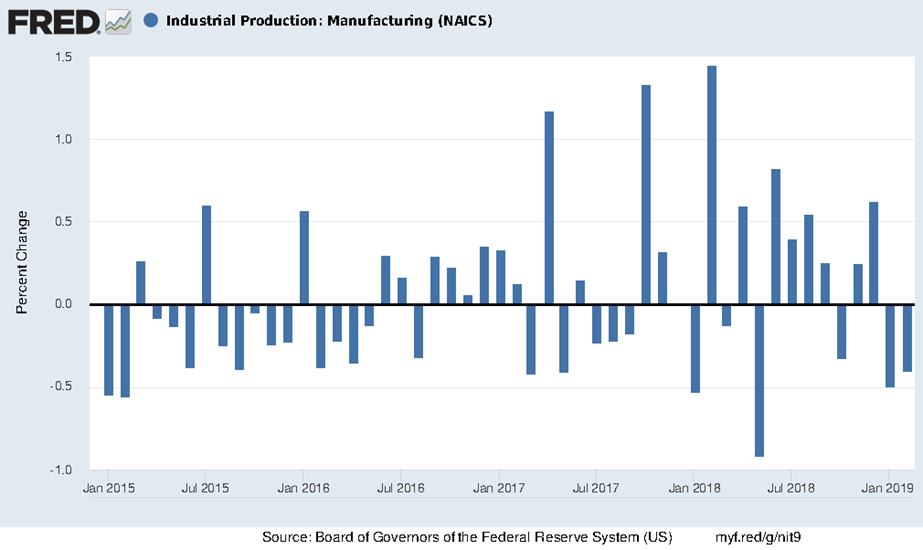
The 3m/3m growth rate in manufacturing output is now 0.2%, trending in line with Markit’s PMI which dropped to 53.0 on February from 54.9 in January.

Similarly, new business received by manufacturers expanded at a slower rate in February. The modest upturn was the weakest since June 2017. Although panellists stated that firmer client demand drove the latest increase, some firms noted that longer lead times were pushing clients to find alternatives. Foreign client demand, however, continued to increase. Though marginal, the rise in new export orders quickened since January. (…)
Worries regarding the impact of tariffs and trade wars, alongside wider political uncertainty, undermined business confidence, with expectations of future growth running at one of the most subdued levels seen for over two years and suggesting downside risks prevail for coming months. (Markit)
France warns EU against rushing into US trade talks Paris wants to narrow scope of negotiations on industrial goods and delay until June
OPEC, Russia Deepen Oil Output Cuts OPEC and a group of 10 oil-producing nations led by Russia are deepening their crude production cuts, but remain split on whether the curbs should remain in place through the end of the year, officials said.
(…) Production levels from Iran and Venezuela “have not declined precipitously—to the point where we see there are still inventory builds,” Saudi Arabia’s Mr. Falih said. “We need to stay the course certainly until June,” he said, adding that the output cuts may have to be pursued until the end of 2019.
Russia’s Mr. Novak said uncertainty over the implementation of U.S. sanctions blurred the group’s planning on future curbs. “We don’t know what will happen in April, so we can’t forecast the second half,” he said.
SENTIMENT WATCH
Market Rebound Reaches Crossroads After Latest Rally Stocks and commodities are on the verge of rallying to highs that have eluded them during recent upswings, a breakthrough that investors say would likely fuel further gains.
The S&P 500 climbed to a five-month high last week, putting the benchmark equity gauge on track for its strongest first quarter since 1998. Meanwhile, U.S. crude oil rose to its highest level since Nov. 12, pushing its early year rebound to almost 30%.
With the rallies, U.S. crude is approaching $60 a barrel and the S&P is just above 2800—a level that marked the end of four previous stock rallies since the start of the fourth quarter. The S&P’s all-time high is 2930.75, reached Sept. 20, 2018. (…)
Some analysts think a sustained surge beyond that barrier could draw more investors back into the market, after about $60 billion flowed out of global stock funds from the start of the year through March 6, the largest such outflow to begin a year since 2008, according to a Bank of America Merrill Lynch analysis of data from fund tracker EPFR Global. (…)
The “wall” was timidly crossed last Friday with positive trends in all moving averages.

Lowry’s Research claims that “rising Supply rather than a lack of Demand most often proves fatal to bull markets. And, that rise in Supply has been notably absent.” In fact, “in the recent rebound, Selling Pressure fell to its lowest level of the 2-month market advance and only 8 points above its low for the entire bull market.”
Last week, however, equity funds saw positive inflows:
 Source: BofA Merrill Lynch Global Research (via The Daily Shot)