More than 240,000 coronavirus cases have been confirmed across the globe. The World Health Organization noted that it took more than three months to reach 100,000 cases worldwide —but only 12 days to log the next 100,000. The number of cases in France has doubled in four days, said Christian Lindmeier, a spokesman for the World Health Organization.
For a second consecutive day, China reported no new local infections. But concerns are growing about a new wave of imported cases elsewhere in the region: Hong Kong reported its biggest daily jump in cases Friday, including many that involved recent travel.
Japanese Prime Minister Shinzo Abe said Friday that his government will draw up plans to allow schools to reopen when the new academic year begins in April, Kyodo News reported. (…) Japan recorded 40 new infections on Thursday and one death, according to a tally kept by public broadcaster NHK, bringing the country’s total to 963 infections and 33 deaths. The figure does not include the 712 people who contracted the virus onboard the Diamond Princess.


PANDENOMICS
-
CHINA SALES MANAGERS SURVEY
Consumer behaviour has been significantly modified in many areas, and it isn’t apparent that these changes will revert to normal quickly. Restaurants are doing far more takeout activity than previously with many diners still reluctant to eat in company. Supermarkets have reopened in many places, but are still scarcely populated with consumers preferring to buy via delivery services. Buying of long lasting canned goods and other consumables is still prevalent as feelings persist the virus may come back as soon as consumers revert to previous behaviour patterns. Many people still stay at home when they have the choice not to go to work in an office or factory. The businesses most heavily impacted by the virus, notably all the hospitality trades, are still largely deeply mired in falling markets. But overall business conditions are gradually improving.
CHINA: SALES MANAGERS INDEX (MARKET GROWTH)

-
U.S. SALES MANAGERS SURVEY
UNITED STATES: HEADLINE SALES MANAGERS’ INDEX

Rethinking the Coronavirus Shutdown No society can safeguard public health for long at the cost of its economic health.
If this government-ordered shutdown continues for much more than another week or two, the human cost of job losses and bankruptcies will exceed what most Americans imagine. (…) Ed Hyman, the Wall Street economist, on Thursday adjusted his estimate for the second quarter to an annual rate loss in GDP of minus-20%. (…)
The politicians in Washington are telling Americans, as they always do, that they are riding to the rescue by writing checks to individuals and offering loans to business. But there is no amount of money that can make up for losses of the magnitude we are facing if this extends for several more weeks. After the first $1 trillion this month, will we have to spend another $1 trillion in April, and another in June?
By the time Treasury’s small-business lending program runs through the bureaucratic hoops—complete with ordering owners that they can’t lay off anyone as a price for getting the loan—millions of businesses will be bankrupt and tens of millions will be jobless. (…)
America urgently needs a pandemic strategy that is more economically and socially sustainable than the current national lockdown.
Engineers of 2009 Auto Bailout Say Virus Rescue Should Be Bigger
(…) “What’s going on in Washington is pretty constructive in the sense that everybody understands the problem is of unbelievable magnitude and they’re going to do whatever it takes.â€
President Donald Trump said Thursday he’d support the U.S. taking an equity stake in companies that receive coronavirus-related aid from taxpayers and prohibiting firms from increasing executive bonuses and stock buybacks. (…)
In 2009, the U.S. allocated $700 billion to bail out banks and automakers as the collapse of high-risk mortgages rippled through the American economy. The government took stakes in car companies and banks that gave it oversight over many aspects of their operations. (…)
The so-called Troubled Asset Relief Program, or TARP, ultimately distributed $443 billion of the $700 billion allocated in assistance for banks, the auto industry and mortgage assistance, most of which was repaid to the government. The ultimate cost to taxpayers was $31 billion, according to an April 2019 report by the Congressional Budget Office.
A TARP 2 might need to be as big as $3 trillion with a combination of direct bailouts for failing companies and more general investments to shore up the overall market confidence, said another top adviser to the auto industry bailout in 2009 who did not want to be named because he is considering suggesting a strategy to the administration. The government might want to consider buying up stakes of as much as 5% of all companies to put a bottom to the market decline, the person said. (…)
Jobless Claims Rise Sharply at Front End of Expected Coronavirus Surge Claims at 281,000, highest since September 2017 level following Hurricane Harvey
Initial jobless claims increased by 70,000 in the week ended Saturday, March 14 to a seasonally adjusted 281,000, marking the fourth biggest jump for jobless claims on record back to 1967. (…)
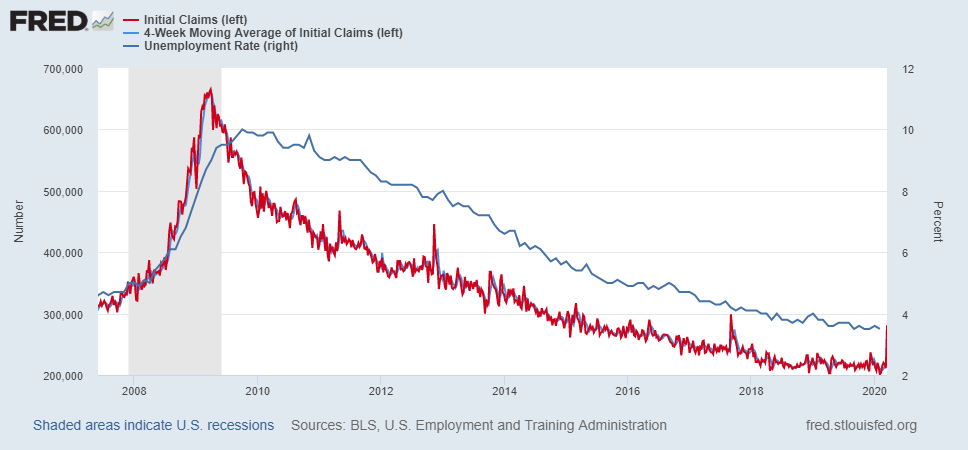
Filings for U.S. unemployment benefits are poised to surge to a record 2.25 million this week, according to a Goldman Sachs Group Inc. analysis of preliminary reports across 30 states. (…)
Consumers Face a Massive Credit Crunch. Lenders Are Still Figuring Out What to Do. Out-of-work customers could miss loan payments and suffer plunging credit scores; lenders and credit-reporting firms are being asked to help
Walmart to Pay $550 Million in Staff Bonuses, Hire 150,000 Temporary Workers Retailer boosts pay and hiring in response to coronavirus shopping surge; to start testing for the virus in Chicago-area parking lots
(…) On Thursday, Walmart said it would pay a $300 cash bonus to full-time hourly workers and a $150 bonus to part-timers. The company said it would also accelerate first-quarter bonuses.
Walmart also plans to hire 150,000 workers through the end of May in its stores and fulfillment centers. The jobs will be temporary at first but could convert to permanent roles.
Walmart’s moves come days after Amazon.com Inc. said it planned to hire an additional 100,000 people in the U.S. and raise pay for warehouse and delivery workers by $2 an hour through April. Both companies are trying to manage a surge in orders at a time that many clothing and mall-based retailers have shut their doors.
China Shipping Exports Rebound, Just as Western Ports Cope With Coronavirus Downturn
(…) “We never saw a port closure in China, and I don’t believe we’ll see a port closure here in Los Angeles,†Mr. Seroka said. “We have 100,000 people and none work concurrently, or at the same time. I believe we will have an ample workforce that is healthy and has the ability to flex based on the needs of cargo flow and personal health and safety requirements.†(…)
Dollar surge threatens global financial stability
(…) The broad U.S. dollar indeed reached an 18-year high this month. That’s bad news for an already-weakened global economy. In theory, USD appreciation is a positive development for non-U.S. economies because their exports are suddenly more competitive. But that impact tends to be more than offset by headwinds generated through the financial channel.
According to the Bank for International Settlements roughly 35% of global trade is financed by the banking system, with around 80% of that denominated in U.S. dollars. So, if the cost of financing (e.g. USD exchange rate) rises, this will slow lending and borrowing in U.S. dollars, hurting trade volumes. That explains the observed negative correlation between growth in global trade volumes and that of the Broad Dollar index.
Another element of the financial channel which can turn an appreciating greenback into a major problem is the record amount of USD-denominated debt. A stronger USD can indeed make it harder for firms to service their dollar credit. Note that USD-denominated debt held by non-bank borrowers outside of the U.S. stood at around US$12 trillion at the end of last year, or nearly 19% of World GDP excluding the U.S. As today’s Hot Charts show, that’s roughly double the exposure of 20 years ago. (NBF)

ANOTHER FACE-SAVING CONTEST
U.S. Contemplates Intervention in Saudi-Russia Oil Standoff Texas regulators are weighing whether to curtail crude production for first time in decades
(…) Administration officials are exploring a diplomatic push to get the Saudis to cut oil production and threats of sanctions on Russia aimed at stabilizing prices, after U.S. oil companies pressed them to intercede, people familiar with the matter said. (…)
The U.S. would ask the Saudis to return to their original, lower production levels before that decision, an administration official familiar with the matter said. The administration could use the threat of sanctions on Russia as part of its engagement with Saudi Arabia to assure the kingdom its rival Russia won’t easily benefit from Saudi cutbacks, the administration official said.
Either way, possible sanctions against Russia are in the works, the administration official and a second person familiar with the matter said, although the details of those possible sanctions and what Russian action might trigger them weren’t available. (…)
“We have a lot of power over the situation. We’re trying to find some kind of medium ground,†Mr. Trump said. “It’s very devastating to Russia because when you look, their whole economy is based on that.†(…)
Harold Hamm, the executive chairman of shale-driller Continental Resources Inc. and the leader of the Domestic Energy Producers Alliance (…) has been focused on getting the administration to do anti-dumping and/or countervailing-duty investigations of Saudi Arabia, Russia and potentially others for selling so much crude at “prices below market value,†(…)
Putin Won’t Submit to What Is Seen as Saudi Oil-Price Blackmail The unprecedented clash threatens to push the price of a barrel below $20.
Russian President Vladimir Putin will refuse to submit to what the Kremlin sees as oil blackmail from Saudi Arabia, signaling the price war that’s roiling global energy markets will continue.
The unprecedented clash between the two giant exporters — and former OPEC+ allies — threatens to push the price of a barrel below $20, but the Kremlin won’t be the first to blink and seek a truce, said people familiar with the government’s position.
Putin’s government has spent years building reserves for this kind of crisis. While Russia didn’t expect the Saudis to trigger a price war, the people said, the Kremlin so far is confident that it can hold out longer than Riyadh. (…)
Russia is always ready to talk, “especially in such dramatic times,†Kremlin spokesman Dmitry Peskov said. Earlier in the week, Peskov said Russia would like to see oil prices higher. (…)
“Putin is known for not submitting to pressure,†said Alexander Dynkin, president of the Institute of World Economy and International Relations in Moscow, a state-run think tank that advises government on foreign policy and economy. He has proved that he is ready for a hard competition “to protect national interests and to keep his political image as a strongman.†(…)
Still, with the national economy bleeding, “Russia has enough pragmatism and common sense not to refuse talks,†with its OPEC partners, Dynkin said. (…)
The Russian proposal — rejected by the Saudis — for OPEC+ to maintain its existing production cuts until the end of June still stands, two of the people said. (…)
So, a compromise will be reached…after somebody finds the necessary face-saver.
-
 OPEC + + ?
But maybe something more than a truce is needed. This is from Al Arabiya:
(…) Analysts were extremely pessimistic on the outlook for oil markets. “What we are seeing here is essentially the atomic bomb equivalent in the oil markets,†said Rystad Energy Analyst Louise Dickson.
Gary Ross, CEO of Black Gold Investors, said prices would quickly fall below the marginal cost of production. “This is scary. It’s a once-in-a-century event,†he said. “They cannot cut enough to deal with this situation. Increasing production is adding fuel to the fire and helping to create the conditions for a financial crisis. They will fill every storage tank in the world then be forced to cut production. We will likely see prices fall below the variable cost of production. Certainly in the teens and possibly in the single digits.â€
(…) even OPEC+, as the wider exporters’ club is called, is unable to accommodate the latest forecasts for demand collapse, the Gulf source said.
“Even if these countries come back together, they cannot move the needle. Demand has dropped and there is oversupply by many countries, so you have a big surplus,†the Gulf source said. “It is no longer about Saudi, OPEC and Russia.â€
The United States, which has become the world’s largest oil producer thanks to evolutions in drilling technology, has traditionally refused to join any international agreements on oil supply. Its production gains over the past decade have taken market share away from OPEC.
Ottawa prepares multibillion-dollar bailout of oil and gas sector
A Look at Economies and Markets After Covid-19 Once the coronavirusis is defeated, the new normal will be marked by much slower growth, the risk of deflation and a distrust of equities.
Gary Shilling:
(…) The decline in manufacturing activity and related jobs in the West resulting from globalization and the vulnerability of worldwide supply chains will promote self-sufficiency but also the accompanying inefficiencies. The hopes of politicians that protectionism promotes domestic jobs and incomes will be dashed as, like in the 1930s, trade barriers reduce economic growth and spawn deflation. (…)
Consumer caution will linger longer after the coronavirus crisis subsides, much as it did after the 2008 financial crisis. The attitude of use it up, wear it out, make do or do without may prevail for years, weighing on consumer spending and retail sales. (…) The low rates of inflation, and possibly even deflation, will damp the zeal for spending, further restraining any economic recovery.
(…) major infrastructure spending is likely. (…)
The recession may well kill President Donald Trump’s re-election hopes and put Democrats in control of the White House and Congress. Then some sort of federal-sponsored medical care-for-all is likely. Also, tax rules to redistribute income from the rich to the poor would be enhanced. (…)
Lending standards will tighten, much as they did for residential mortgages after the subprime collapse. (…)
When investors finally get a sense the depth and length of the recession, stocks will rebound but probably from levels 20% to 30% below current ones. As after the 2007-2009 bear market, individual investors will be slow to return. In the longer run, stocks may well underperform the economy as the elevated price-to-earnings ratios of the last three decades return to more normal levels, if not undershoot. (…)
John Authers:
-
When the Ice Melts, the Bears Have to Move Helicopter money is about to lift them into a new inflationary age that will favor stocks over bonds.
(…) As “perma-bears†have a bad press, let me offer two charts to show that their ideas aren’t so ridiculous. First of all, the great bull market since 2009 is a strictly American phenomenon. Stock indexes for the rest of the world have recently dropped below where they were at the beginning of 2000 — the last two decades have looked like the protracted range-trading that bears expected after the dot-com bubble burst, and not like a bull market at all:

(…) Following Japan, the idea is that the world will sink slowly but steadily into a deflationary slump. Bond yields fall ever further, but this isn’t good news for stocks, because these are a symptom of a deflationary environment, or “Ice Age,†that kills opportunities for equities to make money.
Europe has joined Japan in its own Ice Age over the last decade, but defiant action by the Federal Reserve and — even bears should admit — a few remarkably successful American companies kept things warm in the U.S. Until, suddenly over the last month, bond yields dove to fresh lows, and stocks fell into a bear market. (…)
[Albert Edwards, one of the most famous “perma-bears†and the current chief investment strategist for Societe Generale SA,] remains convinced that the scale of the downturn now is due to the build-up of debt that preceded it. The coronavirus turns out to have been the trigger for a debt reckoning that would have happened at some point:
leverage was built up on the premise that nothing bad happens. And something very bad has now happened. Hence many of us believe that central bank actions over the last decade have made the current already bad situation much worse than it otherwise would have been.
(…) His reading of the coronavirus crisis is dire indeed. He cites the following charts, from the iconoclastic U.K.-based economist Steve Keen, which contrast U.S. indebtedness during the Spanish flu of a century ago with indebtedness today. The world was still on a war footing when that happened, and used to war-time discipline; this time will be different and more damaging economically, Edwards believes:

As for bond yields, the sheer deflationary impact of the recession he sees ahead should still bring Treasuries down to the negative level of bund yields.
(…) His base case, is that U.S. stocks will need to revisit their lows of 2009, or fall even lower. But in terms of time it isn’t far away. From now on, when central banks intervene in the bond market, he says, it “is not about yield suppression or yield curve control. It is about financing fiscal expenditure and tax cuts.†(…)
On the prospect of helicopter money, he says: “Of course it will ultimately work to trigger a recovery, but we collectively have no idea how deep this economic and financial market meltdown will be — especially if you adhere to my own view about the inherent extreme vulnerability of the system even before the coronavirus hit.â€
With so much uncertainty, he is prepared for the possibility of calling a turn even if Treasury yields never sink into negative territory, or if stocks don’t drop below their 2009 lows.
Many will still say that he has been so wrong for so long that he is best ignored. But ad hominem arguments like that are never the best. The framework he presents is a good one. There will be a buying opportunity soon, which will likely come amid an epic crisis for the West. He might well help us to find that opportunity.
FDIC Chairman Asks for Accounting-Policy Changes Due to Coronavirus The regulator requested a delay of a new credit-loss standard for certain companies
In a letter, FDIC Chairman Jelena McWilliams requested the Financial Accounting Standards Board, which sets U.S. accounting standards, to give large public lenders the option to defer implementing a new rule on expected future credit losses. The companies that decide to delay implementation would revert to the old model of recognizing losses once they had evidence the losses had been incurred.
The rule, known as Current Expected Credit Losses, or CECL, requires companies to forecast expected loan-related losses as soon as a loan is issued. It went into effect for large U.S. public companies in December. (…)
Ms. McWilliams also asked FASB not to classify coronavirus-related loan modifications as a concession creditors can grant during troubled-debt restructurings. Companies want to avoid that classification on their financial reports, Ms. McWilliams said. Allowing companies to skip categorizing modifications as TDRs would encourage them to offer forbearance to customers facing economic stress during the coronavirus pandemic, she said. (…)
2 thoughts on “THE DAILY EDGE: 20 MARCH 2020”
Thank you for your coverage.
Tks David. Be safe, you and family.
Comments are closed.