COST PRESSURES: MARGINS SQUEEZE OR INFLATION?
Snarled Supply Chain Trips Up Small Businesses Shortages and delays in supplies are squeezing business owners. A Pennsylvania maker of packaging products even has trouble tracking down wooden pallets.
An Oklahoma restaurant is paying nearly $200 for a case of gloves that normally costs $40. A medical-device maker in Colorado is tweaking the way it manufactures its products to offset higher plastic costs. A clothing wholesaler in Michigan has hundreds of hoodies it has yet to sell because winter was over by the time they arrived from Bangladesh. (…)
Forty-four percent of small businesses reported temporary shortages or other supply-chain problems in March, according to a survey of roughly 800 companies by Vistage Worldwide Inc., a business advisory firm. A U.S. Census Bureau survey of small businesses, completed in early April, found supply-chain disruptions in wholesale trade, manufacturing and construction, among others. (…)
Suppliers recently quoted Dakotaland a price of $1.10 a pound for 4-by-3-inch steel tubing that sold for 45 cents a pound last summer, said Mr. Erfman.
Dakotaland’s contracts allow it to pass along increased costs quarterly to major customers, but delays in raising prices have squeezed profit margins. “Hopefully, it washes out when things turn the other way,” Mr. Erfman said. “At this point, we don’t know when that might be.” (…)
“One of the biggest challenges of being a small company is we buy from billion-dollar companies and sell to billion-dollar companies,” making it difficult to fend off price increases or pass them on to customers, she said. (…) (WSJ)
The NFIB’s March survey did show tougher earnings conditions for small biz…
…but rising costs were not singled out:
Among S&P 500 companies, of the 11 Industrials that had reported Q1 yesterday, 7 beat estimates but the aggregate earnings surprise was -293.0% in spite of a +3.6% revenue surprise. Industrials are the only sector so far with a negative earnings surprise factor. They are also expected to show the worst growth rate in Q1 at -16.7%.

The ISM PMI “Backlog of Orders” index (Bloomberg chart) illustrates the sharp, swift increase in manufacturing bottlenecks causing delays and price increases. Add transportation issues and costs and you get inflation in the pipeline:

The concept of pricing power matters greatly. A research note from Morgan Stanley suggested that consumer staples’ earnings are in for a tough time, because companies won’t be able to pass on all of the inflation in their raw materials to consumers. The following is the Morgan Stanley estimate of gross margins for a range of food manufacturers (their ticker symbols are given in the graphic), compared to average food price inflation with a quarter’s lag:
This is the same exercise repeated for a group of household products manufacturers. Again, the likelihood is that higher material prices will just mean a nasty hit to profits, rather than a pass-through into higher inflation.


Earnings from S&P 500 Consumer Staples companies that have reported Q1 so far (11 of 21) show a beat rate of 73% and a +6.7% surprise factor (vs +25.5% for the 61 S&P 500 companies having reported yesterday). Analysts expect Staples to report earnings up 4.3% in Q1 on revenues up 2.6% (i.e. rising margins) vs +31.6% for the S&P 500.
As I showed yesterday, JP Morgan says that “rising input costs should not be feared at the overall market level…PPIs maintain a clear positive correlation to earnings, and to margins.”
![image_thumb2[1]](https://i0.wp.com/www.edgeandodds.com/wp-content/uploads/2021/04/image_thumb21.png?ssl=1 "image_thumb2[1]")
That can only mean rising prices. This next chart plots the YoY change in CPI (red, rhs) against PPI minus CPI inflation:

As Authers says, “the concept of pricing power matters greatly”. My sense is that given all the stimmies out there, companies have pretty good pricing power in 2021.
This a.m.:
- Procter & Gamble Will Raise Prices in September Price increases on baby products, adult diapers and feminine-care brands come as the company reports slowing growth in latest quarter
(…) “This is one of the bigger increases in commodity costs that we’ve seen over the period of time that I’ve been involved with this, which is a fairly long period of time,” said P&G Operating Chief Jon Moeller, a 33-year company veteran. (…) The price increases, to take effect in September, will be on baby products, adult diapers and feminine-care brands and will be in the mid- to high-single-digit percentage points, the company said. (…)
Kimberly-Clark, maker of Huggies diapers and Scott paper products, said its percentage increases would be in the mid- to high-single digits and take effect in late June. They will apply to the company’s baby- and child-care, adult-care and Scott bathroom tissue businesses.
Several food makers have raised prices as well. Hormel Foods Corp. said in February that it raised prices on its turkey products, such as Jennie-O ground turkey, in response to higher grain costs. J.M. Smucker Co. said it recently raised prices for its Jif peanut butter and that it might do the same with pet snacks because of higher shipping costs and other inflationary pressure. (…)
- Dealers Are Selling Cars So Fast They Don’t Need to Borrow Snarled supply chain for new cars is slowing banks’ loans to dealers, but surging used-car prices are a driving force for auto lenders
The supply-chain woes that have stymied car makers have also been an accelerant for used-car prices as buyers scramble to find vehicles—and, in turn, for auto lenders. Banks are relatively bigger players in used-car loans than new-car loans. Used-car loans generally have higher yields. And car loans get a further boost because any defaulted debts have better recovery values due to higher values for the collateral.
Major auto lender Ally Financial last week said it expects to see yields on retail auto originations in the 7% range for the rest of 2021, above the first-quarter 6.66% average for Ally’s current book of retail auto loans. Leases are a very lucrative business as well when end-of-lease cars are so valuable. Ally’s auto leasing average yields have surged, from 5.2% at the start of 2020 to almost 8.6% in the first recent quarter of 2021. That is a pretty neat trick when benchmark rates have tumbled.
The wonky supply chain isn’t all good news for banks. Dealers typically borrow to finance their floor inventory. So when they can’t get cars, and the cars they do get immediately zoom off the lot, that hurts banks’ loan growth. Still, there is an upside to that: When supply picks up and puts pressure on used-car prices, for banks there may be an offset in the form of faster dealer floor-plan loan growth. (…)
THE (EVENTUALLY) COMING TAPER
Mohamed El-Erian in conversation with John Authers:
There would be a spike in yields… and I suspect that it would happen under all of the following Fed policy scenarios: timely exit, delayed exit, and slamming the brakes. The differences would be in timing and in the shape of the yield curve. In terms of numbers, it would be a 2% to 2.25% 10-year yield initially under the first scenario, more of a hockey stick under the second scenario, and higher than both under the third scenario. I would also add that the response of endogenous (market-based) flows — important as they serve as stabilizers —- would be highest under the first and weakest under the third. I am thinking here of foreign buying, liability-matching flows, etc…
(…) reading between the lines and based on what top Fed officials have said recently, I would guess a 2.5% to 3% rate that persists for the last six months of this year would force the Fed’s hand. Many markets, including equities and EM, have benefited from record loose financial conditions and, more
generally, investors’ full embrace of the liquidity paradigm underpinned by central banks’ ultra supportive policies. The good news is that this has allowed many companies and corporates to refinance themselves, delaying debt challenges and enabling quite a bit of financial engineering that has benefited Wall Street much more than Main Street. But it does expose market segments to liquidity risks and, as we have seen on a few occasions in the recent past, this is not just an issue for the traditionally less liquid segments.
After housing, GME and others:
 Canadian National Makes $30 Billion Topping Bid for Kansas City Southern Offer represents 21% premium to agreement with Canadian Pacific reached last month
Hedge Fund Giant Warns of SPAC Blowup After Betting $1 Billion
The life cycle of SPACs, or special purpose acquisition companies, is riddled with “perverse incentives” for investors, sponsors and the companies using the shortcut route to come to market, Paul Marshall, co-founder of the investment firm [Marshall Wace], told his investors in a newsletter. SPACs have delivered “awful returns” and most recent issuances will be no different, he said.
“The SPAC phenomenon will end badly and leave many casualties,” Marshall said, while disclosing that the firm has more than $1 billion of gross exposure to SPACs in its flagship $21 billion Eureka hedge fund.
The SPAC structure could even have been designed to encourage “the bezzle,” he said, referencing a term coined by economist John Kenneth Galbraith to describe the period in which an embezzler has stolen money but the victim doesn’t yet realize it. (…)
Marshall, who has previously lost money betting on SPACs, said the current frenzy that’s also swept up retail investors presents a money-making opportunity. The firm owns or has owned “almost every SPAC” on the long side and is now also betting on their prices to collapse.
“We have increasing exposure on the short side as the SPACs go ex-deal and the low caliber of the deals, and even the potential for bezzle, becomes apparent,” he said. (…)
Bloomberg:
- This week, the U.S. State Department said it would declare about 80% of the world’s nations no-go zones. That’s made it harder for airlines to claw back overseas travel that includes more lucrative business-class seats. The blow comes after the likes of American and Delta have added capacity.
- China is considering a plan that would see the central bank assume more than 100 billion yuan ($15 billion) of assets from Huarong, helping the state-owned company clean up its balance sheet and refocus on managing distressed debt, people familiar said. A selloff in Huarong debt has stoked fears of market contagion.
And Huarong was formed to handle previous bad debt…
Tesla Apologizes for Its Handling of China Customer After Outcry The car maker’s public apology follows criticism from Communist Party body that the company is arrogant and sells defective products.
(…) Tesla has faced mounting customer complaints in China over quality issues in recent months. Regulators in Beijing summoned Tesla for a rare public rebuke over its quality record in February, prompting the company to promise to make improvements. (…)
Tesla sold 35,478 locally built Model 3 and Model Y cars in China last month, according to the China Passenger Car Association—by far its best monthly performance in the country as it ramps up output from its Shanghai plant.
COVID-19

Data: Our World in Data. Chart: Axios Visuals
Doses administered and fully vaccinated people as percent of population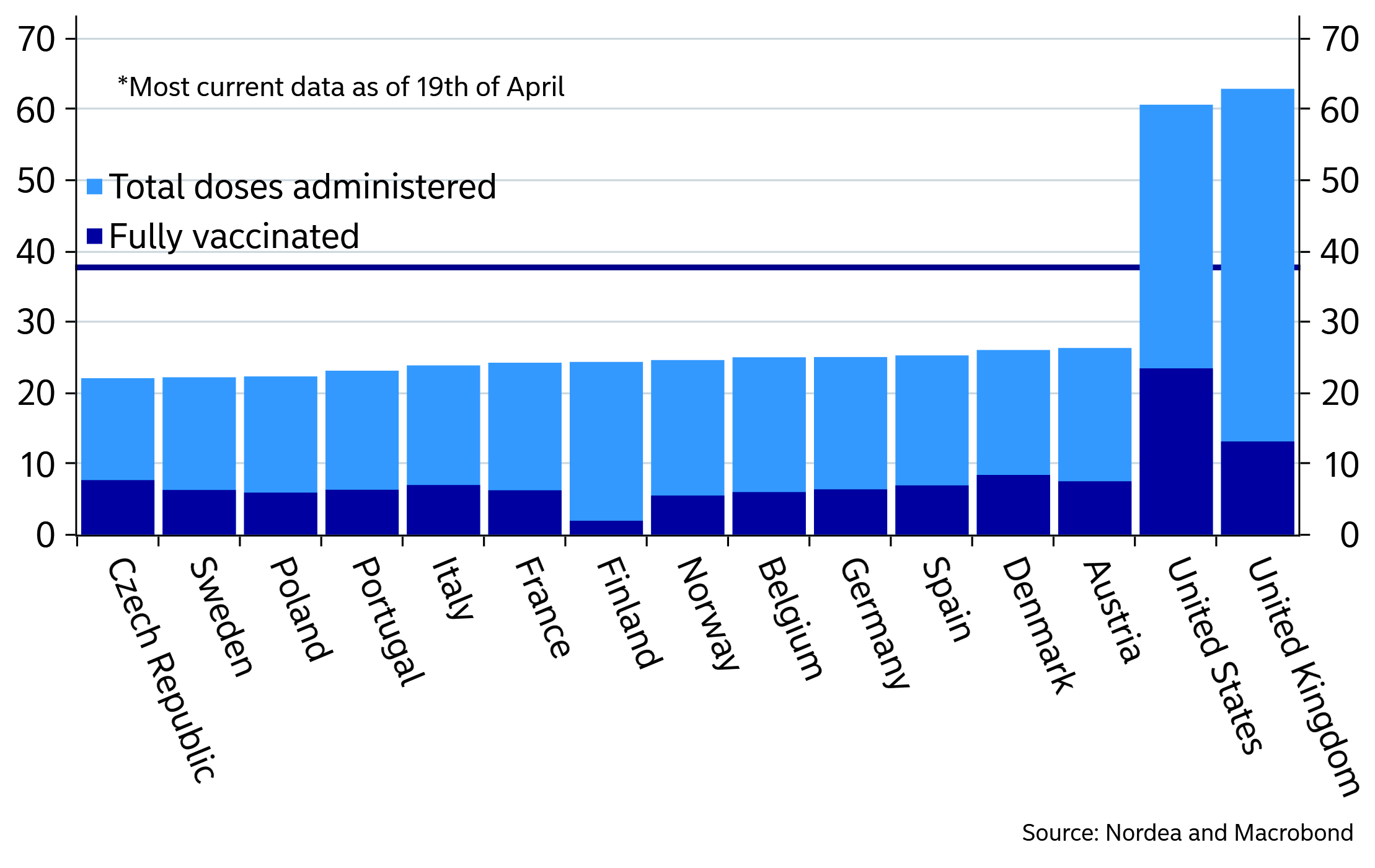
- Vaccination could slow down in the U.S: Polls have shown Millennials and Gen Z are more likely to be hesitant than their elders.
