U.S. Jobless Claims Fall More Than Expected to Four-Week Low
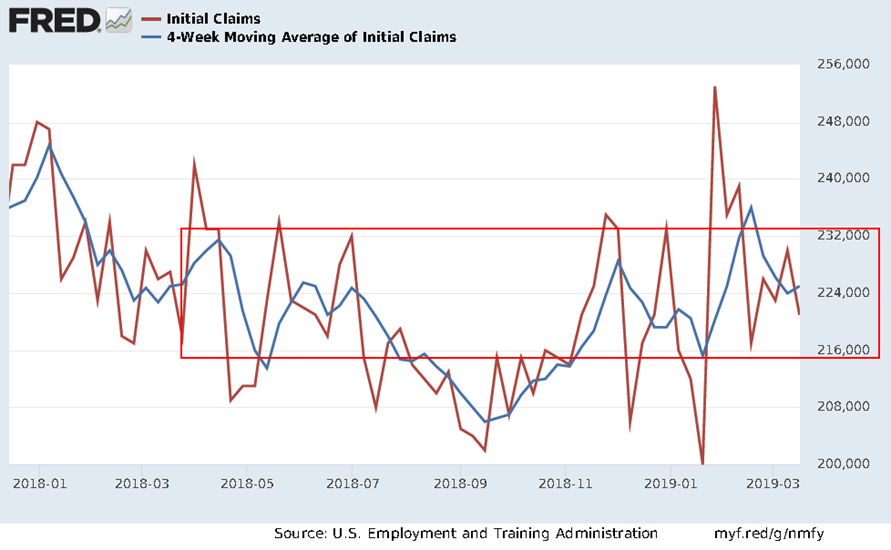
Jobless claims fell to 221,000 in the week ended March 16, beating economist forecasts for 225,000, Labor Department figures showed Thursday. The four-week average, a less-volatile measure, ticked up to 225,000 and has steadily increased since October. (…)
Keeping track of David Rosenberg’s concerns about “forward-looking initial claims”. Back into the 2018 channel after the shutdown:
Fed Signals Rates Will Stay Steady Amid Growth Fears The central bank held its benchmark interest rate steady, and a majority of officials signaled they might not raise the rate this year.
The Fed left its policy rate unchanged in a range between 2.25% and 2.5%. Chairman Jerome Powell suggested the central bank was likely to leave it there for many months.
“It may be some time before the outlook for jobs and inflation calls clearly for a change in [interest rate] policy,” Mr. Powell said at a news conference after the central bank’s two-day meeting. (…)
The Fed also announced that in May it would slow the pace at which it is shrinking its $4 trillion asset portfolio and end the runoff of its Treasury holdings at the end of September, exactly two years after it began the process. (…)
Mr. Powell cited mild inflation pressures, a sharp pullback in financial risk-taking and clear threats to U.S. growth in explaining the Fed’s new wait-and-see stance after its meeting in late January.
Projections released Wednesday underscored the turnabout. They showed 11 of the 17 Fed officials who play a role in interest-rate policy didn’t think the bank would need to raise rates at all this year, up from two in December. The remaining six officials projected between one and two increases would be needed in 2019. (…)
Other changes to the forecast show officials no longer believe they will need to raise rates to slow economic growth to a level that will prevent overheating. They revised lower their projection for gross domestic product growth and revised higher their projection for the unemployment rate at year’s end. (…)
Greg Ip: Fed’s ‘Normal’ Looks Worrisome
Maintaining solid growth and low inflation is requiring the pursuit of a very expansive monetary policy
(…) by any historical benchmark, this “normal” stance of monetary policy is extremely stimulative. The federal-funds rate, at between 2.25% and 2.5%, is just 0.25% when adjusted for long-term expected inflation. By comparison, the real rate was 2.75% at the end of the Fed’s last tightening cycle in 2006, and 4% at the end of the prior cycle in 2000.
And the Fed will still hold more than $3.5 trillion in bonds in September, equal to 17% of gross domestic product, compared with 6% in 2006. (…)
Should the economy stumble again, the Fed won’t have much ammunition with which to respond. It can, at most, cut interest rates a bit more than 2 percentage points, less than half what’s required in most recessions. It could restart bond buying, but that would expand the balance sheet past levels reached in the depths of the last downturn. (…)
Add to the Fed’s weak arsenal the fact that the U.S. government has also tied its hands with excessive spending and indebtedness during the expansion. President Trump never entertained the idea of building a fiscal safety wall for the economy. I also doubt he pays any attention to the clearly cautious slant the Fed has taken. In just a few months, the FOMC assessment of risk has pivoted to an economy that could be too strong to an economy that could be too weak. Just about every phrase in the FOMC statement is downbeat.
Should economic momentum remain weak during Q2, the Fed will need to consider its low ammo level and consider acting earlier. Central bankers across the world must be very worried given the debt levels in the two growth engines of the world, the USA and China. Debt levels are too big for the world economy to fail.
The Debt Crisis Is Coming Soon By Martin Feldstein
The most dangerous domestic problem facing America’s federal government is the rapid growth of its budget deficit and national debt.
According to the Congressional Budget Office, the deficit this year will be $900 billion, more than 4% of gross domestic product. It will surpass $1 trillion in 2022. The federal debt is now 78% of GDP. By 2028, it is projected to be nearly 100% of GDP and still rising. All this will have very serious economic consequences, and the CBO understates the problem. It has to base its projections on current law—in this case, the levels of spending and the future tax rules and rates that appear in law today.
Those levels don’t match realistic predictions. Current law projects that defense spending will decline as a share of GDP, from a very low 3.1% now to about 2.5% over the next 10 years. None of the military and civilian defense experts with whom I’ve spoken believe that will happen, given America’s global responsibilities and the need to modernize U.S. military equipment. It is likelier that defense spending will stay around 3% of GDP or even increase in the coming decade. And if the outlook for defense spending is increased, the Democratic House majority will insist that the nondefense discretionary spending should rise to match its trajectory. (…)
At the same time, the tax increases in current law that the CBO assumes will occur during the next decade as some of the recent cuts are phased out probably won’t happen. Congress will face strong political pressure to avoid a functional tax increase.
(…) When America’s creditors at home and abroad realize this, they will push up the interest rate the U.S. government pays on its debt. (…) A 1% increase in the interest rate the government pays on its debt would boost the annual deficit by more than 1%. The higher long-run debt-to-GDP ratio would crowd out business investment and substantially reduce the economy’s growth rate. That in turn would mean lower real incomes and less tax revenue, leading to—you guessed it—an even higher debt-to-GDP ratio. (…)
Thus the only option is to throw the brakes on entitlements. In particular, the government needs to hold back the growth of Medicare, Medicaid and Social Security. Federal spending on the two major health programs is projected to rise from its current 5.5% of GDP to more than 7.2% by 2029. And it will only keep increasing after that.
The simplest approach is to raise the age of eligibility for Social Security, as Congress did in 1983. Bipartisan legislation then voted to postpone “full” benefits from age 65 to 67, allowing earlier benefits at an actuarially reduced level. Because Congress slowly phased the change in over several decades, it avoided any significant political opposition. In the intervening 35 years, the average life expectancy of Americans in their late 60s has risen about three years. It would be appropriate to increase the age of eligibility for full benefits from 67 to 70 and index it to life expectancy. Exceptions could be made for retirees with low lifetime incomes.
Lawmakers don’t like to cut spending, but they have to do something. Otherwise the exploding national debt will be an increasing burden on our children, economic growth and our future standard of living.
Can we realistically expect this administration and this Congress to do anything about that?
Jumbo Mortgages Are Slowing Down High-end home buyers are turning cautious, a blow to banks that refocused their mortgage businesses around wealthy borrowers in the years after the financial crisis
Trump Signals U.S. to Keep Tariffs on China After Deal The president said that his administration was discussing leaving tariffs in place on Chinese goods for a “substantial period of time.”
(…) “We have to make sure that if we do the deal with China that China lives by the deal,“ Mr. Trump told reporters as he left Washington for Ohio. Administration officials have talked of removing tariffs in stages, as Beijing shows that it has carried out parts of a deal—and reimposing them if China later backtracks. (…)
Beijing has plenty of ammunition it can use to get the U.S. to roll back tariffs more quickly. It has retaliated with tariffs on $110 billion of U.S. goods, about 90% of U.S. exports to China, and could refuse to lift those levies until the U.S. does the same. Chinese tariffs have especially hurt rural farmland areas that are a core part of Mr. Trump’s constituency. (…)
As part of any enforcement plan, the U.S. is also asking China for another important concession—that it agree not to retaliate against U.S. tariffs reimposed for at least some violations of a trade pact. (…)
Despite all the unresolved issues, Mr. Trump said the talks were “coming along nicely.”
How do you say “I think not” in Mandarin?
U.S. whiskey exports dry up as tariffs bite
Canada, China, Mexico and the European Union slapped import duties ranging from 10 percent to 25 percent on U.S whiskey and bourbon last year, resulting in a 11 percent drop in U.S. whiskey exports in the second half, according to a report from the Distilled Spirits Council. (…)
“The damage to American whiskey exports is now accelerating, and this is collateral damage from ongoing global trade disputes,” Distilled Spirits Council Chief Executive Officer Chris Swonger said.
Trump administration withholds report justifying ‘shock’ auto tariffs
A confidential government report has provided President Donald Trump with a legal rationale to impose heavy new tariffs on foreign cars as soon as this spring, a prospect fiercely opposed by White House officials and congressional Republicans alarmed by its enormous economic and political stakes.
The Commerce Department submitted the report to the White House in mid-February, triggering a 90-day period for Trump to decide whether to impose tariffs, which could reach as high as 25 percent, on imported autos. It concluded that Trump could justify the tariffs on national security grounds and offered a range of options in response — putting the decision in the president’s hands, four people familiar with its conclusions told POLITICO. (…)
But Trump’s senior economic advisers are almost universally opposed to slapping new tariffs on auto imports, warning of dire economic and political consequences. They argue that the tariffs would infuriate close U.S. allies from Asia to Western Europe. German Chancellor Angela Merkel said last month that the idea German cars threaten the U.S. would be “a shock.” The move could also undermine efforts to persuade Congress to approve the U.S.-Mexico-Canada trade deal. (…)
1 thought on “THE DAILY EDGE: 21 MARCH 2019”
Re: “low ammo level ”
Sort of reminds me of pre-WWll when England was in denial about the nazis building up ammo — and then obviously in the same period, America was in total denial about global events, failing to react or plan ahead. There is a case to be in regard to taking preventative measures, as a precaution. The Fed is sort of screwed, in that if they do take precautionary steps towards being proactive, they may prematurely set into motion the very thing they need to be fighting later (anyway). Looking backward is was stupid of the Fed to bail out bankrupt pirates, who were not too big to fail. Collusion was the big winner in that war — total waste of ammo!
Comments are closed.