Powell Says Fed Will Consider More-Aggressive Interest-Rate Increases to Reduce Inflation Bringing down inflation and avoiding recession will be ‘challenging task,’ says central bank leader
Federal Reserve Chairman Jerome Powell said the central bank was prepared to raise interest rates in half-percentage-point steps and high enough to deliberately slow the economy if it concluded such steps were warranted to bring down inflation.
“If we think it’s appropriate to raise [by a half point] at a meeting or meetings, we will do so,” Mr. Powell said during a moderated discussion after a speech on Monday before the National Association for Business Economics in Washington, D.C.. (…)
“If we determine that we need to tighten beyond common measures of neutral and into a more restrictive stance, we will do that as well,” said Mr. Powell. Most Fed officials believe a neutral rate is near 2.5%, assuming annual inflation is 2%. (…)
Compared with Mr. Powell’s press conference last week, at which he was speaking on behalf of the central bank’s rate-setting committee, “this was even more explicit, and probably more reflective of his own views.” (…)
Mr. Powell said the inflation outlook had deteriorated significantly even before Russia’s invasion of Ukraine, and he warned that the effects of the war in Europe and the West’s response to heavily sanction Russia’s economy could further aggravate supply-chain disruptions while sending up prices of key commodities used to make a range of goods. As a sign of Mr. Powell’s growing intolerance with inflation surprises, his speech was titled, “Restoring Price Stability.”
In January, the Fed had expected inflation to diminish this year as supply-chain bottlenecks improved. “That story has already fallen apart,” Mr. Powell said Monday. “To the extent it continues to fall apart, my colleagues and I may well reach the conclusion we’ll need to move more quickly. And if so, we’ll do so.” (…)
“I wouldn’t say we’re comfortable at all with the typical we’ll-just-look-through-that approach,” Mr. Powell said. (…)
Engineering such a so-called soft landing is still possible, said Mr. Powell, and he pointed to three instances over the past 60 years in which he thought the Fed had achieved such an outcome. (…)
“No one expects that bringing about a soft landing will be straightforward in the current context—very little is straightforward in the current context.” (…)
The Fed is still counting on significant help from healing supply chains and a return of workers to the job market to bring inflation down this year and next. But, Mr. Powell said, in contrast with the Fed’s stance through much of 2021, it could no longer set policy by forecasting that such relief would materialize.
“As we set policy, we will be looking to actual progress on these issues and not assuming significant near-term supply-side relief,” he said. (…)
Looks like “50” is back on the table…Goldman Sachs now sees 50bp hikes at both the may and June meetings
- Markets Are Pushing Fed Into Developing-Economy Territory Its credibility eroded, the central bank appears to have a choice between risking a recession or prolonging inflation.
Mohamed El-Erian:
(…) In a presentation to the National Association for Business Economics, Chair Jerome Powell tried to restore the Fed’s eroded inflation-fighting credibility by signaling that the central bank is willing to increase interest rates by 50 basis points in May, repeat that at other meetings and continue raising past the neutral level in a bid to meet its inflation objective. Yet nominal market yields, the yield curve and inflation breakevens were far from reassured. Instead, they moved further away from the Fed. (…)
Rather than having a way to contain inflationary expectations, cause no undue damage to the economy and meet its dual objective, the Fed is increasingly being forced to consider what is the least bad policy mistake it wishes to be remembered for: meeting its inflation target by causing a recession, or allowing high and potentially destabilizing inflation to persist well into 2023.
This awful trade-off is familiar to too many developing countries. And one of their typical reactions may also shed light on what may be tempting for the Fed: simply hope for an immaculate recovery — that is, some mix of consequential productivity gains, quick-healing supply chains, surging labor force participation and continued financial market resilience to pull the central bank out of the deep hole it has dug for itself.
(…) For two decades, inflation expectations have been “well-anchored,” in the central banking argot. Bond market forecasts for the next five years stayed below 3%, and for the next 10 years below 2.75%. Those thresholds, marked below, have now been decisively breached. (…)
It looks as though inflationary psychology is getting out of hand, so it behooves the central bank to counter that. (…)
Higher bond yields tend to be bad news for stocks if they are part of a Fed tightening, and make high stock valuations harder to justify. However, expectations of a more aggressive Fed are even worse for bonds. The mathematics of the bond market on this point is inexorable. If rates and yields are going up, then bond prices have to come down. (…)

LME in Talks with Governments on Whether to Block Russian Metal Major Russian metal producers are not currently subject to sanctions.
The London Metal Exchange is talking with governments about whether it should keep allowing Russian metal to be delivered into its warehouse network, said Chief Executive Officer Matthew Chamberlain.
The LME wants to make sure it “can’t be part of financing any type of atrocity,” he told Bloomberg TV in an interview. However, the exchange will take its lead from government policy, and major Russian metal producers are not currently subject to sanctions.
The LME’s copper committee, an advisory group that contains representatives from major miners, traders and consumers, on Friday voted to recommend banning new deliveries of Russian metal into LME warehouses — a move which could send shockwaves through already febrile markets if implemented. (…)
- EU Support Grows for Russia Oil Ban As Moscow’s assault continues with no peace deal in sight, European capitals consider a move that was once off the table
(…) Agreement on any EU ban of Russian crude is far from locked in yet, and a rapid decision to move ahead isn’t likely, diplomats said. (…) Several EU members, including Germany, remain reluctant to support an oil ban, and would only consider gradual restrictions—not a sudden cutoff—if the situation in Ukraine deteriorates. A move to restrict Russian natural gas isn’t being considered, diplomats said. (…)
A smaller group of member countries, including Poland and the Baltic states, have been pushing it, and there is now broader support among other members, diplomats say. (…) Other countries, including Denmark, have said they would support the move if consensus emerges in the bloc, diplomats said. (…)
The energy sector contributes as much as one-fifth of Russia’s gross domestic product and makes up around 40% of its budget revenue. (…) Around half of Russia’s crude oil exports go to Europe. (…)
A ban could, at least temporarily, take out around 3 million barrels a day from a global market of around 100 million barrels a day—a significant chunk in an already tight market, analysts say. (…) The EU also imports from Russia some 15% of its oil products, such as diesel, naphtha and fuel oil, Bruegel said. (…)
The U.S. and U.K. have already banned Russian oil imports, and British officials said that Prime Minister Boris Johnson’s government has been pushing for a Group of Seven-wide ban. Germany, current head of the club of the world’s rich economies, has invited leaders to a summit in Brussels on Thursday on the sidelines of the EU meeting with President Biden and a gathering of leaders of the North Atlantic Treaty Organization. (…)
Any move toward an oil ban would need support from all 27 member states, and diplomats said there is no consensus at this point. In Monday’s discussion, according to diplomats involved in them, Hungary remained outspoken against an oil purchase ban. Critically, Germany is also opposed, for now.
German officials said that Berlin’s position on an oil ban isn’t set in stone, while it isn’t willing to consider a gas ban. They said that if the situation in Ukraine deteriorates, pressure to restrict energy purchases would grow.
If the EU avoids rushing into a decision on oil and ensures that any embargo would be phased in over time, Germany could come on board, the German officials said. (…)
While it would be easier for Europe to replace the flow of oil than that of natural gas, there are several challenges in the short term. The EU’s internal pipeline infrastructure is designed for east-to-west flows, and moving crude oil and products in the opposite direction would need other means of transportation such as rail, truck and river barges, Bruegel said in a report last week. Many European refineries, meanwhile, are optimized to use Russian oil and would be less efficient if producing with a different quality of crude.
CONSUMER WATCH
Last weekend, a generally very busy shopping center here in Florida was very, very quiet. The Chase Card Spending Tracker, with data through March 14, is now estimating control sales down 0.5% in March following -1.2% in February, all in nominal dollars.
Yesterday:
Nike Sales Rise as It Navigates Supply-Chain Snarls Sneaker giant says consumer demand continues to outpace supplies across its markets. The company posted revenue of $10.9 billion for the quarter ended Feb. 28, up 5% from the same period a year earlier. The sneakers giant sold 8% more in its third quarter ended Feb. 28 compared with a year earlier on a constant-currency basis, the company reported on Monday evening.
Note that Nike’s revenue growth of 5% is down from +8.1% in the prior 2 quarters and +19.1% for the year ended in May 2021. We don’t know how much price increases contribute but we know this from various trade journals:
- Nike CFO Matthew Friend made references to second-half price increases as well as “stronger than expected full price realization” and “additional transportation, logistics and airfreight costs to move inventory in this dynamic environment.” (September 2021)
- Figures from the Footwear Distributors and Retailers of America (FDRA) show U.S. consumers are seeing shoe prices increase at the fastest rate in over two decades. “Footwear shoppers are feeling the repercussions from both higher duties from China and surging demand that are pushing retail footwear prices dramatically higher,” said Raines. “We expect these gains to last well into next year.” (October 2021)
- Overall compared to 2020, sneaker prices have increased month-by-month, with a 4.5% rise in July and 5.1% rise in August.
- Foot Locker chairman Kenneth Hicks told investment analysts Friday that his retail chain is seeing the impact of a Nike policy to strategically increase its footwear prices. Hicks pointed to an overall 30 percent price bump on Nike Basketball Air Foamposite shoes to illustrate his point. “We’ve seen Foamposites go from $200 and $220 to deuce and a quarter, all the way up to $260.” (November 2021)
And for the current year: “These sneaker listings across Nike.com and Nike’s retail partners have each respectively gone from $90 to $100, $120 to $130, and $170 to $175 overnight.”
CHINA:
Alibaba to Buy Back Up to $25 Billion of Stock Alibaba boosted its share buyback program to $25 billion from $15 billion, in a bid to reassure investors about the company’s prospects after a year in which its stock has fallen by more than half.
The potential buybacks are substantial compared with the Chinese e-commerce giant’s market value: As of Monday, it had a market capitalization of about $270 billion, according to FactSet. The modified repurchase program will be effective for two years through March 2024 (…). Alibaba said it repurchased about $9.2 billion worth of ADRs as of March 18 under its previous program. That sum will count toward the new $25 billion total. (…)
S&P 500 firms outlined $238 billion of buyback plans in the first two months of 2022, according to Goldman Sachs, and the bank has forecast the full-year total could rise 12% to $1 trillion.
Some of the biggest U.S. technology companies have embraced even bigger repurchase programs than Alibaba. Last year, for example, Google’s parent company Alphabet Inc. and Microsoft Corp. earmarked up to $50 billion and $60 billion, respectively, for buybacks.

- China’s Big Tech Firms Are Axing Thousands of Workers The companies are conducting large-scale layoffs this year as they deal with an economic slowdown and Beijing’s regulatory pressure.
Tencent Holdings Ltd. TCEHY -7.14% , operator of the popular chat, social media and payments app WeChat, is planning to cut thousands of employees in some of its biggest business units this year, including around a fifth of the staff at its cloud unit, people familiar with the matter said.
E-commerce giant Alibaba BABA -4.35% Group Holding Ltd. has started layoffs that could hit at least thousands throughout the year, including at one of its grocery apps, people familiar with the plans said. Ride-hailing app operator Didi Global Inc. DIDI 1.71% is also axing around 2,000 employees from units including its core service, people familiar with the cutbacks said. (…)
Some of the new cuts amount to around 20% of staff in some business units, higher than the single-digit percentage level of cuts common in annual restructuring, people working in the industry said. (…)
In February, China’s official unemployment rate was 5.5%, up 0.4 percentage point from the end of 2021, while the youth jobless rate climbed to 15.3% from 14.3%. (…)
Meanwhile, the accident happening in slow motion and “supervised” by the government seems to be gathering pace. Cockroaches all over the place…
Evergrande Delays Results as Banks Seize $2 Billion From Unit Banks have unexpectedly taken control of more than $2 billion held by one of Evergrande’s key subsidiaries, as the embattled property developer said neither it nor its main listed units could meet an imminent deadline to publish their annual results.
(…) Global bondholders view its two big Hong Kong-listed subsidiaries, which focus on property management and car making, as important sources of potential value for international creditors. (…)
It said these [subsidiaries] had been offered “as security for third party pledge guarantees,” suggesting the cash was backing debts taken on by another borrower.
Evergrande said this was a “major incident” that came to light during a review of the property-services subsidiary’s annual financial report, and would be probed by independent investigation committees at both companies.
Hidden debt has proved a problem for China’s property sector. Investors have been caught out by off-balance-sheet liabilities that weren’t previously disclosed to investors or credit-rating companies, such as guarantees on wealth-management products or private loans. (…)
Evergrande is China’s most-indebted property developer, with the equivalent of more than $300 billion in liabilities as of June 2021. (…)
other developers have also delayed the release of financial information. Ronshine China Holdings Ltd. said Monday the audit work for its annual results wouldn’t be completed on time after its auditor PricewaterhouseCoopers resigned.
Shimao Group Holdings Ltd. said Monday it expects a delay because of disruptions caused by Covid-19 and slowness in obtaining third-party confirmations for its audit.
PricewaterhouseCoopers is also Evergrande’s auditor.
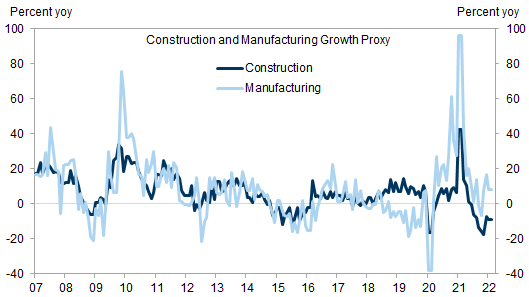
Meanwhile, from Goldman Sachs: