 Goldman Says Treasury Will Drop Under Its Cash Minimum June 8-9
- Janet Yellen doubts the US can pay all its bills by June 15, telling NBC that getting to that date is “very difficult.” Goldman economists said they see the Treasury’s cash levels below the bare-minimum $30 billion mark by June 8 or 9, or sooner. They assigned a 30% chance of a deal this week and the same odds “shortly before” the deadline. (Bloomberg)
Jerome Powell Keeps June Interest-Rate Pause in Play Fed chair says banking strains could mean rates don’t have to rise as much to tame inflation
(…) “Until very recently, it has been clear that further policy firming would be required. As policy has become more restrictive, the risks of doing too much versus doing too little are becoming more balanced,” Powell said Friday at a conference hosted by the central bank. (…)
Earlier, New York Fed President John Williams presented research at the conference showing the Covid-19 pandemic didn’t change estimates of a “neutral” interest rate that neither stimulates nor restricts demand, a finding with important implications for how high officials may raise rates to slow the economy.
Between the 2008 financial crisis and the 2020 pandemic, Fed officials and economists had concluded the neutral rate of interest—or the level that balances supply and demand when the economy is operating at full strength—had declined sharply. That, together with weak growth following the crisis, ushered in a period of historically low interest rates.
Williams said a widely followed model used to estimate the inflation-adjusted neutral rate of interest showed “there is no evidence that the era of very low natural rates of interest has ended.”
If estimates of the neutral rate of interest shifted higher, officials could conclude that the rates needed to slow inflation would be considerably higher. If those estimates haven’t changed, then the fed-funds rate might be expected to return to less than 3% if the Fed succeeds in bringing inflation down to its 2% target over the next few years. (…)
-
Fed Official Is Open to Forgoing June Rate Hike Minneapolis Fed President Neel Kashkari said he could support holding interest rates steady at the central bank’s next meeting.
- Economists push back expected Fed rate cut to 2024, NABE poll shows
Economists now believe the U.S. central bank, which is debating whether it needs to raise rates again, will lower its targeted policy rate in the first quarter of next year, according to the survey released by the National Association for Business Economics.
In February, survey respondents saw the Fed cutting rates in the final three months of this year. Forecasters maintained their view on the peak level of the Fed’s benchmark overnight interest rate, which jibes with the central bank’s current target range of between 5% and 5.25%.
The NABE survey showed respondents split over whether the U.S. economy would fall into recession, although the poll’s median view sees modest levels of growth prevailing through 2024, with an expected 0.4% rise between the fourth quarter of 2022 to the final three months of 2023.
Respondents upsized their estimate of inflation in 2023, seeing the consumer price index up by 3.3% from the last quarter of 2022 to the final quarter of 2023, according to the survey. In February, respondents expected inflation would be up 3% over the same period.
The survey also found upgraded outlooks for the job market, with respondents now saying they expect an average 142,000 jobs to be gained per month, up from 102,000 in the February survey. The jobless rate, currently at 3.4%, is projected to average 3.7% this year, down from 3.9% in the February poll.

(Factset)
Updated r* Estimates from the NY Fed Suggest Incrementally Dovish Policy Risk
This morning [Friday] the NY Fed relaunched their estimates of the natural rate of interest (otherwise known as r*) that had been suspended since 2020. The new estimates update the Holston-Laubach-Williams (HLW) model to account for the unusual economic dynamics during the pandemic. The updated r* estimates are similar to prior estimates during the pre-pandemic period but imply a modest decline in r* since 2019, and in a speech accompanying the data’s release NY Fed President John Williams noted that the model’s estimate of r* would fall more significantly to zero by end-2024 if the economy evolves in line with current Blue Chip forecasts. We have previously noted several reasons why the HLW model estimates may have limited implications for the appropriate near-term policy stance, but the new estimates and the model-implied outlook might suggest some incremental dovishness if FOMC officials factor them into their policy decisions. (Goldman Sachs)
The NY Fed report is here.
US bank deposits and credit slip in latest week, Fed data shows
Deposits at all U.S. commercial banks slipped last week and overall credit provided by banks edged lower as well, Federal Reserve data released on Friday showed.
Deposits in the week ending May 10 totaled $17.10 trillion on a nonseasonally adjusted basis, down from $17.16 trillion a week earlier, the Fed’s weekly snapshot of the banking system’s assets and liabilities showed. Deposits, which had dropped substantially after the collapse in March of Silicon Valley Bank, were down at large banks and little changed at smaller ones.
Meanwhile, credit provided by banks dropped to $17.32 trillion from $17.37 trillion a week earlier, led by a decline in securities holdings. Loans and leases saw modest declines.
Deposits are not fleeing out, even at smaller banks:

And loans are not falling much. They are actually up since SVB, even at smaller banks:

- Private equity steps up lending as US banks pull back The turmoil facing U.S. regional banks has prompted some lenders to step back, leaving space for investors such as asset managers, private equity (PE) funds and insurers to lend more.
(…) “We expect to grow further by filling the void that regional banks are leaving as they pull back from certain types of lending,” said Dan Pietrzak, co-head of private credit at KKR, which manages $76 billion in credit funds. Pietrzak sees “attractive” assets in auto and consumer lending. (…)
“We see U.S. commercial banks retreating from real estate lending,” in some cases because regulators have instructed banks to reduce their exposure, said Andrea Balkan, managing partner overseeing Brookfield Asset Management’s real estate finance funds. “It’s times like this when we have a unique ability to grow.”
Investors providing private credit comprise 12% of the $6.3 trillion U.S. commercial credit market, according to Fitch Ratings. That compares with regional banks, which account for $4.5 trillion in loans, or 40% of the U.S. total. (…)
Shadow banks, as the private creditors are known, are able to lend with fewer regulatory hurdles. While private credit funds have grown swiftly, the risks they pose to the financial system appear limited, the Federal Reserve wrote in a report this month.
The International Monetary Fund painted a different picture, warning in April that the expansion of private credit may have added vulnerabilities to the financial system and called for more supervision of non-banks. The lack of public information about the loans makes it difficult for markets and regulators to measure risks “until it is too late,” the fund wrote. (…)
PE firms have more than $1 trillion that could be deployed on credit deals, Christopher Sheldon, KKR’s co-head of credit and markets, estimated in a recent paper. (…)
“You’ll start to see other areas becoming attractive, including auto lending, small & medium enterprises (SME) and consumer lending, fund financing,” Greg Olafson, president of Goldman Sachs Asset Management’s alternative investments business.
Auto Dealers Finally Have Cars to Sell Again Some brands are getting heavier on inventory than others as shoppers’ concerns about rising interest rates put a dent in demand.
Buyers are finding a bigger selection of models to choose from this spring selling season, in large part because of easing supply-chain woes and more stable factory output.
The replenished inventory also is shaping up to be an important test for car companies, many of which have said in recent years they would keep availability permanently constrained. Some brands, such as Jeep and Buick, are already getting heavy on stock, according to industry data. If supplies get bloated, it could put an end to the lofty prices and big profits the industry has enjoyed since the pandemic’s early days, analysts say. (…)
Overall, dealerships had about 1.8 million vehicles in transit or on lots at the end of April, a 50% improvement compared with the same period in 2022—but still about half the stock available two years before, according to data from industry-research firm Wards Intelligence.
U.S. auto sales have remained resilient, mostly because of pent-up demand, and even picked up in the first quarter of this year as inventory levels improved. Buyers are also still paying historically high prices—the average vehicle sold for about $46,000 in April—and the amount of discounting on the car lot remains well below prepandemic levels, according to data analytics firm J.D. Power. (…)
Micron Stock Tumbles as China Says Chips Are Security Risk Chinese regulators said its products failed to pass a cybersecurity review.
Beijing warned operators of key infrastructure against buying the company’s goods, saying it found “relatively serious” cybersecurity risks in Micron products sold in the country. The components caused “significant security risks to our critical information infrastructure supply chain,” which would affect national security, according to the statement from the Cyberspace Administration of China, or CAC. (…)
The tech sector has become a key battlefield over national security between the two largest economies, with Washington having already blacklisted Chinese tech firms, cut off the flow of sophisticated processors and banned its citizens from providing certain help to the Chinese chip industry. In a statement, the US Commerce Department said Beijing’s conclusion had “no basis in fact” and Washington will continue to try and limit industry disruptions with its allies. (…)
The move brings fresh uncertainty to the other US chipmakers that sell to China, the world’s biggest market for semiconductors. Companies like Qualcomm Inc., Broadcom Inc. and Intel Corp. deliver billions of chips to the country, which puts the components inside electronic products that are shipped all over the world. (…)
Micron derived nearly 11% of its revenue from mainland China in its last fiscal year. Sanford C. Bernstein said the worst hit to revenue would reach that level, but a “more realistic impact will be low-single digit percentage and only in the near term.”
CHINESE DOMINOS
A Poor Province in China Splurged on Bridges and Roads. Now It’s Facing a Debt Reckoning. Guizhou has sent out pleas for help with its finances and investors think Beijing will have to step in
Cracks have been showing in the finances of Guizhou, a southwestern province with jaw-dropping landscapes and some of the world’s highest bridges. It was one of China’s fastest-growing local economies over the past decade—thanks in large part to its heavy spending on infrastructure development.
More than 110 state-backed entities known as local government financing vehicles in Guizhou have outstanding bonds, which in many cases were issued to help pay for the construction of bridges, highways and tunnels. Including these entities, the provincial government had the equivalent of $388 billion in outstanding debt by the end of 2022, about 1.3 times its gross domestic product last year, according to Wind, a financial data provider. (…)
On May 16 the finance bureau of Guiyang, the capital city of Guizhou, made another public admission of its dire debt situation in a 2022 work report. “In recent years, Guiyang has done everything possible” to resolve its debt risk through write-offs and converting government debts to state-owned enterprises’ debts, the government said in the report. These technical methods “have been basically exhausted,” it said. “Debt risks may occur at any time if funds are not available in a timely manner,” it added. It also disclosed a hidden debt of approximately $5.5 billion based on a preliminary tally. The article was also quickly taken down.
What Beijing ends up doing to resolve Guizhou’s debt issues will have ramifications for investors and banks across China that own a lot of local government debt. Economists and analysts have warned that debts have reached unsustainable levels in many parts of the country, and that central-government bailouts could be needed to prevent problems from snowballing.
Chinese authorities largely stood aside over the past two years as the country’s largest property developers slid into financial distress, causing losses for investors and many businesses and depressing the land sales that were a big source of revenue for many local governments. There was also no government rescue earlier on for debt-laden HNA Group, a large airlines-to-hotels conglomerate that went into bankruptcy. Some state-owned Chinese companies that weren’t deemed to be systemic risks have also failed. (…)
China’s Politburo in April said local governments need to strengthen their debt management and “strictly control new hidden debts,” signaling that their borrowing needs to be reined in. (…)
Over the years, smaller local banks and local branches of big banks have lent heavily to these local governments. “It’s absolutely a problem. It is channeling the problems in the real economy to the financial sector and eventually could pose a threat to financial stability,” said Tianlei Huang, a research fellow at the Peterson Institute for International Economics.
Chinese local governments had roughly $5.3 trillion of debts outstanding as of early May. Those numbers don’t include the debt of the local government financing vehicles, which are considered off-balance-sheet liabilities that governments are also on the hook for.
Goldman Sachs estimated the total interest-bearing debt of Chinese LGFVs to be around $8.5 trillion in a recent report. The International Monetary Fund put the figure at $10 trillion. (…)
The Covid-19 pandemic and the housing downturn hit the province hard. Land sales slumped after many property developers ran into liquidity problems, hurting a major source of income for local governments. Stringent Covid restrictions on people’s mobility affected the amount of traffic on Guizhou’s roads and bridges, and their toll collections. (…)
- China’s $23 Trillion Local Debt Mess Is About to Get Worse What happened in cash-strapped Hegang points to a long economic slog for the rest of the country.
(…) Hegang represents just the tip of the iceberg of a local government debt problem that’s making investors increasingly nervous and that threatens to be a drag on the world’s second-largest economy for years to come. Goldman Sachs Group Inc. estimates China’s total government debt is about $23 trillion, a figure that includes the hidden borrowing of thousands of financing companies set up by provinces and cities.
While the chance of a municipal default in China is relatively low given Beijing’s implicit guarantee on the debt, the bigger worry is that local governments will have to make painful spending cuts or divert money away from growth-boosting projects to continue repaying their debt.
“Many cities will become like Hegang in a few years’ time,” said Houze Song, an economist at US think tank MacroPolo, noting that China’s aging and shrinking population means many cities don’t have the workforce to sustain faster economic growth and tax revenue.
“The central government may be able to keep things stable in the short term by asking banks to roll over local governments’ debt,” Song said. Without loan extensions, he added, “the reality is that over two thirds of the localities won’t be able to repay their debt on time.” (…)
A fiscal restructuring can be triggered in one of two ways: if interest payments on a municipality’s bonds exceed 10% of its expenditure, or if local leaders deem it’s necessary. China-based Yuekai Securities Co. estimated that as many as 17 cities had bond interest payments of more than 7% of their budgeted expenditure in 2020, meaning they are close to breaching that 10% threshold. The cities are mainly in poorer provinces like Liaoning in the northeast and Inner Mongolia up north. (…)
Problems are evident in other cities as well. Shangqiu, a city of 7.7 million people in China’s central Henan province, made headlines recently after almost shutting down its only bus service. In Wuhan and Guangzhou, proposed cuts to pensioners’ medical benefits prompted rare street protests earlier this year. Civil servants in wealthy cities like Shanghai are reportedly having their pay slashed. In Guizhou province, officials have begged Beijing for a bailout. (…)
EARNINGS WATCH
- 2023 EPS estimates have improved for the top 10 S&P 500 stocks but not for the bottom 490. via @WarrenPies, @3F_Research

- The ratio of the equal-weighted to market-cap-weighted S&P 500 indexes is down sharply since the banking crisis started on March 8. The former is down 2.5%, while the latter is up 5.0% (chart). (Ed Yardeni)

- Also from Ed Yardeni:

S&P 500 IT S&P ex-IT
- Forward revenue growth: 4.7% -0.3% 5.8%
- Forward earnings growth: -4.4% -7.4% -0.1%
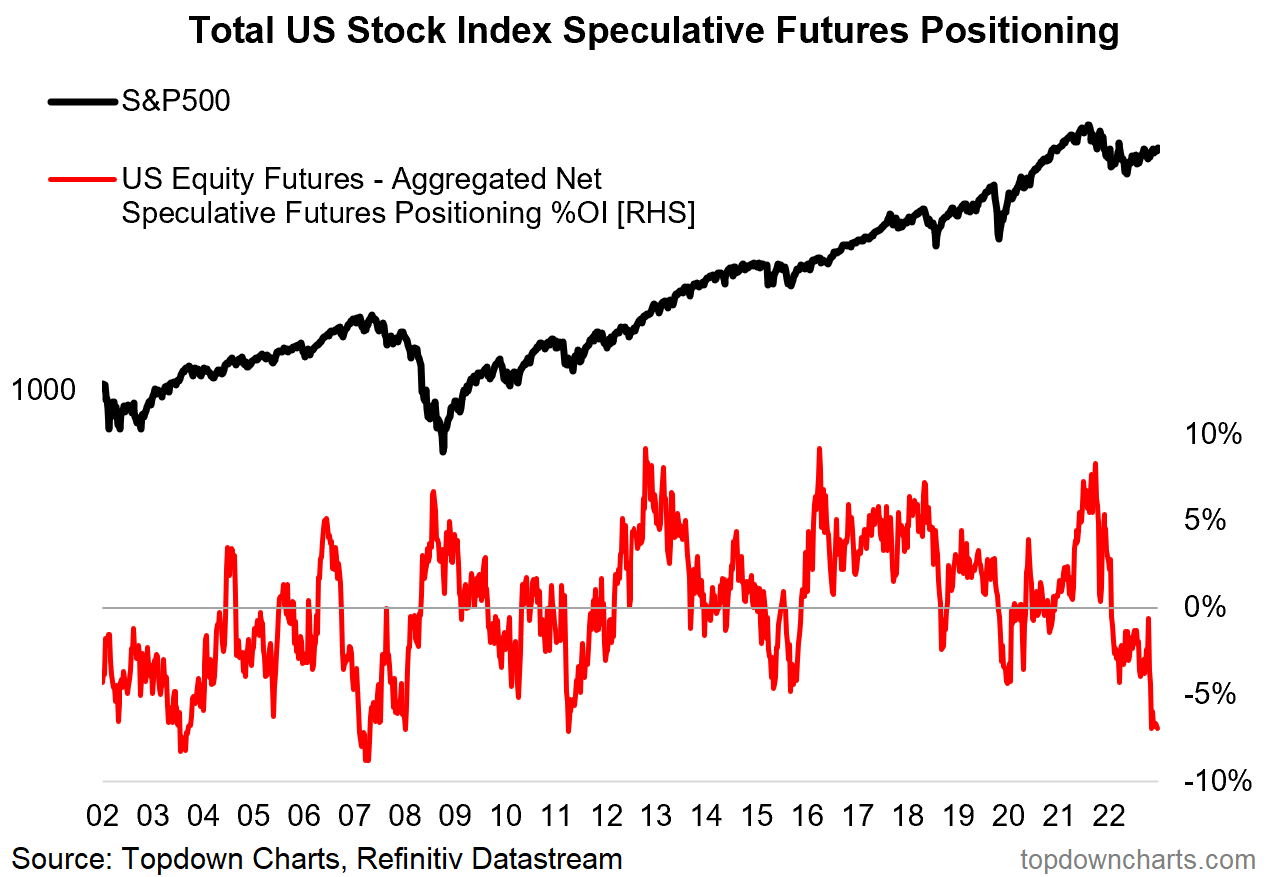
- Short Squeeze: On the other hand, we’re seeing heavy shorts in overall aggregated US index futures (net speculative positioning) — on a similar scale as was seen in the early-2000’s as the bear market was ending… but also similar to 2007 when the bear market was just getting started. The bullish take is that a short squeeze could take the market higher. (Callum Thomas)
Source: @topdowncharts Topdown Charts