Did you miss yesterday’s Edge and Odds? THE DAILY EDGE: 22 APRIL 2019: Slow and Slower
U.S. Existing-Home Sales Declined in March Sales fell 4.9% as the housing market heads into the crucial spring selling season
Sales were down 5.4% from a year ago, marking 13 straight months of annual declines.
Home sales in February experienced their second-strongest monthly gain ever, offering the possibility that the market was finally rebounding. But March’s numbers were a setback as the housing market headed into the crucial spring selling season, and they offered fresh evidence that home sales are still struggling to break out of a period of decline. (…)
The average rate for a 30-year mortgage, which neared 5% in the fall, fell to 4.17% last week, according to Freddie Mac .
Since existing home sales reflect contracts signed in the prior couple of months, some analysts suggested that March data may not fully reflect those recent positive trends. (…)
The weakness is countrywide as these Haver Analytics charts show:


Non-seasonally adjusted sales were down 7.8% YoY and at their lowest since March 2014.
The new housing market is also uninspiring:


However, the mortgage Purchase Applications Index offers hope:
 (Source: Pantheon Macroeconomics via The Daily Shot)
From independent bank analyst Chris Whalen:
(…) The good news is that the number of households is finally starting to grow, but supply remains the key constraint. And many households are moving from expensive coastal markets and into more affordable markets such as NC, TX, IN, CO and OH. This is bad news for states like NY, CT and NJ, where an exodus of affluent homeowners to other states is finally forcing sellers to capitulate in the high end suburban markets.
San Khater, Chief Economist at Freddie Mac, likewise confirmed that a larger cohort of younger buyers is entering the market and that first time buyers are being forced to move further from the city center to find affordable housing. With the median age of the first time home buyer in the early 30s, Khater sees an increase in younger buyers looking for their first house. Of note today’s mortgage production is pristine in terms of delinquency compared with 2008-2014 mortgage loan vintages.
While high-end home prices may be softening, home price appreciation remains robust at the lower end of the price scale, according to Laurie Goodman, Co-Director, Housing Finance Policy Center at Urban Institute. Significantly, Laurie believes that we currently have a 330k deficit in terms of the number of new homes being constructed vs new households created. Whereas the supply of new homes exceeded demand in the 2000s, today the opposite is the case due to soaring land prices and restrictions on new home construction. (…)
EARNINGS WATCH
After 82 reports, the beat rate is 77% and the surprise factor +5.1% and positive across all sectors, so far. At the same time after Q4’18, with 76 reports in, the beat rate was 78% and the surprise factor +2.2%.
The revenue beat rate is 48% and the surprise factor +0.4% and very erratic among sectors (5 positive, 5 negative).
The 82 companies having reported show +6.2% aggregate earnings growth on +3.0% revenue growth. Total Q1 blended earnings now seen –1.7%, from –2.0% April 1.
Trailing EPS: $162.26, very volatile early in the season.
DIFFERENT STROKES FOR DIFFERENT FOLKS
Invoice2go’s U.S. Micro Business Snapshot: 2016 – Q1 2019 What invoicing trends since 2016 are telling us about the current state – and future – of the “Micro” SMB economy
(…) what’s happening farther down the chain, in the world of what’s been dubbed “Micro Business”– i.e., the sole proprietorships and 1-2-person companies that actually make up 92% of the official SMB sector? Generally defined as companies with fewer than five employees, “micro businesses” are responsible for more than 41 million jobs in this country, according to the Association for Enterprise Opportunity. (…)
Reviewing invoiced dollar amounts from the same set of 31,500 Invoice2go users over the past three years, since 2016, reveals an unmistakable pattern across nearly all types of businesses we serve: significantly slowing growth in 2018 (as compared to 2017) and negative growth when comparing Q1 2019 to the same period in 2018.
Specifically, the YOY growth rate across industry sectors dropped from 14% in 2017 to about 3% in 2018. And numbers from Q1 2019 showed a (negative) -3% growth rate compared to about 4% growth in Q1 2018. (…)
The findings of a March 2019 survey – particularly among the micro business users – seem to show some reticence about business in the year ahead, fewer than one in three users polled saying they plan to hire any new employees or add any subcontractors in 2019.
Notably, confidence levels correspond with the size of a respondent’s company, i.e., the more employees a respondent’s company has, the more bullish that business owner is on 2019. For example, 52% of respondents with 1-2 employees predicted they would see growth this year, as compared to 72% of those employing 3-5 people and 74% of those employing 5-10 people.
Overall, only 7% are expecting a decline in revenues this year, while 58% expect to grow. Almost half of those polled (49%) said the current administration’s policies have been “positive for my business,” slightly higher than the 39% who said they had had “no effect” on their business. (…)
There were few mentions of this recent survey in the media and financial world. Bulls did not talk about it while bears who did omitted to inform their readers that more than 50% of Invoice2go’s customers are in the construction, home maintenance and outdoors services sectors specifically. Trends for these companies since 2016, including the 2019 brutal winter:
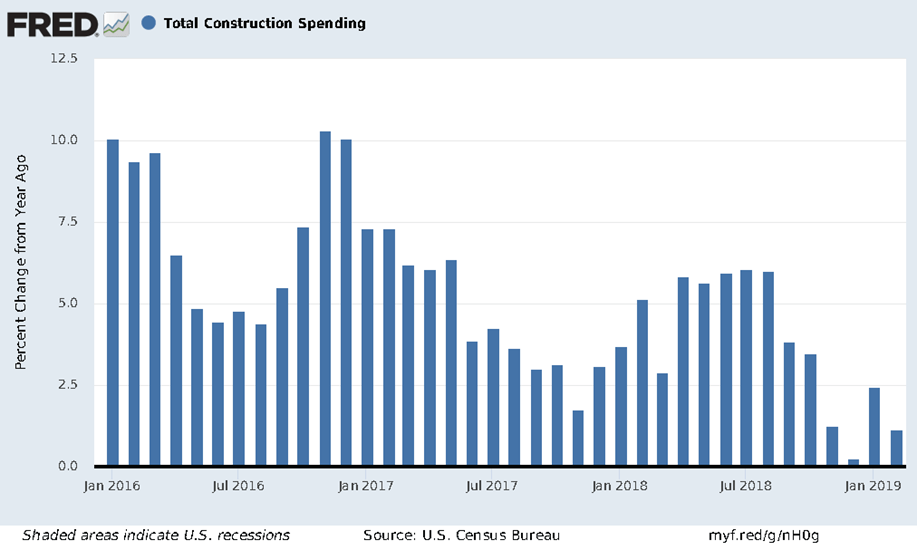
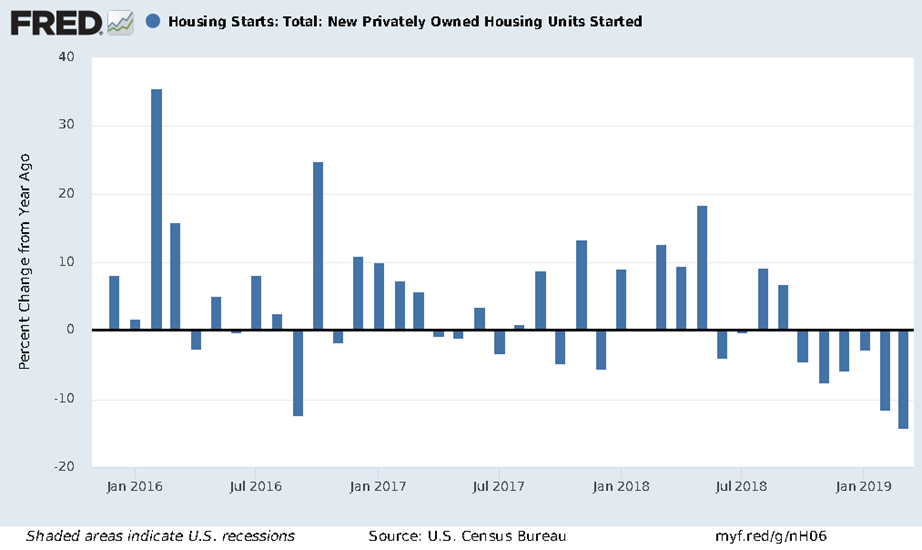
For its part, the Golub Capital Altman Index, which tracks more than 150 middle market private companies (with little or no construction bend), shows approximate YoY “earnings growth of 9.5% and revenue growth of 9.3% during the first two months of the first quarter of 2019. This compares to approximate year-over-year earnings growth of 13.4% and revenue growth of 10.6% in the fourth quarter of 2018.”
Lawrence E. Golub, CEO of Golub Capital, said, “U.S. businesses selling primarily in the domestic market are in great shape. The Golub Capital Altman Index posted nearly double-digit revenue and earnings growth in Q1, despite the U.S. government shutdown for most of January. The Technology sector, which for us consists primarily of business-to-business software companies, remains the standout, extending a nine-quarter streak of double-digit revenue growth and a four-quarter streak of double-digit earnings growth. These signs of fundamental strength, together with low unemployment, stable inflation and a moderating pace of wage growth, suggest the U.S. economy may not need additional support from the Fed in 2019.”
Dr. Edward I. Altman said, “Revenue and earnings growth remain strong in our sample of U.S. middle market companies, although growth has decelerated moderately from the record pace of 2018. The turnaround we identified last year in the Healthcare sector continued in the first quarter of 2019, as the Healthcare companies in our sample maintained solid growth while increasing margins. Although the Industrial companies in our sample reported relatively modest growth, their focus on the U.S. domestic market appears to have insulated them from concerns about growth and trade in the global economy. In sum, our data suggests the U.S. economy has retained much of its momentum from 2018.”

2 thoughts on “THE DAILY EDGE: 23 APRIL 2019”
Curious matter @hand:
Why the funds rate has risen above the IOER is somewhat of a market mystery, though Fed officials attribute it to higher yields on the reverse repo markets that have pushed up the EFFR. Some market participants have feared that the Fed’s balance sheet reduction program, in which it is allowing some proceeds from its bond portfolio to roll off each month, also could be exerting upward pressure on rates.
Overvaluation in the housing market isn’t being offset by slightly lower interest rates. Slow if not stagnate income and wages will force buyers to jump into risky deals — and thus, many buyers are hesitating and many sellers are hesitating, because rent is skyrocketing and there’s no way to leverage a good deal at this point. The economy seems to be drifting along in slow motion, waiting for a recession, so getting people hyped up into buying things they can’t afford will keep everyone in hesitation mode. People do have memories of the Dotcom Bubble and The Great Recession and even Wall Street is “probably” not going to become super greedy and do really stupid things, i.e., people will be more likely to stay the course and go slow, versus risking too much. That said, if homes go up 3% this year, it isn’t gonna change the tune at all.
Comments are closed.