Home Sales Sank 6.4% in December
(…) December capped the weakest year for home sales in three years. Existing-home sales fell 6.4% in December from the previous month to a seasonally adjusted annual rate of 4.99 million, the National Association of Realtors said Tuesday. Compared with a year earlier, sales in December declined 10.3%. (…)
The decline in December sales was broad, with Seattle, Portland, much of California, Denver, Maryland, Delaware and the Philadelphia area experiencing double-digit declines, according to an analysis of local multiple-listing service data by Lawler Economic and Housing Consulting. (…)
The median sale price for an existing home in December grew 2.9% from a year earlier—the smallest increase since March 2012, when the market was still depressed from the housing crash. (…)
The Commerce Department isn’t expected to release December’s data due to the government shutdown, but an analysis by Redfin found that new-home sales dropped 10.3% in the South in December, 13.4% in the West and more than 16% in the Northeast. (…)
Mortgage rates have also come down in recent weeks, easing concerns that a long era of cheap housing credit was about to end. Rates nearly hit 5% about two months ago, but average rates for a 30-year, fixed-rate mortgage dropped to 4.45% last week, according to Freddie Mac. Purchase mortgage applications grew 9% for the week ending Jan. 11 from a week earlier to the highest level since April 2010, according to a Mortgage Bankers Association index. (…)


Here’s a scary chart (@MikaelSarwe)

This will help some:
Los Angeles Teachers, School District Announce Deal to End Weeklong Strike Union members vote to approve agreement that includes 6% raise, additional staffing
(…) LAUSD Superintendent Austin Beutner said the agreement included a 6% raise, additional staffing at schools, and a reduction to class sizes, covering the union’s major demands. He said the nation’s second-largest school district agreed “to invest every nickel we have in our classrooms while maintaining the fiscal solvency of Los Angeles Unified.”
The deal includes $403 million to be spent through 2022 to add nurses, counselors and librarians at schools and to reduce class size. It doesn’t address health-care and other retiree benefits, which the district has cited as a major strain on its finances. (…)
“So far it seems like we got everything we wanted, most importantly that we are taken seriously,” teacher Julia Guzman said. (…)
In the last year, teachers in states including North Carolina, Arizona and West Virginia have gone on strike to demand higher pay and other changes, winning average pay increases of between 5% and 20%.
The trend could continue as teachers unions in Denver and Oakland, Calif. are currently locked in disputes with their districts and threatening to strike within the next month.
Truckers See Momentum Slowing Heading Into 2019
(…) “We see more evidence pointing to a potential freight recession in 2019 similar to 2015/16,” Morgan Stanley analysts Ravi Shanker and Diane Huang wrote in a Jan. 16 research note. “With net inventory levels reaching another all-time high and ordering levels falling, the risk of a destocking event in 2019 is high.” (…)
An index of U.S. domestic freight volumes slipped 0.8% last month compared with December 2017, the first annual decline in two years, according to Cass Information Systems Inc., which processes freight bills.
Trucking rates on the spot market, where shippers book last-minute transportation, also fell in December for the first time in several years, according to online freight marketplace DAT Solutions LLC. The average price to hire the most common type of big rig dipped to $2.07 per mile, a penny lower than the prior month and 5 cents below the level in December 2017.
The first quarter is typically a slower period for freight, although factory production ticked up at the end of last year, suggesting consumer demand could make up for a pullback in exports.
But analysts say trucking companies could face an even steeper drop-off in shipping demand this year because some manufacturers and retailers pulled imports forward in 2018 to avoid tariffs expected to take effect around March.
The impact “will likely be seen most in February after the impacts of an earlier Chinese new year leave the market somewhat naked to difficult [year-over-year] comparisons,” Cowen & Co. transportation analyst Jason Seidl wrote in a Jan. 14 research note. Factor in falling spot rates, and “the data would suggest that much of the spot pricing gains from mid-2018 that strongly benefited carriers could be erased in 1H19, with the advantage in contract negotiations reverting back toward the shippers.”

China Risks Real Hard Landing This Time Beijing’s crackdown on shadow banking has gone overboard. Some backtracking looks necessary.
(…) Chinese credit growth has continued to decelerate, despite nine months of significant central bank easing. If it doesn’t turn back up soon, producer-price inflation could turn negative—causing big problems in the heavily indebted industrial sector.
The mushrooming of Chinese shadow banking was an unfortunate, but necessary, byproduct of a banking system that has grown more state dominated since 2010. Private companies account for about two-thirds of the economy but receive only about a third of net new lending. It’s little wonder they have turned increasingly to unofficial channels to get loans. (…)
Despite several big reserve ratio cuts and sharply lower benchmark interbank rates, growth in net nonfinancial fundraising had declined to 9.8% in December, its lowest in more than a decade.
In other words, in the past year, banking-system liquidity has risen by about a fifth, but net credit growth has fallen by about a third. The reason is clear. Shadow finance outstanding fell by a full 10% in 2018—by far the sharpest contraction on record. (…)
-
Shadow banking was cut sharply last year, with shadow loans outstanding down by almost 11% YoY as of December, in contrast to a rise of 15% through December of 2017. Total credit rose by about 10% last year, but the composition of the new flow changed: traditional bank loans accounted for 81% of new credit, up from a 51% share in 2013 as shadow banking was curbed. There was a similar clampdown on peer-to-peer lending. While these changes are good for the long-term health of the financial system, they created short-term pain for many private firms, who were among the largest recipients of shadow credit. (Andy Rothman)

-
The SMI report from World Economics shows further softening in China’s economic activity in January. (The Daily Shot)

- Want a shot of optimism on China? Has the China Collapse Finally Arrived?
EARNINGS WATCH
We have 61 reports in with an aggregate 20.0% earnings growth rate, a 79% earnings beat rate with a low +1.7% surprise factor (+0.7% for Financials). The revenue beat rate is 57% (42% for Financials).
The blended growth rate for Q4 is 14.1% (12.2% ex-Energy), down from 15.8% on Jan. 1. Q1’19 estimates now show earnings rising 2.7%, down sharply from 5.3% on Jan. 1. with only 3 sectors expected to report good growth: Financials (+5.3%), Health Care (+8.7%) and Industrials (+8.2%). The remaining 8 sectors’ earnings are seen down 0.5% on average in Q1’19.
Trailing EPS are now $162.05. The Rule of 20 P/E is at 18.4.
ODD ODDS
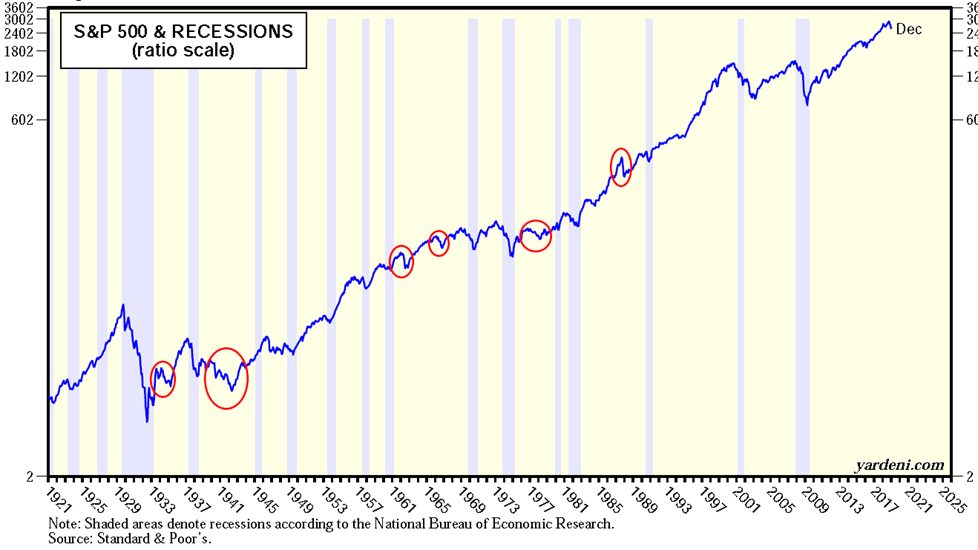
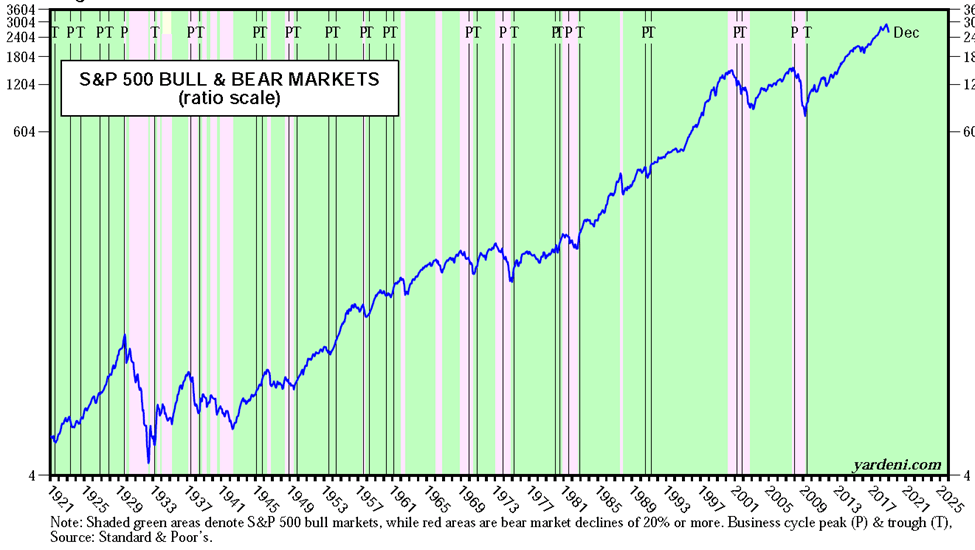
There are many ways to skin a cat, and so many ways to forecast a recession. There’s this old saying that markets have forecasted 9 of the last 5 recessions and economists none of them. David Rosenberg plays the odds in his own many ways:
You don’t need to have the S&P 500 decline 20% to have a recession – we had an official downturn in 1990-91 without that happening (…). And we have had periods in the past when the stock market corrected more than 22% (1961, 1966, 1987) and there was no recession. But (…) declines in the S&P 500 of 20% or more typically does foreshadow recessions around 80% of the time. Nothing is truly infallible, but I’ll take those odds.
We don’t need a 20% beating and we have had bears greater than 22% without recessions but 20% or more typically does foreshadow recessions 80% of the time. Only President Trump can make some sense out of these numbers. Recessions without bear markets, bear markets without recessions but bear markets which, typically, do foreshadow recessions 80% of the time. I never thought I could use “typically” with “does” and 80% odds.
And about those 80% odds: there have been only 11 official recessions since WWII. Pretty small sample to derive solid statistics, especially if you also had recessions without a bear and bears without recessions. But there is a key to this:
The real key is whether the September high in the S&P 500 of 2,930 was indeed the peak of the cycle. This has nothing to do with the severity of the decline. Just a simple fact, which is that every post-WWII peak in the stock market was followed by a peak in the real economy. This is not 9 out of 5; it is 9 out of 9.
The real, real key in all this is what is actually a peak in the stock market? Obviously, if one waits long enough, there will be a peak close enough to a recession…Look at these charts from Ed Yardeni and try to make solid odds out of them.