U.S. New-Home Sales Rose in March All U.S. regions but the Northeast saw new-home sales gains last month
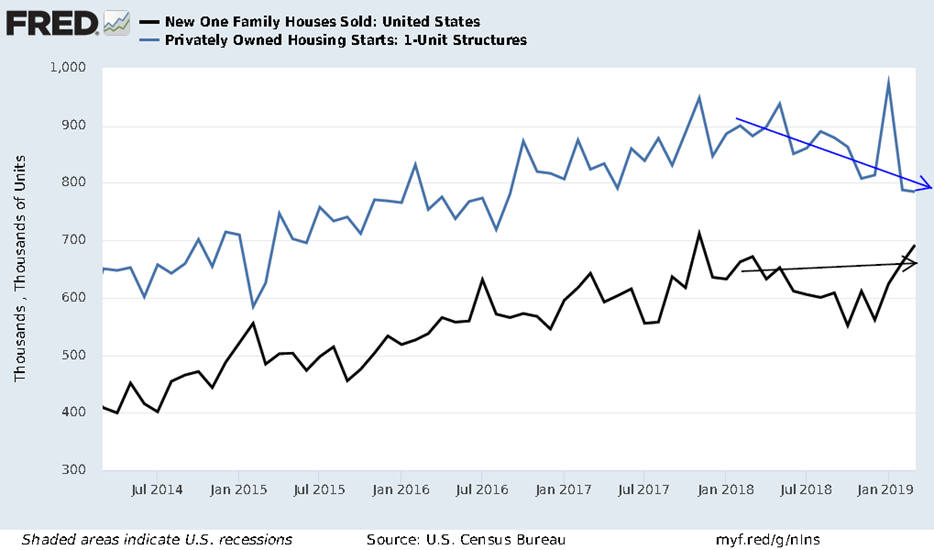
Purchases of newly built single-family homes—a relatively narrow slice of all U.S. home sales—rose 4.5% to a seasonally adjusted annual rate of 692,000 in March, the Commerce Department said Tuesday. Economists surveyed by The Wall Street Journal had expected a 2.5% decline.
Sales were up 3.0% in March from the prior year. (…)
With more homes on the market, the median sales price of a new home declined to $302,700, the lowest level in more than two years. (…)
There is hope for starts to re-start:
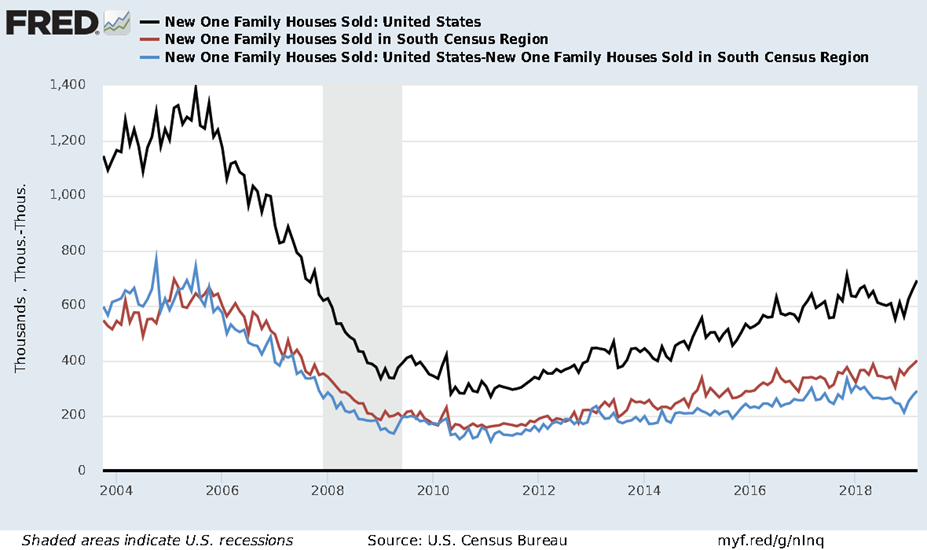
But the action is mainly in the South where YoY sales are up 9.3% vs the U.S. at +3.0% and the West at –4.3% (never mind the Northeast, –20.0%).
U.S., China Officials to Resume Trade Talks April 30 in Beijing
Talks starting next Tuesday “will cover trade issues including intellectual property, forced technology transfer, non-tariff barriers, agriculture, services, purchases and enforcement,” the White House said in a statement. Chinese officials led by Vice Premier Liu He planned to then head to Washington for discussions starting on May 8, the White House said.
The two sides are seeking to have a draft agreement by the end of May, a person familiar with the matter said, asking not be named discussing the private talks. Officials want to announce during Liu’s visit that they’ve agreed to a deal and details of a signing summit, people familiar toldBloomberg News earlier. (…)
Mnuchin has said that enforcement mechanisms will be reciprocal, and that the U.S. is open to “certain repercussions,” addressing one of the biggest sticking points in talks. (…)
The two sides are still haggling over an enforcement mechanism and what duties will stay in place or be removed. (…)
-
BTW:
China’s turning back to American crude after shunning it for months. A tanker of U.S. oil is awaiting discharge off the port of Qingdao and will be joined by more as the country’s buyers feel more assured their orders won’t break government regulations, traders and refiners said. That may be a good sign for next week, when Steven Mnuchin and Robert Lighthizer resume trade talks in Beijing. (Bloomberg)
- BTW:
The perverse notion that Canada is a security and defense threat to the US was invoked by the Trump administration in order to levy steel and aluminum tariffs. Ironically, the administration has subsequently granted far more waivers of these tariffs to Chinese firms than to Canadian ones. According to Susan Harper, Canada’s Consul General in Miami, for the 25% steel tariffs, 40% of waiver applications from China have been granted, but only 2% of those from Canada. For the 10% aluminum tariff the ratio is even worse: 85% of Chinese waivers have been approved, but only 0.2% of Canadian ones. (David Kotok, Cumberland Advisors)
Trade wars ‘would hurt US worst’, ECB says Further escalation of tensions could knock 2 per cent off US GDP, research finds
No need for swift output action after Iran oil waivers end, Saudi energy minister says
Saudi Arabia’s energy minister said on Wednesday he saw no need to raise oil output immediately after the United States ends waivers granted to buyers of Iranian crude, but added that the kingdom would respond to customers’ needs if asked for more oil.
Khalid al-Falih said he was guided by oil market fundamentals not prices, and that the world’s top oil exporter remained focused on balancing the global oil market.
“Inventories are actually continuing to rise despite what is happening in Venezuela and despite the tightening of sanctions on Iran. I don’t see the need to do anything immediately,” Falih said in Riyadh. (…)
May approves Huawei for UK 5G in snub to US
Alibaba Pushes Its Cloud Unit Globally As It Trounces Amazon in Asia
The e-commerce giant widened its lead over Amazon.com Inc. and Microsoft Corp. in Asia’s cloud computing market in 2018, according to Gartner, which in turn helped it narrow its global gap with those two rivals. That’s helping Alibaba advance billionaire co-founder Jack Ma’s vision of earning half its revenue beyond China. (…)
The overall cloud market could grow by 55 percent to $331.2 billion in three years, according to Gartner, and Alibaba’s cloud business has been generating triple-digit revenue growth over the past three years, outpacing the industry.
Gartner estimates that Alibaba last year accounted for 19.6 percent of the Asia region’s markets for infrastructure as a service and infrastructure utility services, two of the most popular forms of cloud business. That means its regional market share rose by nearly a third from 2017, while Amazon’s fell slightly to 11 percent. (Globally, Amazon leads with 30.4 percent to Alibaba’s 4.9 percent.) (…)
THE RULE OF 20 STRATEGY
Yesterday, at 2928 on the S&P 500 Index, the Rule of 20 P/E reached 20.05 which triggered a change in the Rule of 20 Strategy from 100% equity instigated December 24, 2018 at 2374 (a 16.89 Rule of 20 P/E) to 80%. Risk management in action.
U.S. Market Exceptionalism Can’t Continue Forever The S&P 500 is back at a new record high, while stocks in most of the rest of the world are yet to return to 2018’s peaks. But the rampant outperformance of U.S. equities can’t last forever.
The S&P 500 is back at a new record high, while stocks in most of the rest of the world are yet to return to 2018’s peaks. But the rampant outperformance of U.S. equities can’t last forever.
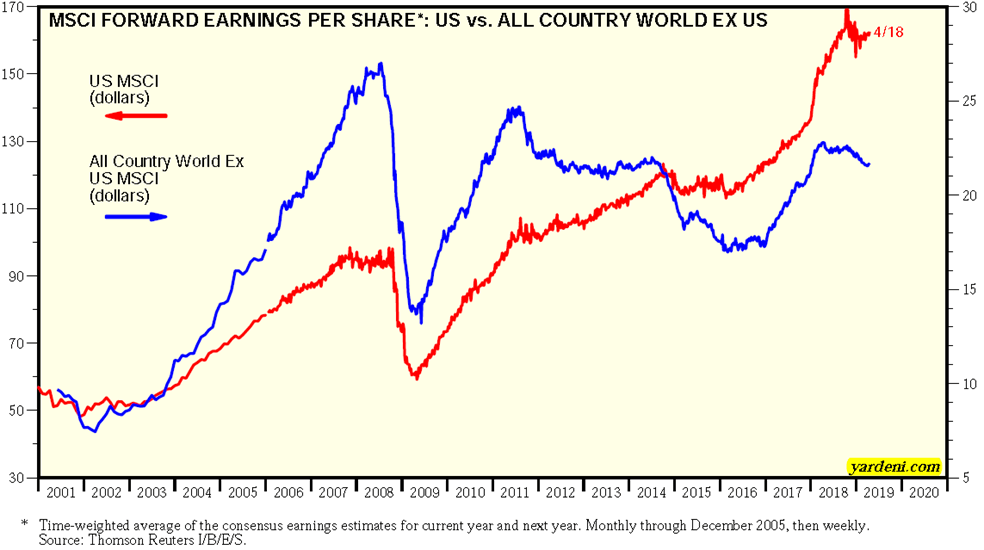
Low interest rates and eye-watering valuations have been credited with driving the U.S. bull market, but financial conditions haven’t been so different elsewhere. The big reason why U.S. stocks have beaten those in almost every other country during the past decade—and why the trend has limits—is more basic: profits.
Since the beginning of 2008, earnings per share for U.S. equities have risen by 80%, according to FactSet data. Over the same period, Japanese earnings have risen by half as much in dollar terms, emerging-market earnings are flat and European companies are yet to see profits recover to their level before the financial crisis. (…)
This divergence could continue, but other parts of the picture look harder to replicate. Above all, U.S. corporate profits have surged relative to the size of the economy. For the second half of the 20th century, corporate profits after tax typically ran to around 6% of output, and almost never rose above 8%. Now, the figure runs to 10%, helped by last year’s tax cuts. It would have to rise to unprecedented levels, double its precrisis average, to repeat the trend of the past decade. (…)
Those factors don’t mean equities elsewhere are about to start steaming ahead of U.S. stocks. Equities in the rest of the world have their own problems.
But they do suggest that investors can’t expect such dramatic outperformance in future. After an amazing run, those with significant exposure to U.S. stocks would do well to take a trip overseas.
…and see by themselves the mess in Europe, the opposite challenges in India and Japan population-wise, and decide by themselves how much of their own money they want to invest in China. Perhaps also glance at these charts:
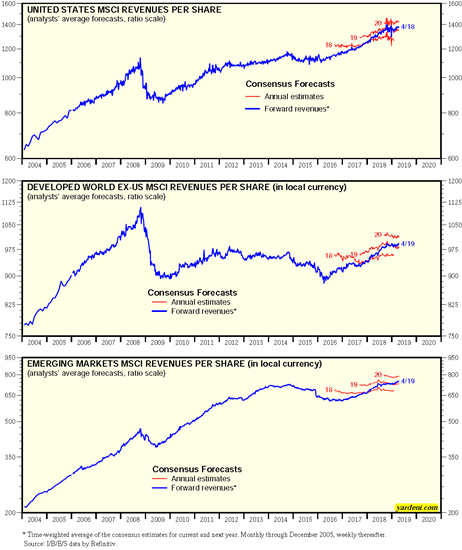

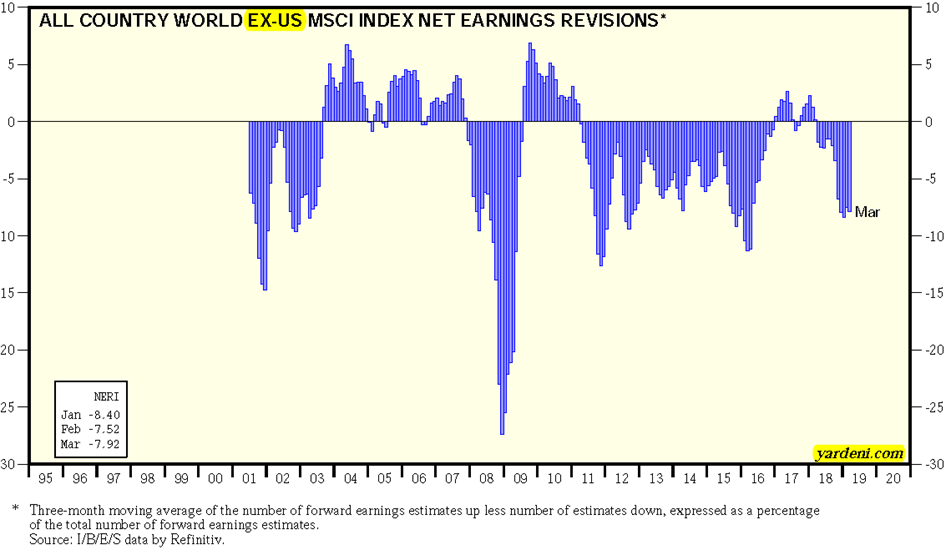
STOXX 600: Q1 2019 Earnings Growth Estimate Trend

Source: I/B/E/S data from Refinitiv
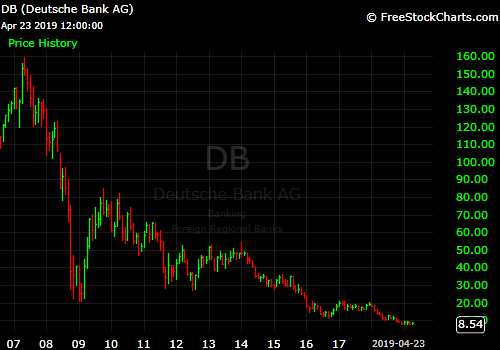
Deutsche Bank Considers Forming ‘Bad Bank’
Seems to me that was done a while back:
2 thoughts on “THE DAILY EDGE: 24 APRIL 2019: Change in the Rule of 20 Strategy”
Argentine news tip?
Central bank officials have pulled out all the stops to reel in inflation, to no avail. Interest rates have risen to 68 percent, the highest in the world, as policy makers freeze the amount of money in circulation.
https://www.bloomberg.com/news/articles/2019-04-25/argentine-bonds-sink-for-second-day-with-no-relief-in-sight
trump booming stock performance FRED chart:
3 yr return:
S&P 500 -0.21918%
Dow -0.22261%
Nice! It’s amazing the amount of noise being made about the new market records and booming earnings!
https://fred.stlouisfed.org/graph/?g=nJ4k
Comments are closed.