Russian Invasion Scrambles Prospects for Global Economy Financial markets reacted swiftly to the invasion, with stock markets dropping sharply and commodity prices soaring
(…) Extensive fighting and sanctions that disrupted Russia’s energy exports would have an outsize impact on the European economy, given its heavy dependence on Russian gas. Some European banks and businesses also have extensive ties with Russia. (…)
Russia and Ukraine together make up a small slice of the world economy and represent only a minor destination of exports for Europe or the U.S. However, Russia is a major supplier of oil, natural gas and other commodities. It pumps about 10% of the world’s oil. In turn, the EU relies on Russia for nearly half of its natural gas imports and almost a quarter its oil imports.
Meanwhile, Ukraine and Russia combined account for nearly 30% of global wheat exports, according to the U.S. Department of Agriculture. The nearby Black Sea serves as a major conduit for international grain shipments from Ukraine and the country is also among the top exporters of barley, corn and rapeseed. (…)
Russia’s MC Norilsk Nickel PJSC is the world’s largest producer of palladium, responsible for between 25% and 30% of total output. The automobile industry, which is struggling with a shortage of semiconductors, could face additional problems if Russia’s supply of palladium were to slow. Platinum, however, can be used as an alternative, and South Africa is by far the world’s largest supplier of that metal.
Russia is also a big producer of the key ingredients for fertilizers such as urea and potash. Disruptions in those supplies could drive food prices, which are already at multiyear highs, up further. (…)
- Fossil fuels — oil, as well as coal and natural gas — provide more than 80% of the global economy’s energy. And the cost of a typical basket of them is now up more than 50% from a year ago, according to Gavekal Research Ltd., a consultancy. (Bloomberg)
- “the war has limited impact on global trade, because apart from oil and natural gas, Russia doesn’t have supply chains that can impact the world, which is different from China.” (Reuters)
- “This puts central banks in a really tricky situation. A March hike from the Fed is being priced out (and) the number of Fed hikes this year being lowered because …it feels like it’s the wrong time to start taking liquidity out of markets. “Central banks may have to look through an inflation spike though that means ultimately rate hikes could become substantially bigger. I’d say medium term inflation risks have increased substantially…” (Reuters)

Goldman Sachs:
Historically, Fed officials have sometimes preferred to delay major policy decisions until uncertainty surrounding geopolitical risks diminished. (…) The current situation is different from past episodes when geopolitical events led the Fed to delay tightening or ease because inflation risk has created a stronger and more urgent reason for the Fed to tighten today than existed in past episodes. With some signs of problematic wage-price dynamics emerging and near-term inflation expectations already high, further increases in commodity prices might be more worrisome than usual. As a result, we do not expect geopolitical risk to stop the FOMC from hiking steadily by 25bp at its upcoming meetings, though we do think that geopolitical uncertainty further lowers the odds of a 50bp hike in March.
But pre-opening today (4100), the S&P 500 is down 14.6% from its January high. Where is the Powel put if there is one?
Michael Batnick (The Irrelevant Investor) tells us that since 1950, the S&P 500 has declined 10% from its highs 25 times, 7 times by 20-30% and 5 times by more than 30%.

At 4100, the S&P 500 is 7.8% below its 200-day m.a.. Since 2010, it got below 10% only 3 times as Ed Yardeni illustrates.

But every time the index traversed its 200dma, it bottomed after the Rule of 20 P/E, currently 24.2, got below 20.0. That would be below 3155 at current earnings and inflation levels. I bet we get the Powell put before we get there.

 Vladimir Putin said nations “will face consequences greater than any you have faced in history” if they interfere in his invasion of Ukraine. This is a rare overt threat of nuclear attack. (Axios)
Assessing the risk of a correction turning into a bear market
(…) The chart below shows the S&P 500’s median price path once it fell into a correction, separated by those that turned into bear markets (black line) and those that did not (blue line).
Both groups tended to see a short-term bounce lasting 1-2 weeks. After that, the bear market corrections fell apart and quickly plumbed lower lows. The non-bear-market corrections only saw some choppiness then went on to recover further in the weeks ahead.

Indeed US Job Postings Tracker: Data Through February 18 Job postings have yet to substantially rebound post-omicron surge.
It seems like the worst of the omicron surge’s impact might have passed. New job postings (those on Indeed for seven days or less) are well above pre-pandemic baseline, up 83.9% as of February 18. (…)
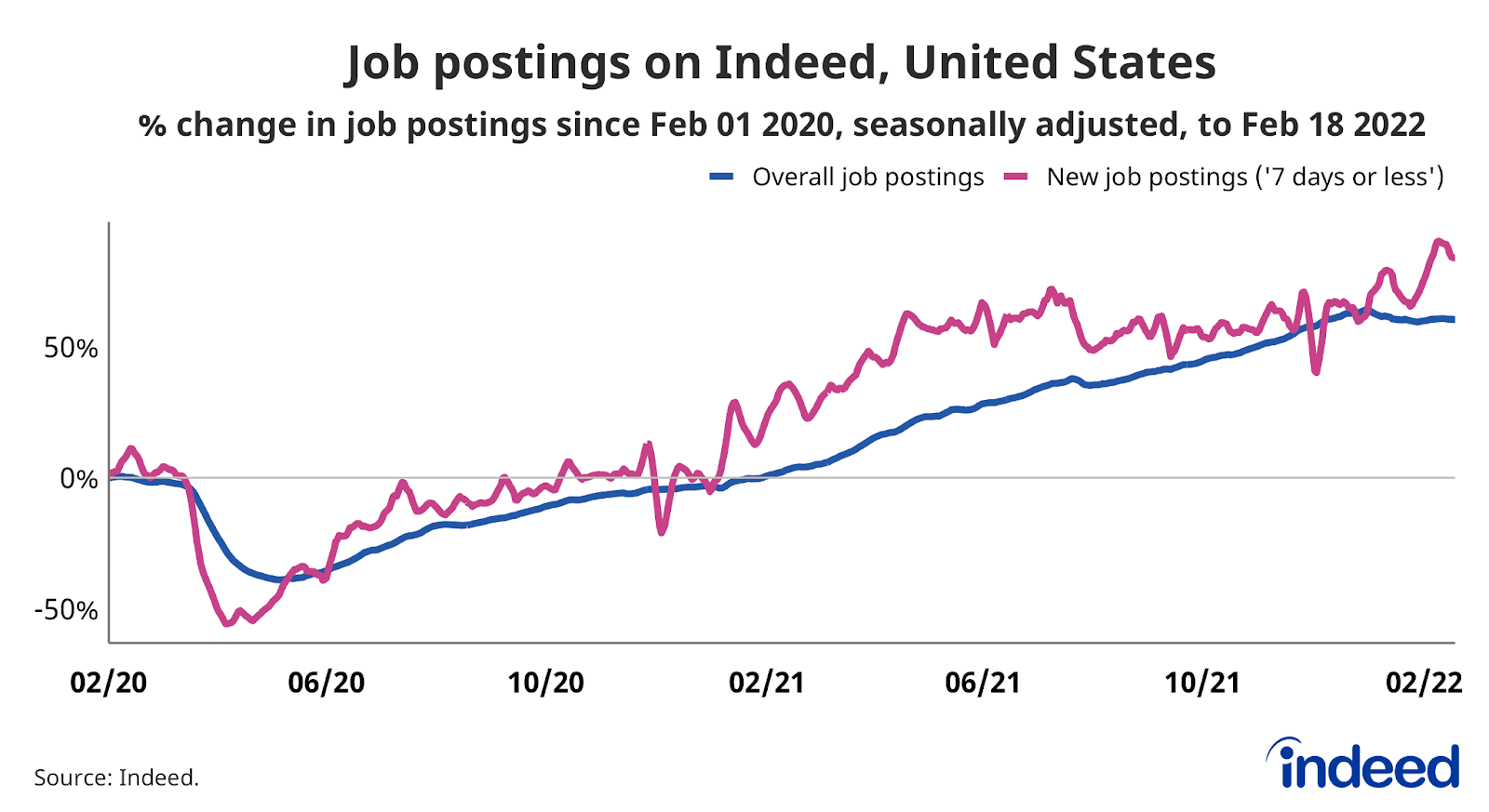
Unretirements are picking up!
 Reproduced from Indeed; Chart: Axios Visuals
Some Companies Ditch Annual Raises and Review Worker Pay More Often The demand for U.S. workers has led some manufacturers, technology firms and other employers to ditch the annual raise and switch to more frequent pay reviews as they compete for talent and keep pace with rising wages.
- Canada’s top law firms are raising pay levels for younger lawyers amid a war for talent in the industry Several Canadian corporate law firms have increased annual salaries for first-year associates in their Toronto offices from the once-standard $110,000 to $130,000
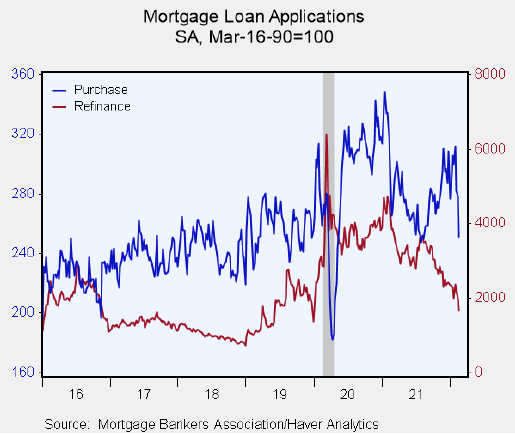
U.S. Mortgage Applications Continue to Fall As Rates Rise
Mortgage rates rose from 2.7% to 4.0% in one year, boosting monthly mortgage payments by 18%. But house prices are also up 18% in the last year. Payments at 2.7% on what was a $300k house are up nearly 40% (+$473/m) on the same $354k house at 4%. An impossible dream for all but the wealthiest.

CalculatedRisk’s Bill McBride computes his own affordability measure
I used median income from the Census Bureau (estimated 2021), assumed a 15% down payment, and used a 2% estimate for property taxes, insurance and maintenance. (…) For house prices, I used the Case-Shiller National Index, Seasonally Adjusted (SA). Also, for the down payment – there wasn’t a significant difference between 15% and 20%. For mortgage rates, I used the Freddie Mac PMMS (30-year fixed rates).
So here is what the index looks like (lower is more affordable like the FirstAm index):

Bill notes that “in December, the average 30-year mortgage rates were around 3.1%, and currently mortgage rates are close to 4.12% – so we already know the “Affordability Price Index” will increase sharply over the next couple of months (meaning houses are less affordable) – and will be the least affordable since the housing bubble / bust.”
Rent? This price-to-rent chart also from CalculatedRisk uses the OFHEO house price index and the Owners’ Equivalent Rent (OER) from the BLS. “Note that OER is lagging behind other measures of recent rent increases.”

Americans are in a housing crisis. Add 7.5% foodflation and 30% energyflation and you get a huge squeeze on most household budgets. Disposable income is up 5.6% YoY but has increased only 4.6% annualized in the last 3 months.
Lowe’s Profitability Improves Despite Dimming Sales Outlook The home-improvement retailer’s management of costs and pricing impresses investors.
(…) Looking ahead, Lowe’s said it expects that on a comparable basis, sales in 2022 will register between a 1% decline and a 1% improvement from 2021’s levels [+5%]. The company forecast that profit will grow by approximately 8% to 13%. (…)
Fast-Spreading Type of Omicron Revives Reopening Concerns A more infectious type of the Omicron variant has surged to account for more than a third of global Covid-19 cases sequenced recently, adding to the debate about whether countries are ready for full reopening.
(…) Evidence so far suggests BA.2 is some 30% more infectious than its cousin, the BA.1 subvariant that kicked off the Omicron wave in southern Africa in November 2021. In South Africa, BA.2 has accounted for 82% of cases so far in February, according to health authorities in that country.
Overall, BA.2 accounted for 35% of Covid-19 virus samples whose genomes were recently submitted to the global Gisaid database, according to a Gisaid update released Tuesday.
Studies so far suggest that both types of Omicron pose about the same risk of severe disease in humans. That risk is lower than last year’s Delta variant, but with so many people getting infected, the death toll from Omicron is still high. (…)
Early studies suggest that vaccines and booster shots work equally well in both Omicron types in preventing serious illness. (…)
Prof. Sato said the current co-circulation of BA.1 and BA.2 could spawn a hybrid virus that would “more easily increase and be more harmful.” (…)
From Katelyn Jetelina:
-
Transmissibility. We now have consistent data showing that BA.2 outcompetes BA.1. A recent study found the global reproductive rate of BA.2 was R(t)= 1.4 compared to BA.1, which had a R(t)=1.1. In England, secondary attack rates in U.K. households are also higher: 13.4% of BA.2 cases transmitted within their households vs 10.3% of BA.1. Together, this means that BA.2 will become the dominant variant worldwide very soon.
-
Immunity escape. In a recent lab study, immune escape was similar for BA.2 compared to BA.1. In the real world, we have evidence that boosters continue to work against BA.2, but just like BA.1, protection against infection wanes over time (see Table below). A study of Denmark households found that vaccination helped protect against transmission more for BA.2 than BA.1. So, vaccines continue to work against BA.2. This is not surprising but sure is great news.

UK Health Security Report Source Here
What about infection-induced immunity? A recent preprint from Denmark found that BA.2 reinfections after BA.1 infection were rare, but much more common among unvaccinated compared to vaccinated: of the 47 reinfections, 89% were not vaccinated and 6% had only the two-dose series.
-
Severity. We’ve gotten mixed signals as to whether BA.2 induces more severe disease than BA.1. A recent lab study in Japan found that BA.2 is more severe in hamsters. Hamster models have helped us out a lot in the past, but they certainly have limitations. A “real world” study in South Africa found something different: BA.2 had similar risk of hospitalization as BA.1. Because hamsters are not people, and because the lab is not the real world, I tend to have more confidence in South Africa’s conclusion that BA.2 is not more severe than BA.1. But we definitely need confirmatory analyses from other countries.
Taken together, we thought BA.2 would extend the tails of the Omicron wave. Many countries, like South Africa, did see the tail of the epidemic extended a little, but BA.2 did not cause a huge case upswing. Which is great news.

Source: Tom Wenseleers Source Here
Over the past two weeks, conversations have bubbled up about the need for another booster. As far as I can tell, the triggering event for these discussion was a recent U.S. study published in MMWR. This study analyzed data from a network of hospitals across 10 states during August 26, 2021–January 22, 2022. The scientists wanted to evaluate mRNA vaccine effectiveness (VE) against hospitalizations over time. What did they find?
-
Two doses: VE for hospitalizations was 93% <2 months of a booster → VE was 80% >4 months after a booster
-
Three doses: VE for hospitalizations was 95% <2 months of a booster → VE was 81% >4 months after a booster
So this study showed that vaccine effectiveness against severe disease waned over time, regardless of a 2- or 3-dose series. Is this a sign that the booster did not solidify long-term effectiveness like we hoped? Maybe.
But there are some significant limitations to this study. For example, the data was not stratified by age or health status. Those over 65+ years or immunocompromised may disproportionally contribute to waning. If that’s the case, this study doesn’t necessarily support a broad fourth dose policy. There was also a very small sample with very limited follow-up data: only 39 people in the study had a booster for more than 4 months. This means there is a lot of uncertainty in the statistics. We really need a more robust study to see whether there is a “true” waning signal.
Cue Kaiser Permanente. They published a study this week in Nature. (Note that the study was funded by Moderna). Kaiser has an incredibly extensive database because of their closed health system, making this sort of study among a huge population feasible. The scientists leveraged a sample of over 26,000 patients to assess VE against infections and severe disease. What did they find?
-
Protection against infection waned, regardless of booster status. This is no surprise and another indicator that we really need to shift our focus away from infection to severe disease.
-
During Delta, VE of 2 and 3 doses against hospitalization was ≥99%.
-
During Omicron, VE of 2 and 3 doses against hospitalization was 84.5% and 99.2%, respectfully.
-
The 4 people hospitalized with Omicron despite three mRNA doses were more than 60 years of age with chronic diseases, and one was also immunocompromised. (Immunocompromised people really need to get their fourth dose!)
-
The number of boosted hospitalizations in this study was so low researchers were not able to measure any possible waning.
This study shows that vaccines and boosters continue to work incredibly well against severe disease. But limitations also exist with this study. There was limited follow-up time to properly evaluate waning against severe disease. This was also an insured population, meaning it’s not a great representation of the general U.S. population.
In addition to the Kaiser study, data from the U.K. continues to show a three-dose mRNA series continues to protect swimmingly well against hospitalization. However, they also only have 14 weeks of follow-up data after a booster, so we are at the mercy of time to see if boosters do in fact start waning like the primary series. So far, in the U.K., it doesn’t look like they do.
So, do we need another booster right now? No. Do we need another one soon? Before next winter? Ever? No one knows. That decision will be highly dependent on the duration of protection, how protection changes due to occupation, age, health, and, probably the most important factor, how this virus continues to mutate.
Bottom Line:BA.2 is something to keep an eye on, but I’m not too concerned. I’m more concerned about another variant popping out of nowhere like Omicron did. The booster story will continue to evolve as long as this pandemic continues to evolve.