Note: I am travelling for the next several weeks, impacting frequency and depth.
Knight-Swift Profit Plunges on Weak Trucking Demand The truckload carrier says it believes retailers are ‘in the late innings’ of their inventory destocking
Revenue dropped 21% to $1.55 billion, with revenue from its core truckload segment falling 15.5% to $829.4 million. Revenue from the freight brokerage logistics business fell 52%, driven by a 35% decline in loads from shippers. Analysts surveyed by FactSet had forecast revenue of $1.28 billion.
The company also saw operating expenses decline 10% to $1.46 billion in the period.
Chief Executive David Jackson said trucking demand has been hit by a destocking of excess inventories by retailers following a sharp buildup in 2022. “We believe we are in the late innings of inventory destocking and expect to see a normalization of imports and seasonality in coming quarters,” he said.
Phoenix-based Knight-Swift lowered its guidance for full-year earnings to a range from $2.10 to $2.30, down from previous guidance of $3.35 to $3.55. The new lower guidance includes a projected loss of 25 cents to 30 cents a share from U.S. Xpress, a truckload carrier Knight-Swift acquired earlier this year.
This merits 2 observations/comments:
- Are we in “the late innings of inventory destocking”? If we consider the inventory to sales ratio, we’re actually in overtime. Total businesses’ I/S is back below pre-pandemic levels. Only wholesalers’ I/S is still above. Unless Americans really tire of buying goods, destocking may have run its course.
- Ex U.S. Xpress, EPS are seen in the $2.45-2.60 range, down 25% from the previous guidance. As one serious analyst puts it: “with the stock up on the year and the 2023 EPS outlook now halved from January, the valuation doesn’t work, no matter what part of the cycle the TL market is
currently in (interestingly, despite 4 consecutive guide downs, we still haven’t missed the opportunity for a downgrade, as the
willingness to “buy the trough” in the shares was so strong all year).”
Th Cass Freight shipments index keeps slipping (-1.9% MoM s.a.) 18 months into its down cycle which Cass says typically last from 21 to 28 months.

Cass says that “Freight markets continue to work through a downcycle” but reckon that “dynamics are shifting as real incomes improve and the worst of the destock is in the rearview.”
Americans in Their Prime Flood Into the Job Market The share of people between 25 and 54 either working or seeking jobs rose this year to the highest level since 2002.
(…) Prime-age workers now exceed prepandemic levels by almost 2.2 million.
The resurgence of midcareer workers is driven by women taking jobs.
The labor-force participation rate for prime-age women was the highest on record, 77.8% in June. That is well up from 73.5% in April 2020.
Men, however, tend to be employed at higher rates. The overall prime-age participation rate rose in June to 83.5%, the highest since 2002.
Women aren’t having as many children—there were about 3.66 million births in 2022, 655,000 fewer than the peak in 2007—so child-care responsibilities have decreased.
Julia Pollak, chief economist at ZipRecruiter, said it is possible for women’s participation to rise further if employers adopt or the government requires additional family-friendly policies. U.S. female participation lags behind that of other industrialized economies in part because of the cost of child care, which is subsidized elsewhere. (…)
Actually, women just got back to their pre-pandemic level while men are 2.6% above.


High Rates, Low Supply Hinder Home Buying This Summer
Existing home sales, which make up most of the housing market, decreased 3.3% in June from the prior month to a seasonally adjusted annual rate of 4.16 million, the National Association of Realtors said Thursday. That was the slowest sales pace since January. June sales fell 18.9% from a year earlier.
The national median existing-home price fell 0.9% in June from a year earlier to $410,200, the second-highest level on record in data going back to 1999, NAR said. (…)
New homes accounted for nearly one-third of single-family homes for sale nationwide in May, compared with a historical norm of 10% to 20%. (…)
Nationally, there were 1.08 million homes for sale or under contract at the end of June, unchanged from May and down 13.6% from June 2022, NAR said. (…)
The number of new listings in June fell 26% from a year earlier, according to Realtor.com.
Big Regional Banks Reported Stable Deposits—Great News for Investors Shares of Citizens Financial, U.S. Bancorp and KeyCorp are up this week.
Many banks, including KeyCorp, Western Alliance Bancorp and Zions Bancorp, posted sharp profit declines. But their deposits were stable or higher compared with the first quarter, a relief after customers yanked their money earlier this year across the industry. Other regional lenders including Citizens Financial Group and M&T also posted higher deposits over the quarter. (…)
The KBW Nasdaq Bank Index added more than 6% this week, and the KBW Nasdaq Regional Banking Index climbed by even more. (…)
Profit fell short of Wall Street estimates at many regional banks in the second quarter—even powerhouses like Truist Financial, Fifth Third Bancorp and U.S. Bank. Giant counterparts JPMorgan Chase and Wells Fargo, meanwhile, beat expectations and posted blockbuster profit increases in the process.
The declines were especially sharp at some regional banks whose deposits have proved more flighty, with year-over-year profit sliding 17% at Western Alliance and 14% at Zions. (…)
A number of regional banks dimmed their profit forecasts for the year. Many have started to hoard more cash rather than using it to make new loans, as they brace for potential new regulations. (…)
Banks have already started to take hits on these loans, especially office properties that have lost value since the pandemic, or they have stashed away money for future losses they expect. Even the vaunted Goldman Sachs took a big second-quarter write-down on its real estate holdings, much of it tied to office properties.
M&T said net charge-offs more than doubled from a year earlier to $127 million, driven by several office buildings in New York City and Washington, D.C., as well as a large healthcare company in New York state. At PNC Financial Services, net charge-offs for commercial real-estate loans jumped to $87 million, from $10 million in the previous quarter and $4 million a year earlier.
From the economy’s viewpoint, it is best to focus on credit. Since the first week of April, right after SVB, total loans and leases are down $26B. Outside of recessions, the pandemic and the immediate post GFC crisis (2010-11), this is the worst credit contraction ever. If this is a demand problem, the economy must be contracting. If this is a supply problem, the economy could be about to contract.
- Commercial property prices are headed lower. (The Daily Shot)
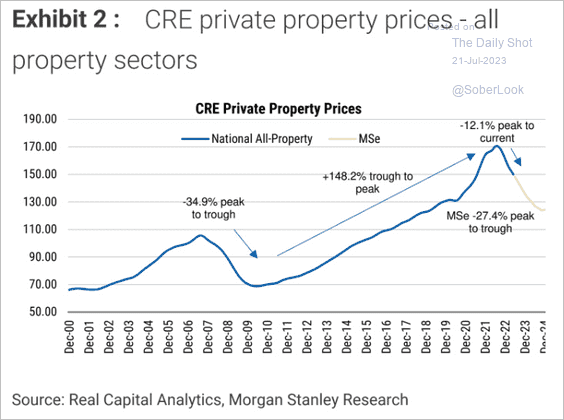 Source: Morgan Stanley Research; @dailychartbook
- Remote work will destroy 44% of NYC office values Academics’ projections grow increasingly dire as work-from-home persists
With the return to office seemingly plateauing at about 50 percent occupancy, the long-term impact of remote work on New York’s office values looks even more dire than previously thought.
That’s according to an update from researchers at New York University and Columbia University, who revised a study they released last year measuring the effect of work-from-home on New York City’s office stock.
The update, published in May, now calculates that the city’s offices as a whole will lose 44 percent of their pre-pandemic value by 2029 — up from the estimated 28 percent when the authors first published the study a year ago.
“We now estimate a more persistent work-from-home regime, which has more of an impairment of office values even in the long run,” NYU’s Arpit Gupta, one of the authors, wrote in an email. (…)
New York’s office buildings saw a notable uptick in physical occupancy after Labor Day last year, hitting nearly 47 percent. But that seems to have been somewhat of a ceiling. As of May, occupancy was slightly higher than 48 percent. (…)
New York’s office buildings saw a notable uptick in physical occupancy after Labor Day last year, hitting nearly 47 percent. But that seems to have been somewhat of a ceiling. As of May, occupancy was slightly higher than 48 percent. (…)
- American Express’ profit view dampens strong results from record card spending American Express kept its annual profit forecast unchanged despite a record spending on its credit cards by consumers in the second quarter, disappointing investors and sending its shares down 5% on Friday.
(…) rising borrowing costs led AmEx to raise its provisions for credit losses to $1.2 billion from $410 million a year ago as it braced for potential defaults in debt repayments. (…)
EARNINGS WATCH
From Refinitiv:
Through July. 21, 89 companies in the S&P 500 Index have reported earnings for Q2 2023. Of these companies, 73.0% reported earnings above analyst expectations and 19.1% reported earnings below analyst expectations. In a typical quarter (since 1994), 66% of companies beat estimates and 20% miss estimates. Over the past four quarters, 73% of companies beat the estimates and 22% missed estimates.
In aggregate, companies are reporting earnings that are 7.4% above estimates, which compares to a long-term (since 1994) average surprise factor of 4.1% and the average surprise factor over the prior four quarters of 4.2%.
Of these companies, 60.7% reported revenue above analyst expectations and 39.3% reported revenue below analyst expectations. In a typical quarter (since 2002), 62% of companies beat estimates and 38% miss estimates. Over the past four quarters, 71% of companies beat the estimates and 29% missed estimates.
In aggregate, companies are reporting revenues that are 1.5% above estimates, which compares to a long-term (since 2002) average surprise factor of 1.3% and the average surprise factor over the prior four quarters of 2.2%.
The estimated earnings growth rate for the S&P 500 for 23Q2 is -7.9%. If the energy sector is excluded, the growth rate improves to -2.2%.
The estimated earnings growth rate for the S&P 500 for 23Q3 is 0.8%. If the energy sector is excluded, the growth rate improves to 6.7%.
The estimated revenue growth rate for the S&P 500 for 23Q2 is -0.8%. If the energy sector is excluded, the growth rate improves to 3.0%.

Trailing EPS are now $213.99, down 2.7% from the end of June. Full year 2023: $217.46e. Forward: $229.94e, up 2.0% from the end of June. 2024e: $244.59
- Main street vs Wall street Not everybody is exuberant… (The Market Ear)

GS
- There has been almost a 3 standard deviation move in bearish responses to the AAII + II surveys from one of the highest readings on record last year to now the lowest since the heights of the pandemic liquidity frenzy. (Callum Thomas)

- Indeed, the seasonal tendency is for higher volatility around this time of the year; climaxing around October. With sentiment increasingly frothy, valuations back to expensive levels, and still murky macro, the path higher may not be as smooth or simple as it seems. (Callum Thomas)
- Valuations by Market Cap Range


Source: @nategeraci
- From Ed Yardeni:

