Europe’s Recovery Choices Will Leave It a Year Behind the U.S.
(…) JPMorgan Chase & Co. estimates the “fiscal thrust” — the boost from discretionary government spending minus the drag of expiring tax breaks and support measures — will add 1.8% to U.S. output this year. For the euro zone, it’ll subtract 0.1%. (…)
The European Union’s 27 sovereign governments set their own fiscal policies, it took months of negotiations last year to agree on a common 750 billion-euro ($910 billion) recovery fund. Proposals for how to spend the money are still being processed, and funds probably won’t start being distributed until the second half of the year. (…)
The EU’s recovery fund, combined with a 1.1 trillion-euro multi-year budget, is a breakthrough package for the union. The money will be spent between now and 2027, with more than half intended for “modernization” such as digitization and fighting climate change.
Not only is it the EU’s largest-ever stimulus package, the recovery fund is financed by jointly backed bonds — the first time the EU has agreed to such a measure.
It’s temporary, but European Central Bank officials hope it will ultimately lead to a permanent joint fiscal capacity, effectively the equivalent of the U.S. federal budget. (…)
The International Monetary Fund estimates the U.S. output gap was 3.2% of gross domestic product in 2020, and 5.1% in the euro zone. (…)
Japan car output slumps on chip shortage
Tesla Temporarily Halts Production at Model 3 Line in California
(…) Workers on a Model 3 production line in Fremont were told their line would be down from Feb. 22 until March 7, said the person, who asked not to be identified because the information is private. Impacted staff were told they would be paid for Feb. 22 and Feb. 23 and not paid for Feb. 28, March 1, 2 and 3. They were advised to take vacation time, if they had it. (…) Tesla said last month that it’s trying to mitigate the effects of a global semiconductor shortage on its operations and that it expects to increase global vehicle deliveries by more than 50% this year.
“When considering Tesla had excess inventory in the fourth quarter of 2020, and has never been able to sell-out its production capacity, we see the company as currently demand constrained, rather than production constrained,” GLJ Research LLC founder Gordon Johnson wrote in a note earlier this week. (…)
TECHNICALS WATCH
Via CMG Wealth:
- 13/34–Week EMA Trend

- Volume Demand vs. Volume Supply

U.S. Stocks Could See $170 Billion Stimulus Boost, Deutsche Says
U.S. stimulus checks could unleash a $170 billion wave of fresh retail inflows to the stock market, according to Deutsche Bank AG strategists.
A survey of retail investors showed respondents planned to put 37% of their stimulus cash directly into equities, a team including Parag Thatte wrote in a note Wednesday. With potentially $465 billion of direct stimulus being planned, that adds up to $170 billion, they said.
“Retail sentiment remains positive across the board, regardless of age, income or when the investor began trading,” the strategists wrote. “Retail investors say they expect to maintain or add to their stock holdings even as the economy re-opens.”

- BTW: Seventy-six percent of voters said they back the new $1.9 trillion stimulus package, including 52 percent who said they “strongly” support the bill. Only 17 percent of voters said they oppose it. Read more.
Stock Market Bubble?
From Bridgewater’s Ray Dalio
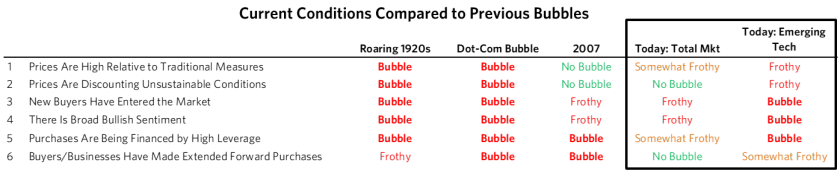
(…) The table below shows the current readings of each of these gauges for the US equity market as a whole, and the chart below it shows the aggregate reading derived by combining these gauges into one reading for the stock market going back to 1910. (…)
In brief, the aggregate bubble gauge is around the 77th percentile today for the US stock market overall. In the bubble of 2000 and the bubble of 1929 this aggregate gauge had a 100th percentile read.
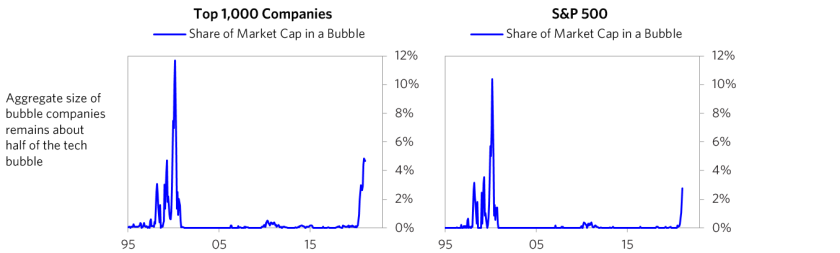
There is a very big divergence in the readings across stocks. Some stocks are, by these measures, in extreme bubbles (particularly emerging technology companies), while some stocks are not in bubbles. The charts below show the share of US companies that these measures indicate being in a bubble. It is about 5% of the top 1,000 companies in the US, which is about half of what we saw at the peak of the tech bubble. The number is smaller for the S&P 500 as several of the most bubbly companies are not part of that index.
(…) This market action is reminiscent of the “Nifty Fifty” in the early 1970s and the dot-com bubble stocks in the late 1990s, both of which I remember well. (…)
- JPMorgan’s Kolanovic Says ‘VIX Bubble’ May Spark Stock Rally
- Meme Stock Mania Kicks Up Anew After GameStop Shares Triple
- GameStop rally builds after puzzling ice-cream cone tweet
GameStop Corp shares surged more than 50% in early deals on Thursday as amateur investors jumped back into the stock (…). The new frenzy puzzled analysts, who had ruled out another short squeeze of the stock which had battered some hedge funds, and fueled more hype after some Twitter users pointed out a cryptic tweet of an ice-cream cone photo from activist investor Ryan Cohen – a major shareholder in GameStop and a board member. (…)
Reddit discussion threads were buzzing again about GameStop on Thursday, with members exhorting others to pile into the stock as the rally gathers steam.
“Bought lots more #GME today, let’s keep fighting !!,” wrote one Reddit user Fundssqueezzer, while another user Responsible_Fun6255 said, “Rise of the planet of the ape: GME edition”.
Earlier on Thursday, GameStop’s Frankfurt-listed shares trebled at one point, overshooting its 100% surge on Wall Street overnight, as European retail traders joined in the fresh buying push. (…)
“It’s a marathon, not a sprint. Whatever happens resist the urge to sell. The longer we hold the higher it goes,” said @catchme1fyoucan, an Italy-based user of retail trading platform eToro, in a discussion on GameStop.
- Lucid takes on Tesla as electric vehicle competition hots up Spac deal injects new funds into Saudi-backed start-up but production delay suggests long road ahead
-
Australia sovereign wealth fund chief warns of stock market ‘clean-out’ Some asset prices are ‘unsustainable’, says Peter Costello, as concerns rise over inflation