Walmart Cuts Profit Outlook, Lowers Prices on Goods The retailer said higher food and fuel prices are denting consumer spending, requiring more markdowns on apparel and other inventory.
(…) Walmart said higher prices for food and fuel have hurt sales of general merchandise, especially apparel, which generate higher profit margins for the company. Overall, the company expects comparable-store sales, excluding fuel, for its Walmart U.S. division to rise 6% in the second quarter from a year ago, but the growth is coming from less profitable items. (…)
“The increasing levels of food and fuel inflation are affecting how customers spend,” Walmart Chief Executive Doug McMillon said in a statement, “and while we’ve made good progress clearing hardline categories, apparel in Walmart U.S. is requiring more markdown dollars.” (…)
Mr. McMillon said the company expects additional pressure on general merchandise in the rest of the year, including the holiday shopping season, but said school supplies were selling well as families prepare for a new academic year.
Walmart now expects its operating income, excluding units it has divested, to decline between 10% and 12% for the fiscal year ending in January. In May the company said it expected operating income for the year to decrease about 1%, excluding currency fluctuations, down from a previous estimate of an around 3% increase.
Actually, Walmart said it now anticipates adjusted EPS for the Q2 and the full year to decline 8-9% and 11-13% respectively vs flat to up slightly for Q2 and -1% for the full year.
Walmart said it now expects same-store sales in the U.S. to rise by about 6% in the second quarter, ex-fuel, up from the 4-5% increase it previously expected.
This is Inflation 101 in action: higher revenue growth but declining margins and profits because real sales are dropping. Compound that with markdowns to clear a significant overstocked position and you get profits down 10-15%.
In the July 18 Daily Edge (SKINNING THE RETAIL SALES CAT) I showed that, while June total CPI was up 9.0%, a weighted average of inflation in durable and nondurable goods was 13.7%, a more accurate proxy of inflation on total retail sales.
This chart plots my “CPI-Goods” (red), nominal retail sales (blue) and deflated retail sales (black). Nominal sales were up 7.7% in June, better than +5.2% in March, but in real terms, growth turned negative in March as many retailers have since reported.

Walmart’s profit warning is a warning on the economy. The largest U.S. retailer, a prime destination for squeezed consumers, is having negative sales growth compounding a huge inventory problem (inventories were up 33% YoY last quarter). Its problems and markdowns will reverberate throughout the economy. Remember that Target reported its own +44% bloated inventories, Amazon +47%.
Manufacturers, worldwide, currently receiving cancellation notices, will themselves reduce input orders and review staffing needs. Transportation, wholesaling, warehousing will get hit. In fact, Axios told us yesterday that spot freight rates have recently plummeted 30%.
Friday we will get consumer spending data for June, many still hoping that services will more than offset weakening demand for goods. But S&P Global’s flash PMI warned us:
At 47.0 in July, down notably from 52.7 in June, the S&P Global Flash US Services Business Activity Index indicated a solid decline in business activity at service providers. The seasonally adjusted index continued its downward trajectory seen since March’s recent high and signalled the sharpest fall in output since May 2020.
(…) General-merchandise stores are an extreme example, but inventory-to-sales ratios at furniture, electronics and appliance stores, and at building-equipment and garden-supplies dealers are also now above prepandemic levels. And while the overall retail inventory-to-sales ratio looks very low, that is because of the dearth of vehicles in car dealers’ lots, a consequence of continuing automotive supply-chain problems.

Four in ten adults said it has been somewhat or very difficult to cover usual household expenses in a poll conducted end of June and early July. That’s the highest since the Census started asking the question in August 2020. It implies that more than 90 million families are struggling, up from about 60 million a year ago.
When the Census first asked the question two years ago, a third of respondents reported difficulties in covering usual household bills. The share fell over the following year but started rising about a year ago after government pandemic relief ended and inflation took hold.
Millions of households with student loans are expected to face an additional monthly expense Sept. 1, when a Covid moratorium on servicing that debt ends. (…)
Nationally, the latest Census survey shows that more than one third of households reduced or forwent expenses for basic household necessities, such as medicine or food, in order to pay an energy bill. More than one in five families kept their home at a temperature that felt unsafe or unhealthy for at least one month, and a similar share hasn’t been able to pay at least part of an energy bill.
- Unilever raises prices 11% as it grapples with ‘unprecedented cost landscape’
- The Economic Mess We’re In
From the WSJ Editorial Board:
(…) We’re about to find out if Mr. Powell has the fortitude to make up for the Fed’s great inflationary mistake.
The economic backdrop for the Open Market Committee is rare and troubling. Inflation has been raging while growth is slowing. The central bank finds itself in the strange position of having to raise interest rates on Wednesday while a day later the Commerce Department may report a second straight quarter of negative economic growth. (…)
- Why Inflation Is on the Way Down When growth of the money supply slows, so does the increase in prices.
By Donald L. Luskin, CIO at TrendMacro:
(…) Normally the Fed would never raise rates in a recession. But the most recent consumer-price index data, showing 9.1% headline inflation year-over-year as of June, is anything but normal. The last time the committee faced such a difficult decision was in the early 1980s, under the chairmanship of Paul Volcker. His courageous determination to keep policy tight through two back-to-back recessions, the second of which was severe, slayed a persistent and embedded inflation and set the stage for decades of inflation-free growth. (…)
Friedman taught Volcker that “inflation is always and everywhere a monetary phenomenon.” For Mr. Powell, inflation has gone from being a “transitory base-effects phenomenon” to a “supply-chain phenomenon” to a “Ukraine phenomenon” and now a “demand phenomenon.”
Yet the relationship between money-supply growth, as measured by M2 (currency in circulation plus liquid bank and money-market fund balances) and subsequent inflation has been statistically near-perfect in the pandemic era, with a 13-month lag. (…)
As of the most recent data, for May, M2 growth stands at just 6.6%, lower than it was immediately before the pandemic. If the relationship with inflation continues, core inflation will be at only 2.3% in 13 months, in June 2023. If inflation is always and everywhere a monetary phenomenon, that’s baked in the cake—even if it seems too good to be true.
June gasoline and food prices are sharply lower so far in July. That points to a July CPI report, released in mid-August, that will show little inflation for the month, and possibly even a slight deflation. Then there will be one more CPI report for August, released in September, just before the FOMC meets again, and it will likely be benign as well. (…)
That’s what happens when money-supply growth collapses. Always and everywhere. And that leads straight to a policy prescription that Friedman and Volcker would applaud: On Wednesday, the Fed should do nothing. (…)
Even if the Fed does what Volcker wouldn’t have done and proceeds with the expected yet wholly unnecessary 0.75-point hike on Wednesday, that is likely to be the last hike. At the September FOMC meeting, after two benign CPI reports, all the committee will need to do is take credit for another slain inflation dragon and bask in Mr. Powell’s courage.
We’ll know where credit is due, however: to a Congress that finally sobered up on pandemic spending.
China’s Slowdown Spills Over to Major Economies Through Imports
(…) Elevated global commodity prices meant that China’s official import growth of 1% in June from a year earlier hid a worse result for manufactured goods. Imports of hi-tech products and mechanical and electrical goods fell about 8% last month, according to recently released Chinese customs data. There doesn’t seem to have been an improvement this month, with South Korea’s exports to China falling 2.5% in the first 20 days of July.
The decline was mainly due to the lingering impact of lockdowns to prevent Covid-19 infections, which hit the confidence of consumers and business, according to Trinh Nguyen, Asian emerging markets economist at Natixis SA. “Countries that are directly exposed to Chinese domestic demand, especially [for] manufactured goods, are more vulnerable,” she said. (…)
Worse for those countries, some of China’s slowdown in imports is structural. China’s electric vehicle exports have surged this year, and the EV supply chain is more China-centered, reducing demand for auto parts from countries like South Korea, said John Gong, a professor at the University of International Business and Economics in Beijing. (…)
Japan’s exports to China recovered in June from year-on-year declines in April and May, but the growth may be short-lived, said Craig Botham, chief China economist at Pantheon Macroeconomics. “Ordinary exports aimed at final demand have no hope given the dire situation Chinese consumers find themselves in, and intermediate goods are only useful as long as global export demand is strong — as far as I can tell, it is fading,” he said. (…)
Russia to Cut Nord Stream Gas Flow to Europe to 20% The move raises new questions about Europe’s ability to sock away enough gas for the winter. Wholesale European gas prices jumped 12%, and analysts expect prices to keep rising.
- European gas prices soar after Russia deepens supply cuts Futures contracts hit five-month high after Gazprom announces drop in flows
Yardeni Says S&P 500 Has Already Bottomed, Sees No Hard Landing
In the view of the Yardeni Research president, the S&P 500’s plunge last month to a 3,666.77 low likely marked the trough of the 2022 equity rout. Underpinning the sanguine call is the resilience in corporate earnings and the still-healthy outlook for consumers and businesses even as the economy slows.
“It’s never easy to pick a bottom in the stock market, but I’m going to give it a try,” Yardeni said on Bloomberg TV. “The real question is going to be the earnings season, and so far the earnings season is going reasonably well. It has not really thrashed the stock market, and the stock market’s held up quite well.” (…)
The strategist, who worked at Oak Associates Ltd. and Deutsche Bank before founding his namesake research firm, called the equity bottom the same month when the 1982 bear market ended. He then repeated the success in March 2009 when the S&P 500 reached an intraday low of 666.79 — 3,000 points below this year’s trough in what he calls another “devilish number.”
While failing to foresee the turn after the dot-com crash in 2002, Yardeni predicted that the 1987 bear cycle would be short-lived less than two months before stocks staged a sustained recovery. (…)
Although Yardeni said that Thursday’s reading on second-quarter gross domestic product could turn negative — marking a second straight quarter of contraction — he would consider it a “mid-cycle slowdown.”
“I don’t see a hard landing,” he said.
LESS FEAR, BUT NOT FEARLESS
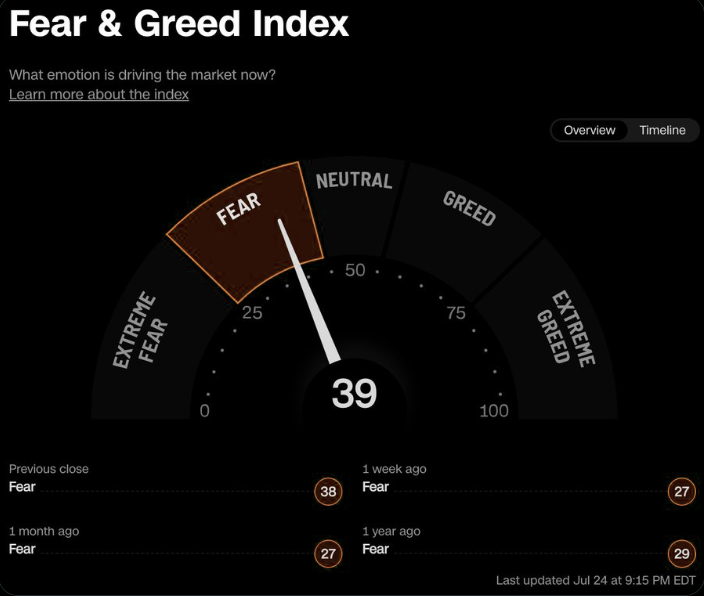
Fear & Greed Index via The Market Ear
EARNINGS WATCH
This week, 174 companies will report Q2 results. This is about 50% of S&P 500 market cap, including Apple, Amazon, Microsoft, Alphabet and Meta. Together, the five companies control 23% of the S&P 500’s market cap, according to Dow Jones Market Data Group.
COVID State of Affairs: July 25
As Omicron subvariants sweep the globe, the international death toll started rising for the first time in seven months. Although deaths still remain low, a 39% increase in death toll is noticeable. This increase is mainly driven by Southeast Asia (+20%), followed by the Eastern Mediterranean (+15%) and Americas (+7%).
Hospitalizations have doubled in Europe and no peaks have been seen yet for countries like France, U.K., Greece, or Italy, although hospitalizations do look to be slowing down. Notably, Australia has surpassed their previous Omicron peak for hospitalizations, and many systems are reaching capacity. Japan hospitalizations are also on the rise, which is not a surprise given that they just reported 152,538 new coronavirus cases—the biggest one-day increase on record.
BA.5 was slower to claim dominance in the U.S., but now accounts for 78% of cases. And, like clockwork, once it claimed dominance, wastewater trends went upwards in all regions of the U.S. Interestingly, this uptick may be short lived as wastewater recently slowed and even reversed in some places. Case trends continue to give all sorts of weird signals, but test positivity rates seem to have peaked, too. This could be the top of the wave, which would be a surprising but welcome reprieve. (…)
On a national level, hospitalization trends continue to steadily increase. And this will continue as hospitalizations lag case trends. More than 43,000 people are in hospitals with COVID-19 on an average day. Notably, many of the acceleration leaders for hospitalizations are in the South: Arkansas, Louisiana, West Virginia, Kentucky, and Georgia. (…)
The vast majority of people in hospitals are older and unvaccinated or not up-to-date with their vaccines. Below are the current hospitalization rates in Los Angeles county.
The national picture mirrors that of LA: The rise in hospitalizations is driven by 70+ year olds (see figure below). The hospitalization gap between this group and other age categories continues to widen, too. Unfortunately, even some fully vaccinated groups remain at risk for hospitalization. These groups will continue to remain at high risk until transmission calms down.
On the other side of the spectrum, pediatric hospitalizations remain relatively low compared to adults. But their hospitalization rate just passed the Delta peak, while other age groups are still far below it. This is likely explained by low vaccination rates among children. (…)


1 thought on “THE DAILY EDGE: 26 JULY 2022”
Yardeni may wish he had waited for the Walmart report…
Comments are closed.