China’s First Quarter Recovery Is Unmistakable, Beige Book Says
(…) “The recovery extends across both sectors and geographies, with every major sector and each one of our regions showing better revenue results than Q4,” CBB International said in a report based on survey data. “Yet this rally didn’t appear out of nowhere, and there are at least three compelling reasons to doubt its staying power: credit, credit, and credit.” (…)
Reports of company borrowing matched the highest level since mid-2013, while loan applications continued to rise and rejection rates plumbed all-time lows, the report said.
The Beige Book authors point to a resurgence in shadow-bank financing, which Beijing had previously been trying to curb, as one reason behind the uptick in activity. The cost of credit is however surging, according to the report, with firms reporting the second-highest overall interest rates in CBB data going back to 2012.
U.S., China Trade Talks to Resume as Trump Vows ‘Excellent’ Deal
(…) The burst of diplomacy suggests both sides remain determined to reach an agreement that would avoid any escalation of the eight-month trade war that has seen them impose duties on $360 billion of each others’ imports.
In a radio interview this week, Lighthizer said he wants to get a deal, but he’s “not necessarily hopeful” one will happen. “We’re working on it,” Lighthizer told National Public Radio. “If there’s a great deal to be gotten, we’ll get it. If not, we’ll find another plan.” (…)
The president told Republican lawmakers on Tuesday that he won’t settle for less than an “excellent deal” with China, according to Senator Marco Rubio, who attended the briefing. (…)
U.S. Housing Starts and Building Permits Decline
Total housing starts during February declined 8.7% (-9.9% y/y) to 1.162 million units (SAAR) from 1.273 million in January, revised from 1.230 million. December’s level also was revised up to 1.140 million from 1.037 million. The February decline was the fifth in the last six months.(…)
Starts of single-family homes declined 17.0% (-10.6% y/y) to 805,000 units and reversed the surge in January to 970,000 units, revised from 926,000. Multi-family home starts strengthened 17.8% (-8.5% y/y) to 357,000 units following declines in four of the previous five months.
The decline in new home building was widespread last month, led by a 29.5% shortfall (-25.8% y/y) in the Northeast to 98,000 units. Starts in the West fell 18.9% (-38.3% y/y) to 240,000 and were 39.2% below the cycle high reached last March. Starts in the South fell 6.8% (+7.8% y/y) to 663,000. Only in the Midwest were starts higher. They rose by 26.8% (4.5% y/y) following sharp declines in four of the previous five months.
Building permits eased 1.6% last month (-2.0% y/y) to 1.296 million after a 0.7% slip during January. Permits to build a single-family home were unchanged (-7.3% y/y) at 821,000. Multi-family building permits fell 4.2% (+8.7% y/y) to 475,000.


Yet, as CalculatedRisk illustrates, the unadjusted Purchase Index is now 4 percent higher than the same week one year ago.
The spring buying season is off to a strong start. Thanks to an unexpectedly large drop in mortgage rates following last week’s FOMC meeting, purchase applications jumped 6 percent and refinance applications surged over 12 percent,” said Joel Kan, MBA’s Associate Vice President of Economic and Industry Forecasting.

U.S. Consumer Confidence Weakens Broadly
The Conference Board Consumer Confidence Index declined 5.6% (-2.3% y/y) to 124.1 during March and reversed most of February’s increase. The decline left confidence 10.0% below the cycle high reached last October. The m/m decline surprised expectations in the Action Economics Forecast Survey which were for a slight rise to 132.3. During the past ten years, there has been a 61% correlation between the level of consumer confidence and the year-on-year change in monthly real consumer spending.
(…) The reading of the present situation declined 7.1% (+1.6% y/y) to 160.6, the lowest level since last April. The expectations reading declined 3.9% (-6.0% y/y) to 99.8 after a 16.1% jump in February, and was 13.3% below the cycle peak reached in October.

The percentage of respondents who believed that business conditions were good dropped sharply to 33.4% from a high of 42.0% last November. The percentage of respondents who believed jobs were plentiful fell to 42.0%, the lowest percentage in nine months. Jobs were viewed as hard to get by an increased 13.7%, up from the cycle low of 11.7% reached in February.
On the expectations front, a greatly lessened 17.7% of respondents felt that business condition would improve. A fewer 16.4% thought that there would be more jobs, down from 22.7% in November, though an improved 21.0% felt that income would increase. That percentage remained nevertheless below the 25.4% who thought in August that income would increase. (…)
By age group, lessened confidence was widespread, but most pronounced amongst younger individuals. For those who were under age 35, the confidence reading declined 12.3% this month and mostly reversed the February gain. The reading was at the low end of its range since the beginning of last year. Confidence in the 35-54 year old age bracket fell sharply to the lowest level since June 2017, off 14.9% from the peak last October. Confidence amongst individuals over age 55 eased slightly m/m, but was 7.0% below the October peak.
Dallas Fed President: Too Soon for Fed to Consider Cutting Rates Some Federal Reserve officials are saying it is too soon to consider cutting U.S. interest rates, despite rising market speculation of such a move because of slowing global growth.
ECB’s Draghi Hints at Drawbacks of Negative Rates European Central Bank President Mario Draghi signaled that the bank is starting to worry about the adverse effects of negative interest rates, a controversial policy tool it introduced almost five years ago to encourage European banks to lend.
(…) But negative interest rates, which are also being deployed by central banks in Sweden, Switzerland and Denmark, come at a cost to commercial banks and weaken interest income from loans and holding safe assets. The policy has also raised the risks of housing bubbles in parts of Europe, by propping up interest-rate sensitive sectors such as real estate.
Speaking at a conference in Frankfurt, Mr. Draghi said the ECB would, if necessary, look for ways to maintain the positive impact of negative rates for the economy “while mitigating the side effects, if any.”
The ECB would continue to monitor how banks can “maintain healthy earning conditions while net interest margins are compressed.” (…)
Mr. Draghi’s comments suggest the ECB could consider action to mitigate the impact of negative rates on banks, a step already taken by some of its peers, including the Bank of Japan and the Swiss central bank, which exempts a certain amount of deposits from its negative deposit rate. One option is to introduce a tiered deposit rate, which would shield a part of banks’ deposits from the charges. (…)
Here’s why smart investors should think globally when watching for recessions
Pat, a long-time friend and reader, alerts me to this piece from Ken Fisher
(…) These old studies demonstrate that today it’s highly unlikely interest rates soar and bond prices plunge unless the cause carries global heft. Wobbles in one country don’t ripple globally. It’s the reverse. The bulk of the world pulls wobblers back toward average.
This is truer now than 20, 50 or 150 years ago, due to technology. The biggest global banks from every continent can borrow in one country and lend to another faster than you can read this column. Any huge American bank can arbitrage long-term interest rates globally, effectively ensuring ours move parallel to overseas. So if you’re worried about mortgage rates, bank borrowing, buying or selling bonds, or interest rates’ business impact, think global.
An easy online source for global data including inflation, interest rates, GDP and much more is tradingeconomics.com.
You’ll spare yourself lots of angst by thinking globally. Last year, people lost lots betting Italy’s rising long-term rates would continue tied to populist political fears. They forgot rates were rising in America and elsewhere – a global move, mitigating Italian fears. When our rates finally fell back, those speculators got clobbered. Global top-down views keep you calm, centered and wealthier, almost always.
EARNINGS WATCH
Have More S&P 500 Companies Issued Negative EPS Guidance for Q1 than Average?
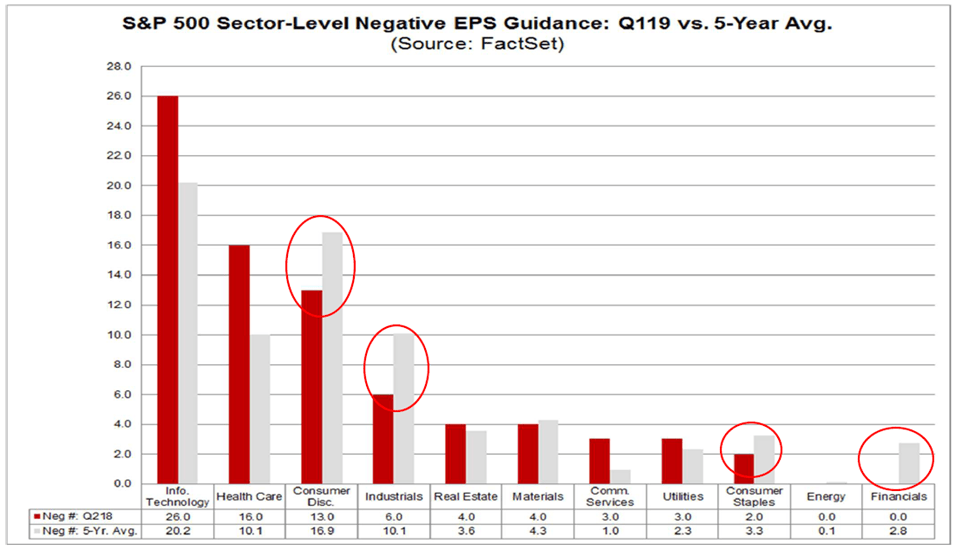
Heading into the end of the first quarter, 105 S&P 500 companies have issued EPS guidance for the quarter. Of these 105 companies, 77 have issued negative EPS guidance and 28 companies have issued positive EPS guidance. The number of companies issuing negative EPS for Q1 is above the 5-year average (74), while the number of companies issuing positive EPS guidance for Q1 is below the 5-year average (32).
The percentage of companies issuing negative EPS guidance is 73% (77 out of 105). This percentage is above the 5-year average of 70%, as more companies have issued negative EPS guidance than average and fewer companieshave issued positive EPS guidance than average.
In the Information Technology sector, 26 companies have issued negative EPS guidance for the first quarter, which is above the 5-year average for the sector (20). If 26 is the final number for the quarter, it will mark the highest number of companies issuing negative EPS guidance in this sector since Q1 2016 (also 26). At the industry level, the Software (7) and Semiconductor & Semiconductor Equipment (6) industries have the highest number of companies issuing negative EPS guidance in the sector.
It is interesting to note that an unusually high number of companies in the Information Technology sector have also issued negative revenue guidance for the quarter. Overall, 31 companies in the sector have issued negative revenue guidance, which is above the 5-year average (20). If 31 is the final number for the quarter, it will mark the highest number of companies issuing negative revenue guidance in this sector since Q4 2012 (36).
In the Health Care sector, 16 companies have issued negative EPS guidance for the first quarter, which is above the 5-year average for the sector (10). If 16 is the final number for the quarter, it will mark the highest number of companies issuing negative EPS guidance in this sector since FactSet began tracking EPS guidance in 2006. (…) Not only is the number of companies using negative EPS guidance in the Health Care sector unusually high, but the number of companies issuing positive EPS guidance in this sector is also unusually low. Overall, two companies in the Health Care sector have issued positive EPS guidance for the quarter, which is below the 5-year average of five. If two is final number for the quarter, it will mark the lowest number of companies issuing positive EPS guidance in this sector since Q1 2014 (one).
On the other hand, I find interesting that fewer consumer-centric, industrials and financials have guided negatively so far, and so late in Q1. Also interesting so late in the quarter, the number of pre-announcements (+ or –) has not changed since March 15.
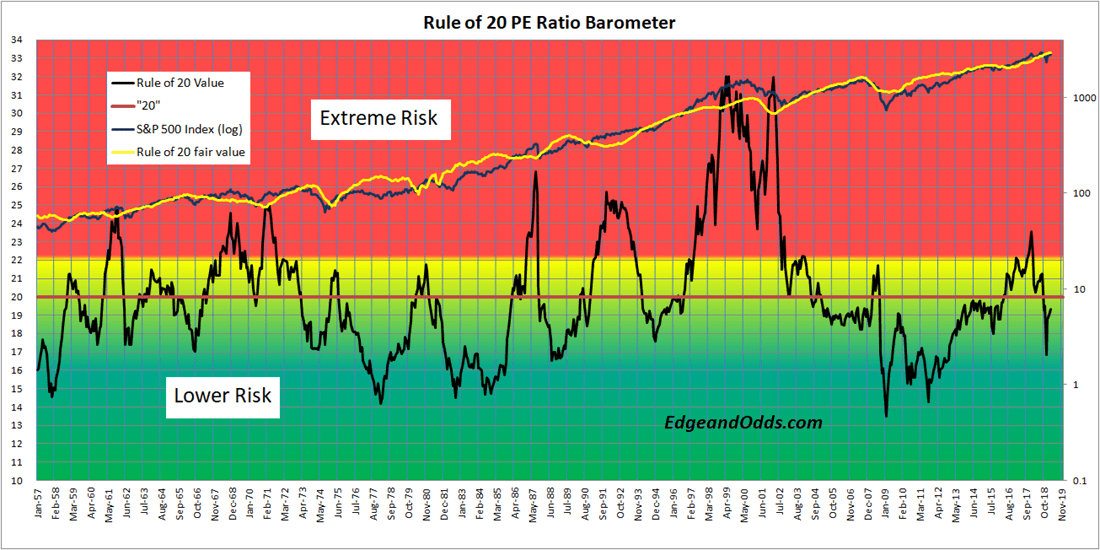
To keep you up-to-date, trailing EPS are now $162.90. The Rule of 20 P/E is 19.3.
Tax Changes Hit Overseas Profits of U.S. Companies P&G and other multinational companies warn that the new tax system, meant to help them compete in foreign markets and create domestic jobs, could instead put them at a disadvantage globally and reduce their incentive to invest at home.
(…) P&G pays about 18% to 19% of its non-U.S. income in foreign taxes. That is high enough that executives thought they would avoid paying a new U.S. minimum tax designed to prevent companies from shifting profits to low-tax countries.
Instead, P&G now expects to pay the U.S. $100 million annually because of that minimum tax, raising its tax rate on foreign profits to 21%. Some non-U.S. competitors, such as Unilever PLC, generally don’t pay home-country taxes on global earnings.
P&G executives say the tax rules could hurt the company’s ability to compete for acquisitions. And, paradoxically, the easiest way for P&G to respond would be by shifting some research and headquarters expenses out of the U.S.
“It’s kind of dawning on everybody at about the same time that this is going to be an issue,” Jon Moeller, P&G’s chief financial officer, said in an interview. “On the margin, it disincents local job creation.”
P&G is part of the Alliance for Competitive Taxation, a 40-company coalition that advocated international tax changes in 2017 and cheered the tax law’s passage. Now, the coalition is highlighting what it sees as flaws of the law’s minimum tax—using the same arguments about unlevel playing fields and disadvantages that companies once used to describe the old tax system.
According to a survey of alliance members, at least 60% have foreign tax rates above 13.125%, the level many of them thought would exempt them from U.S. taxes on foreign earnings. More than one-quarter have foreign tax rates at or above the new U.S. tax rate of 21%. Yet nearly all are paying the minimum tax, known as the Global Intangible Low-Taxed Income tax, or GILTI. (…)
That’s partly because arcane rules that Congress didn’t change in 2017 force some companies to count some domestic U.S. expenses toward foreign operations. These expense allocations shrink foreign tax credits that could otherwise be used to offset GILTI. To lower the tax, they could move the expenses out of the U.S. (…)
United Technologies Corp. pays foreign taxes above 21%. With GILTI and those expense allocation rules intact, it faces a $120 million annual bill above that, said Akhil Johri, the CFO of the company, which is splitting into three parts. The Otis elevator business doesn’t get much benefit from the 10% allowance for tangible assets because it makes much of its money providing services. Otis operates in high-tax foreign countries, such as France and Japan. Because of GILTI, it could be more profitable if owned by a non-U.S. company. (…)
“We’re definitely better off [after the tax law.] That is definitely true,” says P&G’s Mr. Moeller. “But remember. Everyone else is better off, too, including our foreign competitors. What matters in the long term is that relative position.”
LYFTED SPIRITS
Lyft to Price Shares Above Target Range in Initial Offering Lyft is expected to price its shares above the targeted range of $62 to $68 for its IPO, in a sign of strong investor demand ahead of the ride-hailing service’s debut.
Edge and Odds is much about risk management. It is interesting to see how investors don’t seem to care much about one of the main biz risk in the ride hailing industry as Bloomberg reported March 1 (my emphasis):
Regulatory and legal risks stand out in Lyft’s S-1 filing Friday, particularly challenges to its treatment of drivers. Uber Technologies Inc., Lyft and a raft of food delivery businesses have built their businesses by classifying workers as contractors rather than employees, meaning they aren’t guaranteed a minimum wage and don’t get health insurance.
Lyft acknowledges as much and warns that government regulators or a court determination that drivers are employees “could harm our business, financial condition and results of operations.” Lyft says it’s involved in “several thousand” individual legal claims, “including those brought in arbitration or compelled pursuant to our terms of service to arbitration, challenging the classification of drivers on our platform as independent contractors.” (…)
Lawmakers in California, home to both Uber and Lyft, have been reassessing the state’s independent contractor laws. Last year, the state Supreme Court issued a landmark ruling expanding the types of workers who are entitled to employee status. The implications of that decision are just starting to become clear.
In short: While Lyft has been operating on the same business model since 2012, court proceedings may be just warming up.
(…) The New York Taxi Workers Alliance, in a statement, called the ruling a “landmark decision,” arguing that it “could also be persuasive in other contexts where the employment status of Uber drivers is in question.”
“This decision gives drivers a safety net, and one that Uber has to pay for, challenging Uber’s business model of low pay and lower retention. (…)
In the U.K last December.:
Judges have dismissed Uber’s appeal against a landmark employment tribunal ruling that its drivers should be classed as workers with access to the minimum wage and paid holidays. (…) Tim Roache, the GMB [union] general secretary, said: “We’re now at a hat-trick of judgments against Uber; they keep appealing and keep losing. Uber should just accept the verdict and stop trying to find loopholes that deprive people of their hard-won rights and hard-earned pay.” (The Guardian)
Recently in Canada
Uber’s legal campaign to maintain the classification of its drivers as contractors rather than employees suffered a setback in Canada on Wednesday when the Ontario Court of Appeals ruled that the company’s arbitration requirement is illegal and unconscionable.
Three judges issued a ruling in an appeal brought by plaintiff David Heller, an Uber driver who sued the ride-sharing biz in 2017 for failing to pay minimum wage, overtime, and vacation time – benefits generally available to employees but not contractors.
In March last year, an Ontario Superior Court stayed Heller’s $400 million proposed class action lawsuit against Uber in favor of arbitration, the method of dispute resolution Uber requires in its contract with drivers. (The Register)
FYI, yesterday, Business Insider reported that the company was forced to move the location of its San Francisco roadshow after protesting drivers blocked the entrance to the Omni Hotel.

Grant’s yesterday also cited analyst Tom White of D.A. Davidson who told Bloomberg that his buy rating on Lyft is more art than science:
The expenses side is a little trickier, especially when it comes to the incentives Lyft deploys to attract drivers. They give an overall number, but you don’t understand how much is attracting riders versus drivers.
That’s where the art comes into play. With investing I think there’s an element of science and hard numbers and math, but there’s also a bit of art and creativity that you need to employ as well.
The bit of art and creativity was, in White’s case, sufficient to dismiss the hard numbers of Lyft’s $911M in losses last year and his forecast of red ink until at least 2022.
Beijing Gives Electric-Vehicle Makers A Long-Term Power Surge
Beijing said Tuesday it will cut subsidies for electric-vehicle purchases by at least 65%, following a three-month transition period. The cut wasn’t a surprise, but its magnitude was—analysts had been expecting a subsidy decrease of about 40% to 50%.
The Chinese government will also impose tighter standards on auto makers. EVs will only be eligible for a subsidy if they have a battery range above 250 kilometers (about 155 miles), while the subsidy quantum will depend on inputs such as battery density or energy consumption. (…)
Instead, it is launching a credit system designed to encourage auto makers to make more and better EVs. Each company will earn credits based on criteria such as the proportion of cars it produces that are electric. Those whose cars fail to meet basic standards, in areas such as fuel efficiency, will have to purchase credits from other car makers or face penalties—a system akin to carbon credit trading. The new industry model should help weed out weaker players and spur consolidation.
Rather than spending on subsidies, Beijing also plans to encourage local governments to spend more on EV infrastructure, such as battery-charging stations. Such top-down policies will inevitably create some waste. But better infrastructure is precisely what is needed in China to make owning an electric car more desirable. Many Chinese people live in dense urban areas, meaning the country could need about 14 million public charging stations by 2030, McKinsey estimates.
The message is clear: Beijing is serious about creating an environment that will encourage the electric car industry to grow.(…)
 The op-ed that got Stephen Moore his Fed nomination is based on two major falsehoods
President Trump reportedly chose Stephen Moore for one of the vacancies at the Federal Reserve Board after reading a Wall Street Journal op-ed Moore wrote attacking the Fed. The piece, co-authored with Louis Woodhill, made two central claims: (1) we’re experiencing deflation, and (2) the way to address it is to follow a rule adopted by Paul Volcker in the 1980s.
Slight problem though: Both of those claims are flat-out false. There is no deflation, and Volcker never created the imaginary “rule” Moore is now attributing to him. I know, because I asked Volcker — as Moore once suggested I do. (…)
1 thought on “THE DAILY EDGE: 27 MARCH 2019: Lyfted Spirits”
Re: “It’s kind of dawning on everybody at about the same time that this is going to be an issue,” Jon Moeller, P&G’s chief financial officer, said in an interview. “On the margin, it disincents local job creation.”
P&G, like many S&P companies embrace the same non-GAAP accounting used by Kraft — the same GAAP accounting that Warren Buffy likes to trash. Nonetheless, keep in mind that companies adjusting earnings with accounting that SEC doesn’t like, may end up with downward revisions ….
==> P&G Feb 21, 2019 – Organic sales growth*: Organic sales growth is a non-GAAP … diluted net earnings per share from continuing operations adjusted as indicated.
Comments are closed.