U.S. Drops Threat of 25% Tariffs on Chinese Goods In the strongest sign yet that an accord is near, U.S. Trade Representative Robert Lighthizer said the U.S. was abandoning for now its threat to raise tariffs to 25% on $200 billion of Chinese goods.
(…) His comments came following a House Ways and Means Committee meeting where Mr. Lighthizer said that the U.S. and China have reached a tentative agreement on a mechanism to enforce the trade deal, which has long been a stumbling block in talks. (…)
During his House testimony Mr. Lighthizer gave a preview of some of the important provisions—those involving enforcement and currency manipulation. He said a deal with China would allow the U.S. to use tariffs to enforce a deal, but only after a series of consultations with Beijing.
Complaints of violations of the accord would be discussed in a series of consultations, he said—monthly by staffers, quarterly by vice ministers and twice-yearly by ministers of the two nations. That last would likely mean Mr. Lighthizer and Chinese Vice Premier Liu He, China’s special envoy on trade.
Those consultations would look at individual complaints—sometimes brought anonymously by companies fearing retaliation—and also problems that appear to be part of a pattern. The goal, he said could be to resolve the problems at the lowest possible level.
The discussions are meant to address complaints by Chinese negotiators that the U.S. has been proposing to enforce any deal unilaterally—essentially acting as a judge and jury of any alleged Chinese violations. (…)
But if the talks fail to resolve the issues, Mr. Lighthizer said, the U.S. would impose tariffs—essentially what trade experts call a “snap-back” provision. “Without that sort of thing then to me we don’t have real commitments,” Mr. Lighthizer said. (…)
The trade representative also gave some details about the currency accord the two sides are discussing. He said it consisted of two parts: pledges by China not to engage in competitive devaluations and to be transparent in terms of its intervention in the markets. (…)
China’s Factory Activity at Lowest Level in Three Years It is the latest among many signs of persisting weakness in a slowing economy
China’s official manufacturing purchasing managers index in February dropped to 49.2 from 49.5 in January, data from the National Bureau of Statistics showed Thursday. (…) While the Lunar New Year holiday played a role in dampening factory activity in February, some economists noted that averaging out performance for the first two months of the year also showed a slowdown. (…)
A subindex for production fell to 49.5 in February from 50.9 in January, dropping below 50 for the first time since January 2009. However, in a sign that government’s easing measures have had some effects, the overall new orders subindex climbed to 50.6 from 49.6, suggesting a rebound in domestic demand. (…)
A component measuring new export orders—an indicator of external demand for Chinese goods—decreased to 45.2 from 46.9 in January. February’s reading of the subindex is the lowest since late 2011. (…)
While the subindex measuring larger firms, which tend to be more sensitive to the government’s policy-easing measures, strengthened for the third straight month, small firms continued to struggle, the official survey of 3,000 firms showed. (…)
The official nonmanufacturing PMI, which covers construction and service sectors, fell to 54.3 in February from January’s 54.7. (…)


-
Chinese Banks Will Rise or Fall With the Property Market China’s banks are increasingly exposed to the country’s noxious property market
(…) During the last decade, the share of the loan books of Bank of China, Agricultural Bank of China and the Industrial & Commercial Bank of China made up of commercial and real estate-mortgage loans have each risen by about 10 percentage points. Lending for real-estate transactions has made up the lion’s share of growth in banks’ outstanding assets. (…)
Beijing will do its best to avoid property prices falling, given the importance of tax revenue from land sales and the fact that property is the main savings vehicle for ordinary citizens. But policy makers will also want to prevent further big price increases, with homeownership currently out of reach for millions of young workers. (…)
In fact, China’s whole economy is intimately tied to the health of its housing market.
U.S. Trade Gap in Goods Widened 10% in 2018 Strong consumer spending drove imports higher as trade tensions and softening global growth hit exports
The U.S. trade gap in merchandise reached $79.5 billion at the end of 2018, $7 billion wider than a year earlier, the Commerce Department said Wednesday. The gap—a record high, though not adjusted for inflation—grew because exports fell 0.3% while imports rose 3.2%. (…)
Mixed Factory Orders and Shipments Data
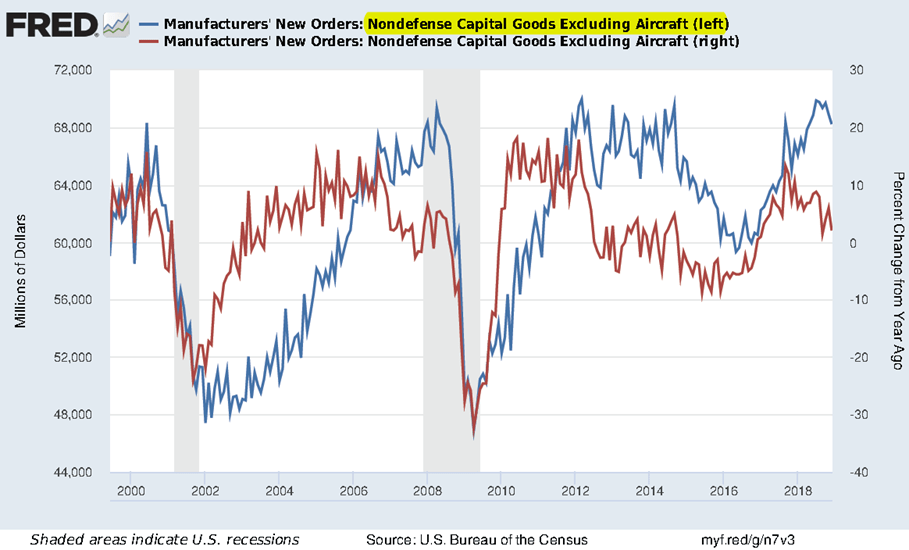
Manufacturers’ orders edged up 0.1% (2.4% year-on-year) in December following a slightly upwardly-revised 0.5% decline in November (this report was delayed as a result of the government shutdown). The Action Economics Forecast survey looked for a 0.5% rise. Factory shipments shrank 0.2% (4.1% y/y), the third consecutive monthly decrease. Despite this weakness, shipments rose at a 0.8% annual rate in Q4 as strong August data created a healthy starting point for the quarter.
Orders in the volatile durable goods sector increased 1.2% (3.4% y/y) after a 0.9% gain in November. Orders for transportation equipment rose 3.2% (3.2% y/y) due to a 28.4% takeoff in volatile civilian aircraft bookings (-27.2% y/y). Total factory orders excluding transportation declined 0.6% (+2.2% y/y). (…) Excluding the transportation sector, unfilled orders inched up 0.1% (4.6% y/y). Non-transportation unfilled orders have been on a steady rise since early 2017. (…)


U.S. Pending Home Sales Rebound
The National Association of Realtors (NAR) reported that pending home sales jumped 4.6% in January (-2.3% year-on-year) in after six consecutive monthly declines. The December reading for the index was revised slightly lower to 98.7, the weakest reading since April 2014.
All regions of the country experienced some improvement. Sales rebounded 8.9% in the South (-3.1% y/y), rose 2.8% in the Midwest (-0.3% y/y), increased 1.6% in the Northeast (7.6% y/y) and edged up 0.3% in the West (-10.1% y/y).


AMERICA CURSED
KKR’s Henry MacVey reveals that China has rapidly become much less dependant on exports since the Great Financial Crisis and has been recycling its surpluses into its own economy rather than buying U.S. assets. Importantly, its exports have been focused on higher valued added products, hitting directly at American domination.

Chinese brands now sell more smartphones globally than Apple and Samsung combined. Chinese smartphones were virtually non-existent 7 years ago! China’s auto market is now dominated by Chinese brands (42%) with American brands a distant fourth with 10% of the market behind Japan (18%) and Germany (21%). American automobiles lost nearly 2 full market share points in 2018 alone to the benefit of Japanese and German brands which now supply 40% of the Chinese market combined.
Caterpillar’s January 2019 unit sales dropped 15% YoY according to CMBOL while total excavator sales in China rose 10%. CAT’s market share in China was 11.3% in January, down a huge 3.3% from the prior year’s second place 14.6%. SANY boosted its dominant share from 20.9% to 28.3% in one year while the current number 2 and 4 Chinese players increased their combined share from 17.1% to 20.4%.
KKR adds
(…) by insourcing more goods as well as meeting growing domestic demand with more domestically-manufactured products and services, China has begun to insulate itself
from the vagaries of the geopolitics that currently dominate the global headlines.Against this backdrop, we are not surprised that many U.S. CEOs doing business in China are growing increasingly concerned about the long-term impact of the heightened tensions between that country and the U.S. as these tensions have the ability to derail growth in one of the largest market opportunities for these American companies. (…)
SENTIMENT WATCH
A Global Macro And Market Update: Does The Rally Have Legs?
(…) 2019 is likely to unfold as a year of two halves. In the first half, global equities will benefit from the non-inflationary growth dynamic that is sustaining earnings in developed markets without triggering a shift to restrictive monetary policy. In the second half of the year, core U.S. inflation should return to the Fed’s target via rising wage growth, a function of a very tight labor market, reviving justification for U.S. rate hikes. Concurrently, per the Fed’s revealed sensitivity to financial conditions and anxiety about the weak pulse of global growth, evidence that China’s growth slowdown is reversing, thereby lifting global growth by mid-year, will reduce concerns that a tightening bias in the US will provoke another global market riot.
BCA presciently sounded a cautious alarm about the global equity market late last June. We flipped that switch back to an overweight recommendation on December 20, judging that markets had discounted too bleak an outlook for global growth. Since then, the Fed-sponsored easing of financial conditions has underwritten a recovery in risk assets, but the macro fundamentals are also showing signs of light. A recession is not in the cards for 2019.
Listen to my 27Feb19 webcast here: A Global Macro And Market Update: Does The Rally Have Legs?

KKR, After Nailing the Rally in Stocks, Says It’s Time to Lighten Up
After a bullish stance in January paid off, KKR & Co. is now turning more cautious, saying equities are no longer cheap and investors should hold the same amount of U.S. stocks as suggested by benchmarks. It’s a reversal from just two months ago, when the firm boosted its recommendation to overweight from underweight. (…)
“We are not bearish, but we do not think that public markets will continue to appreciate in a straight line from current levels if earnings growth continues to disappoint,” Henry McVey, the firm’s head of global macro and asset allocation, wrote in a report released Wednesday. The equity upgrade in January was “based on our belief that investors were already pricing in a recession, ” he said. Now, “We think that fear is no longer being discounted in global equity prices, U.S. ones in particular.” (…)
KKR sees 2019 S&P 500 earnings growth of 2.5%, heavily weighted down by lower oil prices.
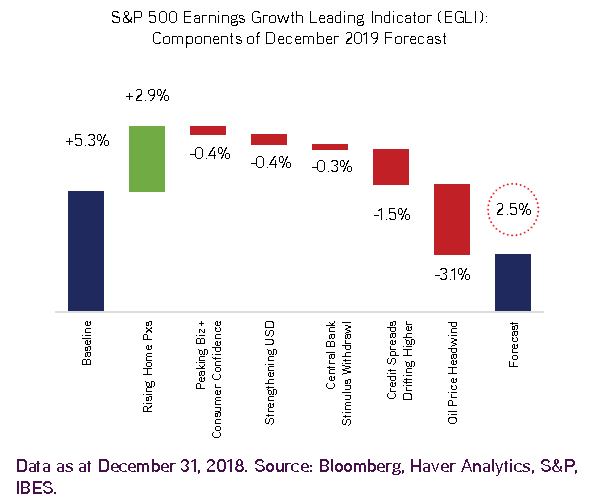
Current consensus calls for earnings growth of 4.1% including a 1.0% drag from Energy. WTI prices are currently around $55 compared with a fairly steady $65 average during 2018. We should all admit our inability to confidently forecast oil prices but we can argue that current expectations of continued low prices are reasonably conservative.
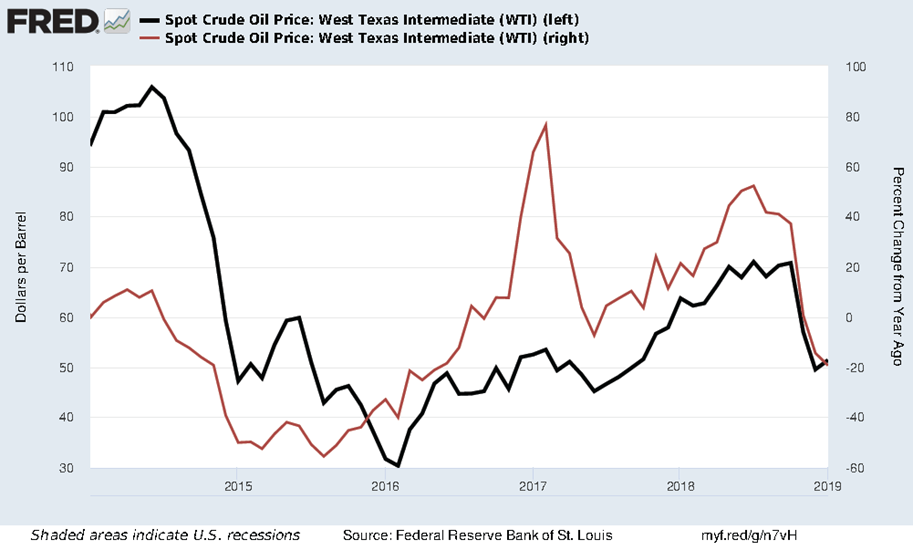
We can thus accept that Energy will drag total earnings down fairly evenly throughout 2019. The big question mark rests with Q4’19 ex-Energy earnings which have not been revised down as much as other quarters have:
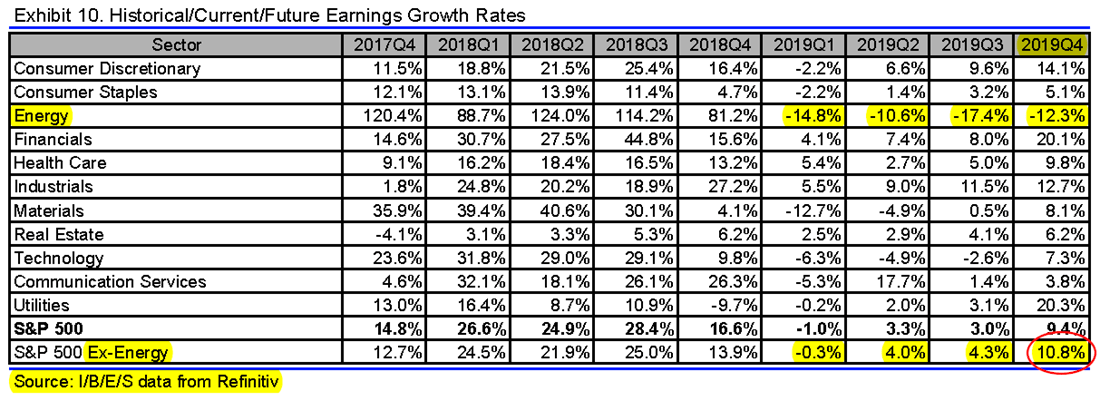

 Source: Yardeni Research (via The Daily Shot)
That said, while 2019 growth rates edge lower, Q4’18 actual earnings edge higher. After 464 reports, the blended growth rate for the quarter has increased to 16.6% and trailing EPS have risen to $162.81, higher that the full 2018 estimate still hanging at $161.62.

Trump, Kim End Summit Early With No Pact President Trump said disagreement over sanctions was the deal breaker at his second summit with Kim Jong Un.
‘I am never afraid to walk away from a deal,’ Trump says.