Americans Leave Unemployment Rolls Faster in States Cutting Benefits Some Missouri businesses see an uptick in applications after the state set a June end to pandemic jobless aid.
The number of unemployment-benefit recipients is falling at a faster rate in Missouri and 21 other states canceling enhanced and extended payments this month, suggesting that ending the aid could push more people to take jobs. (…)
The number of workers paid benefits through regular state programs fell 13.8% by the week ended June 12 from mid-May—when many governors announced changes—in states saying that benefits would end in June, according to an analysis by Jefferies LLC economists. That compares with a 10% decline in states ending benefits in July, and a 5.7% decrease in states ending benefits in September. Workers on state programs would lose the $300 weekly federal enhancement but could continuing receiving the state benefits.
Jefferies also found somewhat larger decreases in the number of people receiving benefits through pandemic programs in states curtailing benefits, though the data lags behind by an additional week. In many cases, those recipients will be cut off entirely when their state ends participation in the federal programs. (…)
But @JedKolko, Indeed’s chief economist says the impact is marginal so far:
Job search activity bit above national trend in states ending federal UI benefits June 26 or later, and bit below in states opting out June 12 and 19. Overall, pretty small differences now in search activity relative to when states are ending federal UI benefits.

Americans’ Hunger for the World’s Goods Drives Global Recovery Pent-up U.S. demand, fed by federal stimulus and pandemic-sparked savings, fuels growth abroad
The U.S. economy, turbocharged by stimulus worth almost $6 trillion and hungry for the world’s goods, is playing the role China played in the aftermath of the 2008 financial crisis, economists say. (…)
China, while still growing strongly, is expected to slow later in the year following its rapid comeback from the pandemic, as its government seeks to rein in credit. Europe’s slower economic recovery, weighed down by weak consumer spending, is also helping to blunt global inflation and demand.
The U.S., in contrast, has approved stimulus spending about seven times as large as a share of world GDP as China’s fiscal stimulus after the 2008 financial crisis.
The most recent U.S. spending program alone is expected to lift output by up to 0.5 percentage point in Japan, China and the eurozone over the next 12 months, and by up to 1 percentage point in Canada and Mexico, according to the Organization for Economic Cooperation and Development. The OECD in May raised its forecast for global economic growth this year to 5.8%, which would be the fastest since 1973. (…)
What a booming U.S. economy gives to the world with one hand, it takes back with the other. Other nations benefit from surging trade, but many face the risk of rising inflation, a stronger dollar and higher bond yields, which can act as a restraint on their recoveries. (…)
A global march toward higher interest rates, with the Fed at the center, would risk stifling the recovery in some places, especially at a time when emerging-market debt is high. It has risen to a record of over $86 trillion, according to the Institute of International Finance. (…)
The U.S. accounts for around 27% of final consumption expenditure world-wide, compared with only around 11% for China, according to 2017 figures from Deloitte.
A big chunk of economic output in other countries is dependent on U.S. consumer spending, which is expected to rise by around 10% year-over-year in 2021 after adjusting for inflation—the strongest performance since 1946—according to Oxford Economics. (…)
The Fed’s easy-money policies have given cover to governments, even highly indebted emerging markets such as Brazil, and central banks around the world to throw open the floodgates on their own economies with cheap lending and generous state spending.
“Knowing that the Federal Reserve is going to try to hold its rates for two years has given us a lot of breathing room,” said Jonathan Heath, deputy governor of Mexico’s central bank, in an interview on May 31. “Under normal circumstances, we would definitely be increasing rates.” (…)
“Everyone is accepting significant price increases,” Ms. McDonald said. “I’ve never seen this level of demand.” (…)

- Bundesbank boss calls on ECB to scale back bond purchases Jens Weidmann says ‘inflation is not dead’ and warns of risk that energy prices will rise
- U.K. House Prices Surge Most in 17 Years, Nationwide Says
Property prices rose 13.4% from a year earlier, the biggest gain since November 2004, Nationwide Building Society said Tuesday, a day before the Treasury is due to begin phasing out a stamp-duty holiday worth as much as 15,000 pounds ($21,000). A separate report from the Bank of England showed mortgage approvals rose unexpectedly in May and consumers increased unsecured borrowing for the first time since last summer.
The withdrawal of relief is expected to slow the momentum that has helped the U.K. housing market defy the worst economic slump in 300 years, as the pandemic prompted buyers to snap up homes with more space away from urban areas. Values rose 0.7% from May, their third consecutive increase. (…)

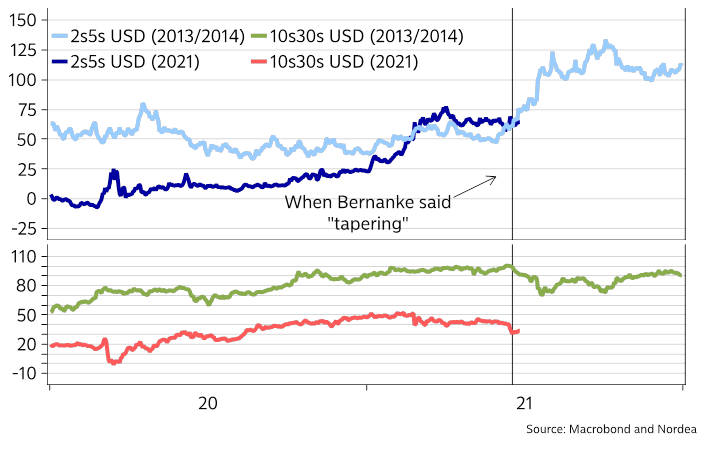
The Fed tapering decision and its repercussions for the USD and rates markets
Jay Powell and the Fed finally admitted to talking about tapering at the June meeting, and it looks fairly likely that we will get a decision already at the meeting in September, potentially with several taper pre-warnings during July and August. Usually, the Fed would utilize the Jackson Hole conference in late August to provide a fairly firm clue about the upcoming tapering process. This is likely to be the case again this time.
The Fed has promised us to “warn” about tapering in good time ahead of the actual tapering process, which likely means that a tapering decision in September (our base case) equals a tapering process that is initiated in December. On the other hand, we find that the long run-up to the actual tapering process makes it more likely that the Fed will chose to taper in bigger chunks than in 2013/2014. From 120bn to 80bn from December-2021 and then down to 40bn by April-2022. This also leaves the door open for a summer hike in 2022 or during H2-2022 the latest. (…)
What happened to the USD yield curve when Bernanke said tapering in 2013 compared to this year
TECHNICALS WATCH
Persistent Advance in Stocks and Commodities Shows Investor Confidence Broad gauges of market performance are surging together in a way few on Wall Street have ever seen, masking volatility under the surface.
Stocks and commodities are surging together in a way few on Wall Street have ever seen, a sign that demand for riskier investments remains robust.
The S&P 500 and S&P GSCI gauge of commodities enter the last few days of the second quarter up about 8% and 13% for the period, respectively. This would mark the first time that both indexes climbed at least 5% in five consecutive quarters, according to a Dow Jones Market Data analysis of figures going back 50 years. (…)
Although frenetic trading in individual stocks and sectors has jolted investors throughout the year, the S&P 500 hasn’t dropped 5% or more from a record in nearly eight months, the longest stretch since February 2018, per Dow Jones Market Data. The Cboe Volatility Index, which measures expected swings in the broad stock index and is also known as Wall Street’s “fear gauge,” recently hit its lowest level since February 2020.
Markets remain calm even though traders are rapidly shifting their expectations for the economy and which sectors will outperform. (…)
Investors are pouring tens of billions of dollars each week on average into global stock exchange-traded and mutual funds, Bank of America figures from data provider EPFR Global show. In May, individual investors pushed stockholdings to their highest level in nearly 3½ years, increasing them for the fourth consecutive month, according to figures from the American Association of Individual Investors. Investors have also lowered their bond and cash allocations in recent months. (…)

Data: FactSet; Chart: Axios Visuals
But:
- “Under the surface fewer stocks have been participating. Just 15% of the stocks in the index hit a new one-month high along with the benchmark on June 24, and for the first time since December 1999, a record closing high occurred with less than half of the stocks in the index above their 50-day moving averages.” (LPL Financial)


Early last week, the percentage of S&P 500 members above their 50-day moving averages had plunged, even while the majority were still above their 200-day averages. That has tended to be a good sign.
But…
The problem is what’s happened in recent sessions. Despite a push to new highs in the S&P toward the end of the week, the percentage of its members above their averages barely budged. In terms of divergences, this one is gonzo.
Going back to the mid-1920’s, there have only been a handful of dates with breaks like this. It happened in 1929, 1959, 1963, 1972, 1998, and 1999, and all of them ended up preceding losses in stocks.
Several more days (or weeks) with this kind of behavior should trigger all kinds of risk warnings, the types of things we’ve been watching for since speculation reached its heights in February.

BlackRock Warns U.S. Stocks at Risk From Higher Tax, Peak Growth
(…) BlackRock strategists say that if the Biden administration manages to impose a 28% corporate tax and a 21% global minimum tax, this would cut earnings per share for the S&P 500 by 7% next year. At the same time, they expect the eventual tax boost to be more moderate. (…)

- Canadian shares are a bargain at a time when “U.S. stocks look frothy,” in Bank of America Corp.’s view. Strategists Ohsung Kwon and Savita Subramanian made the argument in a report last week that compared forward price-earnings ratios for the S&P/TSX Composite and S&P 500 indexes. The valuation gauge showed Canada’s benchmark was 23% cheaper as of Friday, according to data compiled by Bloomberg. The discount bottomed out April 13 at 27%, the biggest in more than two decades. “Canada looks particularly attractive” as the global economy rebounds, the report said. (Bloomberg’s David Wilson)

Delta Variant of Covid-19 Surges Across Africa The continent with the fewest vaccines and weakest healthcare systems is facing record numbers of coronavirus infections, feeding fears of a public-health disaster.
Meanwhile, in rich America:

(BCA Research via John Authers)