China Gears Up to Weaponize Rare Earths in Trade War Its dominance of rare earths could hit hard.
A flurry of Chinese media reports on Wednesday, including an editorial in the flagship newspaper of the Communist Party, raised the prospect of Beijing cutting exports of the commodities that are critical in defense, energy, electronics and automobile sectors. The world’s biggest producer, China supplies about 80% of U.S. imports of rare earths, which are used in a host of applications from smartphones to electric vehicles and wind turbines. (…)
The newspaper’s commentary included a rare Chinese phrase that means “don’t say I didn’t warn you.” The specific wording was used by the paper in 1962 before China went to war with India, and “those familiar with Chinese diplomatic language know the weight of this phrase,” the Global Times, a newspaper affiliated with the Communist Party, said in an article last April. It was also used before conflict broke out between China and Vietnam in 1979. (…)
Not so simple as Fortune explains
Huawei Loses a Key Customer for 5G Network
SoftBank Group Corp.’s Japanese telecom unit selected Nokia Oyj and Ericsson AB as vendors for its next-generation wireless network, excluding long-time supplier Huawei Technologies Co.
SoftBank Corp. named Nokia as a strategic partner for 5G rollout and Ericsson as a supplier of radio access network equipment, the companies said in separate releases. Huawei, which together with ZTE Corp. was a 4G vendor for the Japanese company, wasn’t selected despite participating in earlier 5G trials. (…)
“You can also expect Docomo and KDDI to follow suit,’’ said Masahiko Ishino, an analyst at Tokai Tokyo Research Center. “So SoftBank isn’t going to be at a cost disadvantage.’’
The phone companies are also scrapping plans to sell Huawei handsets as the impact of a U.S. supply ban spreads. (…)
-
Huawei warns ban will hit 1,200 US suppliers Chinese telecoms group says cyber security vendors among those at risk
In the May 24 Daily Edge, I wrote about the rising layoffs in the industrial goods and automotive sectors:

Deutsch Bank’s Torsten Slok adds this chart:

U.S. Consumer Confidence Posts Surprising Improvement
Not a great indicator (59% correlation with spending per Haver):

This more interesting chart from Bespoke shows the growing wedge between present and future assessments:
 (Bespoke)


- Consumers’ assessment of the current situation hit a multi-year high. This index tends to peak near the end of economic cycles. (The Daily Shot)

Source: @TaviCosta
How about that?

THE LONE RISER
Looks like the trend on the left is about to turn lower:

(ING)
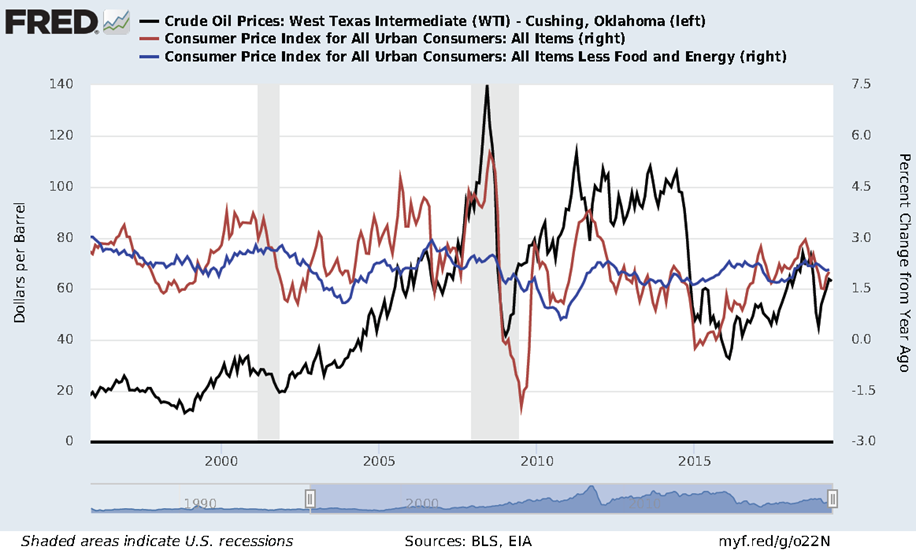
Rising U.S. Supply Latest Trigger for Oil-Price Swings U.S. crude stockpiles are climbing at their quickest pace since 2016, fueling fresh volatility in the oil market as fears of excess supply gather momentum.
Rising inventories have powered a 11% drop in oil since prices hit a nearly six-month high in late April, with analysts wary that increased production from the Organization of the Petroleum Exporting Countries and its allies could cause another glut. (…)
Shares of many of those companies have fallen alongside oil prices with domestic stockpiles rising 8% in the first 4½ months of the year, according to government data. That pace would be the quickest such rate in three years if it holds through the end of May. The last time inventories climbed at this pace, in early 2016, oil dipped below $27 a barrel, hitting its lowest level in more than a decade as U.S. production and anxiety about the world economy both surged.
Few analysts expect a similar price drop this year, but many remain cautious after oil tumbled from a multiyear high of $76 into the low $40s in the fourth quarter of last year. U.S. crude closed Tuesday at $59.14 a barrel. (…)
Steady U.S. production and softening refinery consumption have pushed up stockpiles in seven of the nine weeks through May 17, according to the Energy Information Administration. Inventories are at their highest level since July 2017. Figures for the week ended May 24 will be released Thursday. (…)
A combination of refinery outages and maintenance, along with recent flooding, has contributed to weaker demand, analysts say, making it hard to discern whether higher stockpiles are the result of idiosyncratic issues or actually signaling excess supply. (…)
Meanwhile, U.S. output is hovering at record levels, and pipeline bottlenecks in prolific producing regions such as the Permian Basin continue to contribute to the buildup in crude as companies struggle to transport oil. (…)
At the same time, rising tensions between the U.S. and Iran and the shutdown of a Russian pipeline have raised the possibility of global supply shortages should OPEC and its partners cut output too much. (…)
 Personally, I decided several years ago that it was impossible for me to get any conviction on oil prices, one way or the other. More and more people are joining me…No big deal for me, I just don’t invest in oil producers. But I pity the FOMC members having really no clue on such an important variable.

-
Bolton Signals Caution Over U.S. Tensions With Iran The White House isn’t planning a military offensive response to a U.S. assessment that Iran was behind recent attacks on tankers off the U.A.E., national security adviser John Bolton said, mirroring a conciliatory tone taken by President Trump.
 Germany’s unemployment rate rises for first time since 2013 Number of jobless Germans climbs most in a decade

TECHNICALS WATCH
Today’s pre-opening is 2790, down 5.4% from the recent May 1 peak of 2950 and only 0.6% above the 200-d m.a. (2774). However, the equal weight S&P 500 Index has done the crossunder and its 200-d m.a. has turned down.

Another scary stat back to last fall’s level:

This is where we are on valuation at 2790:
