Personal Income and Outlays: July 2019
Personal income increased $23.9 billion (0.1 percent) in July according to estimates released today by the Bureau of Economic Analysis. Disposable personal income (DPI) increased $44.4 billion (0.3 percent) and personal consumption expenditures (PCE) increased $93.1 billion (0.6 percent). Real DPI increased 0.1 percent in July and Real PCE increased 0.4 percent. The PCE price index increased 0.2 percent. Excluding food and energy, the PCE price index increased 0.2 percent.

Real expenditures remain solid, core inflation in the 1.5-2.0% range.
U.S. Growth Slows, Corporate Profits Rise
U.S. gross domestic product—the broadest measure of the nation’s output of goods and services—rose at a seasonally adjusted annual rate of 2.0% in the second quarter, a solid pace but down from a 3.1% rate in the first quarter and 2.9% overall in 2018, the Commerce Department said Thursday.
A closely watched gauge of business investment declined in the second quarter for the first time since early 2016. Nonresidential fixed investment—which reflects spending on software, research and development, equipment and structures—fell at a 0.6% rate.
U.S. households boosted spending at a 4.7% annual rate in the second quarter, the strongest pace since late 2014, shrugging off the uncertainty over trade policy and tariffs that rattled financial markets. That was stronger than the previously estimated 4.3% pace.

Forecasting firm Macroeconomic Advisers on Thursday projected GDP would rise at a 2.2% pace in the third quarter, now in its ninth week. The Federal Reserve Bank of Atlanta’s GDPNow model most recently predicted a 2.3% growth rate.
U.S. corporate profits rebounded in the second quarter as companies cut investment. A broad measure of corporate earnings—after taxes, without inventory valuation and capital consumption adjustments—rose 4.8% from the prior quarter. That came after corporate profits, which are often volatile on a quarterly basis, dropped 1.5% in both the first quarter of this year and the fourth quarter of 2018.
Looking over a longer period, they were up a more muted 1.7% in the second quarter from the same period a year before. (…)
Looking at an ever longer period, there has been no growth in corporate profits at the national level since 2012:

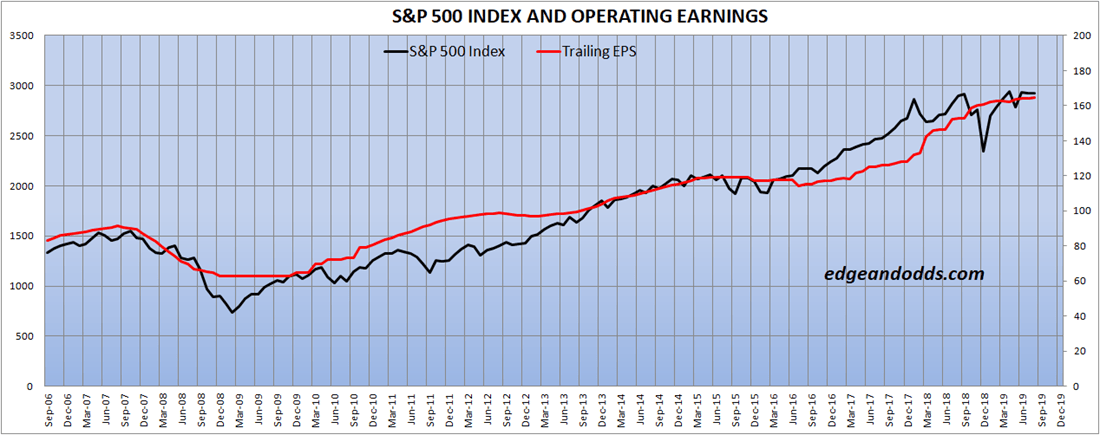
Even though S&P 500 companies, which btw derive more than 40% of their revenues from abroad, have grown their profits by 70% since 2012.
Pretax margins at the national level peaked at 15.7% in 2014 to steadily decline to their current 12.1% level. After tax margins held up better thanks to lower tax rates in 2018.

Ed Yardeni illustrates the decoupling since 2012:

S&P 500 sectors that have most improved their margins since 2012 are IT, Real Estate Communication Services and Utilities. These 4 sectors account for nearly 38% of the S&P 500 market cap and 34% of the profits a disproportionate share compared with the overall economy.
(…) The CWA said the four-day strike it held was the largest private sector strike in the South in a decade.
I am very curious of the terms of the 5-year agreement.
Energy Bankruptcies Rise as Investors Lose Taste for Shale Bankruptcies are rising in the U.S. oil patch as Wall Street’s disaffection with shale companies reverberates through the industry.
Twenty-six U.S. oil-and-gas producers including Sanchez Energy Corp. and Halcón Resources Corp. have filed for bankruptcy this year, according to an August report by the law firm Haynes & Boone LLP. That nearly matches the 28 producer bankruptcies in all of 2018, and the number is expected to rise as companies face mounting debt maturities.
Energy companies with junk-rated bonds were defaulting at a rate of 5.7% as of August, according to Fitch Ratings, the highest level since 2017. (…)
Private companies and smaller public drillers have been hit hardest so far. Those producers collectively generate a large portion of U.S. oil, according to consulting firm RS Energy Group, and their distress reflects issues affecting all U.S. shale. (…)
The current financial strain on shale producers is likely to intensify as many companies that took on debt after the 2016 oil slump face large debt maturities in the next four years. As of July, about $9 billion was set to mature throughout the remainder of 2019, but about $137 billion will be due between 2020 and 2022, according to S&P. (…)
Energy is the largest sector of the high-yield market (…)

Eurozone inflation: no sign of upward pressure ahead of September ECB meeting
Headline inflation is at 1%, with core inflation at 0.9% in August and unemployment falling by just 16,000 in July. These are the final readings the ECB will get before the important stimulus decision. Don’t expect the ECB to hold back. (…)
Core inflation has been creeping up in Germany, however, in spite of a pretty weak economy:
 Source: Commerzbank Research (via The Daily Shot)
Foreign Investors Pile Into U.S. Stocks and Bonds In a global market dominated by negative-yielding debt, foreign investors say they see American assets as a haven, piling into U.S. stocks and bonds at the fastest pace in about a year.
In a world dominated by tepid economic growth, mediocre returns and a mountain of negative-yielding debt, foreign investors say they see American assets as a haven: They bought nearly $64 billion of U.S. stocks and bonds in June, the largest sum since August 2018, according to the latest available Treasury Department data. (…)
A survey of 224 fund managers who manage $553 billion in assets said U.S. stocks are more desirable than their overseas peers during the next 12 months, and 15% said they are looking to bolster those positions, according to Bank of America Merrill Lynch. Still, more than three-quarters of respondents said U.S. stocks are already overvalued.
At the same time, investors bought about $37 billion of long-term U.S. debt securities in June, bringing the total through the first half of the year to about $136 billion. Although that is down from the first half of last year, flows picked up in June and are showing signs of strengthening further, analysts said. (…)
“For the first time in my career, I started buying U.S. Treasurys without hedging the dollar,” he said. “Having unhedged U.S. Treasurys in portfolios gives you exposure to two safe-haven investments.” (…)
U.S. Prosecutors Probe Huawei on New Allegations of Technology Theft Investigators are looking into episodes in which Huawei was accused of stealing intellectual property from people and companies and how it recruited employees from competitors.
(…) The new inquiries overlap with findings from a Wall Street Journal investigation in May that documented numerous allegations of intellectual property theft against Huawei throughout its history, these people said. They include alleged theft of smartphone-camera technology from a Portuguese multimedia producer and Huawei’s practices of recruiting employees from rival companies, the people said. (…)
Huawei has repeatedly defended its record when it comes to respecting intellectual property rights, and says it has found itself on both sides of such disputes during its history. At a news conference in June, Huawei’s chief legal officer said the company has never been found by a court to have acted maliciously in any case involving alleged theft of trade secrets. Attorneys define malice as intention to do injury. (…)
-
China Studying Tech Companies’ Exposure to U.S. Suppliers The effort comes ahead of the release of a retaliatory blacklist