U.S. Pending Home Sales Decline Throughout the Country
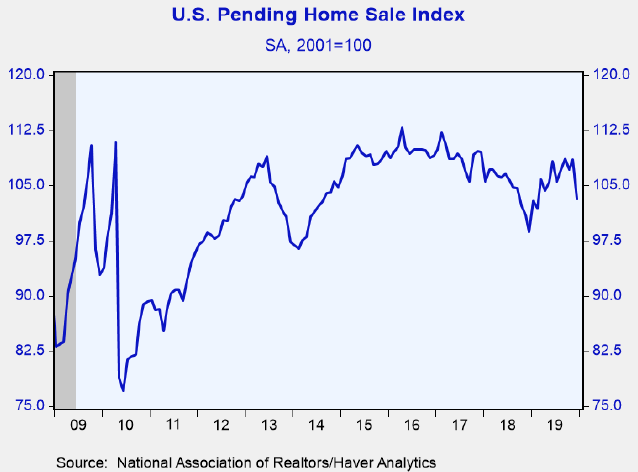
U.S. pending home sales fell 4.9% (+4.6% y/y) during December, according to the National Association of Realtors (NAR). The shortfall was the second in the last three months. During all of 2019, the average index level of 105.7 was 1.0% higher than in 2018 when the index declined 4.0%.
Sales declined in each region of the country last month. They fell 5.5% (+7.4% y/y) in the South, the third consecutive monthly decline. In the West, sales were 5.4% lower (+7.0% y/y) and have moved irregularly sideways for almost a year. Midwest sales fell 3.6% (+1.3% y/y), the second decline in three months. Sales in the Northeast declined 4.0% (-0.1% y/y) to the lowest level since May.

Fed Holds Benchmark Rate Steady All 10 members of the Fed’s rate-setting committee voted to hold the fed-funds rate in a range between 1.5% and 1.75% and reaffirmed the Fed’s make-no-moves posture.
“We’re comfortable with our current policy stance and we think it’s appropriate,” Fed Chairman Jerome Powell said at a news conference after the central bank announced its decision.
But his comments suggested that lingering risks to the global economy and difficulty sustaining inflation at the Fed’s 2% target meant that if Fed officials were to change rates, they would be more likely to cut them than to raise them. (…)
“We have seen this dynamic play out in other economies around the world and we’re determined to avoid it here in the United States,” he said. Mr. Powell later said the review was designed to address how “ongoing powerful, global disinflationary trends” have hampered central banks around the world. (…)
The Fed’s postmeeting statement Wednesday offered a mixed assessment of the economic outlook. It described consumer spending growth as moderate, a downgrade from “strong” in December, and said business investment had remained weak. (…)
ONLY AROUND RICHMOND?
Richmond Fed’s Regional Surveys of Business Activity:
Survey results suggest strong wage growth among service sector firms in January, as this index rose to an all-time high of 50. Measures of employment and the average workweek also indicated growth, but firms reported difficulty finding workers with the necessary skills. They expected this struggle to persist but wages and employment to grow in the near future.
The average growth rates of both prices paid and prices received by survey participants fell in January, as growth of prices paid continued to outpace that of prices received. Respondents expected both growth rates to slow further in the coming months.
Fifth District Survey of Service Sector Activity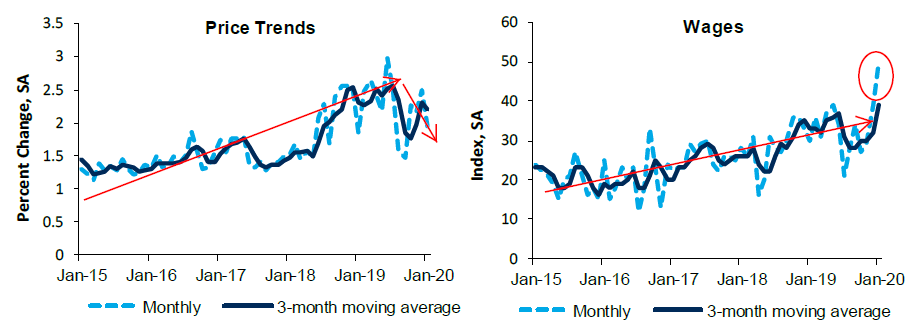
China first quarter growth may dip below 5% as virus spreads: government economist
(…) Zhang, an economist at the Chinese Academy of Social Sciences – a top government think tank – said his forecast was based on the assumption that the outbreak will peak in early to mid-February and end by the end of March.
Zhang is among many government economists and, while the Academy’s views often serve as a recommendation for Chinese policymakers, his views may not fully align with those of the government, which has yet to issue any assessments. (…)
In response, the government is likely to step up policy support, which could boost the annual budget deficit as a share of GDP to over 3% in 2020, he said. (…)
German Unemployment Falls as Industry Outlook Starts to Brighten
The number of people out of work dropped by 2,000 in January to 2.277 million, defying economist predictions for an increase. The jobless rate held at 5%, near a record low. (…)
Germany’s government raised its growth projection for this year to 1.1% and sees momentum accelerating further in 2021. Even though that’s an improvement from 2019, when output expanded at the weakest pace in six years, Economy Minister Peter Altmaier said Wednesday that rates at those levels are hardly satisfactory. (…)
Eurozone economic sentiment jumps as unemployment reaches new decade low
Compared to the other eurozone surveys that have come out this month, the ESI was surprisingly upbeat with an increase to 102.8 from 101.3. German and French industry, in particular, became a lot more optimistic about the outlook and somewhat less pessimistic about recent production developments. These are signs that the bottom in manufacturing is now getting close.
One has to be cautious in interpreting these numbers though as uncertainty around the impact of the coronavirus on the global economy is mounting. That has not been factored into these results just yet, meaning that the revival of optimism could be short-lived. (…)
What the Middle East Peace Plan Really Means
(…) the Deal of the Century is remarkable for the overwhelming support it has among Gulf Arab states. Saudi Arabia, the United Arab Emirates, Egypt, Bahrain, Qatar and Morocco have all endorsed the proposal, though they have offered nothing specific about what they would do to see it through. Still, their collective rush to champion the deal is notable for what the breach between Arab Gulf states and the Palestinian Authority signifies: the new geopolitical reality emerging in the Middle East, one arrayed against the actions of Turkey and Iran.
(…) Put simply, the expansion of Iranian influence has become the security priority to which all other foreign policy issues take a back seat. The same could be said in response to Turkey, which has been aggressively advancing its interests in Syria and the Eastern Mediterranean. (…)
In that sense, the “Deal of the Century” is not about an Israel-Palestine peace; it’s about reconfiguring the alliance structure of the Middle East. Sunni Arab countries are beginning to pivot from foreign policies grounded in post-WWI realities and nationalisms stemming from 20th-century colonial mandates that defined the regional balance of power. Now they are becoming more visible in redefining regional geopolitics and aligning with former adversaries, grounded in new, emerging security threats. (Geopolitical Futures)
EARNINGS WATCH
We now have 143 S&P 500 companies in, a 71% beat rate (20% miss rate) and a +4.0% surprise factor. Aggregate earnings of those 85 companies are up 5.2%, much better than at the same time during Q3’19.
 The 22 IT companies having reported so far sport a 100% beat rate on earnings and 86% on revenues (S&P 500 avg: 65%). Their surprise factor is +8.9% on earnings and +2.9% on revenues (+0.7% avg). IT companies are 24% of the S&P 500 market cap and 20% of earnings. Analysts are now expecting IT earnings up 5.4% in Q4, from +0.5% on Jan. 1.
Q4’19 earnings are now seen unchanged (+2.7% ex-Energy). Q1’20 estimates are +5.6%, down from +6.3% on Jan. 1.
FYI from Goldman Sachs:
The EURO STOXX 50 derives 10% of its revenues from China, roughly twice as much as S&P 500 companies (6%). For some indices, such as the DAX, as much as 15% of company revenues come from China. In terms of sector exposure, Luxury stocks, Basic Resources and Autos are the most exposed (exhibit 2). Our China exposure basket, GSSTCHNA, generates about 25% of its revenues in China.

TECHNICALS WATCH
- 13/34–Week EMA Trend Chart (CMG Wealth)

- NDR Crowd Sentiment Poll

SENTIMENT WATCH
-
Bonds continue to see historic inflows
The week ended Jan. 8 saw the largest inflows to bonds ever recorded and the following week (which ended Jan. 15) saw the fourth highest total on record. Those two weeks combined set a record for bond inflows during a two-week period, according to Lipper data. (Axios)


-
Reasons Abound for Markets to Worry About the Election Investors face triple uncertainty about the 2020 outcome – and should be concerned
The world’s business elite is convinced that Donald Trump will win a second term in the White House in November, and investors seem to believe there’s little risk they will end up victims of the U.S. election.
In reality, investors face triple uncertainty about the outcome—and should be concerned. The election is highly likely to be close, because modern America is split down the middle—and that makes it inherently uncertain. The Democratic candidate isn’t yet chosen, and could be radical. And a victory by Mr. Trump might not provide the relief that investors expect. (…)
So far, markets have stayed sanguine. Shares have had a great run interrupted only by the fears from the Wuhan virus in the past few days. There’s little sign that investors are scared of anything on the political front.
They should be: The prospect of a socialist-leaning White House would surely hurt stocks in the short run, while Mr. Trump could hurt stocks for longer with a new trade war. CEOs and investors are too sure both of Mr. Trump’s prospects and that their share prices would do as well in his second term as they did in the first.
KKR’s views:
While all presidential elections are important, 2020 could be particularly consequential, as both a referendum on President Trump’s disruptive leadership and a harbinger of future direction for U.S. policy and politics. (…)
The historical context for this election is also important to keep in mind. Since 2015, insurgent candidates have won overwhelmingly across the world. This trend goes back further in the U.S. where, over the past 20 years, U.S. voters have increasingly voted against incumbents in favor of opposition parties. President Trump was elected as the ultimate insurgent, but today he is the incumbent. He will benefit most from a strong economy (since 1924, the only incumbent President’s defeated for re-election faced a recession in the two years prior to the vote). Recent tensions with Iran could help the President as historically Americans rally around their Commander in Chief during times of global crisis. Focus on Iran could also reduce coverage of and miniaturize impeachment proceedings against President Trump. Also, the power of any sitting President to set policy, build his party machine and make news is not to be underestimated, particularly when coupled with a unified GOP and President Trump’s remarkably effective communications and marketing skills.
On the other hand, President Trump, who has never achieved a 50% approval rating, has also mobilized and unified his critics. Remember the Trump GOP machine has lost many elections in 2017, 2018 and 2019. Consistent with the backdrop of a more politically charged environment, the 2018 midterms saw the highest eligible voter turnout in 104 years, and many of the 2019 off-year elections also produced historic turnout. Hence, our view is that President Trump will have more difficulty winning the popular vote. However, we all know that American Presidents are elected by the Electoral College, which means fewer than 10% of eligible voters in seven states — Florida, Michigan, Minnesota, North Carolina, Pennsylvania, Wisconsin, and Arizona — will select the next President of the United States. Within those states, pay particular attention to white working class men and suburban female voters.
U.S. Senate elections will also be important as the closely divided Senate will have a critical voice on new policy. The GOP’s four seat majority is potentially in peril, as several Republicans in Democratic leaning states face serious challengers. Prediction markets may underestimate this possibility, in our opinion. (…)