U.S. Pending Home Sales Decline Again, Fell to Lowest since Spring 2014
The National Association of Realtors (NAR) reported that pending home sales fell 2.2% m/m (-9.8% y/y) in December. This was the third consecutive monthly decline and the seventh decline in the past nine months. The December reading for the index was 99.0, down 12.4% from the April 2016 peak. This is the lowest reading for the index since April 2014 and was the twelfth consecutive month in which pending sales were lower than a year earlier
The nationwide decline in pending home sales in December was widespread. Sales plummeted 5.0% m/m (-13.5% y/y) in the South, slipped 2.0% m/m (-2.5%) in the Northeast, and edged down 0.6% m/m (-7.2% y/y) in the Midwest. In contrast, pending sales rose 1.7% m/m (-10.8% y/y) in the West for their second consecutive monthly increase. (…)

THE POWELL FED
We always emphasize that our policies are data dependent. In other words, as economic conditions and the outlook evolve, we take that new information into account in setting our policies. We are now facing a somewhat contradictory picture of generally strong U.S. macroeconomic performance, alongside growing evidence of cross-currents. At such times, common sense risk management suggests patiently awaiting greater clarity–an approach that has served policymakers well in the past.
(…) the cross-currents I mentioned suggest the risk of a less-favorable outlook. (…)
This is the Powell Fed, much like all other Feds: “we are definitely data-dependent…until not so much, if and when required by a bunch of other considerations including but not limited to financial markets volatility.”
So long “interest rates normalization”, the neutral rate, whatever it might be, transparency, clarity and visibility.
REAL FED FUNDS RATES
Greg Ip:
-
The Fed’s Mysterious Pause If the Federal Reserve is signaling a halt to rate increases, it could mean officials view the economy as fundamentally fragile
(…) If indeed the Fed is done, that would be a breathtaking pivot. Yet the motivation remains somewhat mystifying: What changed in the past six weeks to justify it?
Mr. Powell cited several factors: global growth has continued to slow, in particular in China and Western Europe; financial conditions have tightened (which does some of the Fed’s tightening for it); and the partial federal government shutdown has weighed on U.S. growth. He also mentioned policy uncertainty about Brexit and trade.
These factors might justify a pause, but not a halt—unless they foreshadowed a pronounced slowdown in the U.S. economy, which doesn’t seem to be the Fed’s base case.
Perhaps, having been pilloried in December for sounding too hawkish when credit and stock markets were in turmoil, Mr. Powell is compensating in a dovish direction. For example, he said in December that the shrinkage of the Fed’s balance sheet was on “autopilot,” a reiteration of what the central bank had already indicated, and of what it had been doing for a year. Jittery investors nonetheless chastised him as tone deaf. Chagrined, the Fed said Wednesday it was “prepared to adjust” the pace of shrinkage. (…)
Others:
-
Fed’s ‘momentous’ U-turn prompts puzzlement US central bank faces criticism for bending to market pressure over rates guidance
-
Fed Gives Markets What They Want (Mohamed A. El Erian)
-
DoubleLine CEO Gundlach says Fed’s Powell ‘caving to the stock market’
“He’s caving to the stock market. The stock market scared him,” in late 2018, Gundlach, who oversees $123 billion, said in a phone interview with Reuters. (…)
Not that the pivot was stupid, just that we now know not to trust the Fed’s narrative on its data dependency. This time is not different.
In truth, we are in a global pivot, courtesy of Mr. Trump whose policy initiatives have totally stalled global trade and capex.
-
Central Banks Pivot in Tandem, Pausing Stimulus Plans A slowing global economy and low inflation has central banks around the world rethinking plans to gradually pull back financial stimulus from markets and the banking system.
The role reversal could support the economy in the months ahead and bolster markets and sectors like housing and autos.
Central bankers have geared their messages toward pausing on tightening steps rather than imminently launching new stimulus. That is because they doubt the global economy is going beyond a slowdown toward outright recession. (…)
Central banks in South Korea, Malaysia and Indonesia kept rates unchanged this month after raising them in 2018. At its meeting last week, the Bank of Japan downgraded its inflation forecasts, suggesting no end in sight to its asset purchases and negative policy rate. China’s central bank, meanwhile, has taken a number of steps to improve credit to businesses.
In Canada, where the economy is sensitive to the U.S. and commodity markets, the central bank kept rates unchanged at 1.75% in January—it had raised them four times in a little more than one year through last October—and signaled a wait-and-see approach on future increases.
The Bank of England is expected to leave its rate at 0.75% when it meets next week, and future increases depend on how smoothly Brexit proceeds.
And last week, the European Central Bank downgraded its assessment of the European economy, opening the door to new stimulus including a promise to keep interest rates where they are for a longer period or a fresh batch of cheap loans to banks. (…)
China’s Manufacturing Remains Listless, if Slightly Improved After falling for four straight months, the manufacturing purchasing managers’ index rose a tick, beating economists’ expectations.
After falling for four straight months, the manufacturing purchasing managers’ index rose a tick to 49.5, from 49.4 in December, the National Bureau of Statistics said Thursday. (…)
In the purchasing managers’ survey, the subindex for new orders edged down to 49.6 from 49.7 in December, suggesting weakness ahead. A new export subindex, an indicator of external demand for Chinese goods, increased to 46.9 from 46.6, while the subindex for production edged up to 50.9 from 50.8 in December. (…)
Some 440 firms disclosed on Wednesday — the day before a deadline to do so — that their 2018 financial results deteriorated, according to data compiled by Bloomberg. Of the more than 2,400 mainland-listed firms that have announced preliminary numbers or issued guidance this season, some 373 said they’ll post a loss, the data show. About 86 percent of those were profitable in 2017. (…)
BTW, European companies are also hurting. Only 50% of the 26 STOXX 600 Index companies (which actually comprises only 330 companies!) that have reported so far beat Q4 estimates and sport a –8.1% surprise factor according to Refinitiv.
STOXX 600: Q4 2018 Earnings Growth Estimate Trend

Source: I/B/E/S data from Refinitiv
Not much can ‘save the day’ for Canada’s stumbling economy Gross domestic product believed to have contracted in November
Central bank gold-buying reaches half-century high Russia leads countries shifting reserves from the US dollar
The FT reveals that central banks bought a net $27bn worth of gold, driven by Russia, whose net purchases were the highest on record. Volumes jumped 74% YoY. The share of central bank currency reserves held in the dollar fell close to a five-year low in the third quarter of 2018, according to the International Monetary Fund.
TECHNICALS WATCH
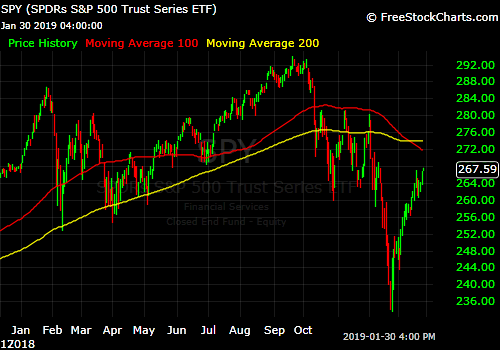
The pivots have somewhat reassured world…
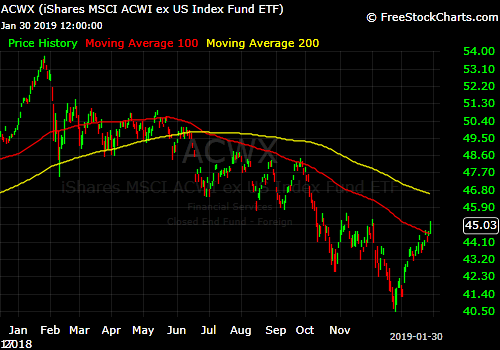
…and U.S. equity markets, the latter’s 200dma even trying to perk back up.
The 13/34–Week EMA Trend Chart, courtesy of CMG Wealth, also seems to be trying a pivot:

The Rule of 20 P/E has also pivoted. Historically, it always cycle through its “20” fair value level which is currently 2885 based on trailing EPS and inflation.

EARNINGS WATCH
- General Electric (GE) Misses Q4 EPS by 5c, Revenues Beat
- Visa (V) Tops Q1 EPS by 5c; New $8.5B Share Buyback Plan
- MasterCard (MA) Tops Q4 EPS by 2c
- Facebook (FB) Tops Q4 EPS by 19c
- Tesla (TSLA) Reports Q4 EPS of $1.93, Missing Views
- UPS (UPS) Tops Q4 EPS by 3c, FY19 EPS Comes in Light
- Microsoft (MSFT) Misses Q2 EPS by 1c, Revenues In-Line
- Qualcomm (QCOM) Tops Q1 EPS by 11c, Offers Q2 Guidance