Did you miss: BEAR ESSENTIALS?
Virus Update


- Cases world-wide topped 801,000, while the death toll neared 39,000.
- US reports more than 500 deaths for first time
- US confirms largest one-day case jump
- Russia reports jump in cases, deaths
- Maryland, Virginia and DC all locked down
- The head of Germany’s public health authority said he expects the coronavirus pandemic to continue for several more months and the nation’s death rate to rise. The current death rate in Germany of 0.8% is relatively low, partly because extensive testing was conducted early and included many of the less severe cases, Robert Koch Institute President Lothar Wieler said. That means there is a time lag and the rate is likely to rise, he said.
- Italy is discussing an extension of lockdown measures into May as European countries fight to contain the spread of the coronavirus, even as the outbreak shows signs of slowing.
- Dr. Fauci warns he fears virus will return this fall
NYU Langone Tells ER Doctors to ‘Think More Critically’ About Who Gets Ventilators NYU Langone Health, one of the nation’s top academic medical centers, told emergency-room doctors that they have “sole discretion†to place patients on ventilators and institutional backing to “withhold futile intubations.â€
Gun Stores Ruled Essential Businesses During Coronavirus Shutdowns
An FDA Breakthrough on Treatment The agency finally approves anti-malarial drugs for Covid-19.
(…) The malaria drugs hydroxychloroquine (HC) and chloroquine have been around for more than five decades, so their safety is well documented. New evidence suggests that they could also help fight the novel coronavirus, as op-eds by Dr. Jeff Colyer on these pages have reported. Both chloroquine and HC in vitro block the replication of RNA viruses like the novel coronavirus. (…)
Notably, a study in France of 80 coronavirus patients given HC and azithromycin, an antibiotic for upper respiratory infections, documented “a clinical improvement in all but one 86 year-old patient who died, and one 74 year-old patient still in intensive care unit.†Doctors have also reported anecdotal evidence of the malaria drugs’ efficacy.
More study is needed, and a clinical trial of the two drugs involving 1,100 patients started last week in New York. But the FDA’s emergency authorization will let more doctors prescribe the drug outside of clinical trials, and hospitals will be required to maintain data on drug dispensation and patient outcomes. This will allow a larger review than possible in a controlled clinical trial. (…)
China Excluded Infected People With No Coronavirus Symptoms China said for the first time that it excluded people who were infected with the novel coronavirus but haven’t shown symptoms from its national tally, as questions arise about its accounting of the infectious disease.
On Tuesday, China said there are at present 1,541 asymptomatic carriers of the coronavirus in the country. Of that group, 205 people recently returned from overseas.
Chang Jile, a top Chinese health official, said the country will—beginning Wednesday—start reporting the number of asymptomatic carriers. He said this will be done “in order to respond to society’s concern in a timely manner.â€
Mr. Chang said all asymptomatic carriers will be quarantined for 14 days and released only after they are medically cleared. (…)
China’s National Health Commission reported 48 new infections on Monday, all people who were recently abroad, taking the country’s total to 81,518.
This week, some high-school students in Shaanxi and Jiangsu provinces and the Inner Mongolia autonomous region returned to classes following more than a month off. An official in China’s education ministry said students are required to wear masks inside classrooms. Schools elsewhere in the country will reopen when the coronavirus situation is brought under greater control, necessary precautions are in place and it is safe for students and teachers to gather again. (…)
South Korea’s education ministry said Tuesday it would further delay the start of its new school year—which was originally scheduled to reopen in early March to—April 9. It was the fourth time that the start date was pushed back. (…)
PANDENOMICS
New Fed Data Point to Economic Pain and Worrisome Ebbing in Inflation
On Monday, the New York Fed launched a “Weekly Economic Index†aimed at capturing where the economy is in near real time, and extrapolated historical levels based on past data. In its first outing, the index showed “developments in the past week saw the index fall to a level unseen since 2008,†during the heat of the financial crisis.
The report’s authors note that their index seeks to show what a given quarter’s activity would look like if it persisted for a year. The index, which had been indicating economic growth on either side of 3% since about 2017, plunged in nearly a straight line and now reflects a contraction of about 3.97%.
The New York Fed index’s authors said their new weekly index is based on a mix of job, consumer-confidence, steel-production, energy-use and electric-utility data.
A separate report from the San Francisco Fed warned uncertainty generated by the crisis could wash away already modest inflation impulses in the economy. This uncertainty may “lead to a persistent increase in the unemployment rate of roughly 1 percentage point, while simultaneously reducing the inflation rate by as much as 2 percentage points and bringing the interest rate close to its zero lower bound.â€
The San Francisco Fed report warns its current findings “will surely understate the overall impact of the current pandemic†because new negative effects are still playing out, leading it to say “the pandemic is likely to weigh on the economy persistently, depressing economic activity and inflation well beyond the near term.†(…)
Goldman Sachs Group Inc. expects the U.S. economy to experience a far deeper slump than previously anticipated. The world’s largest economy will shrink an annualized 34% in the second quarter, compared with an earlier estimate of 24%, economists led by Jan Hatzius wrote in a report. Unemployment will soar to 15% by mid-year, up from a previous forecast of 9%.
The economists, however, now expect a stronger recovery in the third quarter, with gross domestic product expanding 19%.
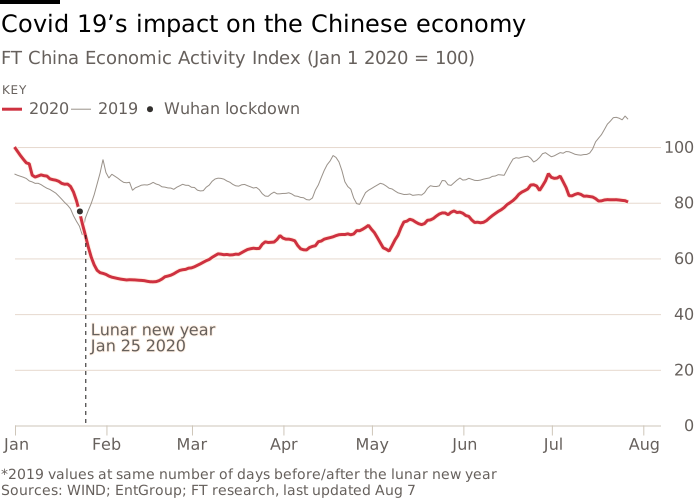
China’s Coronavirus-Battered Economy Shows Tentative Signs of Renewed Life Manufacturing activity rebounded sharply from record lows after the virus appeared, but analysts say the economy is still far from pre-outbreak levels
China’s official manufacturing purchasing managers index jumped to a reading of 52.0 in March from a record low of 35.7 in February, the National Bureau of Statistics said Tuesday. (…)
A separate nonmanufacturing PMI, also released Tuesday, showed service and construction activity similarly rebounding in March to 52.3 from 29.6 in February. (…)
The manufacturing PMI’s subindex for new export orders, while rising to 46.4 in March from 28.7 in February, remained in contraction territory, though the subindex measuring factory production climbed to 54.1 from 27.8 in the previous month. (…)
China’s statistics bureau cautioned that the sharp rebound in the manufacturing PMI reading didn’t mean economic activity had returned to pre-virus levels. The bureau said the result merely reflected the resumption of work after more than a month of forced idleness. (…)
- Using Wind’s financial database, the FT has compiled a weighted index of six daily, industry-based data series.
-
Eurozone CPI Fell Steeply in March
The European Union’s statistics agency Tuesday said prices were 0.7% higher than a year earlier, down from a 1.2% rate of inflation in February. That slide was largely due to energy prices, which were 3.1% lower than in February, and 4.3% down on a year earlier.
Excluding energy and other volatile prices, the core rate of inflation fell much more modestly, to 1% from 1.2% in February.
The only important stuff from these February data is that Americans were already in saving mode:


Oil-Price War Batters Poorer OPEC Members With Saudi Arabia preparing to flood oil markets, countries including Iraq and Venezuela are cutting expenditures even as they confront the coronavirus.
(…) Oil and gas income for many members of the Organization of the Petroleum Exporting Countries is set to fall by 50% to 85% in 2020, reaching the lowest level in more than two decades, according to an International Energy Agency analysis. “This is likely to have major social and economic consequences, notably for public sector spending in vital areas such as health care and education,†the agency said. (…)
(…) The gap has opened so quickly that producers can’t shut down in time and two of the largest are ramping up on purpose. What is more, analysts at Citigroup point out that inventories have never been filled at more than 4.7 million barrels a day in any given month—a universe away from the 20 million barrels of excess supply being daily. In the U.S., pipeline operators are anxious that customers will leave them stuck with crude that nobody actually wants at the other end. (…)
The companies predicted that spot oil prices would fall below $10 a barrel unless the inventory situation is solved. They may be right, and they may also be too late.
IHS Markit expects as much as 10 million barrels a day of world oil production to be cut or shut-in from April through June as storage fills up and demand craters due to the Covid-19 pandemic.
Output is projected to fall in every region of the world, with OPEC members, Russia, and the U.S. among the hardest hit, the consultancy said in a note. Oil demand in the second quarter is expected to decline by 16.4 million barrels a day compared with the same period last year. (…)
The consultancy still expects that the price of Brent futures will fall to around $10 a barrel in April and some producers will experience negative prices, where they pay the buyer to take the crude. (…)
Russian President Vladimir Putin and his US counterpart Donald Trump agreed during a phone call on Monday that the current situation on world oil markets suited neither, the Kremlin said on Tuesday.
Trump and Putin agreed during their call to have their top energy officials discuss slumping global oil markets, the Kremlin said on Monday, as Trump called Russia’s price war with Saudi Arabia “crazy.â€
On Tuesday, the Kremlin said the two men had agreed to have further consultations on oil markets, but had not fixed a date for more talks.
“Undoubtedly, there is an understanding that the current oil market situation is not in the interests of our countries,†said Kremlin spokesman Dmitry Peskov.
Saudi Arabia plans to boost its crude oil exports to 10.6 million barrels per day starting from May due to burning less oil for power generation at home and lower domestic consumption, a Saudi energy ministry official said on Monday. (…)
(…) A number of Norwegian fields would be profitable even at $10 per barrel, Bru said, adding that any unilateral action by Norway would have no effect on prices.
While Norway has not entered into formal agreements with OPEC to curb output, it did at some points in the 1990s and early 2000s cut its production in tandem when prices fell.
“It’s been done earlier, in Norway, out of regard for good resource management but there’s nothing Norway could do alone to balance the market,†said Bru when asked about output cuts, adding that Norway produces around 2 percent of global oil output.
Hidden Chinese Lending Puts Emerging-Market Economies at Risk More than $200 billion in Chinese overseas lending hasn’t shown up in official data in recent years, allowing emerging markets indebted to China to also borrow from other investors. Now borrowers are at risk of drowning in debt and investors face the reality that China may be ahead of them in collecting.
(…) Exactly how much China has lent is kept under wraps by state-run banks such as China Development Bank and the countries receiving the loans. China’s opaque lending can lead investors and organizations to underestimate the risk they are taking when they make loans to these countries or buy their bonds, leading them to lend at rates that might be too low given the potential losses. These include global investors and multilateral lenders such as the World Bank.
Investors “have to be very, very leery of what’s going on,†said Carmen Reinhart, a Harvard University economist and former IMF official who has studied China’s lending practices.
Ms. Reinhart, one of the most influential U.S. economists on financial crises, was part of a team that over the last two years pieced together a data set of Chinese loans. A resulting study by Ms. Reinhart and economists Sebastian Horn and Christoph Trebesch concluded more than $200 billion of Chinese overseas loans–around half of all its cross-border lending–was hidden from public view. Around a dozen of the poorest countries owed debts to China equal to 20% or more of their annual GDP, the research estimated. (…)
“This is scary stuff.â€
Nigeria, Africa’s largest economy and which depends heavily on oil exports, was one such recipient. Official statistics have presented China as a modest financier for Nigeria in recent years. By the end of 2017, Nigerian government statistics show external debt owed to China was under $2 billion.
In reality, the total debts Nigeria owed to China were more than double that amount, according to the research. Chinese loans have financed infrastructure such as a light-rail project for the capital city of Abuja. Last year, China also committed $629 million in financing for the country’s first deep-sea port. Nigeria’s government is trying to borrow an additional $17 billion from the state-controlled Export-Import Bank of China. (…)
Parallels to the 1980s debt crisis in Latin America—which spurred a “lost decade†of growth for Mexico and others—concern economists today. (…) Some economists say China’s opaqueness in its lending is reminiscent of the syndicated U.S. bank loans that crippled Latin America decades ago. (…)
REBALANCING THE IMBALANCE
The severity and swiftness of the downturn in the stock market happened faster than any other time, including the Great Depression, and as a result, [for instance], the 60-per-cent stock, 40-per-cent bond portfolio that investors had as their ideal strategic weights has now become a 50/50 portfolio. That is not just true for individual investors but it’s true for large institutional investors and pension funds.
We are going to be hitting the end of the quarter and a lot of these funds are going to be looking to rebalance. Portfolios have drifted incredibly fast away from strategic weights and it makes sense to either, if there is cash, devote it to stocks – that is one avenue – or potentially take money out of the bond market and put it to work in stocks.
DIVIDENDS
Bank dividend payments should be suspended Balance sheets must be reinforced to help cope with disruption
(…) Banks will bear a large part of the burden that will come from the economic disruption of the coronavirus pandemic. They will need to support lending to households, businesses and large corporates. To weather the storm, they must build their balance sheets into fortresses and use every means to shore up capital.
The banking sector already serves a quasi-public function. It provides public infrastructure: the money supply and the payment system. And it is intertwined with the state through central banks and deposit insurance. (…)
Goldman Sachs:
We forecast S&P 500 dividends will decline by 25% to $44 per share in 2020. Dividends actually rose by 9% during 1Q. However, we expect a wave of dividend suspensions, cuts, and eliminations will result in dividends declining by 38% during the next nine months so on a full-year basis dividends will be 25% below the level of 2019. The dividend payout ratio will equal 40% this year based on our recently reduced EPS growth forecast of -33%. Looking ahead, we expect S&P 500 dividends will grow by 3% in 2021 and rise by 12% in 2022.
The recently passed Coronavirus Aid, Relief, and Economic Security (CARES) Act stipulates that any companies that borrow money from the federal government may not repurchase stock, pay a dividend, or make any other capital distributions until 12 months after the loan is repaid in full. However, the bill does not restrict dividends or share repurchases by firms that do not accept government assistance.
Using history as a guide, dividend drawdowns typically result in a 6% peak-to-trough decline over a period of 3 quarters and take 6 quarters from the trough to recover to the prior high. Of 15 S&P 500 dividend drawdowns since 1900, the cuts following the Great Depression were both the sharpest and required the longest time to recover. S&P 500 DPS fell by 55% during a period of 11 quarters and took 61 quarters from the trough to recover to the prior high. During the Financial Crisis dividends fell by 24% over 5 quarters and took 10 quarters from the trough to recover to the prior high.

(…) Dividends are considered sacrosanct in Canadian income investing circles in normal circumstances, but a mass suspension may be unavoidable in an enduring pandemic.
Since the sell-off took hold, recreational vehicle maker BRP Inc., bus manufacturer NFI Group Inc. and two restaurant royalty trusts – Boston Pizza Royalties Income Fund and SIR Royalty Income Fund – have all cut or suspended their dividend payouts.
On Monday, Inter Pipeline Ltd. announced it was slashing its dividend by more than 70 per cent, which will save the company $525-million on an annualized basis. “We are currently in a unique and very challenging business environment,†Inter Pipeline’s chief executive officer, Christian Bayle, said. (…)
The biggest banks have reliably paid quarterly distributions for decades, even as payout ratios occasionally soared during tough times, including during the financial crisis. About 35 per cent of dividend payers in the S&P/TSX Composite Index cut their payouts in 2008, according to FactSet, but the big banks were not among them.
Even if the banks run into regulatory issues related to their capital levels, RBC expects that the banks would prefer to raise cash by issuing more shares rather than cutting their dividends. (…)
Dividends from Canadian insurance companies also look sustainable, according to RBC, given insurers’ strong capital ratios, low leverage and a sector-wide commitment to the payouts after being tarnished by Manulife Financial Corp.’s dividend cut in 2009. (…)
Germany went even further, asking listed companies to pause dividends as a condition for receiving government support, according to a Bloomberg report. Details are still emerging about Canada’s wage subsidy program, which will cover up to 75 per cent of worker salaries at companies affected by the pandemic. But there’s no indication that dividends might factor into whether a company can qualify. (…)
Re Inter Pipeline dividend cut, NBF reveals the naked swimmer in this receding tide:
Following a series of strategic missteps since late 2017, including 1)
choosing to go it alone on the $3.5 bln Heartland Petrochemical Complex
(HPC) without having contracts firmed up; 2) remaining unhedged on
NGL frac spreads; and 3) failing to close on a sale of the European
Storage business; IPL has announced a 72% dividend cut to $0.48/sh
annually (was $1.71/sh) versus our -50% forecast, alongside the
suspension of the DRIP, commencing with the May dividend payment.