Note: I am travelling (ancient word: “go from one place to another, typically over a distance of some length”) in Europe until August 23rd. Postings will thus be erratic, limited and time-zones impacted.
SERVICES PMIs
USA: Business activity declines for first time in over two years amid soft demand conditions
Business activity across the US service sector decreased at a solid pace during July, according to the latest PMI™ data. The fall in output was the fastest since May 2020. Although new orders returned to growth, the rate of expansion was historically subdued and much slower than those seen earlier in the year. Subsequently, service providers registered weaker expectations regarding the outlook for output, as confidence dropped to a 22-month low. Nevertheless, companies expanded workforce numbers at a solid pace, with sufficient capacity allowing firms to work through backlogs of work effectively.
Inflationary pressures remained historically elevated during July, but eased further. Input costs and output charges increased at the slowest paces for five and 16 months, respectively.
The seasonally adjusted final S&P Global US Services PMI Business Activity Index registered 47.3 in July, up slightly from the earlier released ‘flash’ estimate of 47.0, but down from 52.7 in June. The latest headline reading signalled the fourth successive decline in the seasonally adjusted index, marking a notable contrast seen from the steep expansions earlier in the year. The decrease in business activity was the first since June 2020 and solid overall. Where firms reported a contraction in output, this was linked to relatively subdued demand, worsening financial conditions and higher prices.
Although service providers recorded a renewed rise in new orders at the start of the third quarter, following a marginal decline in June, the rate of growth was only slight overall. Higher new business was attributed to the acquisition of new customers, but some firms continued to highlight customer hesitancy amid reductions in purchasing power.
The rise in total new orders was driven by the domestic market, as new export orders contracted for the second month running. The impact of inflation on foreign customer spending and travel hampered sales, with new business from abroad falling at the second-fastest rate since December 2020.
Average cost burdens at service providers increased markedly in July, albeit at the slowest pace for five months. Input price hikes reportedly stemmed from higher fuel, energy, wage and transportation costs. Although softer, the rate of inflation was quicker than any seen before May 2021.
Service providers continued to pass on higher cost burdens to clients, as output charges rose at an historically elevated pace. Mirroring the trend for input prices, however, the rate of selling price inflation eased to the slowest since March 2021.
Meanwhile, output expectations regarding the year ahead outlook weakened during July. The degree of confidence dropped to the lowest since September 2020, as concerns relating to inflation and wider economic conditions dampened optimism.
Services firms raised workforce numbers further, as companies sought to fill vacancies. That said, the pace of job creation was the slowest since January amid reports of struggles to find suitable candidates and, in some instances, the non-replacement of voluntary leavers in an effort to cut costs.
Sufficient capacity to process incoming new business was reflected in a second successive monthly decline in backlogs of work in July.The decrease quickened to the sharpest since May 2020 and was solid overall.

Eurozone slips into contraction at beginning of third quarter
For the first time since February 2021, eurozone output declined in July as a deepening manufacturing downturn was accompanied by a further slowdown in the service sector. There were also additional signs of the negative impact that high inflation was having on demand as overall new business intakes fell at a rate which, excluding those seen during COVID-19 lockdowns, was the steepest since May 2013.
There was however a slight cooling of inflationary pressures during July, although rates of increase in both input costs and output prices were faster than anything seen prior to their recent highs.
Further evidence of economic weakness was also seen in new export orders, which fell at the strongest pace for just over two years. Amid growing concerns surrounding future gas supply, risks of a recession in Europe and persistently high price pressures, business confidence fell in July to its weakest level since the initial outbreak of COVID-19 in the first half of 2020. (…)
The S&P Global Eurozone PMI Services Business Activity Index posted 51.2 in July, down from 53.0 in June and indicative of the slowest increase in service sector output since January. A fading post-pandemic restrictions bounce and cooling demand pressures reportedly drove the weaker expansion at the start of the third quarter.
For the first time since April 2021, incoming new business at eurozone services firms fell. Panel members frequently commented on higher prices as a reason for lower demand. New business from overseas clients also fell, with the decline gathering pace to the quickest since March 2021. (…)

Walmart Lays Off Hundreds of Corporate Workers The retailer is restructuring headquarters operations after warning of profit troubles last week as merchandise has piled up in its stores. Around 200 jobs are being cut.
-
Companies Weigh Fresh Cuts as Operating Costs Go Up CFOs are looking closely at real estate, consulting and even packaging expenses to cut back on spending
(…) operating expenses at investment-grade nonfinancial companies rose 19.9% to $2.72 trillion during the first quarter from a year earlier, according to data provider S&P Global Market Intelligence. Those U.S. companies spent 83.1% of their total revenue on operating expenses during the quarter, up from 82.6% a year earlier, S&P data show. (…)
About 46% of businesses plan to decrease spending on consulting over the next year, while 45% expect real estate reductions in that time, more than any other categories, according to Gartner, which in July surveyed 234 finance executives at mostly U.S. companies with annual revenue ranging from around $300 million to $100 billion.
“CFOs don’t want to be the loser of this recession and pare back spending on things that will be really important to quickly accelerate if growth does recover and a recession subsides,” Mr. Bant said, referring to investments in digital technology or employee compensation. (…)
SLOWING INFLATION
Recent PMIs mention easing input and output prices, at still elevated levels.
- Oil Plunges to Lowest Since February as US Gasoline Demand Drops
- EIA Weekly Oil Markets Report
- The latest report saw crumbling demand for both gasoline and refined products as a whole
- Inventories rose across the board and are now typically a bit above normal on a seasonally and demand-adjusted basis
- US crude and condensate production was flat at 12.1 mbpd.
- Oil prices have collapsed, likely driven by recession fears
- Incentive to store analysis shows that balances have returned to pre-war levels. So much for Russian oil sanctions.
- The coincident indicators we [Princeton Energy] track suggest continued contraction in Q3
- Both US total product supplied (total oil products consumption) and gasoline supplied (consumption) are cratering
- Initial unemployment claims continue to rise
- The Michigan Consumer Sentiment Index for July remains just above record lows
- All of these suggest continuing recession
- OPEC+ Answers Biden’s Diplomacy With ‘Minuscule’ Output Hike

(Alpine Macro)
Gerhard Schröder says Russia wants negotiated end to Ukraine war
Heat records shattered
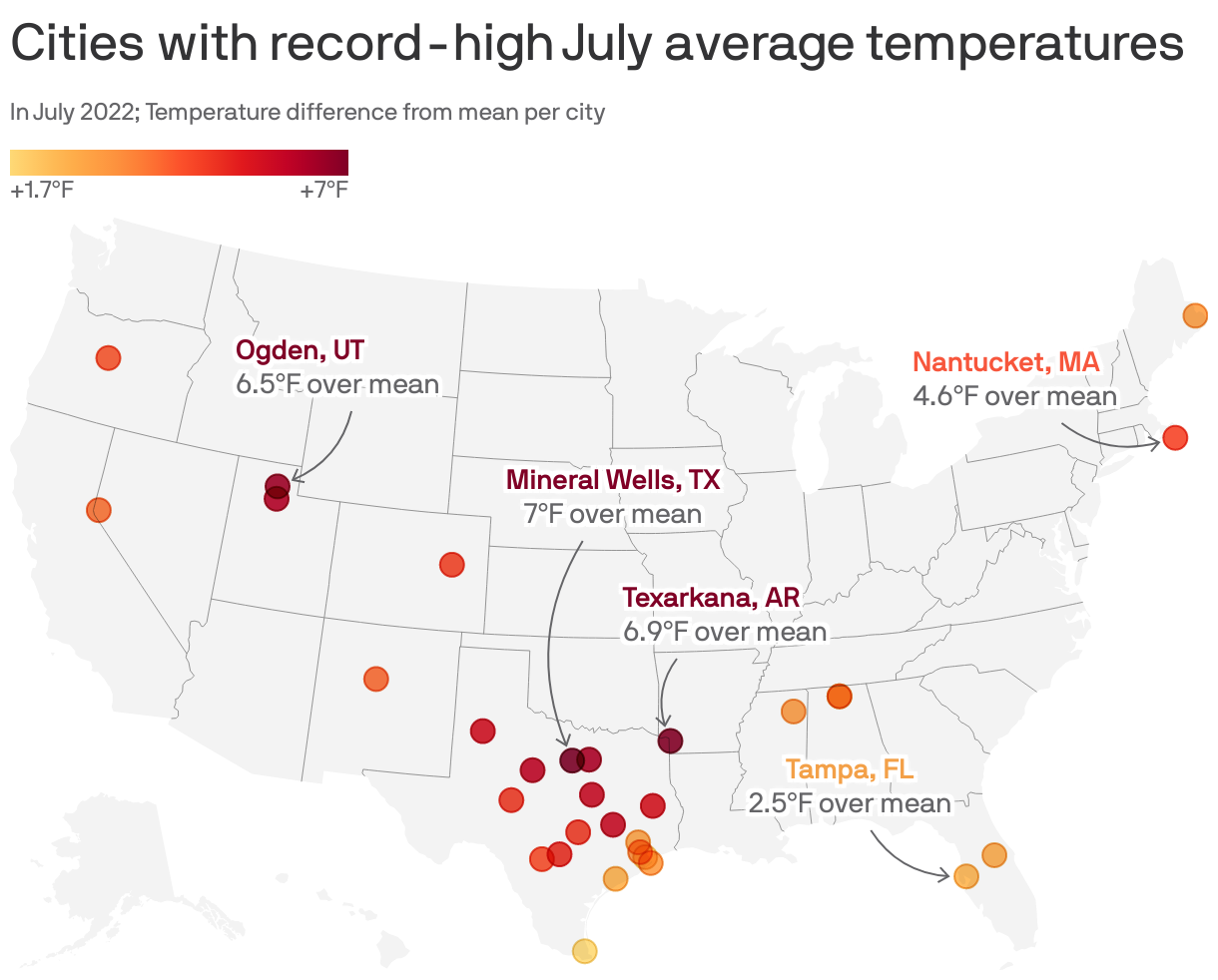
This was from Axios.
From me: it was 38C (100F) yesterday in Strasbourg! Heading to the Swiss Alps!