MANUFACTURING PMIs
Renewed decline in US manufacturing performance as demand wanes
The seasonally adjusted S&P Global US Manufacturing Purchasing Managers’ Index™ (PMI) posted 49.4 in November, unchanged from the earlier released ‘flash’ estimate, but down from 50.0 in October. The fall in the headline figure signalled a renewed decline in the health of the manufacturing sector and one that was the strongest since August.
Contributing to the lower headline reading was a sixth drop in new order inflows in the last seven months. Orders have in fact risen in only three of the past 18 months. Goods producers noted that, although only marginal, the decrease in new sales was linked to weak client demand, economic uncertainty and customers continuing to run down stock levels.
The fall in total new orders was focused on the domestic market as new export sales returned to growth for the first time since May 2022 in November. Foreign client demand reportedly improved, especially for specialist items, with new export orders rising at a modest pace.
Encouragingly, there are some signs of the inventory cycle starting to turn, with producers of intermediate goods (inputs supplied to other firms) now reporting modest order book growth.
Nonetheless, subdued overall demand conditions across the sector resulted in a slower uptick in output. The expansion in production was only marginal, with firms often attributing growth to greater efficiencies in production processes. The pace of upturn was the slowest in the current three-month sequence of increase.
At the same time, manufacturers recorded a notable moderation in the pace of input price inflation during November. The pace of increase eased to the slowest since August and was well below the historic trend rate. Although resin and steel prices continued to place particular pressure on costs, lower energy and other material expenses led to am softer uptick, according to panellists.
In response to a less marked rise in cost burdens, and in an effort to drive sales, the pace of charge inflation eased in November. Selling prices rose at the joint-slowest pace since July.
US manufacturing employment fell for the second successive month during November. Workforce numbers decreased at the second-fastest rate since June 2020 as some firms used natural attrition to lower staffing levels. That said, other companies noted redundancies following lower new order inflows.
The decline in employment did not hamper firms’ efforts to clear backlogs, as unfinished work fell at a quicker and solid pace.
Meanwhile, firms reported little-change to input buying during November compared to the previous month. Nonetheless, manufacturers continued to work through their current holdings of finished goods and purchases in a bid to cut costs.

(…) Activity remained stuck in the same rut in November with the headline ISM number at 46.7, unchanged from where it stood in October, not even budging a tenth in either direction. All five sub-components that feed into the headline were in contraction in November. Production came in at 48.5, down 1.9 points which, while not a huge move, crosses the 50 line and signals mild contraction versus slow expansion.
With less work to be done, industry-oriented businesses are cutting back on hiring with the employment component falling deeper into contraction at 45.8. Orders are also still falling, though not as much as last month, but the production pipeline is looking worryingly thin with the index for backlog of orders falling to 39.3. (…)
Source: Institute for Supply Management and Wells Fargo Economics
“Economy appears to be slowing dramatically. Customer orders are pushing out, and all efforts are being made to right-size inventory levels, both to mitigate carrying costs on pushed-out orders and to load up on inventory where costs are exploding, like cold-rolled steel.” (…)

In my November 6 Really Slowing? post, I noted the very weak October Services PMI reports (“muted demand conditions, new orders down for the third month running, modest job creation”) along with the much weaker employment and wage data for the August to October period after the BLS revised August and September jobs down 101k (-18%), concluding that
weak consumer economics indicate difficult demand conditions ahead. The October PMIs confirm the sudden change, across the board, but particularly in services, supposed to take the slack from goods.
Last week, BRP Inc., a leading manufacturer of off-road recreational vehicles, said that industry demand suddenly dropped in October/November. The ORV industry was the poster child of the splurge on goods from “excess savings” showing solid demand through September 2023. BRP is now reducing production and cutting costs to cope with the new reality.
Two weeks ago, many retailers including behemoths Walmart and Target revealed weakening across-the-board sales in October.
From the ISM survey:
- “Economy appears to be slowing dramatically. Customer orders are pushing out, and all efforts are being made to right-size inventory levels.” [Computer & Electronic Products]
- “Starting to feel softening in the economy, with labor still a challenge to backfill critical roles. The 2024 forecast looks challenging, specially from a cost perspective.” [Chemical Products]
- “Our executives have requested that we bring down inventory levels considerably…” [Food, Beverage & Tobacco Products]
- “Automotive sales still impacted by UAW strike. Still waiting for orders to come in, and we also need to work down inventory levels that increased during the strike period. This will most likely happen in December.” [Fabricated Metal Products]
- “Customer orders have pushed into the first quarter of 2024, resulting in inflated end-of-year inventory.” [Miscellaneous Manufacturing]
November employment data will be released Friday but the PMIs are not optimistic:
- US manufacturing employment fell for the second successive month during November. Workforce numbers decreased at the second-fastest rate since June 2020 as some firms used natural attrition to lower staffing levels. That said, other companies noted redundancies following lower new order inflows.
- Barring the early months of the pandemic, the survey has not seen such a back-to-back monthly fall in factory employment since 2009.
- Job shedding has spread beyond the manufacturing sector, as services firms signalled a renewed drop in staff in November as cost savings were sought. (Flash PMI)
The share of industries in the ISM saying they are now expanding is all the way down to a grand total of 17%. The chart says we’ll be drawing a fresh shaded region before long. @EconguyRosie

- Overall, the findings paint an economy that is losing momentum and “poised to slow sharply in 2024,” said Capital Economics. The firm’s Beige Book Activity Index slipped into negative — but not recessionary — territory for the first time since the start of the pandemic. (Bloomberg’s John Authers)

Source: Oxford Economics
Powell Brushes Off Rate-Cut Bets as Fed Moves Carefully Chair says policy is ‘well into restrictive territory’
(…) “Having come so far so quickly, the FOMC is moving forward carefully, as the risks of under- and over-tightening are becoming more balanced,” Powell said at Spelman College, a historically Black school in Atlanta. (…)
“Monetary policy is thought to affect economic conditions with a lag, and the full effects of our tightening have likely not yet been felt,” Powell said. (…)
In addition, the Fed chair described the labor market as “very strong,” though he noted that with recent slowing, “the economy is returning to a better balance between the demand for and supply of workers.” (…)
(…) “It would be premature to conclude with confidence that we have achieved a sufficiently restrictive stance, or to speculate on when policy might ease,” Powell said Friday in Atlanta. “We are prepared to tighten policy further if it becomes appropriate to do so.” (…)
But not the other way around? The “very strong” labor market is Powell backward looking. Recent corporate surveys and presentations seem to increasingly emphasize “cost cuttings” and labor “redundancies” as higher interest rates bite into new orders and backlogs.
Forward looking financial markets bet the other way around but John Authers reminds us that
Neither the Fed nor the market is much good at predicting the fed funds rate. This chart from Jim Bianco or Bianco Research LLC shows the implied future course of the rate (derived from the futures market) at each meeting of the FOMC. They persistently predicted hikes throughout the post-GFC decade when rates stayed at or close to zero, and also persistently understated how far the Fed would go during the most recent cycle:
There’s no particular reason to believe that the market is right about its latest move, then. As for guidance from the Fed, this is the “dot plot” of the predicted course for the fed funds rate from each member of the FOMC that was published in March 2021. Most thought that rates would still effectively be zero now, at the end of 2023. Then core inflation tripled over the next three months, and the rest is history:


- This week features important jobs data with the JOLTS report tomorrow, productivity and labor costs on Wednesday and the NFP on Friday. Ed Yardeni says that “comparable indicators suggest that job openings remained high around 9.5 million.”

But Indeed’s Job Postings data through November 24 hint at 9.0-9.2mn.

Canada: Manufacturing sector downturn intensifies in November
The seasonally adjusted S&P Global Canada Manufacturing Purchasing Managers’ Index™ (PMI®) posted below the 50.0 no-change mark during November. Recording 47.7, down from 48.6 in October, the index signalled an accelerated rate of contraction that was close to September’s 40-month record.
There were concurrent falls in production and new orders during November. Rates of decline accelerated in both cases, with the net reduction in sales the sharpest since August 2022.
Panellists commented on client hesitancy in product markets, in part due to global conflicts like the war in Ukraine. Elevated inflation also continued to eat into client budgets, according to panellists. Reflective of the international nature of these factors, new export orders declined during November for a third month running, and to the greatest degree since March.
Manufacturers remained circumspect when it came to buying in new inputs during November. Latest data showed that purchasing activity declined for a sixteenth successive month, against a backdrop of falling orders and production requirements. Firms also signalled a preference for utilising stocks,which were lowered for a sixteenth successive month.
This in part reflected the high cost of buying new inputs. Input cost inflation accelerated to the highest since April 2023, but remained below the long-run survey average. Vendors were reported to have raised their list prices for goods like steel, driven in some cases by stock shortages, which in turn contributed to another month of mildly worsening delivery times.
Manufacturers sought to protect their margins by raising their own charges to a greater extent. Overall, output price inflation rose to a nine-month high in November.
Despite cost pressures and deteriorating sales demand, manufacturing employment rose slightly in the latest survey period. It was the first time in seven months that a rise in staffing levels has been recorded amid reports that leavers were being replaced and long-held vacancies filled. Positive projections for production also supported employment growth, as seen by a tick-up in confidence about the future.

The number of employed working-aged people in Canada rose a modest 24,900 in November from the month before, while the unemployment rate was 0.1 percentage point higher at 5.8%, the first time it has broken above pre-pandemic levels since January 2022, Statistics Canada reported Friday.
The jobless rate increased for a second straight month and has now climbed 0.8 percentage point since April. Though still low historically, that compares with the record low of 4.9% in the middle of last year as the labor market continues to loosen despite high levels of immigration. (…)
At the same time, the country’s working-age population climbed by 77,700 during November and the employment rate—the proportion of people 15 years and older with a job—slipped 0.1 point to 61.8%. Statistics Canada has estimated that monthly job gains of roughly 50,000 a month are needed for the employment rate to hold steady given the growing population. (…)
Average hourly wages for permanent employees again rose 5.0% in November, a signal of lingering inflationary pressures and well above the central bank’s 2% target for consumer price inflation.
The November data showed total hours worked was down 0.7% in November, though up 1.3% from a year earlier.
All of the jobs added in November were in full-time employment, which rose by 59,600 from the previous month to more than offset a drop of 34,700 in part-time jobs. (…)
China Evergrande Avoids a Debt Disaster—for Now The company was given until late January 2024 to reach a debt restructuring deal after Hong Kong’s High Court postponed a hearing that could have pushed it into liquidation.
(…) The unexpected delay came as the original petitioner didn’t push for an immediate liquidation on Monday, an about-turn that caught Evergrande and other creditors off guard and marked the latest twist in a lawsuit that has dragged on for more than a year. (…)
The petition for liquidation was filed in June 2022 by Top Shine Global Limited of Intershore Consult (Samoa) Ltd., which was a strategic investor in the homebuilder’s online sales platform, and subsequently became a consolidated class action for other frustrated creditors.
Top Shine’s lawyer declined to elaborate on its position change on Monday. Judge Chan asked Top Shine to notify others before the next hearing should it choose not to seek liquidation.
When asked whether the ad-hoc group would step in to continue to push for a wind-up if the petitioner dropped the lawsuit, McDonald, the legal advisor for creditors, said “likely, yes.” (…)
- China’s property developer China South City Holdings asks bondholders to exempt some covenants, extend bond payment deadlines, and lower principal repayment as the group has no sufficient funds to make interest payments before 20 December 2023, which may trigger an event of #default. (@Sino_Market)
Chinese borrowers default in record numbers as economic crisis deepens More than 8mn people are blacklisted by authorities after missed payments on mortgages and business loans
The FT says that is equivalent to about 1% of working-age Chinese adults, and is up from 5.7mn defaulters in early 2020.
“Under Chinese law, blacklisted defaulters are blocked from a range of economic activities, including purchasing aeroplane tickets and making payments through mobile apps such as Alipay and WeChat Pay.”
The FT adds that “household debt as a percentage of gross domestic product almost doubled over the past decade to 64.”
This adds to the real estate crisis, already significantly hurting banks balance sheets and ability to lend. The FT reveals that “China Merchants Bank said this month that bad loans from credit card payments that were 90 days overdue had increased 26 per cent in 2022 from the year before. China Index Academy, a Shanghai-based consultancy, reported 584,000 foreclosures in China in the first nine months of 2023, up almost a third from a year earlier.”

(Bloomberg)
SENTIMENT WATCH
Three chart from Callum Thomas:
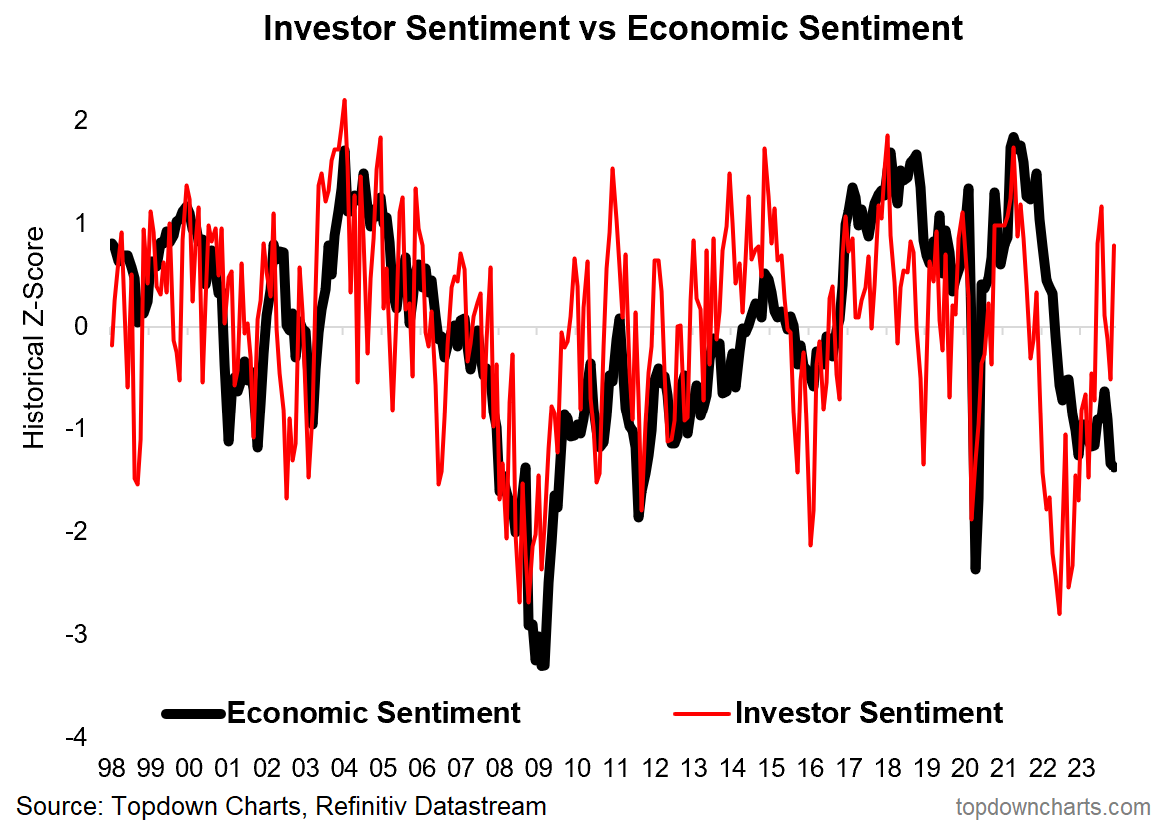
- Investor Sentiment vs Economic Sentiment: On a similar note, as of the latest data investor sentiment has surged back towards the heights of extreme bullishness… while economic sentiment (combined signal from consumer, small business, manufacturing, services, housing surveys) remains deeply depressed, recessionary. So who’s right?
(Wall Street says: Bull Market, Main Street says: Recession)
- Growth Gain Gridlock: Last year value stocks gained the upper hand (and growth stocks took a step back) — this year that was all completely reversed. And now?We’re back to that growth vs value relative performance line hitting its head on the ceiling…

Source: @meanstoatrend
- Concentrate! So the definition here is a bit of a mouthful, but basically it’s saying the biggest stocks are bigger than usual vs the rest of the market. Again, passive market-cap index-following investors are blindly piling into an increasingly concentrated bet.

Source: The Crude Chronicles
- From NDR:

- From Steve Blumenthal: S&P 500 Large Cap Index – 13/34–Week EMA Trend Chart:
