U.S. Light Vehicle Sales Strengthen
The Autodata Corporation reported that sales of light vehicles during January edged 1.1% higher (2.0% y/y) to 17.05 million units (SAAR) from 16.87 million in December. During the last three months, sales averaged 17.00 million units, a figure that has been trending lower since the 2016 sales peak of 17.55 million units. (…)
Trucks’ share of the U.S. light vehicle market rose to a record 73.7%, up from a low of 48.8% during all of 2012. (…)
Imports’ share of the U.S. vehicle market was steady last month at 22.0%. Imports’ share of the passenger car market rebounded to 25.9% after falling in December. Imports share of the light truck market slipped to 20.5% but remained up from the 12.0% low in January 2015.


U.S. Factory Orders Rebound; Inventories Strengthen
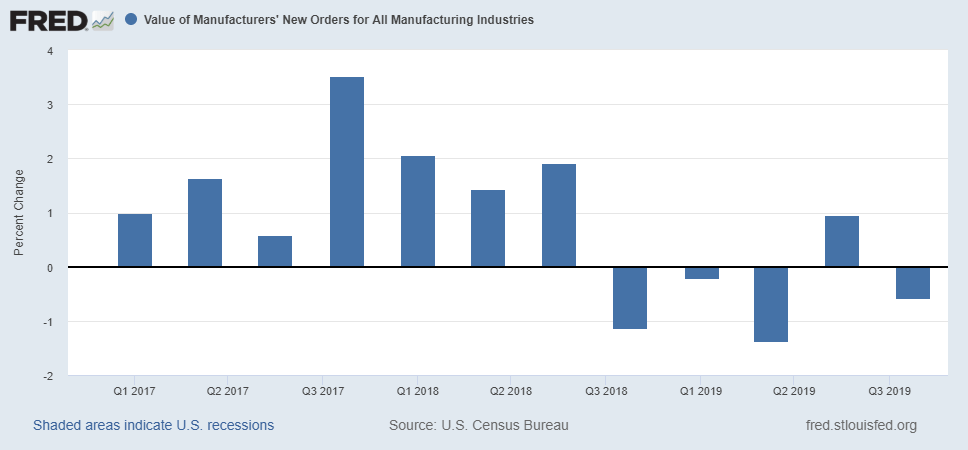
Factory orders increased 1.8% (-0.4% y/y) during December following a 1.2% November decline, revised from -0.7% m/m. (…) Durable goods orders surged 2.4% (-3.6% y/y, the same as in the advance report issued last week. A surge in defense aircraft orders raised transportation sector orders by 7.9% (-8.2% y/y). Overall orders excluding transportation improved 0.6% (1.3% y/y). (…)
Unfilled orders in the factory sector were little changed (-2.2% y/y) in December. Backlogs of durable goods held steady and excluding transportation, unfilled orders eased slightly (-0.5% y/y) for the third month in the last four. (…)
Inventories in the factory sector strengthened 0.5% (3.3% y/y). Durable goods inventories rose 0.5% (4.8% y/y) as transportation equipment inventories gained 1.1% (14.7% y/y). Motor vehicle as well as aircraft inventories rose strongly y/y. Excluding transportation, inventories rose 0.3% (0.5% y/y). (…)
Eurozone economy registers stronger growth at start of 2020
The IHS Markit Eurozone PMI® Composite Output Index strengthened for a second successive month at the start of 2020. Rising to 51.3, from 50.9 in December and above the earlier flash reading, the index indicated a modest rate of growth, but nonetheless the highest recorded by the survey since last August.
Expansion of the private sector was again driven by the services economy during January, although growth here was softer than in the previous month. Manufacturing output continued to fall, extending the current sequence of contraction to a full year. However, the rate of decline was the weakest recorded by the survey since last June.
All nations covered by composite PMI data recorded an expansion in private sector output during January. Ireland led the way, expanding at its fastest pace in just under a year. Growth tended to be only modest elsewhere, although notably Germany enjoyed its strongest performance for five months.
France and Spain recorded slower gains in output than in December, whilst Italy remained the weakest-performing despite recording its first expansion for three months.
Underpinning the latest increase in region-wide activity was another rise in incoming new business. Whilst modest, growth was the best recorded in seven months.
Foreign trade continued to weigh on overall new business gains, declining for a sixteenth successive month. However, the rate of decline was marginal and the weakest since late-2018.
Companies continued to add to their staffing levels during January, extending the current period of expansion to well over five years. Despite improving, growth was modest and remained well below the average for the current expansionary sequence.
Increased employment helped firms to keep on top of their workloads during January. Backlogs of work continued to fall, albeit only negligibly and at the weakest rate in the past 11 months.
Average input prices increased once again during January, with inflation accelerating to its sharpest of the past eight months. However, the rate of increase remained well below the survey average. There was also only a modest increase in output charges during January, with the rate of inflation unmoved for a third month in succession.
Looking ahead to the next 12 months, confidence about the future strengthened during January to its highest level since September 2018. All nations, with the exception of Spain, recorded an improvement of sentiment at the start of the year. Irish companies remained the most optimistic, followed by those based in Italy. Confidence amongst German companies was again the lowest, thought continued a recent improvement to the highest in nearly a year-and-a-half.
The IHS Markit Eurozone PMI® Services Business Activity Index was a little lower during January, falling to 52.5, from 52.8 in the previous month. Weaker expansion reflected slower service sector gains in France and Spain. All other nations registered stronger growth compared to December.
A solid increase in new work was signalled during January, with growth unchanged on December’s four-month high. In line with recent trends, growth was limited by another fall in new export business, the seventeenth in successive months.
Companies again took on additional staff, with employment rising at a solid pace that was slightly stronger than the previous month. Additional capacity helped firms to broadly keep on top of their workloads as backlogs rose only marginally.
Input price inflation accelerated at the start of the year to the strongest recorded by the survey for nine months. However, margins remained under pressure as charges again rose only modestly.
Finally, business confidence about the future was the strongest recorded since last April. With the exception of Spain – where sentiment fell to its joint-lowest in over six years – optimism was higher across the region during January.


Chris Williamson, Chief Business Economist at IHS Markit:
A further rise in the headline PMI to the highest since last August adds to evidence that the tide may be turning for the eurozone economy. Although growth remains subdued, with the survey signalling a quarterly GDP growth rate of just under 0.2%, manufacturing is showing welcome signs of stabilising after the heavy downturn seen last year and services growth remains encouragingly resilient, thanks largely to the improving labour market. (…)
Fears of a manufacturing downturn spreading to services have therefore eased, in turn helping assuage the risk of recession. We expect to see growth gaining momentum steadily as 2020 proceeds, as low inflation, a healthy job market and easing financial conditions support consumer spending, while improving global trade helps manufacturers.
However, the pace of output growth is still subdued, and firms remain concerned by existing headwinds as well as fresh risks. Although US-China trade war tensions have cooled, US trade rhetoric has now turned to Europe, with the auto sector looking especially vulnerable to tariff threats. Similarly, while the UK has formally left the EU, trade discussions will no doubt cause an air of uncertainty to hang over the continent. The Wuhan coronavirus meanwhile represents a new potential disruptor to business and trade. We consequently expect the eurozone to avoid recession in 2020 but to struggle to muster growth of 1.0%.

CHINA: Business activity rises modestly at start of 2020
Chinese services companies saw business activity growth slow further in January, according to latest PMI data. Total new orders also expanded at a softer rate, in spite of a stronger increase in new work from abroad. At the same time, firms registered a sustained rise in operating expenses, while efforts to help contain costs contributed to a broad stagnation of employment across the sector. Prices charged by service providers meanwhile fell slightly due to efforts to boost sales. Nonetheless, firms recorded a stronger degree of optimism towards the year ahead, with business confidence improving to a 16-month high in January.
Adjusted for seasonal factors, including Chinese New Year, the headline Business Activity Index fell from 52.5 in December to 51.8 in January, to signal a softer rise in services activity at the start of the year. Notably, the rate of expansion was the softest recorded for three months.
Higher business activity was generally linked to new client wins and new projects. However, the rate of new order growth also weakened slightly during January. Although rising solidly, total new business rose at the slowest pace since last October. Underlying data indicated this was partly driven by a slower rise in domestic demand, as new export business increased at a quicker pace.
After expanding in each of the prior 15 months, workforce numbers across China’s service sector were broadly unchanged in January. According to panellists, efforts to reduce operating costs had weighed on staff hiring at the start of the year.
At the same time, firms indicated that there was only mild pressure on operating capacities. Outstanding business rose only slightly for the second month in a row.
Chinese service providers registered a softer increase in overall input costs at the start of the year. Furthermore, the rate of input price inflation was the weakest seen for 10 months. Higher cost burdens were often attributed to greater staff and fuel expenses.
Although input costs rose again, Chinese services companies cut their average selling prices during January. Though only slight, it was the second time charges had fallen in as many months, with some firms mentioning reducing their prices to help boost new order intakes.
Looking ahead, services companies were, on balance, confident that business activity would increase over the next year. Moreover, the degree of optimism was the highest seen for 16 months. Positive forecasts were attributed to planned company expansions, entry in to new markets, new product releases and signs of improving demand in the property sector.
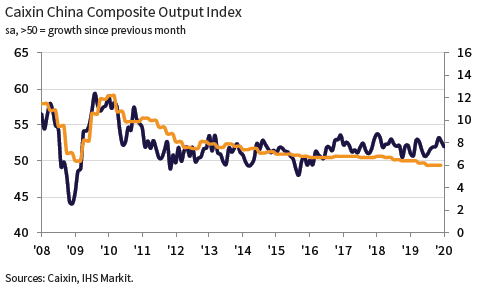
At 51.9 in January, down from 52.6 in December, the Composite Output Index pointed to only a modest expansion of overall Chinese business activity at the start of the year. Notably, the pace of growth was the weakest recorded for four months. Concurrently, the rate of composite new order growth eased to a five-month low.
Chinese companies meanwhile cut their staffing levels for the first time since last October, albeit only slightly, which was often linked to efforts to contain costs. Operating expenses rose at the quickest pace for four months at the composite level, but output charges rose only slightly.
Business confidence meanwhile rebounded to a 20-month high in January, supported by stronger optimism across both sectors.

VIRUS UPDATE
- China death toll at 490; 24,324 confirmed cases, 3,219 severe
- Despite global fears, the virus is still concentrated mostly in Hubei
- Foxconn cuts outlook, will quarantine workers; may hit Apple output
Epidemiologists are struggling to predict how the outbreak may evolve over time. The lack of tests to detect the disease, the potential for patients to be infected with only mild or no symptoms and the overwhelmed health-care system in China has cast doubt on the accuracy of the numbers that the government is providing.
“It is not a matter of if—it is a matter of when,” said Amesh Adalja, a senior scholar at the Johns Hopkins University Center for Health Security and a spokesman for the Infectious Diseases Society of America. “There is not a doubt this is going to end up in most countries eventually.”
“This is about mitigation at this point, and keeping the global spread as minimal as possible,” said Rebecca Katz, a professor and director of the Center for Global Health Science and Security at Georgetown University.
Japan said 10 people on a cruise liner tested positive for the disease. In Hong Kong, 3,600 passengers and crew from another ship were quarantined after three travelers were found to have the virus. (…)
On a call to discuss the company’s earnings, Chief Financial Officer Christine McCarthy said Disney expects the Shanghai park closure alone to crimp profits in the current quarter by $135 million, assuming it is shuttered for two months. With Hong Kong closing, Disney expects the coronavirus to reduce profit there by another $40 million. (Bloomberg)
The phase-one deal calls for China to step up purchases of U.S. goods and services. Mr. Kudlow and others say the purchases could be affected by the economic strains on China, where business and industry has been widely idled as efforts continue to prevent the virus from spreading. (…)
U.S. Pushing Effort for 5G Networks Without Huawei Seeking to blunt the dominance by China’s Huawei, the White House is working with companies including Microsoft and Dell to make software for next-generation 5G telecommunications networks.
The plan would build on efforts by some U.S. telecom and technology companies to agree on common engineering standards that would allow 5G software developers to run code on machines that come from nearly any hardware manufacturer. That would reduce, if not eliminate, reliance on Huawei equipment. (…)
“The big-picture concept is to have all of the U.S. 5G architecture and infrastructure done by American firms, principally,” Mr. Kudlow said in an interview. “That also could include Nokia and Ericsson because they have big U.S. presences.” (…)
EARNINGS WATCH
 We now have 249 reports in, a 69% beat rate, a +5.2% surprise factor and a +1.6% blended growth rate for Q4’20, UP from –0.3% on Jan. 1. Ex-Energy, earnings are now seen up 4.5% on a 5.9% gain in revenues!
Pre-announcements for Q1’20 look better than at the same time during Q1’19 and Q4’20.

Estimates for Q1’20 are for earnings to grow 4.8%, down from 6.3% on Jan. 1.
Trailing EPS now $164.00, the first monthly gain since November 2019. Per the Rule of 20, the 3-month downtrend in trailing EPS has reversed, even if only slightly, suggesting no earnings recession at this time.
As a result, the Rule of 20 Strategy increases its equity exposure from 0% set at 3220 on December 27, 2019 to 50%. The Strategy doubles the cash exposure when trailing EPS get on a 3-month downtrend. The risk of an earnings recession having diminished, cash is restored to the normal R20 Strategy rule, currently 50% at current valuation levels. Cash would be raised to 100% above 23 on the R20 P/E.
At 3315 (this a.m. pre-opening), the R20 P/E is 22.5.

Market’s Favorite Recession Signal Probably Has It Wrong Fears over the coronavirus outbreak have pushed the yield curve negative, but this may reflect something more benign
(…) The yield curve has inverted not because investors think the Fed is in danger of raising rates too far, but because they are anticipating that rates will be cut even further. Rather than inverting because short-term bill yields went up, the curve has inverted because long-term bond yields have come down. (…)
VISION!
The FT informs us that “Michael Ronen has stepped down as the managing partner for U.S. investments at SoftBank’s $100 billion Vision Fund. The U.S. executive expressed concerns about “issues” at the fund, which has recently received a few black eyes through lackluster investments such as WeWork.”
Last week, the WSJ ran this story:
-
SoftBank Is Funding Every Side of a Bruising Startup Battle Money from the Japanese tech investor is fueling a price war in Latin America between three of its own: Uber, Didi and Rappi
(…) Uber is under siege in Latin America amid a bruising price war where its ostensible rivals are Rappi and China’s Didi Chuxing Technology Co. But here’s the twist. All the combatants have as their biggest owner the same tech investor, Japan’s SoftBank Group Corp., which has injected a total of $20 billion into the three.
Startup investors typically don’t back competing companies. SoftBank, which runs the world’s largest venture-capital fund, has poured so much money into popular tech categories that it created a sort of circular firing squad in which SoftBank-backed companies use SoftBank cash to attack one another. (…)
And now we learn that Saudi Arabia’s sovereign wealth fund, which invested $45B in SoftBank’s first Vision Fund, sold almost all of its 8.2 million Tesla shares in Q4 last year. 