SERVICES PMIs
Note: The US and Canada Services PMIs will be out later today.
Eurozone growth slows to 16-month low in June
Latest PMI data pointed to a further expansion of the eurozone economy in June, as has been the case in each month since March 2021. However, the pace of growth slowed to the weakest in this sequence and was only modest overall.
Weighing on the performance in June was the first fall in manufacturing production for two years and a weaker rate of increase in services business activity.
Furthermore, inflows of new work stalled in June, thereby ending a 15-month sequence of growth as eurozone firms struggled with weakening demand. Notably, factory order book volumes declined at the steepest rate since the depths of the initial COVID-19 lockdown in May 2020. International demand conditions continued to weaken in June, with the latest fall in exports the quickest in two years.
Nonetheless, firms continued to struggle with capacity pressures, as backlogs of work rose again, and subsequently took on additional staff at a sharp pace.
On the price front, cost burdens surged further, albeit with the rate of inflation retreating further from March’s peak. Consequently, charges levied rose at a slightly reduced pace, but one that was nonetheless marked.
Stalling demand conditions and weaker activity growth were reflected in a further dampening in business confidence amongst eurozone firms. The level of sentiment was the weakest since October 2020 and subdued in the context of historical data.
The seasonally adjusted S&P Global Eurozone PMI® Composite Output Index registered 52.0 in June. Although still indicative of a modest upturn in private sector output, the latest reading was down from 54.8 in May, signalling the slowest rate of expansion in the current 16-month sequence as demand stalled. The fall in the headline figure reflected both a weaker upturn in service sector activity – the slowest since January – and the first reduction in manufacturing output for two years.
Of the monitored euro area constituents, Spain registered the fastest expansion in June, although the respective seasonally adjusted index nonetheless pointed to the slowest rate of growth since March. Slowdowns were broad-based across the remaining eurozone economies, most notably in Ireland and France where the rates of increase in output slowed sharply, to 16- and 14-month lows respectively, but remained solid in both cases. Elsewhere, Italy and Germany were tied at the bottom end of the growth rankings, with the latest upturns only marginal.
Inflows of new work to eurozone companies stagnated in June, ending a 15-month sequence of growth. Weakness was principally in the manufacturing sector, where order book volumes declined sharply, although services firms did record a weaker uplift in demand.
Despite stagnating demand conditions, eurozone firms continued to face capacity pressures in June, as signalled by a further increase in outstanding business. That said, the rate of backlog accumulation was the slowest since the current sequence of increase began in March 2021.
Ongoing capacity pressures were nonetheless strong enough to spur on additional job creation in June, stretching the current sequence of hiring growth to 17 months. Although the slowest since December, the rate of job creation remained strong overall.
Turning to prices, June data highlighted further severe inflationary pressures. Costs faced by euro area firms rose steeply, although the rate of inflation retreated further from March’s peak. Most pressures were again more acute in manufacturing. Consequently, charges levied by companies rose further. The rate of inflation eased to a four-month low, but remained marked in the context of historical data.
Looking ahead, the weaker performance in June was also reflected in a further moderation of business confidence amongst eurozone firms. The level of sentiment was the weakest since October 2020 and subdued in the context of historical data, with firms concerned around the economic outlook and inflationary pressures.
The S&P Global Eurozone PMI Services Business Activity Index fell from 56.1 in May to 53.0 in June, indicative of a sustained upturn in eurozone services activity but one that was the weakest since January.
The slowdown in June primarily reflected a weaker uplift in new business to services firms. New work rose for the fourteenth month running, but the pace of growth was the slowest since January and only mild overall. Inflows of new work from abroad meanwhile declined for the first time in three months, albeit at just a marginal pace.
June data nonetheless pointed to sustained capacity pressures at service providers, with the level of work in hand (but not yet completed) increasing further. That said, the pace of backlog accumulation eased to an eight-month low.
Eurozone services firms also reported ongoing cost pressures in June, extending the current sequence of rising input costs to over two years. The rate of increase accelerated on the month and was the third-steepest on record.
Efforts to maintain margins subsequently led firms to raise their average charges further during June. The rate of inflation hit a three-month low, but was nonetheless amongst the strongest in the series history and marked overall.
Concerns around inflationary pressures and the economic outlook weighed notably on business confidence at euro area services firms in June. The Future Activity Index fell to a 20-month low and pointed to subdued expectations towards activity over the next year.
Chris Williamson, Chief Business Economist at S&P Global Market Intelligence:
“The sharp deterioration in the rate of growth of eurozone business activity raises the risk of the region slipping into economic decline in the third quarter. The June PMI reading is indicative of quarterly GDP growth moderating to just 0.2%, with forward-looking indicators such as the survey’s new orders and business expectations gauges pointing to falling output in coming months.
“The manufacturing sector is already in decline, for the first time in two years, and the service sector has suffered a marked loss of growth momentum amid the cost of living crisis. Household spending on non-essential goods and services has come under particular pressure due to soaring prices but business spending and investment is also waning in response to the gloomier outlook and tightening financial conditions.
“While employment growth remained robust in June, the downshifting in the pace of demand growth and deterioration in business optimism points to the labour market also cooling in the coming months.
“More encouragingly, although price pressures remain elevated, there are signs that inflationary forces peaked back in April, reflecting a marked cooling of industrial price growth, improving supply chains and diminished demand. However, energy and food supply will likely remain two particular areas of concern and potential inflationary pressures as long as the war in Ukraine continues.
“The June PMI data therefore suggest that risks have increasingly tilted towards the economy slipping into a downturn at the same time that inflationary pressures moderate but remain elevated.”

China: Steep rise in services activity as COVID-19 measures are loosened
Chinese services companies registered a steep increase in business activity during June, according to latest PMI data, as the domestic COVID-19 situation improved and containment measures were loosened. New orders also returned to growth, rising modestly overall,while the downturn in foreign client demand softened notably. Firms trimmed their staffing levels at a softer pace, while backlogs of work rose only slightly. June saw a sustained slowdown in the rate of input price inflation, with costs rising only slightly. At the same time, efforts to attract new work led to only a marginal increase in prices charged.
When assessing the 12-month outlook for business activity, firms remained upbeat in June. That said, the degree of confidence was little-changed from May and remained below the series average. (…)


MANUFACTURING PMIs
Note: Japan, China and Eurozone PMIs were covered last week.
USA: PMI falls to near two-year low in June amid contraction in client demand
The US manufacturing sector signalled subdued improvements in operating conditions during June, according to latest PMITM data from S&P Global. The headline PMI dropped to its lowest level since July 2020 amid a near-stagnation of factory output and a fall in new orders. The decrease in sales was the first since May 2020, with domestic and foreign client demand falling. As a result, firms utilised their current holdings of inputs and finished goods to supplement production, with input buying stagnating and supply chain delays easing. A reduction in new orders, combined with a sustained rise in employment led to greater success clearing backlogs of work, which increased at a notably weaker pace.
At the same time, inflationary pressures remained historically elevated, but increases in input costs and output charges eased to three-month lows.
The seasonally adjusted S&P Global US Manufacturing Purchasing Managers’ Index™ (PMI™) posted 52.7 in June, down notably from 57.0 in May but up slightly on the earlier released ‘flash’ estimate of 52.4. The latest headline index reading was the lowest for almost two years and pointed to a relatively subdued improvement in operating conditions.
Contributing to the drop in the headline index was a renewed fall in new orders at manufacturing firms in June. The decrease in client demand was the first in over two years. Although only marginal overall, the drop in sales signalled a marked contrast to the sharp upturn seen in May. Firms stated that inflationary pressures, weak client confidence in the outlook and supply-chain disruption drove the decline.
Similarly, new exports returned to contraction territory in June. The fall in foreign client demand was the quickest since June 2020, albeit marginal overall.
Reduced new order inflows weighed on production volumes in June. The respective seasonally adjusted index fell to its lowest for two years. Some companies also highlighted that supplier shortages had constrained production capacity. Average supplier delivery times nevertheless lengthened to the smallest extent since November 2020, signalling some easing in the pandemic-induced supply squeeze.
Meanwhile, input costs and output charges continued to rise at substantial rates amid marked increases in supplier prices. Alongside hikes in material costs, firms noted that greater fuel and transportation charges pushed up operating expenses. The rate of input cost inflation was the slowest for three months, however. Output charge inflation also moderated. That said, firms reiterated the need to passthrough higher costs to their clients through greater selling prices.
Inflationary concerns were once again cited by firms, as business confidence regarding the year-ahead outlook slumped to the lowest level since October 2020. Firms were also more cautious regarding their forecasts due to weak customer demand and further disruption to supply chains.
Nevertheless, firms expanded their workforce numbers further in June. Hiring activity reportedly stemmed from efforts to clear backlogs of work and the filling of long-held vacancies. As a result, pressure on capacity eased and the level of work-in-hand was broadly unchanged on the month, a stark contrast to the sharp expansion seen in May.
Buying activity stagnated during June, as weak client demand led firms to work through their current holdings of inputs. As such, stocks of purchases were at a similar level to that seen in May. Firms also used post-production inventories to supplement output, as stocks of finished goods fell once again.

Canada Manufacturing PMI at 17-month low
Notably, output expanded at the softest pace for two years, while new orders rose only moderately. At the same time, weaker uplifts were recorded for employment and purchasing activity, while exports fell
for the first time in four months. Panel comments indicated that persistent price hikes and material shortages weighed on demand and output growth, as input price inflation ticked higher. (…)Firms cited that while demand continued to expand, price hikes deterred some clients from placing orders.
The softening in overall sales growth was partly driven by a renewed fall in exports, which dropped for the first time in four months. Although modest, the rate of decline was the joint-steepest since July 2020. Respondents blamed the war in Ukraine and weak demand from Europe and Asia. (…)
Overall, the rate of [input inflation] was marked, and among the quickest in the series history. A general uptick in expenses contributed to another sharp increase in selling prices at the end of the quarter. (…)
Americans Tap Pandemic Savings to Cope With Inflation Households of almost all income levels drew down those balances in the first quarter
From the start of the pandemic to the end of 2021, U.S. households built up $2.7 trillion in extra savings, according to Moody’s Analytics. (…) Families have tapped about $114 billion of their pandemic savings so far, according to Moody’s Analytics, which analyzed government data. (…)
Americans’ checking-account balances jumped after they got their pandemic stimulus payments, bank executives have said. While customers have spent some of that money, balances still remain markedly above where they were in 2019, said Chris Wheat, co-president of the JPMorgan Chase Institute, the bank’s in-house think tank. At the end of March, balances of families with the lowest incomes were 65% above 2019 levels.
Still, they used to be higher. In March 2021, around the time of the third round of federal stimulus checks, balances for those families were up 126% from 2019 levels. (…)
The bottom 20% of earners was the only income group that didn’t draw on their pandemic savings in the first quarter of the year, Moody’s Analytics found. “These are folks working in leisure, hospitality, retail, healthcare,” Mr. Zandi said. Strong wage growth has allowed many of these workers to continue to save.


 The data is to March. More recent data show the sharp declines in real income and spending since. Retail sales weakened in March but got very weak in April and May per recent corporate results and comments.
The Chase card spending tracker currently estimates that control retail sales are down 3.8% MoM in June (data through June 26).
Bosses Offer Midyear Raises to Retain Employees Employers say higher pay is needed to keep up with rivals and to reflect that staffers are paying more for gasoline, groceries and other daily living expenses.
(…) Exxon Mobil Corp. XOM 2.23%▲ gave U.S. employees a one-time payment in June equivalent to 3% of their salaries. PricewaterhouseCoopers LLP says it will hand out raises in July to reflect its performance in its fiscal year that just ended. Microsoft Corp. MSFT 1.07%▲ told employees this spring it planned to nearly double its global budget for merit-based raises. (…)
“The market has moved,” said Michelle Swanenburg, head of human resources at asset manager T. Rowe Price Group Inc., TROW 1.50%▲ one reason companies are changing pay now.
Last month, T. Rowe sent thousands of employees an email saying it would give about 85% of its workforce a 4% raise effective July 1. T. Rowe employs more than 7,500 full-time staffers.
Though the company’s fiscal year doesn’t end until December, executives made the decision to grant raises now after noticing an uptick in attrition, particularly among technology workers and some entry-level employees, and to account for inflation, Ms. Swanenburg said. The firm extended the raises to some new hires, meaning some employees got a pay bump after only weeks on the job. (…)
The 4% raise is in addition to annual, year-end salary adjustments that the company still plans to offer.
Overall, companies have on average increased base pay in the U.S. by 4.8% so far in 2022, and about a third of employers are considering or planning midyear raises, according to a survey of more than 300 large employers conducted in May by Pearl Meyer, a compensation advisory firm. (…)
Exxon’s 3% bonus in June came outside of the company’s typical annual review cycle. Chief Executive Darren Woods said on a call with investors in late April that it was meant to help Exxon maintain competitiveness. The company also said it would triple the number of employees eligible for stock grants. (…)
Larger employers say they are monitoring pay data almost continuously now, too. At PwC, the firm no longer reviews salary data once a year, said Tim Ryan, the firm’s U.S. chairman. Instead, PwC regularly looks at a number of data points, including salary expectations of new hires, using that information to react quickly and make compensation changes if needed.
The firm raised pay 5% in January, and offered additional raises this month. “Our people will get another round of good raises and we will stay competitive,” Mr. Ryan said. (…)
If the U.S. Is in a Recession, It’s a Very Strange One Economic output is down—but the job market is strong, unlike in previous recessions. It’s the latest twist in the odd trajectory of the pandemic economy.
The U.S. economy has experienced 12 recessions since World War II, and each one included two features: Economic output contracted and unemployment rose.
Today, something highly unusual is happening. Economic output fell in the first quarter and signs suggest it did so again in the second. Yet the job market showed little sign of faltering during the first half of the year. The jobless rate fell from 4% last December to 3.6% in May. (…)
The backdrop to U.S. jobs is now unusual. The U.S. has recorded more than 11 million unfilled job openings in six of the past seven months, four million more monthly openings than was typical before Covid-19 hit the economy in early 2020. In other words, demand for workers is abundant. (…)
But unemployment is always low just before recessions and job openings per unemployed always high…

Bloomberg last week: US Layoffs, Hiring Freezes Are Tip of Labor Market Slowdown
In the past few weeks, companies have announced tens of thousands of job cuts and plans to freeze hiring. The bulk has come from technology, cryptocurrency and real estate firms big and small, which have laid off at least 37,000 workers since May, according to tech job-listings website TrueUp. Brokerages and banks including JPMorgan Chase & Co. are reducing headcount as the housing market cools.
(…) The country’s second-largest aluminum producer, Century Aluminum Co., said it was laying off about 600 workers. (…)
Manufacturing overtime hours have declined for three months in a row, the longest downward streak since 2015. The four-week average of jobless claims, which is less volatile than the weekly figures, climbed to the highest level since January as more people filed for benefits. And wage growth across the country is cooling. (…)
One nonfinancial-service firm told the Richmond Fed that its plans for hiring and spending are on hold because clients are capping or cutting budgets. Another services company told the Kansas City Fed it too instituted a hiring freeze after sales dropped, adding it’s looking to cut costs. (…)
And, nowhere near the pandemic levels but, at its current 232k, the four-week moving average of initial unemployment claims is up 35% from its April 2 low and is back to its pre-pandemic range.
J.P. Morgan’s job tracker based on alternative data suggests a pretty weak job market in June.

The U.S flash PMI survey last week said that “service providers signalled a notable change in pressure on capacity during June, as backlogs of work fell for the first time in two years. As a result, the rate of job creation eased to the softest in four months.”
- Latest Real GDP Estimate estimate: -1.0% June 30, 2022 (GDP Now)
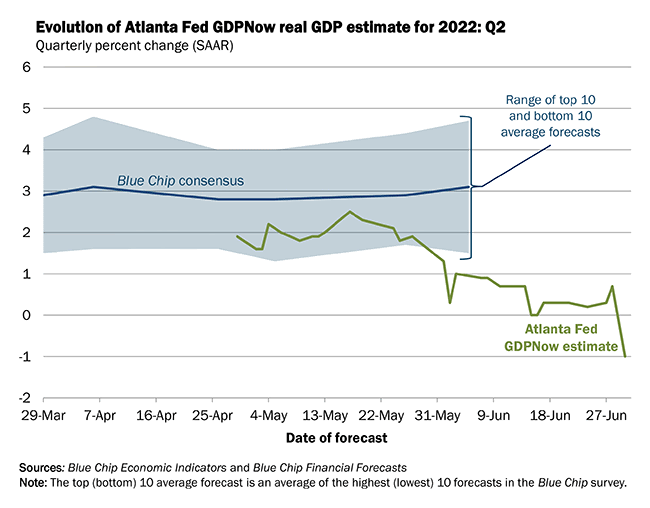
- Ned Davis Research: “The downward revision to our growth outlook implies that the risk of recession has been pulled forward from late 2023 to end of 2022/early 2023. While nine of the ten key indicators we track for turning points in the business cycle have yet to signal a recession, several are close to doing so. All ten have registered local peaks/troughs, and half have declined to levels no
longer consistent with above-trend growth - US Recession Chances Surge to 38%, Bloomberg Economics Model Says That’s up from around 0% just a few months before.
- Our Recession Forecasting Model Is Broken There might be a recession soon, but trying to predict it using our pre-Covid-19 toolbox is silly
(…) The pandemic brought about major distortions to the economy and, though worries about Covid-19 have been waning, many of those distortions remain. There are still fewer jobs in the U.S. than before the pandemic struck, but because many people still haven’t returned to the workforce, the unemployment rate is near its lowest level in more than 50 years. Reduced spending and government relief allowed households to accumulate savings like never before. Federal Reserve figures show that holdings of cash and cash equivalents were 30% higher in the first quarter than two years ago. (…)
With everything looking so different, trusting too much in recession models, which are based on how the economy behaved going into previous downturns, is problematic. Consider a New York Fed forecasting model, which now puts the chances of a recession occurring over the next 10 quarters at about 80%. It uses a variety of inputs, including gross domestic product, which contracted at a 1.6% annual rate in the first quarter, and gross domestic income, which theoretically should be the same as GDP, but grew by 1.8%. It also includes a measure of productivity, which, with all the supply-chain issues and labor-market shifts the economy has been going through, is even harder to assess than usual. (…)
Industries focused on the production, transportation and selling of goods, such as manufacturers and construction firms, truckers and retailers, also throw off a lot more economic data than many services-focused industries, in part because it is easier to do things such as count freight-car movements than to count the lines of code the nation’s programmers produce. Typically, this isn’t a problem for economists, because even though services are a bigger part of the economy, they aren’t as volatile as goods sectors, which drive ups and downs. But services got crushed by the pandemic. To the extent that more spending is moving back toward them, the goods focus in the economic data creates a blind spot that could be flowing into recession models. (…)
Surely with the Fed raising rates in an attempt to cool inflation, the risk of recession has to be higher than it was a year ago. A downturn could still be on the way, and by the time it is obviously coming, it might already have arrived.
- Bank of England tells lenders to brace for economic storm
- European gas prices jump as Norway strikes add to supply woes Region’s energy crisis intensifies as Equinor begins shutting down oil and gasfields
Demand for Chips Eases as Sales of PCs Slow Intel and Nvidia are among the semiconductor makers warning of rockier times ahead after two years of surging demand across their product lineups, pointing to a chillier consumer climate.
Inflation Expectations Hit Record in Bank of Canada Surveys
The Bank of Canada’s quarterly surveys of executives and consumers released on Monday show the price pressures that have brought inflation to four-decade highs are expected to persist for longer than previously thought, as the country faces tight labor markets and companies get hit by rising input costs. (…)
Consumer expectations for price increases rose across all time horizons, with households seeing inflation at 6.8% in one year and 5% in two years. Both are records.
The five-year inflation expectation also increased significantly to 4%, but still remains slightly below pre-pandemic levels. (…)
Businesses anticipate “significant” wage and price increases, according to the report, with supply chain bottlenecks now expected to persist for longer. Investment intentions and hiring remain elevated, but so are expected wage costs. The average expected wage increase is now at 5.8% next year, according to the business survey, a record.
“Expectations for higher inflation and rising interest rates are affecting consumer confidence,” the Bank of Canada said. “In response to such factors, Canadians plan to cut spending. They are seeking out more-affordable options when shopping.” (…)

Americans likely think alike…
Markets Had a Terrible First Half of 2022. It Can Get Worse.
We keep making history!


- This one is actually low-key shocking — US equity market drawdown is equivalent of -46% of US GDP, that’s massive. (Callum Thomas)

Source: @strategasasset
- iTraxx main is now leaving CDX IG behind. Both are elevated, but Europe’s panic is becoming rather “spectacular”. (The Market Ear)

Refinitiv
JPMorgan Sees ‘Stratospheric’ $380 Oil on Worst-Case Russian Cut
(…) given Moscow’s robust fiscal position, the nation can afford to slash daily crude production by 5 million barrels without excessively damaging the economy, JPMorgan analysts including Natasha Kaneva wrote in a note to clients. (…)
A 3 million-barrel cut to daily supplies would push benchmark London crude prices to $190, while the worst-case scenario of 5 million could mean “stratospheric” $380 crude, the analysts wrote.
“The most obvious and likely risk with a price cap is that Russia might choose not to participate and instead retaliate by reducing exports,” the analysts wrote. “It is likely that the government could retaliate by cutting output as a way to inflict pain on the West. The tightness of the global oil market is on Russia’s side.”
- Citi Warns Oil May Collapse to $65 by the Year-End on Recession Crude oil could collapse to $65 a barrel by the end of this year and slump to $45 by end-2023 if a demand-crippling recession hits, Citigroup Inc. has warned. (…) oil prices fall in all recessions to roughly the marginal cost.
We now have a range to work with…
Peter Thiel-Backed Vauld Suspends Withdrawals The crypto lender backed by Coinbase and Peter Thiel is exploring a possible restructuring after becoming the latest cryptocurrency platform to freeze services.
China’s Covid Outbreak Flares, Fueling Fears of Wider Spread
China reported more Covid-19 infections in its current epicenter, putting pressure on authorities to tame the outbreak before it spills over into some of the country’s most economically important areas.
The eastern province of Anhui reported 231 Covid cases for Monday, with the tally since late June topping 1,000 infections. Authorities locked down Si county and one neighboring county late last week to carry out mass testing and to try and stop the virus from spreading, and pledged on Monday to stop community spread in the next three days.
Still, the virus is already spreading through the Yangtze Delta region that accounts for a quarter of China’s economy and is home to key hubs for medicine to semiconductor chips and e-commerce. (…)
The restrictions came after the provincial disease control center said it detected the BA.5 omicron sub-variant in its recent outbreak, state media China National Radio reported earlier Tuesday. The BA.5 sub-variant is more infectious than the BA.2 variant found in earlier outbreaks, the report said. (…)
FYI:
Summer in America is becoming hotter, longer and more dangerous (Washington Post)