Note: sorry for recent site problems as my host needed to do some maintenance.
SERVICES PMIs
USA: Fastest rise in business activity since July 2014 as new order growth reaches six-year high
March PMITM data indicated a substantial increase in business activity across the U.S. service sector, and one that was the steepest for almost seven years. Contributing to the marked upturn in output was the fastest expansion in new business for six years, reflecting strengthening client demand. Firms also registered a renewed rise in new export orders. Meanwhile, rates of input cost and output charge inflation reached fresh record peaks, as firms sought to pass on steep rises in input prices to clients.
Meanwhile, sentiment among service providers about business in the year ahead improved, helping drive employment growth to a three-month high .
The seasonally adjusted final IHS Markit US Services PMI Business Activity Index registered 60.4 in March, up from 59.8 in February and above the earlier released ‘flash’ estimate of 60.0. The rate of output growth signalled was the fastest since July 2014. Service providers often stated that the stronger expansion in business activity was due to greater client demand and the easing of virus containment restrictions in some states.
At the same time, new business increased further in March, with the rate of growth accelerating for the third successive month. The pace of the upturn in client demand was the quickest since March 2015. Firms attributed the expansion to greater spending by existing customers as well as the acquisition of new clients, often through more sales and marketing activities. Others suggested that higher confidence stemming from the vaccine roll-out had driven up customer spending.
Total sales were also supported by a renewed increase in new export orders, which rose for the second time in the past four months due to increased demand following easing lockdown restrictions in some markets.
On the price front, input costs soared in March. The rate of inflation accelerated to the fastest since data collection for the services survey began in October 2009. Anecdotal evidence widely linked the uptick in costs to higher prices for key inputs such as PPE, paper, plastics, fuel and transportation.
Subsequently, firms sought to pass on higher costs to clients through a sharper rise in selling prices. A number of companies also stated that stronger client demand allowed a greater proportion of the hike in costs to be passed through. The resulting rate of charge inflation was the quickest on record.
Meanwhile, business expectations regarding the outlook for output over the coming year improved in March. The degree of confidence was robust overall and among the strongest for six years. Optimism was commonly attributed to the ongoing vaccine roll-out and hopes of a substantial boost to new sales if social distancing measures are further eased during 2021.
Stronger positive sentiment was also reflected in a solid rise in employment at the end of the first quarter. The rate of job creation was the quickest for three months, as greater new business inflows sparked an increased need for additional staff. Softer pressure on capacity was evident in only a fractional rise in backlogs of work, and the slowest in the current nine-month sequence of expansion.
The IHS Markit Composite PMI Output Index* posted 59.7 in March, up slightly from 59.5 in February, to signal the fastest upturn in private sector business activity since August 2014. Although the expansion in manufacturing sector production eased, service providers registered a marked rise in output.
Supporting the increase in total activity was the sharpest rise in new business since September 2014. Manufacturers and service providers alike signalled stronger expansions in client demand. At the same time, new export orders increased solidly.
Price pressures remained elevated across the private sector in March. Rates of input cost and output charge inflation reached record highs amid severe supply chain disruptions and input shortages. Some firms noted that stronger demand conditions meant they could pass on a greater proportion of the increase to clients.
Employment continued to rise in March, and at a solid pace. Manufacturers registered a marked increase in backlogs as supply chain issues constrained production capacity.
Finally, business expectations regarding the outlook for output over the coming year improved across the private sector, and were robust overall. (Markit)

China: Solid increase in services activity in March
China’s service sector expanded at a stronger pace in March, with firms reporting the steepest increases in both activity and overall sales for three months. Panel members often attributed the upturn to a further recovery from the pandemic, which in turn boosted new projects and client numbers. Higher new orders led to greater pressure on capacities, with backlogs rising for the first time in five months, which prompted firms to add to their staffing levels. Prices data signalled solid increases in both input costs and output charges.
Optimism regarding the 12-month outlook for activity meanwhile hit its highest for over a decade amid hopes of a strong recovery from the coronavirus disease 2019 (COVID-19) pandemic.
The headline seasonally adjusted Business Activity Index posted 54.3 in March, up from 51.5 in February, to signal a solid increase in Chinese services activity. Furthermore, the rate of growth was the steepest seen for three months and slightly quicker than the series average.
Supporting the stronger rise in activity was a further increase in total new work placed with services companies. The rate of new order growth likewise quickened to a three-month high. New export business fell slightly, however, to suggest the upturn was largely driven by stronger domestic demand. Some companies mentioned that the pandemic continued to dampen new orders from overseas. The measure for new export business remained in contractionary territory for the second straight month, though the contraction was limited.
Rising intakes of new work led to renewed pressure on operating capacities, as highlighted by the first increase in outstanding business for five months. That said, the rate of accumulation was only marginal. As part of efforts to expand capacity and process orders, employment at service providers increased in March. Though modest, the upturn contrasted with a slight fall in workforce numbers during February. Average operating expenses faced by Chinese services firms rose for the ninth month running in March. Though solid, the rate of inflation was the softest recorded since last September. Firms cited a variety of factors when explaining the latest rise in costs, including higher prices for raw materials and labour.
In order to alleviate pressure on margins, prices charged by services companies in China rose again at the end of the first quarter. The rate of inflation was the quickest seen in the year to date and solid.
Finally, business confidence improved markedly in March, hitting its highest since February 2011. Companies that projected higher business activity over the year ahead frequently linked this to forecasts of more normal business conditions and a further recovery in market demand once the pandemic ends. There were also reports that new product investment and planned company expansions would boost activity.


The Eurozone PMI is out tomorrow.
Nordea:
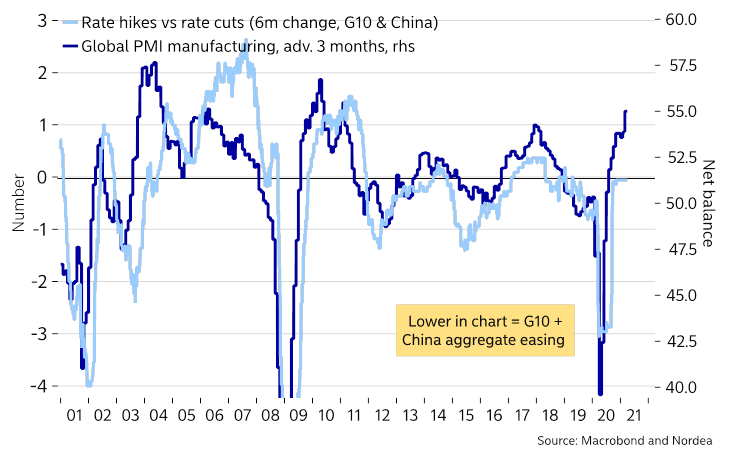
This week delivered the highest global PMI manufacturing reading since 2011, and at these levels manufacturing PMIs are actually screaming for policy tightening. The Fed and Norges Bank are likely to act much earlier than others, with an early tapering decision from the Fed very much in play (perhaps pre-signalled at Jackson Hole?).
It seems as if year over year base effects have started to show up in month over month figures such as PMIs. Maybe it is time for Markit to test whether respondents actually respond to the question asked or whether they are influenced by yearly base effects in the answers.
But we are well past the base effect in U.S. manufacturing. New orders for all manufacturing segments are above their pre-pandemic levels: total manufacturing (+1.9%), Durable Goods (+3.2%) and Core Capex (+8.5%).

Another example of base effects is the Chase consumer card spending tracker going through the roof on a YoY basis. But the yellow line was almost back to its pre-Covid level in mid-March before easing a little last week.

This is in spite of continued depressed spending on services. Check this next chart:

The ISM survey on Services at the end of March:

Data: FactSet; Chart: Danielle Alberti/Axios
The Pent-up vs Spent-Up debate
The NY Fed puts itself in the Spent-Up camp in its latest piece “Excess Savings” Are Not Excessive:
(…) Excess savings are unlikely to unleash pent-up demand for services. One caveat to the previous reasoning is that some of the “excess savings” might be due to a dearth of spending opportunities in the sectors of the economy most affected by the virus, such as travel and entertainment. If this is true, some of that lost spending could materialize once those sectors fully re-open.
How large is this “pent-up” demand for services likely to be? On the one hand, there is little doubt that many consumers will enjoy a few extra restaurant meals and perhaps splurge on a nicer vacation after such a long period without them. On the other hand, there is a limit to how many extra restaurant meals and vacations people will be able to enjoy. To have a sense of how much of this pent-up demand might be activated by the “excess savings” accumulated during the pandemic, recall that available estimates of the propensity to consume out of the CARES Act transfers is about one-third. This means that the average household spent about 33 cents out of each dollar received in direct payments. As it turns out, this estimate is in line with those based on previous transfers of this kind, such as the Economic Stimulus Payments of 2008. Therefore, the pandemic does not seem to have substantially limited households’ ability to spend the support that they received.
The bottom line from these three sets of considerations is that, although large by historical standards, the savings accumulated by U.S. households during the pandemic do not appear to be “excessive” when set against the extraordinary need of many American families and the unprecedented government intervention to support them. It is certainly possible that some of these savings will pay for extra travel and entertainment once the COVID-19 nightmare is behind us, but our conclusion is that the resulting boost to expenditures will be limited. This conclusion does not rule out a strong economic recovery from the virus shock. It only implies that spending out of excess savings won’t be one of its major drivers.
The problem here is that pandemic savings are extraordinarily high and in past stimulus payments the savings rate tended to return near its previous level. From its current 13.6%, a return to the 8% range would boost spending tremendously.

Goldman Sachs is in the Pent-Up camp:
We see several reasons why goods spending will remain strong even as the service sector fully reopens. First, the current overshoot mostly reflects delayed purchases from last spring, suggesting that at most a small amount of future goods spending has been pulled forward so far. Second, consumer expectations for goods purchases have actually increased recently, and many companies also anticipate that demand will remain elevated after the pandemic ends. Third, household income and balance sheets will likely remain supportive of purchases. (…)
After taking demand normalization into account using a category-level forecast, we estimate that real goods spending will fall in 2021H2 as consumers shift consumption back towards services but will still remain well above trend through 2022.
China Asks Banks to Curtail Credit for Rest of Year
At a meeting with the People’s Bank of China on March 22, banks were told to keep new advances in 2021 at roughly the same level as last year, said the people, asking not to be identified as the matter is private. Some foreign banks were also urged to rein in additional lending through so-called window guidance recently after ramping up their balance sheets in 2020, one of the people said. (…)
The PBOC wants banks to focus on lending to areas such as innovative technology and the manufacturing sector, it said at the March gathering. Earlier in the month, Guo Shuqing, chairman of the China Banking and Insurance Regulatory Commission, warned about bubbles in the property and financial markets, fueling concerns policy makers will begin tightening monetary policy. (…)
Last year’s stimulus pushed debt to almost 280% of annual economic output. (…)
U.S. auto industry calls for government help as it warns of impact of chip shortage A U.S. auto industry group on Monday urged the government to help as it warned the global semiconductor shortage could result in 1.28 million fewer vehicles built this year and disrupt production for another six months.
China Creates Its Own Digital Currency A cyber yuan stands to give Beijing power to track spending in real time, plus money unlinked to the global financial system dominated by the dollar. It also could soften the bite of U.S. sanctions.
John Authers: Nirvana for Stocks Rests on Faith in Fed Doves It’s the best of both worlds for equities, with economic data strong and bond yields contained. How long that can continue depends on central bankers.
(…) On Monday, the ISM services survey for last month came in with the highest figure since it started in 1997, while beating expectations by the biggest margin since Bloomberg began compiling economists’ estimates in 2008.
(…) bond yields haven’t been hit hard by April’s strong data. They have come a long way in a hurry, but it is intriguing that both inflation expectations and nominal yields have edged down a little since the beginning of the month (…).
Hedged 10-year U.S. Treasuries offer a much nicer return than equivalent bunds. Foreign buying naturally limits the increase in U.S. yields. (…)
Everyone is alive to the fact that base rates will give us scary-looking inflation of 3.5% later this year; but the market expects the headline figure to settle down at about 2.5%. As consumer price inflation tends to be a few tenths of a percentage point higher than the PCE measure that the Fed prefers to target, this shows the market thinks the Fed will get what it says it wants — inflation averaging a little above the target of 2% for a while, without accelerating. (…)
The Fed says it really cares about employment. If so, it should be happy with the unambiguously positive trends in the U.S. jobs market. However, the numbers also show that it will want to stay very easy for a while. That could keep downward pressure on yields. (…)
Growth can continue from here without putting pressure on wages and prices (…).
Over time, stocks have tended to move in tandem with the ISM manufacturing index, which again makes sense. The ISM is intended to be a leading indicator of growth, and equities are attempting to discount future growth. Over the last 20 years, the correlation has been very close, so it is to be expected that a blowout ISM number would immediately be followed by a blowout in stocks:
The bad news is that once the top is in for the ISM, equities almost always pull back. This isn’t necessarily the beginning of a bear market or a crash, but they can be expected to have a bumpier ride before long. (…)
But the story of the latest leg up is that bond yields have stopped their ascent, at least for a few days. There is some chance that faith in a dovish Fed, and the natural market balancing mechanisms that attract buyers when yields rise, can keep them where they are even if reflation continues. If that happens, equity bulls can enjoy themselves a little while longer before the rate of growth peaks.

Employers are in no Nirvana:
Prospective Hires Plied With $1,500 Signing Bonuses and Pizzas Despite high unemployment, a record share of small businesses say they have jobs they can’t fill.
(…) Sierra Pacific Industries, which manufactures doors, windows, and millwork, is so desperate to fill openings that it’s offering hiring bonuses of up to $1,500 at its factories in California, Washington, and Wisconsin. In rural Northern California, the Red Bluff Job Training Center is trying to lure young people with extra-large pizzas in the hope that some who stop by can be persuaded to fill out a job application. “We’re trying to get inside their head and help them find employment. Businesses would be so eager to train them,” says Kathy Garcia, the business services and marketing manager. “There are absolutely no job seekers.” (…)
On April 1 the National Federation of Independent Business reported that in March a record-high percentage of small businesses surveyed said they had jobs they couldn’t fill: 42%, vs. an average since 1974 of 22%. Also 91% of respondents said they had few or no qualified applicants for job openings in the past three months, tied for the third highest since that question was added to the NFIB survey in 1993.
(…) judging from the jobless rate, which the Federal Reserve tracks closely, there’s still plenty of slack in the labor market. But that’s not how employers and job counselors see it. (…)
Many of the jobs that employers can’t fill are low-paying, while the high-paying ones generally require skills that most people don’t have. (…)
Toronto Home-Price Surge Tops 20% as Bubble Debate Heats Up
New listings were up 57% from March 2020, when the onset of the pandemic temporarily caused a freeze in real estate activity. But the new supply was not able to keep up with demand spurred by low borrowing costs and demand for bigger homes, especially in the suburbs, a report from the Toronto Regional Real Estate Board said Tuesday.
Across the metropolitan area, the average price of all homes sold was C$1.1 million (about $878,000) during the month, up 21.6% from last March. Detached homes in the 905 area code, which surrounds the city’s core, sold for 31.4% more, an average of C$1.32 million. (…)
TECHNICALS WATCH
My favorite technical analysis firm is getting concerned by the recent rise in selling indicators but would await confirmation from other indicators before calling a peak.
TAXATION
- West Virginia Sen. Joe Manchin, seen as a necessary swing vote for Democrats, says he won’t support raising the corporate tax to 28% but could see 25%. (Bloomberg)
- Richest New Yorkers Face Tax Hike Under Proposed Budget Deal
Governor Andrew Cuomo and state lawmakers have reached a tentative agreement to raise taxes on the wealthiest New Yorkers as part of a roughly $200 billion budget deal expected to be announced as early as Monday, according to a person familiar with the negotiations.
If approved, state income-tax rates would temporarily [!] increase to 9.65% from 8.82% for single filers earning more than $1 million, according to the person, who wasn’t authorized to speak publicly because a final budget hasn’t been reached.
New York City residents with income over that threshold would pay between 13.5% and 14.8%. That compares with 13.3% on income over $1 million in California, currently the highest in the nation, according to the Tax Foundation.
Lawmakers were nearing a budget agreement that would increase corporate and income taxes by $4.3 billion a year with additional revenue going to fund aid for schools, undocumented immigrants and small businesses, the Wall Street Journal reported Sunday, citing unnamed sources. (…)
The New York agreement would create two new tax brackets. Under the proposed plan, income between $5 million and $25 million would be taxed at 10.3% and income over $25 million would be taxed at 10.9%. The new rates would expire in 2027 under the proposed plan. (…) (Bloomberg)
COVID-19
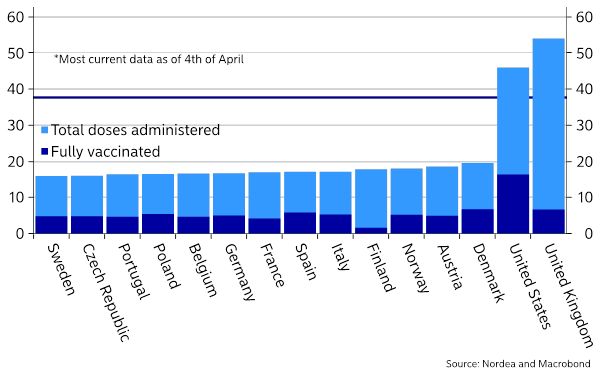
Doses administered and fully vaccinated people as percent of population