China Says It’s Implementing Deals Done With U.S. on Trade
(…) “China will start from agricultural products, autos and energy to immediately implement specific items that China and the U.S. have agreed upon,” Ministry of Commerce Spokesman Gao Feng told reporters in Beijing. “In the next 90 days we will work in accordance with the clear timetable and road map to negotiate in areas where both sides have an interest and there are mutual benefits, such as intellectual property rights protection, technology cooperation, market access, and the trade balance.” (…)
When asked for details on car tariffs, Gao repeated the above statement and suggested watching for an announcement from the State Council’s tariff committee. He also declined to comment on the detention of Huawei Technologies Co.’s chief financial officer on Thursday in Canada over potential violations of U.S. sanctions on Iran.
China and the U.S. will work on intellectual property rights protection, technology cooperation, market access issues and the trade balance in the next 90 days, Gao said, adding that China’s goal is to remove all new tariffs within that period.
China is fully confident that it can reach a trade deal with the U.S. within the 90 days set for talks, Gao said. The Chinese and American trade teams have good communication and have already reached a high level of consensus, he added.
Arrest of Huawei CFO, Seen as Rising Star, Adds Strain on U.S.-China Ties Huawei’s CFO, who was arrested in Canada at the behest of American authorities, isn’t an ordinary senior executive. She’s the daughter of the Chinese tech giant’s founder.
(…) China’s embassy to Canada has already complained bitterly about the arrest and other Chinese tech companies have been punished this year for sanctions violations and allegedly stealing chip-design secrets. (…)
Washington has lately been stepping up efforts to curb Huawei’s global dominance in telecom-networking equipment due to concerns that its systems could be used for spying by Beijing. Huawei has long rejected the American claims, saying its systems are as secure as those of its Western rivals.
Huawei said it isn’t aware of any wrongdoing by Ms. Meng, who was arrested as part of an investigation into whether Huawei violated sanctions on sales to Iran. It said it complies with laws and regulations everywhere it operates. (…)
(…) The incident’s timing may be curious. But Huawei, the world’s top cellular-equipment maker, encapsulates the conflict between the two countries.
Beijing champions the company as one of China’s few truly global brands, and its best bet to dominate the build-out of the next-generation wireless network called 5G. But in Washington, Huawei has long been a boogeyman, with myriad accusations against it including spying and cyber theft. The U.S. has effectively barred major carriers from using Huawei and has launched a campaign to persuade its allies to do the same. Australia, New Zealand and Britain’s BT Group have heeded the call so far.
What happened to ZTE, Huawei’s Chinese peer, could offer a taste of what comes next. The Trump administration banned American companies from selling to ZTE in April due to its violations of sanctions against Iran and North Korea, a move that could have killed the company given the difficulty of sourcing crucial components from elsewhere. The U.S. later lifted the restriction, but ZTE’s Hong Kong-listed stock is still around 40% lower than where it traded before the ban. Huawei isn’t listed, but its suppliers in Asia are already taking a hit: Lens-maker Sunny Optical dropped 5% Thursday while optical-component manufacturer Accelink Technologies fell 8%, with investors assuming more moves against Huawei are coming.
The bad news could now spread to small American suppliers to Huawei. Optical component maker Neophotonics, for example, generates almost half its revenue from the Chinese company, according to Goldman Sachs. Other U.S.-listed companies such as Lumentum, Oclaro, Qorvo and Finisar have around 10% of their revenue tied to Huawei, the bank estimates.
Bigger players could get hit too. Chip makers Qualcomm and Broadcom , which are already grappling with the global smartphone sales slowdown, are the most likely victims. While both generate only around 5%-6% of annual revenue from Huawei directly, that number rises to over 50% when broadened to all Chinese companies.
No matter which country wins the technological battle in the end, those companies that have hitherto benefited from more cordial relationship between the U.S. and China will be the biggest losers.
The Commerce Department this year penalized ZTE for breaking the terms of a sanctions-busting settlement—nearly shutting down the company after banning U.S. firms from selling it supplies—but then gave it a reprieve after ZTE agreed to pay a fine, change its management and fund a team of U.S. corporate monitors. (…)
Huawei is the world’s biggest maker of equipment for cellular towers, internet networks and related telecommunications infrastructure. It is also the world’s No. 2 smartphone brand. (…)
Growth Is Good but Uncertainty Is Climbing Among U.S. Businesses
Most of the Fed’s 12 regional districts reported their economies expanded at a modest or moderate pace in recent weeks, the central bank said in its latest roundup of anecdotal information about regional economic conditions known as the beige book. The report was based on information collected through Nov. 26.
But representatives of businesses across many of the districts expressed worry about the eventual economic price of rising interest rates and the Trump administration’s recent trade actions. (…) Multiple businesses in the Minneapolis district told the Fed they put “capital spending plans on hold due to uncertainty in their outlooks.” (…) A central California agricultural business said trade policy uncertainty continued to “limit the ability of growers to secure longer-term sales contracts.”
Meanwhile, rising interest rates appear to be putting the brakes on the housing market and other sectors of the economy. (…) Rising rates affected auto sales, too. (…)
The strengthening employment picture appeared to be adding to business uncertainty as well, as employers found it increasingly difficult to find and retain qualified talent. Business contacts in many districts said the labor market had tightened further in a broad range of fields.
The Chicago Fed district reported a number of businesses “had been ‘ghosted,’ a situation in which a worker stops coming to work without notice and then is impossible to contact.”
The Fed’s report also showed most districts reported wages grew at a modest to moderate pace. (…) Meanwhile, prices rose at a modest pace in most districts, with a few noting moderate increases. (…)
U.S. COMPOSITE PMI POINTS TO “SOLID GROWTH”
Growth momentum in business activity across the U.S. service sector was maintained in November, with firms registering a strong expansion in output. Foreign demand strengthened, leading to the fastest rise in new export business for six months. However, the upturn in overall new business moderated from rates seen earlier in the year. In line with a slowdown in new order growth, workforce numbers were expanded at the weakest rate since June 2017. Meanwhile, input prices continued to rise at a historically sharp rate. Subsequently, firms increased output prices charged further.
The seasonally adjusted final IHS Markit U.S. Services Business Activity Index registered 54.7 in November, broadly in line with a figure of 54.8 seen in October. The strong rise in business activity was linked by service providers to a sustained rise in new business and robust client demand. Although down on rates of expansion seen earlier in the year, the increase was faster than the previously released flash figure of 54.4.
New business received by service providers continued to expand in November, extending the trend seen since data collection began in late-2009. Panellists suggested the rise in new orders was due to new client acquisitions and more favourable market conditions. Although the rate of growth was strong overall, it was the slowest for 13 months and signalled a moderation in growth momentum compared to earlier in the year.
Meanwhile, new export business increased at a quicker pace in November. Panellists registered a moderate rise in new orders from abroad that was the fastest since May. In line with a sustained upturn in new business, service providers indicated a further need to expand workforce numbers. Greater business requirements pushed firms to increase employment at a solid rate. That said, the pace of job creation was the slowest since June 2017. Reduced strain on capacity was also reflected in a slower accumulation of backlogs. The level of outstanding business rose only modestly in November.
On the price front, cost burdens faced by service sector firms rose at a strong rate. The pace of inflation was faster than the long-run series average, with greater input prices reportedly linked by survey respondents to higher fuel and labour costs. Robust client demand and greater cost burdens led to a further increase in output charges, with service providers registering a relatively sharp rise. Panellists stated that higher selling prices were linked to the partial pass-through of larger cost burdens to clients.
Finally, service sector firms expressed a lower degree of optimism towards future business activity growth in November. Although well above the 50.0 no change mark, confidence was below both the series and year-to-date averages.
The Composite Output Index posted 54.7 in November, down slightly from 54.9 in October. The overall expansion in the US private sector was strong overall, despite slower rates of growth in both the manufacturing and service sectors.
Notably, the upturn in new orders softened to the slowest since October 2017, despite a slightly stronger expansion in the manufacturing sector. Conversely, new export orders from abroad strengthened as foreign demand increased across the private sector.
Both manufacturers and service providers continued to register a historically sharp rise in input costs, despite the rate of inflation moderating. Higher fuel and labour costs were commonly attributed to the rise in cost burdens, with manufacturers reporting ongoing concerns surrounding tariffs.
Consequently, private sector firms increased their output charges further. Favourable domestic and foreign demand conditions allowed companies to raise prices strongly. Finally, the overall degree of confidence towards future output growth weakened in November. More tentative forecasts for the year ahead were registered by both goods producers and service providers, with the former raising concerns surrounding the sustainability of the current sequence of new order growth.
Chris Williamson, Chief Business Economist at IHS Markit:
The PMI surveys paint a picture of an economy growing at a solid annual rate of 2.5% so far in the fourth quarter, and continuing to add jobs in impressive numbers. Although some cooling in the rate of job creation was seen in November, the surveys are still pointing to payrolls growing at monthly rate of around 185,000.
The surveys therefore add to evidence that the domestic economy remains in good health, generating balanced growth across both manufacturing and services and increasingly outperforming other major economies.


The caveat to the strength of the U.S. economy is that there has been a fair amount of pre-buying in recent months. As a result, the finished goods inventory index rose sharply, highlighting a deterioration in supply-demand dynamics as enterprises have passively replenished inventory levels.
The good news is that the consumer is buying strongly which should help keep inventories at manageable levels in January.

Bank of Canada Takes Cautious Turn While Keeping Rate Steady Central bank highlights risk posed by energy downturn, loss of momentum in fourth quarter
The Bank of Canada held its benchmark interest rate steady at 1.75% on Wednesday as low oil prices and slowing economic momentum prompted officials to strike a more cautious tone, casting fresh doubts on the chances of a rate increase in January.
In a statement explaining the rate decision, the central bank said interest rates will need to rise to a neutral range, currently estimated around 2.5% to 3.5%, to keep inflation on track. The pace of future rate rises will depend on a number of factors, the statement said, including the effect of higher rates on consumption and housing, and developments in global trade policy.
“The persistence of the oil price shock, the evolution of business investment, and the bank’s assessment of the economy’s capacity will also factor importantly into our decisions about the future stance of monetary policy,” the Bank of Canada statement said.
(…) the central bank noted signs are emerging “that trade conflicts are weighing more heavily on global demand” and acknowledged there is less momentum in the Canadian economy going into the fourth quarter.
The Bank of Canada also suggested that due to downward historical revisions to Canada’s gross domestic product, there may be more room for the economy to grow without stoking inflation—a development that could result in a slower pace for future rate rises. (…)
“In light of these developments and associated cutbacks in production, activity in Canada’s energy sector will likely be materially weaker than expected,” the Bank of Canada said.
In reality, the BOC is making a complete 180-degree turn to be completed shortly as it realizes that the Canadian economy is slowing very seriously as I discussed Monday.
THE YIELD CURVE
-
Treasurys Are on the Edge of a Yield-Curve Inversion—That’s Bad News Treasury market moves are sending a menacing signal about the economic outlook. An inverted curve is often interpreted as a signal of a looming recession.
(…) For most of this year, both short- and long-term bond yields rose as government bond prices fell across the board. However, yields on bonds due in less than two years rose quickest. The pattern indicated both the short- and long-term growth outlooks had improved, leading investors to expect more interest-rate increases both now and in the future.
That is no longer true. Now, the yield curve is closer to inverting not because short-term economic indicators are improving, but because longer-term rate expectations are falling.
This quarter, yields on longer-dated bonds have dropped and those on two-year Treasurys are flat. The gap between two and 10-year Treasury yields is now around 0.11 percentage point, compared with around 0.55 percentage point at the beginning of the year. (…)

(…) The downdraft in European yields of between 30 and 40 basis points of late has matched what’s happened in the United States, so this flight to safety has hardly been an isolated event. It is global.
Plus, nobody ever mentions the foreign-exchange hedging costs for a typical European buyer of U.S. debt securities. It is perilous to bet against a leading indicator that has worked with near precision over the past seven decades. (…)
If history has taught us anything, it is that cycles, up or down, do not last indefinitely – they all die at the hands of the Fed, and this one is no different. Not to mention, at 10 years, this current one is very old and the laws of longevity are taking over. This thing doesn’t last to 2020 or beyond, in my opinion, and the markets have been signalling all year long that we are making the transition out of this elongated expansion. (…)
It’s time for understanding what history teaches us, which means de-risking, heeding the wisdom of sages from the past such as the first Baron Rothschild, who said he got wealthy by playing the middle 60 per cent of the cycle instead of trying to time the lows and highs. As such, effective risk-management right here and right now requires the discipline of preserving capital, bolstering the quality of the investment portfolio and turning off the television set.
(…) For starters, the inversion between two-year and five-year Treasury yields could be a temporary kink. In 1998, the gap turned negative without the rest of the curve following suit, and no recession followed. The most common measure of yield curve steepness is the difference between two-year and 10-year yields. This has also flattened but remains positive. A flattening curve itself has shown no predictive power.
Even if the full curve does flip, investors shouldn’t confuse cause for effect: Inverted yield curves don’t cause recessions, nor provide new information about the economy. They simply reflect a market assumption that growth will slow, based on how long the expansion has been going on and what data is available. (…)
-
Economic Doubts Drag Treasury Benchmark Rate Further Below 3% Reversal from upward climb earlier this year suggests investors less hopeful about growth accelerating
(…) after touching a seven-year high of 3.23% early in November, the 10-year yield has fallen in 14 of the last 16 trading sessions, settling Tuesday at 2.921%, its lowest close since Sept. 6. Spurring the retreat included Federal Reserve officials’ comments suggesting the central bank could slow its pace of interest-rate increases, a shift in tone coinciding with rising doubts that U.S. economic growth can accelerate substantially.
As the 10-year yield has fallen, so has the yield on the two-year note, though at a slower pace. The gap between them narrowed to 0.13 percentage point Tuesday, the smallest difference since 2007. (…)
EARNINGS WATCH
Amid all the turmoil and uncertainty, earnings still matter. The Q3 earnings season is almost over with 491 reports in, a 77% beat rate and a +6.4% surprise factor. Q3 earnings are up 28.3%, up from 21.6% expected on Oct. 1. Revenues are up 8.6% (7.4%).
Trailing 12 months EPS are now $157.79 or about $160.40 pro form the tax reform for the full 12 months. Q4 earnings are seen up 17.0%, down from 20.1% on Oct. 1 which would bring full year EPS to $162.76 according to Refinitiv, excluding any beat potential.
Corporate pre-announcements are not showing any meaningful deterioration just yet, more than two-thirds of the way into the quarter.

At 2655 this morning, the S&P 500 index is trading at 18.7 on the Rule of 20 gauge. Will the recent low of 18.3 (2600) hold once more amid all the uncertainty and nervousness?
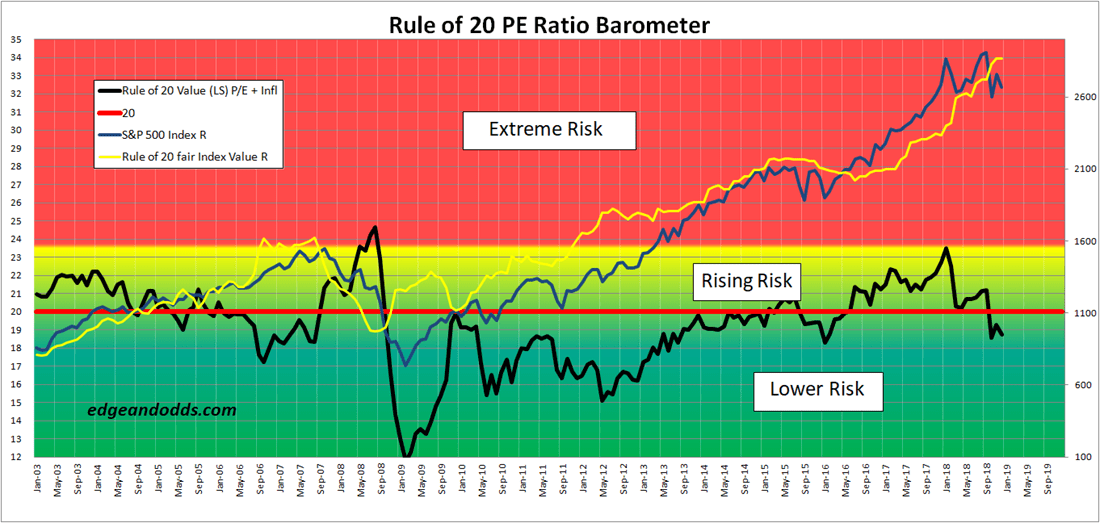

Back in January 2016 when the S&P 500 touched a low of 1810, 15% below its May 2015 high, real GDP was cratering from +3.8% in Q1’15 on its way to +1.3% in Q2’16. Trailing EPS were falling and inflation was rising.
This time around, GDP is up 3.0%, EPS are rising and inflation is slowing.
But investors hate uncertainty and they find plenty of that in the U.S.-China trade war, Brexit, Italy and, now, the perceived message from a potential yield curve inversion. These next charts from my old friend John Aitkens at TD Securities provide enough evidence to respect what the bond market may be saying without totally panicking at first sight.


Given the importance of the consumer sector in the U.S. economy, and the fact that it is the only solid sector currently, this next chart from John suggests that recession odds should be kept low, unless one truly believes that Trump and Xi will totally mess the world up.

Wait, there’s more:
-
Putin Threatens Arms Race as U.S. Prepares to Exit Nuclear Treaty
-
North Korea Expands Long-Range Missile Base, Analysts Say Pyongyang is also still producing nuclear weapons, according to researchers studying satellite images, casting a new shadow over disarmament talks