U.S. Services PMI: Joint-weakest rise in new business since October 2017
January data signalled a further upturn in business activity across the service sector. The rise in output was the slowest for four months, amid one of the softest increases in new business seen for more than a year. Although only fractional, new export orders fell for the second successive month. In line with a slower rise in new business, employment growth eased to the second-weakest since June 2017. However, firms registered a stronger degree of confidence towards business activity levels over the coming 12 months.
The seasonally adjusted final IHS Markit U.S. Services Business Activity Index registered 54.2 in January, down slightly from 54.4 in December. Anecdotal evidence linked the solid rise in business activity to a sustained increase in new orders and greater client demand. That said, the rate of expansion was the softest for four months and weaker than both the series trend and the average seen in 2018.
New business received by service providers continued to increase at a solid rate, and one that matched that seen in December. The upturn was, however, the joint-slowest since October 2017. Where a rise was reported, panellists often attributed this to the release of new product lines and solid domestic demand. Others, meanwhile, suggested client demand growth remained subdued in comparison to the first half of 2018.
Service sector firms noted a decrease in foreign client demand in January, signalling the second successive month the respective seasonally adjusted index has posted below the 50.0 no change mark. The decline in new business from abroad was only fractional but was the third fall in the past six months.
Meanwhile, price pressures eased in January, with the rate of input price inflation softening to a 22-month low. The increase in cost burdens was also slower than the series trend but solid overall. Panellists stated that higher input prices were linked to greater raw material and wage costs. However, others noted that lower fuel prices had led to reduced cost pressures.
Firms were able to pass on higher input costs to clients through greater output charges in January. The rate of charge inflation picked up from December’s 12-month low, albeit remaining well below last year’s peaks. Alongside reports of the need to pass on higher costs, a number of panellists suggested they were able to increase their operating margins.
January data signalled a renewed accumulation in backlogs of work at service providers. That said, a softer expansion in new work resulted in a weaker rate of job creation. Employment growth was the second-slowest since June 2017 (behind November 2018).
Business activity expectations picked up in January, with the degree of optimism rising since December. Panellists noted that positive sentiment stemmed from hopes of more favourable demand conditions, however, the level of confidence was still historically subdued.
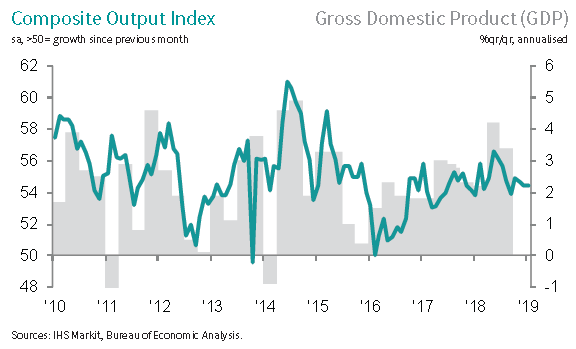
The Composite PMI Output Index posted 54.4 in January, matching that seen in December. The solid expansion was nonetheless one of the weakest seen in the last year and below the average seen in 2018.
Conversely, new business across the private sector increased at a faster pace. The upturn accelerated following a quicker rise in new orders across the manufacturing sector. A softer rise in new export orders among manufacturers and a contraction in new business from abroad in the service sector, led to the the slowest overall increase in new export business since last October.
Price pressures continued to soften across the private sector, with the rate of input price inflation easing in both the manufacturing and services sector. Strong client demand, however, allowed firms to increase their output charges at a faster pace in January.
Meanwhile, employment growth also eased, taking the rate of private sector job creation to the slowest since June 2017. Weaker service sector hiring offset an upturn in manufacturing employment growth.
Finally, survey respondents expressed a stronger degree of confidence towards the outlook for output over the coming 12 months, though the overall level of optimism remained below the average seen last year.
At current levels, the surveys are consistent with annualised GDP growth of around 2.5% at the start of the year.

RECESSION WATCH
Pick your chart:
- The NY Fed (yield-curve based model) (The Daily Shot)

-
U.S. Economy vs. Yield Curve – Low U.S. Recession Risk (Ned Davis via CMG)

-
Longview’s view:
 Source: Longview Economics
- Barclay’s view (NDR via CMG):

OPEC Pursues Formal Pact Between Cartel and Russia Saudi Arabia and its Persian Gulf allies are proposing a formal partnership with a 10-nation group led by Russia to try to manage the global oil market, according to OPEC officials, in an alliance that would transform the cartel.
(…) The proposal by the Organization of the Petroleum Exporting Countries would formalize the loose union between OPEC members and the group led by Moscow, which includes some former Soviet republics and other countries including Mexico. The two groups have increasingly worked together in recent years, including in December when they agreed on a deal to curb production.
Iran and other producers have opposed a tighter partnership, fearing it could be dominated by Saudi Arabia and Russia, according to officials in the cartel. (…)
In December, the 14-strong OPEC and the 10 allies led by Russia reached a new agreement to tackle an oversupplied global crude market by cutting production by a combined 1.2 million barrels a day.
At the time, the groups put off a final decision on the nature of their future cooperation. The groups first collaborated in late 2016 to help oil prices to rebound after a two-year crash. It was Russia’s first solid alliance with the cartel in decades.
Under the proposal, OPEC would continue regular meetings to agree on production and monitor implementation with the Russia-led group, according to OPEC officials. Under the current draft document, the alliance could last up to three years and wouldn’t be legally binding, one of the OPEC officials said.
Participants still need to iron out differences, said another OPEC official. The first cartel official said all sides were likely to end up agreeing on some arrangement as oil prices could fall without a deal. Traders believe OPEC needs to coordinate with Russia to balance supplies efficiently, the official said. (…)
Don’t Obsess Over the Earnings Season Earnings are overrated. As we reach the halfway point in the S&P 500’s fourth-quarter earnings season, investors are obsessing over financial reports and downgraded profit forecasts. Here’s a heresy: This doesn’t matter nearly as much as people think.
(…) Looking at 145 years of U.S. stock-market history collected by Yale University Prof. Robert Shiller, reported earnings moved in a different direction than stocks in 55 years. Even when they moved in the same direction, the gaps were often vast, as with 1997’s 31% gain in the S&P when earnings rose less than 3%.
Of course, investors attempt to anticipate earnings. One might think that what really matters isn’t earnings, but earnings expectations, proxied by the consensus forecast of analysts.
Surprisingly, changes in earnings estimates are as useless as changes in trailing earnings for forecasting price moves over the earnings season. Since 1985, the U.S. market and 12-month forward earnings estimates have moved in different directions in almost one in three quarters. The gap between their quarterly moves averages more than 5 percentage points, sometimes up, sometimes down. (…)
To put it simply: The stream of all future earnings is far more important than the latest quarter. Information about growth prospects outweighs the number of dollars per share a company delivered in the previous three months, or how much it will deliver in the next 12 months.
Theory backs this up. Future profits are expected to be worth far more than current profits for all but a few dying companies, so small changes to profit growth or to the discount rate, used to translate future profits into today’s money, have an outsize effect. A CEO who reports fat profits but leaves investors convinced of gloomy prospects ahead shouldn’t be surprised if the stock sinks.
The market has been dominated recently by worries about future earnings, not current earnings. The prospects of a trade war, tighter monetary policy and global economic slowdown hit the price-earnings multiple last year even as earnings headed for a stupendous 2018, juiced by tax cuts. This year some of those worries went into reverse, and the multiple expanded again. Moves in earnings reported for 2018 or predicted for 2019 weren’t the main driver. (…)
Facts are:
Earnings do matter…

…but so do fluctuating price/earnings multiple…

…which sometimes fluctuate very differently than earnings…
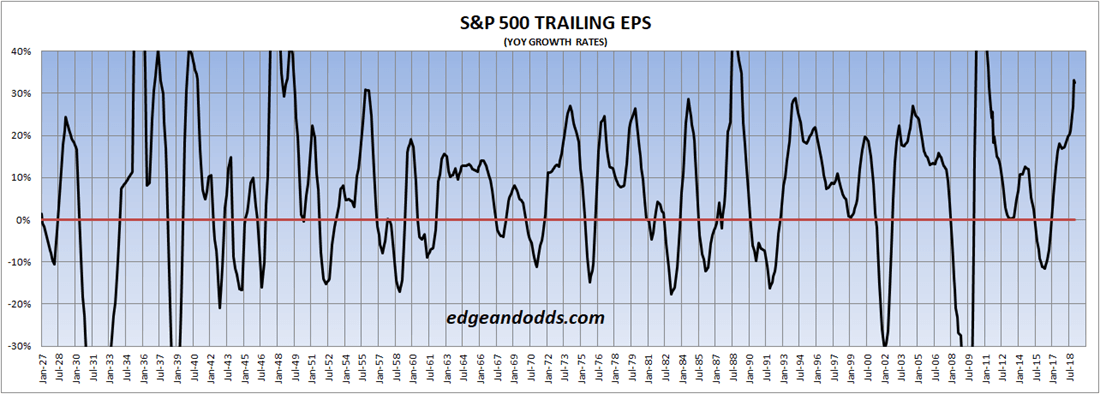
…primarily because of fluctuating inflation…

…but also because of fluctuating investor sentiment (chart from Ed Yardeni)…

…hence the Rule of 20 incorporating all of the above to better appreciate risk vs reward:

See also The Rule of 20 Strategy.
EARNINGS WATCH
We now have 258 companies in and a 71% beat rate. The Surprise Factor is now +3.1%, up from +2.0% on Jan. 28 when we had only 135 reports in. Recent Energy companies’ releases were surprisingly strong.
Q4’18 earnings are now seen up 15.8% (13.2% ex-Energy), in line with the Jan. 1 expectations.
Pre-announcement for Q1’19 are soft. The number of negative guidance is down from 38 at the same time during Q4’18 to 32 yesterday but only 14 companies guided positively so far, a marked decline from 26 at the same time during Q4’18. Perhaps executives have elected to wait a bit longer before committing themselves one way or the other. Only 49 companies guided for Q1 so far, down from 72 at the same time in Q4’18 and from 62 at the same time during Q1’18.
Q1’19 estimates are barely up at +0.4% (0.9% ex-E), down from 5.3% on Jan. 1. Q2 and Q3 earnings are expected up in the 3.0-4.0% range but Q4’19 are forecast to rise 9.9%, down from 11.5% on Jan. 1, bringing full year 2019 earnings up 4.6%, down from 7.3% expected on Jan. 1.
Trailing EPS are now $162.47
1 thought on “THE DAILY EDGE: 6 FEBRUARY 2019: Fluctuations”
Interesting thought from John Hussman:
“It’s important to recognize that what we call “structural” real GDP growth (labor force growth + trend productivity) has declined persistently in recent decades, to a level that’s now down to just 1.4% annually. All additional real GDP growth in recent years has been driven by a decline in the rate of unemployment from 10% in 2009 to the current level of just 4%. With a far smaller reservoir of “cyclical” economic slack, it’s likely that real GDP growth will slow toward that 1.4% structural rate. Any material increase in the unemployment rate would go hand-in-hand with a recession, and an outright contraction in real GDP.”
Comments are closed.