U.S. Business activity growth accelerates to 10-month high at start of 2020
The opening month of 2020 signalled a solid expansion in business activity across the U.S. service sector. Output growth was supported by another modest increase in client demand, albeit historically soft and weighed on by a renewed contraction in new export sales. Nonetheless, the rate of job creation quickened in an effort to alleviate pressure on capacity. Firms were not, however, more confident about an increase in business activity over the coming year, as optimism remained historically muted and eased since December.
On the price front, cost pressures strengthened amid supplier price hikes, but output charges rose only marginally as firms sought to attract new clients.
The seasonally adjusted final IHS Markit US Services Business Activity Index registered 53.4 in January, up from 52.8 in December and revised up slightly from the flash figure of 53.2. The latest index reading signalled a solid expansion in output at the start of 2020 and was reportedly supported by greater marketing activity and a sustained increase in new business. Moreover, the rate of expansion quickened to a ten-month high, albeit still running below the long-run series trend.
New business growth was broadly in line with that seen in December and only moderate overall. Client demand has now risen for three months running, with companies also linking the upturn to the acquisition of new customers. Foreign demand conditions, however, were challenging and weighed on the overall expansion in new orders, as new business from abroad fell for the fifth time in six months.
Meanwhile, the sustained rise in new business led firms to increase their workforce numbers at a marginal pace in January. Moreover, the rate of job creation quickened slightly to the fastest since last July.
Service providers signalled pressure on capacity in the opening month of 2020, following broadly unchanged levels of outstanding business in December. Backlogs of work rose at the strongest rate for six months. Although only marginal, the pace of accumulation was above the long-run series average.
Despite a faster increase in staffing numbers and a further rise in new business, output expectations for the coming year stayed relatively subdued in January. Where optimism was reported, firms attributed this to marketing efforts and hopes of a pick up in new order growth. That said, a degree of hesitancy stemmed from concerns surrounding the longevity of greater client demand.
At the same time, the seasonally adjusted Input Prices Index increased for the fourth month running in January, with the rate of inflation the fastest since last July. Higher cost burdens were linked to supplier price hikes and greater wage costs. That said, the pace of increase was below the series trend and slower than those seen at the start of 2019.
As a result, the rate of output charge inflation was only marginal overall. Firms stated that increases stemmed from the partial pass-through of higher costs to clients, but efforts to remain competitive weighed on inflation.
The IHS Markit Composite PMI Output Index* registered 53.3 in January, up from 52.7 in December and above the earlier flash reading of 53.1, indicating a solid increase in private sector business activity at the start of 2020.
The rate of new business growth eased, however. Slower expansions in both the manufacturing and service sectors led to a softer private sector increase in new orders. Firms also reported a renewed fall in new export orders.
Meanwhile, input prices rose at a relatively soft pace, with cost pressures easing across the manufacturing sector. Greater efforts to attract new clients limited increases in charges, as output prices increased only marginally.
Although manufacturing firms registered a greater degree of optimism in the outlook for output, private sector business confidence remained historically subdued.
Finally, firms increased their workforce numbers marginally. Pressure on capacity was only slight however, with backlogs rising for only the third successive month.

Chris Williamson, Chief Business Economist at IHS Markit:
The PMI data indicate that the US economy is ticking along at a steady but unspectacular annualized rate of growth of approximately 2% at the start of 2020. Growth has gained some momentum from the lows seen in the fall as the service sector enjoys stronger growth and manufacturing has also shown signs of the trade-led downturn easing. (…) optimism about future growth across the business community as a whole continues to run at one of the lowest levels seen over the past decade.
Business are concerned by the prospect of weaker economic growth at home and abroad in the coming year, especially with spending potentially being dampened in an election year. Fresh worries are also likely to appear. With the vast majority of the survey data having been collected prior to the 24th January, we’ve yet to see any impact from the Wuhan coronavirus outbreak, but the potential disruption to business and the associated financial market jitters pose additional downside risks to both the global and US economies in coming months.
Sector margin trends in January:

The ISM manufacturing PMI is finally catching up:

China to Cut Tariffs on $75 Billion of U.S. Goods Beijing said it would slash tariffs on $75 billion of U.S. imports in half as part of its efforts to implement a recently signed trade agreement with Washington.
Beginning Feb. 14, China will cut tariffs on some U.S. goods to 5% from 10%, while levies on some other items will be reduced to 2.5% from 5%, China’s Ministry of Finance said in a statement Thursday. (…)
In a statement accompanying Thursday’s announcement, the Finance Ministry said the decision was intended to “alleviate economic and trade frictions and expand economic and trade cooperation” between the two countries. “We hope to work with the United States towards the ultimate elimination of all increased tariffs,” it added. (…)
Virus Update
China death toll at 563; mainland cases at 28,018, with 3,859 severe
EARNINGS WATCH
We now have 274 S&P 500 companies in, a 70% beat rate (20% miss rate) and a +4.8% surprise factor. Aggregate earnings of those 274 companies are up 1.1%, somewhat better than the +0.3% at the same time during Q3’19.
Pre-announcements for Q1 remain supportive but we are starting to hear about the virus impact.
Trailing EPS are now $164.19.
At today’s pre-opening of 3342, the P/E on trailing EPS is 20.4. It had reached 21.7 in January 2018. On forward EPS of $176.30 per Refinitiv/IBES, the P/E is 19.0 (17.7 in January 2018).

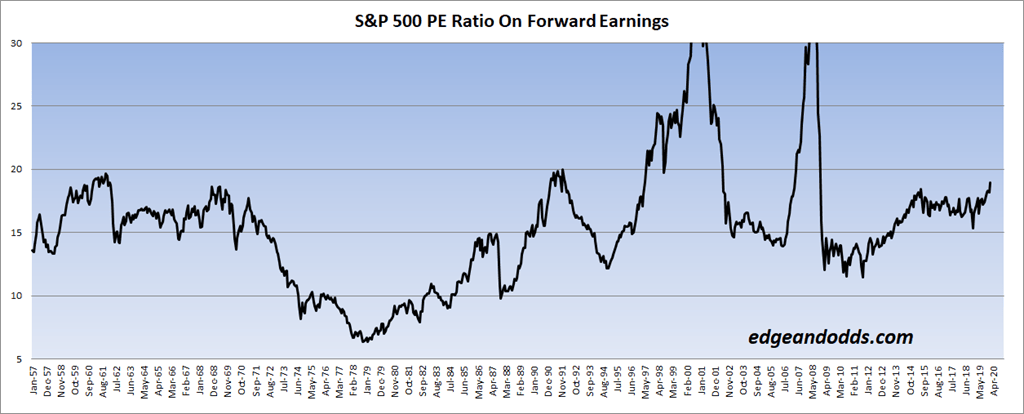
The Rule of 20 P/E is 22.7. It touched 23.5 in January 2018.

TECHNICALS WATCH
- 13/34–Week EMA Trend Chart (CMG Wealth):
