U.S. New Home Sales Rose in December Sales increase 3.7%, closing weak year for housing market
New home sales increased 3.7% to 621,000 during December following a November increase to 599,000, revised from 657,000. It was the highest level of sales in six months. During all of 2018, new home sales increased 0.9% to 621,000, the highest level since 2007. (…) The median price of a new home rose 5.0% (-7.2% y/y) in December to $318,600. For the full year, the median price was fairly steady y/y at a record $321,483. The average price of a new home rose slightly m/m to $377,000 (-6.4% y/y) and was steady for the full year at $377,992. (…)
Is it the weather? The South has been the only really stronger market lately:


Housing = affordability. The impact on affordability from big drop in mortgage rates after the crisis was mitigated, and then eliminated, by prices rising much faster than wages.
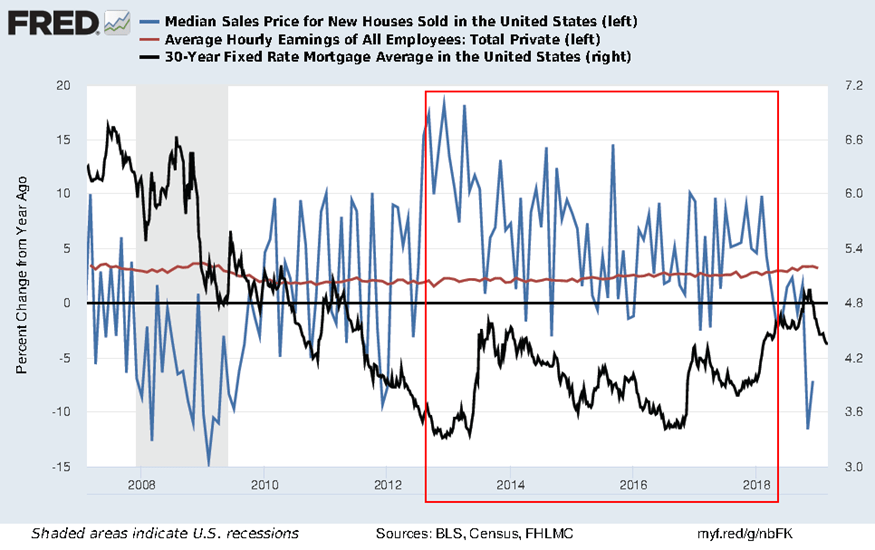
The picture seems to be changing, however, as new house prices have declined and mortgage rates have stabilized. Affordability is rising along with employment. Particularly for the important first-time buyers:
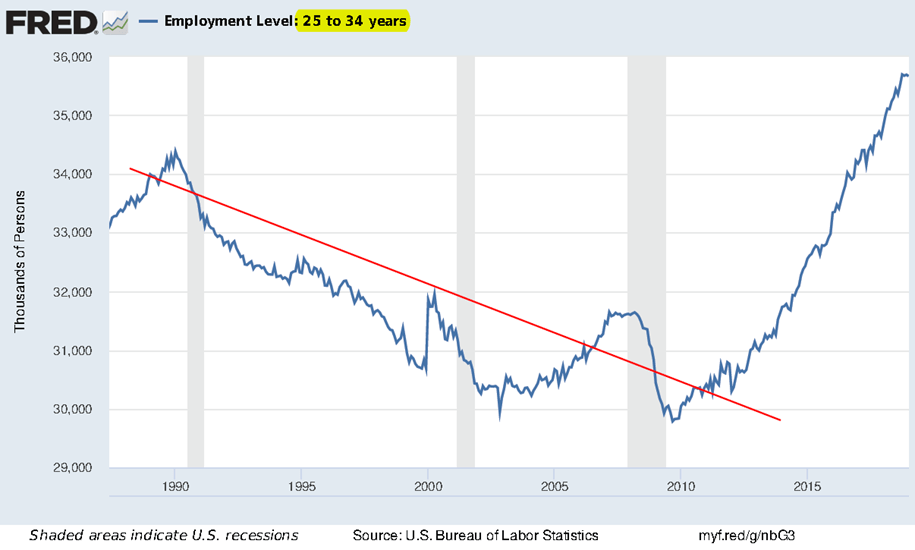
Return to trend?

Maybe, eventually…but lower end house prices need to come down some more

THE U.S. CONSUMER WATCH
David Rosenberg keeps hitting on the recession nail, highlighting the recent SpendTrend data that slowed markedly to +0.9% YoY in February and illustrating the generally good correlation with official data. The Johnson Redbook Index (now mainly a small sample of apparel retailers) also slowed measurably in recent weeks:

On the other end, most fundamental income data (employment, wages, inflation) point to continued strength in real spending.
Maybe it’s the weather! Gleaned here and there about the weather in the northern part of the U.S.:
- In the span of a week in mid-February 2019, record-breaking snow buried Seattle, a strong storm known as a “Kona Low” pummeled the Hawaiian Islands, and a fire hose of moisture known as an “atmospheric river” soaked California.
- By February 11, Seattle had experienced its snowiest February on record, with over 14 inches of snow.
- February, by contrast, started cold and stayed cold — which is unusual here — and ended up being the third coldest and the snowiest February on record, with 20 inches of snow. This February was surpassed in frigidity only by 1989 and 1956, which both had average daily temperatures of 36 degrees, compared with 37 this year, according to the weather service.
- The heaviest rains fell on February 13 and 14 across the entire state. In northern/central California, Redding observed over a foot of snow, the most in 50 years, and San Francisco observed over 2.5 inches of rain.
- February 2019 broke records and topped the charts in many weather categories across the Inland Northwest. The snow was a constant headline with the cold temperatures gripping the area all month long.
- Nearly all of the Inland Northwest experienced a top-10 coldest February on record.
- Extreme cold in the Midwest broke numerous daily records and a few all-time records.
- For some in the upper Midwest, it was the coldest outbreak since the 1990s.
- A preliminary all-time state record low may have been set in Illinois.
- Numerous snowfall records were broken in February. By February 12th, Eau Claire had already broken the record for the snowiest February, and they continued to demolish the record total with each additional storm. On February 20th, the Twin Cities and St. Cloud also broke their February snowfall record, and added several more inches to the total through the remainder of the month. Eau Claire had so much snow in February that a new record was set for the all-time snowiest month with 53.7″. This shattered the previous monthly snowfall record from January of 1929 when 35.3″ fell.
- In the Twin Cities, this has been the 4th all-time snowiest month on record with 39.0″, and the 7th snowiest meteorological winter (December through February) with 52.5″. The total snowfall for the 2018-2019 season in the Twin Cities is 56.8″ as of February 28th. The normal snowfall for the season is 54.4″, so this season’s total is already in excess of the normal snowfall for the entire season.
Maybe it’s the weather!
OECD Cuts Global Outlook Again and Warns Worse May Be Ahead
The global economy is suffering more than expected from trade tensions and political uncertainty which are clouding prospects particularly in Europe, according to a gloomy report from the OECD. (…) The OECD cut its growth outlook for this year to 1 percent from 1.8 percent. (…) While the U.S. outlook was lowered slightly, the U.K.’s 2019 forecast was cut to 0.8 percent from 1.4 percent, and Germany’s to 0.7 percent from 1.6 percent. (…) The OECD expects [China] expansion to slow to 6 percent next year from 6.2 percent in 2019. (…) However, there have been some small signs recently that the global economy is stabilizing, while the U.S. and China are making progress on ending their lengthy trade dispute.
In the USA, Markit PMI is far from pointing towards a recession:
The improvement in output and orders in February suggest the rate of economic growth in the first quarter is running at a similar pace of that seen in the closing months of 2018. Having correctly indicated that the economy grew at a slower but still solid pace in the fourth quarter (our model from the survey indicated 2.5% growth against an initial official estimate of 2.6%), the composite PMI data for the first two months of 2019 point to a similar 2.6% annualised rate of expansion in the first quarter (a 2.4% rate of expansion in January was followed by an upturn to 2.7% in February).

While in Europe:

Trump Pushing for China Deal in Hope of Fueling Market Rally He is increasingly concerned that the lack of an agreement could drag down stocks, sources say.
China blocks imports of canola from Canadian exporter Move points to growing tensions over the detention of Huawei finance chief Meng Wanzhou
FYI:
This table shows China’s market share across various categories. (The Daily Shot). Noteworthy: 39% of world robots and 27% of university graduates.
