U.S. SERVICES PMIs
S&P Global’s: Selling price inflation accelerates amid renewed upturn in output in February
- PMI rose from 46.8 to 50.6, signalling “only a marginal uptick in business activity, but an end to a seven-month sequence of contraction.”
- New business across the service sector continued to decrease during February, albeit at a softer rate. The impact of higher interest rates and inflationary pressures
remained a drag on customer spending, according to survey respondents. Some reports of improving demand conditions led new orders to fall at the slowest pace since last October, however. - New export orders declined for the ninth month running midway through the first quarter, the pace of contraction was solid overall.
- The rate of job creation was the quickest since September 2022, despite being only marginal overall. Some companies noted that greater availability of candidates
supported the upturn. - Meanwhile, service sector firms registered a marked rise in cost burdens midway through the first quarter. The uptick in input prices was driven by supplier price hikes, higher wage bills and increased expenses following interest rate changes. Nonetheless, the pace of cost inflation lost momentum and was the second-slowest since October 2020.
- Despite a softer increase in cost burdens, service providers raised their selling prices at a sharper pace in February. The rate of charge inflation was the quickest since October 2022 and strong overall. Survey respondents commonly noted that higher output charges were due to the pass-through of greater costs to clients.


The ISM:
 Economic activity in the services sector expanded in February for the second consecutive month as the Services PMI® registered 55.1 percent vs 55.2.
- New orders: 62.6 vs 60.4.
- Employment Index registered 54 percent, up 4 percentage points from the January figure of 50 percent. “Increase in applications resulting in more new hires”

New Orders Employment


WHAT RESPONDENTS ARE SAYING
- “Sales activity is generally strong, despite economic headwinds.” [Accommodation & Food Services]
- “Activity is steady. Costs continue to escalate, eliminating any profit we had hoped for in the first and second quarters.” [Construction]
- “There is some slight improvement in availability and delivery turns.” [Educational Services]
- “Upward pricing pressures have eased slightly but are still elevated.” [Finance & Insurance]
- “Inflation, though somewhat eased from the peaks of the past six months, continues to drive higher-pricing demands from suppliers.” [Health Care & Social Assistance]
- “The current dynamics in the marketplace are such that it is getting harder to reduce costs. Most industries are being pinched by inflation and more expensive labor markets. Before, cost reduction was the goal; it’s now cost avoidance. That said, since we’re not able to reduce cost to maintain margins, we have to reduce the employee base more aggressively to achieve margins.” [Information]
- “Seeing a slow decline in activity, but not a collapse like in 2009.” [Management of Companies & Support Services]
- “Generally flat activity level.” [Mining]
- “Starting the new business cycle with a noticeable uptick in demand.” [Professional, Scientific & Technical Services]
- “Continual effort to right-size inventory to match lower sales forecasts for the coming year.” [Retail Trade]
- “Customers now are very cost conscious and looking for lower-priced product options.” [Wholesale Trade]
The discrepancies between the two surveys narrowed but remain, particularly on new orders.
Powell preview
In testimony to lawmakers this week, Fed Chair Jerome Powell is expected to echo fellow central bankers in suggesting interest rates will go higher than policymakers anticipated just weeks ago if economic data continue to come in hot. Traders are betting the Fed will hike rates beyond the 5.1% level officials estimated in December. A hawkish tone from Powell, when he appears before a Senate panel on Tuesday and a House committee Wednesday, will likely prompt pushback from progressives warning the Fed not to inflict undue pain on the labor market. (Bloomberg)
Larry Summers Urges Fed’s Powell to Open Door to 50 Basis Points in March
(…) Six recent jolts have hurt the possibility of the soft landing that the Fed has sought, according to Summers:
- Seasonal revisions to the consumer price index that took the downward trend of inflation out of the data for the last several months of 2022.
- The CPI for January showed an acceleration in inflation.
- The personal consumption expenditures price index also picked up.
- January economic indicators “read strong.”
- Wage figures “no longer show the kind of reductions that we had been expecting.”
- The jump in Treasury yields, with 10-year rates climbing past 4%
Not to mention February’s uptick in rentflation (Oups! Rents Are Rising!).
- Housing Market Momentum Stalls as Spring Approaches Rising interest rates are again squeezing affordability and driving mortgage applications to their lowest levels in decades.
Retailers Fear High-Flying US Consumers Are Falling Back to Earth After the highest inflation in a generation, an increasing group of shoppers — including wealthy ones — are bargain hunting.
(…) Rising prices not only make paychecks seem smaller, but they’ve also papered over the fact that a lot of the sales growth in the consumer sector has been from inflation, not shoppers buying more stuff.
Home Depot Inc. has been one of the biggest beneficiaries of the pandemic because increased time at home led Americans to spend more on sprucing up their houses. It has boosted revenue by $47 billion, a 43% gain, since Covid-19 hit the US in early 2020.
But in the fourth quarter, which ran through January, the chain’s sales gained just 0.3% — its worst quarterly performance when excluding the initial hit from the pandemic in almost a decade. That came as transactions fell by 24 million, or 6%. Its results were saved by inflation as the average purchase rose by 5.8%. (…)
Inflation can create an illusion of growth. Business sales and sales expectations have converged to nominal GDP’s final sales to private domestic purchasers (solid black)which slowed from 12.5% YoY growth in Q4’21 to 7.2% in Q4’22, likely on its way to the 4.5% range indicated by February’s business expectations.
But growth in real demand has slowed to less than 1.0% in Q4’22, its weakest reading (ex-pandemic) since 2007…

… Actually, since 1968, real domestic demand has never been below 1.0% YoY other than in a recession.

- Fed’s Rate Moves Put Manufacturing Sector at Risk The American manufacturing sector is starting to show signs of weakness after two years of strong growth, as higher interest rates and a slowdown in exports threaten production.
(…) A manufacturing downturn could be a sign of trouble in the broader U.S. economy. Although manufacturing accounts for a relatively small share of gross domestic product, about 11%, it has historically been an early indicator of recession. (…)
- Alan Blinder Warns a US ‘Soft Landing’ Is Getting Harder “I think they still have a chance” at a soft landing, he concludes, “but it’s a tougher chance than it was.”


 Hard, soft, or no landing? The Motley Fool’s recent roundtable with Liz Ann Sonders, Ed Yardeni and Jurrien Timmer covers them all, and a lot more. Pretty good in its entirety.
Global output and new orders expand for first time seven months in February
The February PMIs provide a convincing signal that the global expansion is gathering steam early in the year. The global composite output PMI rose 2.4-pt to an eight-month high of 52.1 in February, consistent with global GDP growing at its potential pace. The new orders PMI also took an encouraging step up in February. This performance uplift is filtering through to the labor market and business confidence.
With reduced recession risks, improving supply chains, and the reopening of the Chinese economy likely to boost demand in the immediate future, further gains in output are expected in the coming months.


China Sets Lowest Economic Growth Target in Decades Officials aim for around 5% GDP growth this year, the lowest target in a quarter-century
Toronto Home Prices Increase for First Time in Almost a Year
The price of a home in Canada’s largest city rose 1.1% to C$1.09 million ($803,000), in February on a non-seasonally adjusted basis, according to data released Friday by the Toronto Regional Real Estate Board. February’s gain is the first month-over-month price increase since the central bank started raising borrowing costs in March 2022. (…)
Even after February’s bump, benchmark prices in Toronto are still down nearly 19% from their peak last year.
There were some signs of buyer interest returning last month, with the number of sales in February rising 8.5% from a month earlier to 5,224 transactions on a seasonally adjusted basis. That’s the highest number since August, although it’s still only about half of the transactions in February 2022.
New listings, meanwhile, were down 41% from the same month a year earlier, the real estate board data show. (…)

(NBF)
EARNINGS WATCH
Through Mar. 3, 493 companies in the S&P 500 Index have reported earnings for Q4 2022. Of these companies, 67.7% reported earnings above analyst expectations and 27.2% reported earnings below analyst expectations. In a typical quarter (since 1994), 66% of companies beat estimates and 20% miss estimates. Over the past four quarters, 76% of companies beat the estimates and 21% missed estimates.
In aggregate, companies are reporting earnings that are 1.0% above estimates, which compares to a long-term (since 1994) average surprise factor of 4.1% and the average surprise factor over the prior four quarters of 5.3%.
Of these companies, 67.5% reported revenue above analyst expectations and 32.5% reported revenue below analyst expectations. In a typical quarter (since 2002), 62% of companies beat estimates and 38% miss estimates. Over the past four quarters, 73% of companies beat the estimates and 27% missed estimates.
In aggregate, companies are reporting revenues that are 1.7% above estimates, which compares to a long-term (since 2002) average surprise factor of 1.3% and the average surprise factor over the prior four quarters of 2.5%.
The estimated earnings growth rate for the S&P 500 for 22Q4 is -3.2% [-2.7% on Feb. 3]. If the energy sector is excluded, the growth rate declines to -7.4% [-7.0%].
The estimated revenue growth rate for the S&P 500 for 22Q4 is 5.8% [4.6%]. If the energy sector is excluded, the growth rate declines to 5.0% [3.7%].
The estimated earnings growth rate for the S&P 500 for 23Q1 is -4.5% [-2.5%]. If the energy sector is excluded, the growth rate declines to -6.3% [-4.3%].
After nearly all S&P 500 companies have reported, 68% have beaten expectations, yet, both revenues and earnings have been ratcheted down for both Q4’22 and, more significantly, Q1’23.


Factset calculates that the Q1 bottom-up EPS estimate decreased by 5.7%, much more than usual. “Analysts usually reduce annual earnings estimates modestly during the first two months of the year”. Their estimates in January and February declined 1.6% on average during the past 5 years and the reduction never exceeded 1.7% in the last 20 years.

Earnings growth is seen bottoming out in Q1 with Ex-Energy earnings growth returning positive in Q2 and reaching +13.3% in Q4’23. Analysts are thus expecting a nice improvement in margins this year.
As François Trahan illustrates, “The decline in EPS thus far is attributable to weaker margins and nothing more.”

Analysts see revenue growth averaging 3.0% in 2023, reaching 4.2% in Q4.
Recall that the S&P 500 Index is a “goods” index. This Yardeni.com chart illustrates the tight correlation between trends in the ISM Manufacturing PMI and S&P companies revenues growth.

At its current level, the ISM PMI suggests that revenue growth will turn negative in 2023. Not in analysts’ models yet.
My sense is that analysts are just as puzzled as everybody else on the economy and inflation and that their aggregate individual forecasts must look like camels.
I put more weight on corporate guidance:
Compared with the same period during Q4’22, fifteen more companies have pre-announced, all negative, bringing the total negatives to 78, 47% more than at the same time last quarter.

Trailing earnings are now $221.71. Full year 2023: $221.64, potentially reaching $248.27 in 2024.
Here’s the hopeful trends by sector:

The Hidden Message in Credit Spreads
Today’s John Authers’ Bloomberg column debates about the apparent complacency of credit markets:
The credit market is trying to tell us something. But what, exactly? Look at it almost any way, and credit is available at rates that imply no particular risk of default, and very little risk of recession. In both the euro zone and the US, high-yield bonds are looking misnamed. After a brief and sharp rise last year, their spreads over equivalent five-year government bonds are right back to a level that suggests all is quiet:
The pattern continues in investment-grade credit. And if we compare it with cash in the form of the yield on six-month Treasury bills, the reward for risking an investment in corporate credit is historically low. The spread is less than 1%, and at one point dipped below the low set in the spring of 2007, just as the Global Financial Crisis was about to break out:
This flies in the face of other important indicators. The Federal Reserve’s survey of senior lending officers measures whether banks are tightening or loosening their lending standards, and at present shows a sharp tightening. As demonstrated in the chart by Andrew Lapthorne, chief quantitative strategist at Societe Generale SA, tighter bank standards generally imply higher credit spreads, at least for junk bonds. But not now:
(…) All of this looks very strange. Even with cash offering a guaranteed return over six months that is close to the yield of corporate credit, there doesn’t yet appear to be any great concern. The parallels with the GFC, which began in 2007 as credit markets that had long been absurdly overvaluing corporate and mortgage-backed credit began to crack, are obvious. The fact that corporate credit is now trading at a spread over six-month Treasury bills only previously seen in the spring of 2007 is disquieting to say the least. (…)
So the credit market could be telling us that we are back in the realm of irrational equanimity, brewing perfect conditions for a crisis. But there’s another way to look at it, which is that the credit market might just conceivably have it right. Memories of the GFC are still fresh. People keep making the same mistakes, but it’s rare to repeat a mistake quite this big quite this quickly.
And while the credit market looks alarmingly tight given the environment of rising rates and fears of recession, there are other ways in which this is very different from 2007. The critical one is that consumers’ balance sheets are in much better shape, in part thanks to learning the lessons of the GFC, and in part because households received so much government largesse to tide them through the pandemic. (…)
While households and corporations can still service their debts as easily as they can at present, there is no risk of a repetition of the GFC. The problem is that it might not be possible to beat inflation without the kind of genuine tightening that comes when businesses are driven to the wall.
For a revealing insight on this, listen to this podcast in which my colleague Vildana Hajric asked Alan Blinder, now a professor at Princeton, about an anecdote he tells about Paul Volcker.
As a young academic, he once asked the man now lauded as the slayer of inflation just how monetary policy could bring inflation down. Volcker’s reply: through bankruptcies. Tighter rates, in his view, worked by pushing some businesses to the wall and squeezing the life out of inflationary pressures.
Assuming Volcker was right about this, then perhaps the credit market does have a message for us. Rates will have to rise further, until they force defaults (and bring down corporate profits), before inflation can be beaten.


FYI:
- Tesla slashes prices of some models in the US for a second time this year
- A price war among electric vehicle makers in China takes its toll
TECHNICALS WATCH
- The S&P 500 Large Cap Index – 13/34–Week EMA Trend is trying to turn bullish but high volatility warrants a question mark.

(TradingView)
- Volume Battleground: The bull-bear-battle is also playing out in volumes — this chart shows the volume on up days vs down days (how technicians gauge the relative flows in terms of demand and supply in the market). Normally in a bull market demand/up volume would dominate, and certainly after a major/decisive bottom in the market you would expect to see “accumulation“ (more demand volume). So arguably another piece of evidence against the new bull thesis.
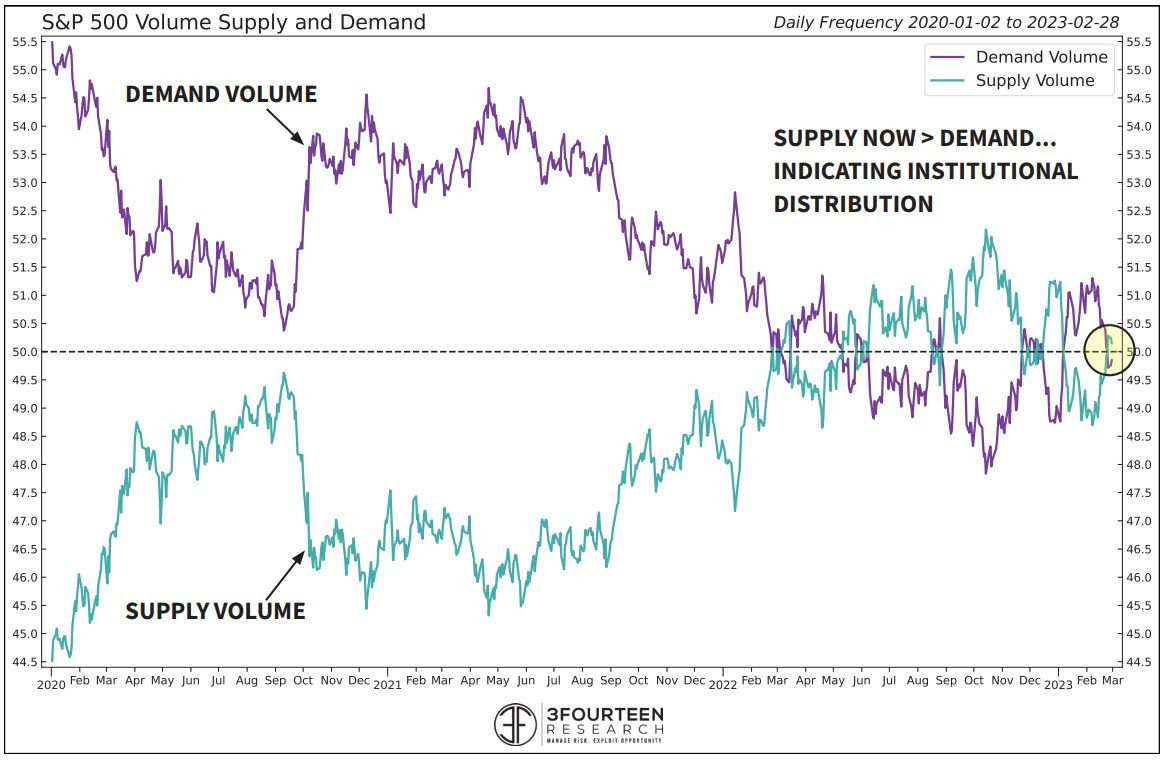
Source: @3F_Research (via Chartstorm)
- Morgan Stanley Sees Near-Term US Stock Market Rally “Equity markets survived a crucial test of support last week that suggests this bear market rally is not ready to end just yet.”
Morgan Stanley’s Michael Wilson pivoted on the short-term outlook for US stocks, saying the rally may have room to run before earnings headwinds increase. (…) He noted that the S&P 500 stayed above its 200-day moving average, and could see further upside if the dollar and interest rates continue to recede after last Friday’s drop.
While Wilson sees the next resistance for the S&P 500 at 4,150 points — about 2.5% higher than Friday’s close — he views it as a short-term pivot. Markets have further to fall in the medium term, as fundamentals continue to deteriorate, especially on the earnings front, he wrote.
Despite the rally, “we believe it does not refute the very poor risk reward currently offered by many stocks given valuations and earnings forecasts that remain way too high, in our view,” Wilson said, expecting margins to disappoint the current consensus “by a large amount.”
Wilson noted the gap between reported earnings and cash flow is the widest in 25 years, driven by excess inventory and capitalized costs that have yet to be reflected. (…)
Note that the 200dma is still falling.

(TradingView)
- Cash ain’t trash. Rather than a drag on portfolios, investors say cash may be a winning strategy this year.

Crypto Companies Behind Tether Used Falsified Documents and Shell Companies to Get Bank Accounts Tether Holdings and related crypto broker obscured identities, documents show
In late 2018, the companies behind the most widely traded cryptocurrency were struggling to maintain their access to the global banking system. Some of their backers turned to shadowy intermediaries, falsified documents and shell companies to get back in, documents show. (…)
Tether runs tether, the $71 billion stablecoin that is the most widely traded cryptocurrency, and a sister company runs Bitfinex, one of the world’s largest crypto exchanges. Losing access to the banking system was “an existential threat” to their business, the companies said in a lawsuit.
A cache of emails and documents reviewed by the Journal show a long-running effort to stay connected to the financial system. The companies often hid their identities behind other businesses or individuals. Using third parties occasionally caused problems, including hundreds of millions of dollars of seized assets and connections to a designated terrorist organization.
In a statement after this article was published online, Tether said the Journal’s report was “wholly inaccurate and misleading” and said that Tether and Bitfinex have “world-class compliance programs” and adhere to legal requirements. (…)
The WSJ is finding its way into the crypto web, unearthing myriads of dubious interlinks underpinning an apparent house of cards that traditional financial institutions refuse to support. Now, finally, authorities are stepping in.
- Texts From Crypto Giant Binance Reveal Plan to Elude U.S. Authorities The exchange was intertwined with an American firm portrayed as independent. Now, regulators are circling.
- Crypto Firms Ditch Silvergate, a Favorite Bank Partner Bank says it was at risk of being ‘less than well-capitalized’
Silvergate bet big on the crypto market, focusing on crypto firms as a way to distinguish itself from other regional banks by becoming a conduit for turning dollars into digital currency. It grew along with the rest of the market during crypto’s rise but has fallen fast. On Wednesday, Silvergate said that it was at risk of being “less than well-capitalized” and was evaluating its ability to continue doing business.
On Thursday, the crypto firms Coinbase Global Inc., Circle Internet Financial, Paxos Trust Co. and Galaxy Digital Holdings Ltd. all announced plans to stop banking with Silvergate. (…)
While the crypto industry likes to pitch itself as an alternative to the traditional financial system, crypto firms rely heavily on regulated banks. Without banks, crypto companies struggle to fulfill basic functions, such as moving money on behalf of customers or paying employees.
“This is a very important part of crypto infrastructure,” said Ilan Solot, co-head of digital assets at the London-based financial firm Marex. “It’s going to be evermore difficult for the U.S. crypto industry to connect with the financial system.” (…)
The three major banking regulators warned banks in January that they were concerned about their crypto ties. They cited “significant safety and soundness concerns” and questioned if the industry could be safely banked. That shift made many banks re-evaluate their exposure to the crypto industry, even if serving the industry was just a small part of their business. (…)
New York’s Metropolitan Commercial Bank said in January that it was closing its crypto business, citing material changes in the regulatory environment.
In February, Signature Bank cut ties with the international business of Binance, the biggest crypto exchange. (…)